
Wood duck country rarely looks impressive from the road.
A narrow creek disappears into hardwood timber.
A small beaver pond sits behind brush.
Flooded leaves cover a shallow flat.
A fallen tree lies across dark water.
There may be no huge lake.
No massive marsh.
No broad open bay.
Then legal light arrives.
A pair of ducks rockets through the trees.
Another group drops into a hidden opening.
A third flock disappears around a creek bend before the hunter can fully identify the route.
That is wood duck hunting.
These birds often use small, intimate wetlands that are easy to overlook.
Successful hunters learn to recognize the importance of:
- Flooded creeks
- Beaver ponds
- Bottomland timber
- Small sloughs
- Hardwood edges
- Hidden openings
- Shallow feeding water
The best wood duck habitat may cover only a few acres.
That does not make it unimportant.
Sometimes the smallest water holds the most predictable movement.
Wood Ducks Are Closely Tied to Forested Wetlands
Wood ducks are strongly associated with wooded water.
Productive habitat may include:
- Flooded hardwoods
- Beaver ponds
- Creeks
- River backwaters
- Sloughs
- Forested swamps
- Small woodland ponds
Unlike many open-water ducks, wood ducks often feel comfortable in places surrounded by trees.
Think Smaller
Hunters accustomed to large marshes sometimes overlook wood duck water.
A creek only twenty feet wide can still be important.
A beaver pond hidden behind timber can hold several birds.
Small Water Can Be Extremely Productive
Wood ducks may use:
- Narrow channels
- Tiny openings
- Flooded timber pockets
that other waterfowl hunters ignore.
Forest Cover Is Part of the Habitat
Trees provide:
- Security
- Travel corridors
- Roosting structure
- Nesting habitat
The water and the forest work together.
Beaver Ponds Can Be Excellent
Beavers create wetland habitat by flooding:
- Timber
- Brush
- Creek bottoms
This can produce ideal wood duck conditions.
Beaver Flooding Creates Food
Newly flooded ground may expose:
- Seeds
- Mast
- Aquatic invertebrates
Pond Age Matters
A newer beaver pond may contain:
- Freshly flooded timber
- More woody structure
An older pond may develop:
- Open water
- Emergent vegetation
- Mud flats
Both Can Hold Birds
But bird use may differ.
Hunt the Edges
The best part of a beaver pond may be where:
- Open water
- Timber
- Creek channel
meet.
Small Openings Can Be Landing Zones
Wood ducks often need just enough room to drop between trees.
Do Not Assume the Biggest Opening Is Best
A small protected hole may feel safer than a broad exposed pond.
Creek Corridors Are Natural Travel Routes
Wood ducks frequently move along wooded waterways.
Creeks connect:
- Feeding areas
- Roosting areas
- Beaver ponds
- River backwaters
Watch Creek Bends
A bend can hide approaching birds until the last second.
Listen Before You See Them
Wing noise or calls may reveal birds first.
But Sound Is Not Identification
Always confirm the bird visually.
Narrow Water Changes Shooting Angles
Creek hunting requires strict awareness of:
- Partners
- Dogs
- Houses
- Roads
Never Shoot Blindly Around a Bend
You may not know what is beyond it.
Bottomland Hardwood Forests Can Be Excellent
Flooded hardwood habitat provides wood ducks with:
- Food
- Cover
- Protected water
Mast Can Matter
Where acorns and other natural foods are available, flooded timber can become highly attractive.
Water Depth Influences Feeding
Shallow flooded forest often allows easier access to food.
Deep Water Is Not Always Better
Wood ducks may spend more time in shallow protected habitat.
Sloughs Can Connect Larger Systems
A small backwater slough may sit beside:
- River
- Creek
- Larger wetland
These Secondary Waters Can Hold Birds
Especially when main channels receive more disturbance.
Quiet Water Matters
Wood ducks often respond quickly to pressure.
A small hidden slough may hold more birds than a heavily hunted open marsh.
Pressure Changes Timing
Birds may begin moving:
- Earlier
- Later
- More quickly
through heavily disturbed areas.
Scout Before Hunting
Wood duck hunting often rewards precise scouting.
Watch where birds:
- Enter
- Exit
- Cross the timber
- Land
Flight Paths Can Be Very Specific
Birds may repeatedly use the same gap between trees.
One Creek Opening May Matter More Than the Entire Pond
Note exact travel lanes.
Morning Movement Can Be Fast
Wood ducks often move quickly around first light.
Be Ready Early
Do not wait until movement begins to finish preparing.
But Follow Legal Shooting Hours
Always verify the current regulations.
Evening Movement Can Be Strong Too
Birds may return toward:
- Roost water
- Protected timber
late in the day.
Do Not Assume Morning Is the Only Option
Local patterns matter.
Wood Ducks Fly Fast
They are famous for quick, twisting flight through timber.
Trees Make Them Look Even Faster
The visual window can be extremely short.
Do Not Rush Identification
A fast bird is not automatically a wood duck.
Pick One Bird
Small groups can appear suddenly.
Choose one clear target.
Do Not Shoot Into the Group
Individual discipline improves safety.
Wooded Wetlands Create Close Shots
That makes background awareness especially important.
Trees Are Not Backstops
A tree line may hide:
- Another hunter
- Road
- Home
- Dog
Know the Entire Area Before Hunting
Scout beyond the immediate water.
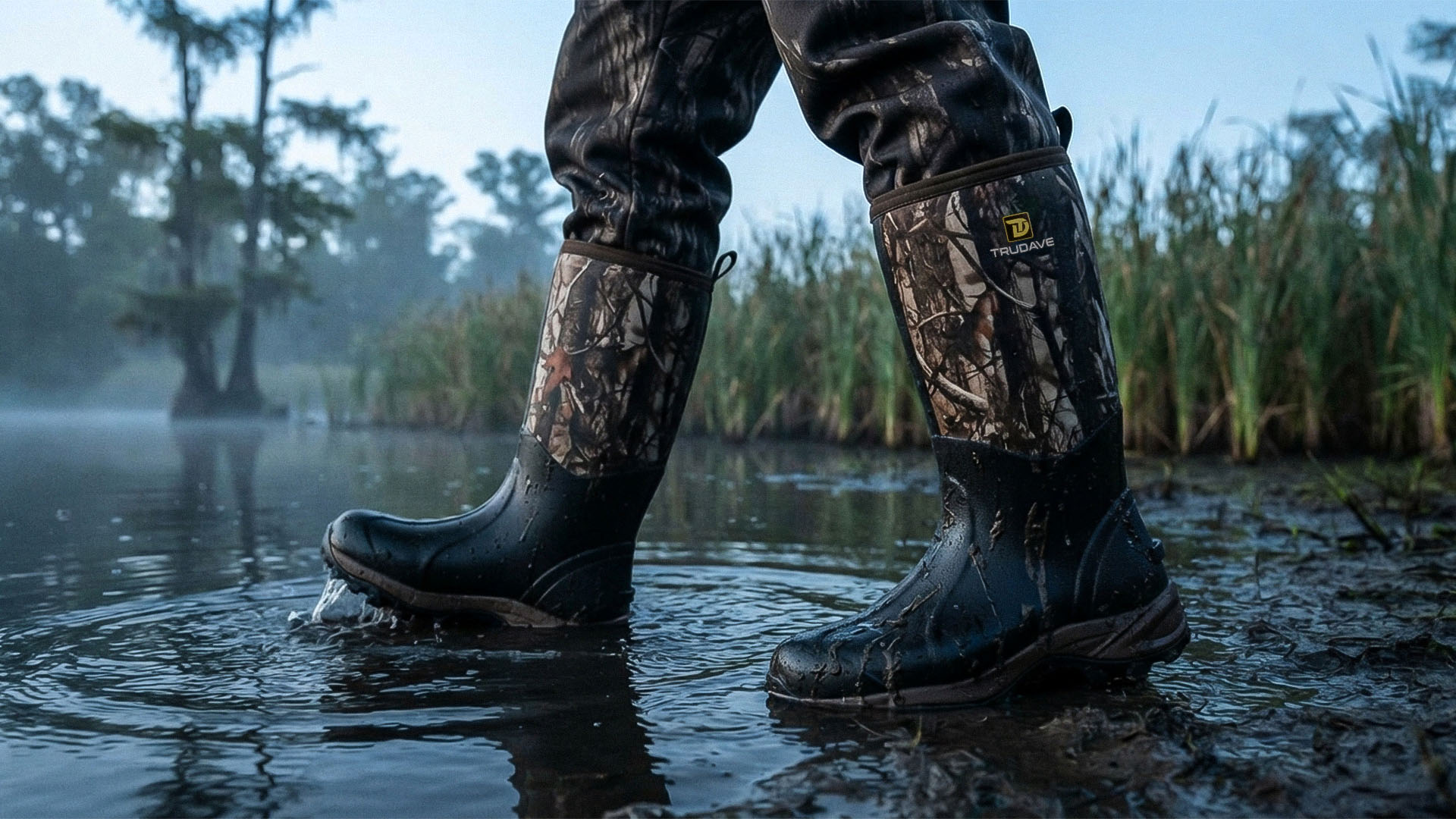
Wood Duck Hunting Is a Serious Footwear Test
A typical hunt may involve:
- Mud
- Wet leaves
- Shallow water
- Creek banks
- Beaver pond edges
- Roots
- Fallen timber
- Long forest walks
Hunters may benefit from waterproof hunting boots for wood duck hunting that provide secure heel retention, dependable mud traction, and enough waterproof protection for repeated movement through wet bottomland terrain.
Tall Rubber Boots Can Work Very Well
Where water stays below boot height, rubber hunting boots are practical.
They Handle:
- Mud
- Wet grass
- Shallow water
especially well.
Secure Fit Matters
Beaver pond mud can create strong suction.
Loose boots become exhausting.
Boot Height Matters
One hidden creek channel may be deeper than the surrounding water.
Lace-Up Waterproof Boots Can Work on Drier Routes
If much of the access involves:
- Forest trail
- Dry ridge
- Logging road
supportive waterproof boots may be more comfortable.
Choose Boots for the Entire Route
Think about:
- Parking
- Creek crossing
- Pond edge
- Hunting position
Waders May Be Necessary in Deeper Habitat
Where water exceeds normal boot height, properly fitted hunting waders may provide better protection.
Waders Do Not Make Deep Water Safe
They do not remove:
- Current
- Soft mud
- Hidden holes
Use a Wading Staff
A sturdy staff can help test:
- Depth
- Bottom firmness
- Obstructions
Creek Channels Can Be Much Deeper
Flooded timber can hide old streambeds.
Never Assume Uniform Depth
One step may be shin deep.
The next may be waist deep.
Beaver Runs Can Create Hidden Channels
Beavers repeatedly use underwater travel paths.
These can form deeper grooves.
Muskrat Holes Can Also Create Hazards
Wetland bottoms are rarely perfectly flat.
Submerged Logs Are Common
Flooded woodland contains:
- Branches
- Stumps
- Fallen trunks
Lift Your Feet Deliberately
Dragging steps can catch on wood.
Wet Logs Are Extremely Slick
Avoid stepping directly on them when possible.
Muddy Creek Banks Can Collapse
Soft soil may break beneath body weight.
Stay Back From Undercut Edges
Especially after heavy rain.
Rain Can Improve Wood Duck Habitat
Rain may flood new forest and creek edges.
Wood Duck Hunting After Rain Can Change Quickly
Water can spread into:
- Hardwood flats
- Small sloughs
- Low forest
Newly Flooded Ground Can Attract Birds
Fresh water may make new food accessible.
But Rain Can Make Access Harder
Creeks may rise.
Mud becomes deeper.
A Safe Morning Crossing May Change
Plan the return route.
Never Force a Rising Creek
Take the longer route.
Floodwater Can Carry Current
Even forest water can move strongly.
Wind Is Less Obvious in Timber
Trees block some surface wind.
But wind still influences:
- Bird movement
- Scent
- Weather
Creek Corridors Can Funnel Wind
Local airflow may differ from open-country wind.
Strong Wind Can Push Birds Toward Protected Water
Hidden beaver ponds and timber sloughs may become more attractive.
Calm Days Can Favor Small Water
Birds may use quiet protected ponds naturally.
Fog Can Be Difficult
Bottomland wetlands can hold dense morning fog.
Visual Identification Becomes Harder
If unsure, do not shoot.
Navigation Can Also Become Difficult
A flooded hardwood forest looks repetitive.
Offline Maps Are Useful
Download:
- Creek systems
- Wetlands
- Property boundaries
- Access roads
Mark the Vehicle
One creek bend can look like another.
Carry a Headlamp
Waterfowl hunters often enter before daylight.
Scout the Route in Daylight First
Learn:
- Deep holes
- Fences
- Logs
- Creek crossings
Do Not Explore Unknown Flooded Forest in Darkness
That creates unnecessary risk.
Boats Can Be Useful on Larger Beaver Ponds
Where legal and practical, small boats may help.
Shallow Water Still Requires Boat Safety
Wear appropriate flotation equipment.
Do Not Overload Small Boats
Hunters may carry:
- Decoys
- Dogs
- Waders
- Gear
Hidden Stumps Can Damage Boats
Travel slowly.
Beaver Ponds Are Full of Wood
Submerged trees and branches can catch:
- Propellers
- Hulls
Paddle Access May Be Better in Tight Water
Where conditions allow.
Dogs Can Be Very Effective
A trained retriever helps in:
- Flooded timber
- Creek edges
- Beaver ponds
But Wooded Water Creates Hazards
Dogs may encounter:
- Logs
- Deep channels
- Current
- Wire
Do Not Send a Dog Into Unsafe Water
A retrieve is not worth injury.
Cold Water Can Chill Dogs Quickly
Monitor:
- Shivering
- Reduced energy
- Coordination
Provide a Dry Resting Area
Especially in late season.
Carry Fresh Drinking Water
Do not depend on swamp or creek water.
Warm Early Seasons Can Cause Heat Stress
Small wooded ponds may feel cool.
Dogs still work hard.
Give Frequent Breaks
Paw Checks Matter
Bottomland habitat can contain:
- Shell
- Sticks
- Sharp debris
Eye Protection Can Be Useful for Dogs
Branches are common at face level.
Hunters Need Eye Protection Too
Dense creekside brush can strike the face.
Wet Leaves Make Walking Quiet
This can help access.
But Wet Leaves Are Slippery
They can slide over:
- Roots
- Clay
- Rock
Short Steps Improve Stability
Fallen Leaves Can Hide Holes
Especially around old roots and creek edges.
Wood Duck Habitat Can Be Mosquito Habitat Too
Warm-season hunts may involve:
- Mosquitoes
- Biting insects
Use Appropriate Protection
Ticks May Be Present
Check clothing and skin after the hunt.
Cold Weather Changes Conditions
Later-season hunts may include:
- Frost
- Ice
- Frozen mud
Shallow Beaver Ponds Can Freeze Quickly
Ice Is Not Automatically Safe
Trees and current create weak areas.
Do Not Walk on Unknown Ice
Wildlife tracks do not prove safety.
Ice Around Stumps Can Be Especially Weak
Water movement differs around structure.
Snow Can Hide Shoreline Hazards
Frozen mud, branches, and holes disappear under snow.
Move Slowly
Layering Matters
Access may involve hard walking.
The hunt itself may involve long stationary periods.
Avoid Sweating During the Walk In
Open layers before overheating.
Add Insulation at the Setup
Dry clothing is warmer.
Gloves Need Water Resistance
Wet decoys and branches can soak hands quickly.
Carry a Backup Pair
Wood Ducks Are Easy to Recognize—Until Light Is Bad
Adult drakes are highly distinctive.
But not every bird is a bright adult male.
Learn Hens and Juveniles
Female and immature birds require more careful identification.
Low Light Reduces Color
Use multiple features.
Wood Ducks Can Fly With Other Ducks
Do not assume every bird following them is the same species.
Mixed Flocks Require Discipline
Identify each target.
Wood Ducks Are Migratory Game Birds
Before hunting, verify current official:
- Season dates
- Daily bag limits
- Possession limits
- Species-specific restrictions
- Shooting hours
- License requirements
- Migratory bird requirements
- Non-toxic ammunition rules
Species-Specific Limits Can Apply
Wood duck limits may be more restrictive than the overall duck limit.
Do Not Use Last Year’s Regulations
Migratory bird rules can change.
Public Wetlands May Add Restrictions
Individual wildlife areas can regulate:
- Entry
- Boats
- Hunting days
- Parking
Check Exact Property Rules
Statewide legality is not enough.
Private Creek Access Requires Permission
A navigable-looking creek does not automatically provide access to surrounding land.
Know Property Boundaries
Waterways can cross multiple ownerships.
Retrieval Across Private Property Requires Permission Where Applicable
Discuss it before hunting.
Beaver Ponds Can Cross Property Lines
The water may look continuous.
Ownership may not be.
Mark Boundaries Before the Hunt
Hunting Pressure Can Push Birds
A small pond may hold birds until repeatedly disturbed.
Do Not Hunt Every Roost Constantly
Pressure can empty the habitat.
Rotate Areas Where Possible
Lower disturbance can preserve bird use.
Scout Quietly
Do not walk directly through the middle of the pond just to count birds.
Observe From the Edge
Wood Ducks Can Use Very Small Roosts
Do not overlook hidden forest ponds.
Small Habitat Is Often More Sensitive to Pressure
A few hunters can change it quickly.
Recovery Can Be Difficult
A downed wood duck can disappear among:
- Leaves
- Roots
- Grass
- Flooded brush
Mark the Fall Immediately
Use fixed references such as:
- Large tree
- Creek bend
- Stump
- Beaver lodge
Keep Watching the Bird
Do not immediately turn toward another flock.
Current Can Move Birds
Even small creeks can carry a downed bird.
Begin Recovery Quickly
Dogs Improve Recovery
Especially in dense cover.
Without a Dog, Search Methodically
Work from the marked point.
Check Downstream
If water is moving.
Ethical Shot Selection Includes Recovery
A bird flying toward:
- Deep channel
- Dangerous current
- Private property
may be a poor opportunity.
Small Water Requires Careful Safety
Hunters can become too comfortable because the pond looks harmless.
Know the Entire Background
Partner Position Is Critical
Trees and bends hide people.
Establish Shooting Zones
Before legal shooting time.
Never Swing Through a Partner
Even when a bird appears suddenly.
Low Birds Are Common
Creek ducks may remain close to the water.
Never Shoot Toward a Dog
Common Wood Duck Hunting Mistakes
Ignoring Small Wetlands
Tiny creeks and beaver ponds can hold excellent bird numbers.
Hunting Only Open Water
Wood ducks often prefer timbered, protected habitat.
Entering Before Scouting the Creek
Hidden channels and logs create hazards.
Walking Too Fast Through Mud
Bottomland terrain punishes poor balance.
Assuming Rubber Boots Fit Well Enough
Mud suction exposes loose heel fit quickly.
Assuming Waders Make Deep Water Safe
They do not.
Studying Only Adult Drakes
Hens and juveniles require identification too.
Using Old Waterfowl Regulations
Always verify current species-specific rules.
Frequently Asked Questions
Where do wood ducks usually live?
Wood ducks commonly use forested wetlands, flooded creeks, beaver ponds, sloughs, river backwaters, wooded swamps, and small woodland ponds.
Are beaver ponds good for wood duck hunting?
Yes. Beaver ponds can create flooded timber, shallow feeding habitat, protected water, and small openings that wood ducks use heavily.
Are small creeks good for wood ducks?
They can be excellent. Wood ducks frequently travel narrow wooded waterways connecting feeding and roosting habitat.
Does rain help wood duck hunting?
Rain can flood new bottomland habitat and make additional food accessible, but it may also raise creeks and make mud and access more difficult.
What boots are best for wood duck hunting?
Waterproof hunting boots with secure heel fit, good mud traction, and enough height for wet creek and pond edges are practical. Tall rubber boots work especially well in shallow flooded timber.
Are waders necessary for wood duck hunting?
Not always. Many small-creek and beaver-pond hunts can be handled with tall waterproof boots, while deeper flooded habitat may require properly fitted hunting waders.
Can retrievers hunt beaver ponds?
Yes. Trained retrievers can be very useful, but submerged logs, deep channels, cold water, current, and sharp debris require careful management.
Do wood duck hunting regulations vary?
Yes. Seasons, species-specific bag limits, possession limits, shooting hours, licensing, migratory bird requirements, ammunition rules, and public-land restrictions vary by jurisdiction and year. Hunters should verify current official regulations before hunting.
Final Thoughts
Wood duck hunting teaches hunters that productive water does not need to be large.
One narrow creek creates a travel corridor.
One beaver pond floods fresh feeding habitat.
One small timber opening gives birds enough room to land.
One quiet slough provides security.
One rainstorm turns a dry hardwood flat into new duck habitat.
The best-looking lake may hold fewer birds than the hidden pond behind the trees.
Think smaller.
Scout the creeks.
Check beaver ponds.
Watch timber openings.
Pay attention to water depth.
Respect mud, current, submerged logs, property boundaries, and changing flood conditions.
Wear boots that let you cross wet leaves, muddy creek banks, shallow flooded timber, beaver pond edges, slick roots, and miles of bottomland forest without making soaked feet, poor traction, or loose fit the reason the hunt ends early.
Use properly fitted waders when water depth actually requires them.
And when a pair of wood ducks drops through a gap in the trees into a tiny flooded creek that looked too small to matter, remember the lesson.
Wood ducks do not need huge water.
They need the right water.
And the right water is often hidden where most hunters never bother to look.
