
Pacific Northwest blacktail country rarely gives hunters a clean view.
Rain falls through fir branches.
Fog sits inside logging cuts.
Salal and blackberry hide the ground.
Young conifers crowd together so tightly that a deer can disappear only a few steps from an opening.
A hunter glasses a clearcut for thirty minutes.
Nothing.
The hillside appears empty.
Then one ear moves beside a stump.
A dark back becomes visible behind young fir.
For only a few seconds, a black-tailed deer stands in the opening before slipping back into timber.
That is blacktail hunting.
The challenge is not simply finding deer.
It is finding the small pieces of visibility inside a landscape built to hide them.
Successful hunters learn to understand the relationship between:
- Young clearcuts
- Mature timber
- Brush
- Weather
- Feeding openings
- Logging roads
- Terrain
Blacktails often live close to excellent food.
They simply stay close enough to thick cover that a hunter can walk past them without ever knowing they were there.
Black-tailed Deer Are Forest-Edge Specialists
Black-tailed deer are closely associated with western coastal and mountain forest environments.
Productive habitat may include:
- Young clearcuts
- Regenerating timber
- Mature conifer forest
- Brushy creek bottoms
- Logging roads
- Burns
- Mountain meadows
- Coastal forest edges
The most valuable habitat often contains several of these features together.
A huge mature forest may provide security.
A young clearcut may provide food.
The transition between them can provide both.
That edge deserves attention.
Clearcuts Can Create Excellent Feeding Habitat
Timber harvest opens the canopy.
Sunlight reaches the ground.
Vegetation responds.
Depending on age and location, a regenerating cut may produce:
- Blackberry
- Fireweed
- Grass
- Shrubs
- Young hardwoods
These plants create feeding opportunities.
The problem for hunters is that clearcuts change quickly.
The same cut can be excellent one year and almost impossible to glass a few years later.
Clearcut Age Matters
Very fresh cuts may be:
- Open
- Easy to glass
- Limited in vegetation
Several years later, they may develop ideal food and security.
Later still, young conifers can become tall enough to hide deer completely.
Learn to recognize different stages.
The best blacktail cut often contains enough vegetation to attract deer but enough openings to still see them.
Do Not Hunt Every Clearcut Equally
One cut may face the sun.
Another stays shaded.
One contains blackberry and hardwood browse.
Another contains mostly young conifers.
Look for:
- Food diversity
- Creek proximity
- Timber edge
- Terrain benches
The prettiest opening from the road is not automatically the best deer habitat.
Mature Timber Provides Immediate Security
Blacktails often do not need to travel far from feeding areas.
A deer may feed inside a cut and disappear into mature forest within seconds.
This creates one of the most important patterns in blacktail hunting:
Food beside dark timber.
Focus on the first strip of cover where the two meet.
Hunt the Timber Edge Carefully
The first twenty or thirty yards inside mature timber can hold deer waiting for safer light.
Look for:
- Tracks
- Droppings
- Rubs
- Beds
along the transition.
Deer may stage just inside cover before stepping into a feeding opening.
Small Timber Fingers Can Be Escape Routes
Mature forest often extends into clearcuts through narrow strips.
These timber fingers can provide:
- Travel cover
- Bedding
- Escape routes
A buck feeding in an opening may retreat directly into one of these strips when disturbed.
Study them before choosing a stand or still-hunting route.
Logging Roads Can Reveal Patterns
Old forest roads often connect:
- Clearcuts
- Creeks
- Ridge systems
Deer may use them as easy travel.
Look for:
- Tracks
- Droppings
- Fresh crossings
especially where roads intersect cover transitions.
Closed Logging Roads Can Be Even Better
Roads closed to vehicle traffic may receive less disturbance.
Vegetation often grows along the edges.
These routes can function as:
- Travel corridors
- Feeding strips
- Quiet access for hunters
Walk slowly.
A deer may be standing only several yards inside the timber.
Road Crossings Can Identify Hidden Trails
Fresh mud makes crossings easy to see.
If several deer trails repeatedly cross the same road, study what connects on both sides.
Possible features include:
- Clearcut
- Creek
- Ridge
- Bedding timber
The road itself is not the pattern.
It reveals the pattern.
Rain Is Part of Blacktail Country
Blacktail hunters should expect wet weather.
Rain changes:
- Sound
- Scent
- Visibility
- Footing
- Deer movement
Instead of treating rain only as a problem, learn how it changes the hunt.
Light Rain Can Help Still-Hunting
Wet leaves and forest litter become quieter.
A hunter can move through timber with less noise.
This creates better conditions for slow still-hunting.
Use a rhythm:
Walk several steps.
Stop.
Glass through openings.
Listen.
Continue.
Heavy Rain Creates Different Challenges
Strong rain reduces:
- Visibility
- Optics performance
- Hearing
Deer may also move toward more protected habitat.
Search:
- Dense timber
- Leeward slopes
- Creek benches
when exposed cuts become uncomfortable.
Rain Makes Fresh Tracks Easier to Identify
Soft roads and muddy trails record movement.
Look for tracks with:
- Sharp edges
- Clean impressions
after recent rainfall.
Fresh sign can show whether deer are currently using a clearcut.
But Constant Rain Can Erase Sign Too
Heavy rain may soften or destroy tracks quickly.
Do not expect every active trail to remain obvious.
Combine:
- Tracks
- Droppings
- Browse
- Rubs
to build a stronger picture.
Fog Can Be Both Helpful and Frustrating
Fog reduces long-distance visibility.
A large clearcut may become impossible to glass from one point.
But fog can also encourage deer to remain comfortable in openings longer.
When visibility is limited:
Move carefully.
Glass smaller pieces of the cut.
Wait for conditions to improve.
Fog Often Moves Quickly
A hillside completely hidden at sunrise may open twenty minutes later.
Do not abandon good habitat immediately.
Pacific Northwest weather changes rapidly.
Patience can create a sudden opportunity.
Low Clouds Can Keep Deer Comfortable
Dark wet conditions reduce bright exposure.
This may encourage blacktails to remain near feeding cover longer than they would on a clear sunny day.
Overcast weather can be excellent.
Wind Matters Even in Dense Forest
Hunters sometimes underestimate wind inside timber.
Blacktails still rely heavily on scent.
Check wind around:
- Clearcut edges
- Logging roads
- Creek systems
Vegetation and terrain can create unpredictable air movement.
Mountain Thermals Matter
Cool morning air often drops into:
- Creeks
- Drainages
- Valley bottoms
As slopes warm, air may rise.
A setup with good wind before sunrise can become poor later.
Monitor conditions throughout the hunt.
Creek Bottoms Create Natural Travel Corridors
Streams provide:
- Water
- Vegetation
- Cooler cover
- Terrain structure
Deer may use creek bottoms to move between:
- Feeding areas
- Bedding timber
- Elevation zones
Look for crossings and benches just above the water.
The Wettest Ground Is Not Always Best
Deep creek bottoms can be:
- Thick
- Dark
- Difficult to hunt
Slightly higher benches often provide better travel.
Search where the terrain becomes just dry enough for comfortable movement.
Small Benches Are Valuable
Mountain forest can be steep.
A flat shelf only thirty yards wide can become important.
Deer may use benches for:
- Bedding
- Feeding
- Travel
Topographic maps can help locate them.
Benches Above Clearcuts Can Be Excellent Bedding Areas
A deer feeding downhill may climb to a flatter timbered shelf during the day.
These areas can be difficult to see from roads.
Study contour lines.
Then scout for beds and trails.
Ridge Saddles Can Funnel Movement
A saddle provides an easier crossing between terrain features.
Blacktails may use these natural low points when moving between drainages.
Fresh tracks after rain can confirm use.
Do Not Ignore Small Terrain Features
Dense forest makes hunters think in terms of vegetation.
Terrain still matters.
A hidden bench or saddle can control deer movement even when every slope looks equally wooded.
Burns Can Create New Feeding Habitat
Wildfire opens forest canopy.
As vegetation returns, burns may develop:
- Shrubs
- Forbs
- Hardwood regeneration
These areas can attract deer.
The best habitat may occur where recovering vegetation meets surviving timber.
Burn Age Matters
Fresh severe burns may provide little immediate cover.
Several growing seasons later, browse can improve.
Eventually, young forest may become dense again.
Just like clearcuts, burns need to be evaluated by age.
Post-Fire Terrain Can Be Dangerous
Burned forests may contain:
- Falling trees
- Unstable slopes
- Loose soil
Use caution.
Check current closures and land-management warnings.
Coastal Brush Can Hide Deer Completely
Blacktail habitat may contain dense vegetation such as:
- Salal
- Blackberry
- Ferns
- Vine maple
A deer can stand almost invisibly only yards away.
Search for:
- Ears
- Legs
- Antler tips
- Horizontal lines
Do not expect the whole animal to appear.
Learn to Glass Through Vegetation
Instead of focusing on the first wall of brush, use binoculars to search openings deeper inside.
Look through:
- Branch gaps
- Fern openings
- Tree trunks
Blacktail hunting often involves assembling several small pieces of an animal mentally before realizing a deer is there.
Binoculars Matter Even at Short Range
Some hunters think optics are unnecessary in thick forest.
They are extremely useful.
Binoculars help distinguish:
- Deer body
- Stump
- Branch
- Shadow
at fifty or one hundred yards.
Use them often.
Glass Every Stump Twice
Clearcuts are full of:
- Stumps
- Logs
- Dark vegetation
All of them can resemble deer.
A suspected stump may move.
A suspected deer may remain a stump.
Patience prevents mistakes.
Early Morning Is Productive but Not the Only Time
Blacktails may feed during low-light periods.
But wet overcast conditions can extend activity.
Do not assume the hunt is finished two hours after sunrise.
Weather can keep deer moving throughout the day.
Midday Can Be Worth Hunting During Storms
On dark rainy days, deer may remain active longer.
Still-hunt:
- Timber edges
- Closed roads
- Creek benches
rather than spending the entire midday period at camp.
Late Afternoon Can Bring Deer Back Into Clearcuts
As daylight fades, blacktails may move from security cover toward food.
Position where you can observe:
- Clearcut edges
- Brush openings
without exposing yourself.
Rut Behavior Can Change Movement
During breeding periods, bucks may:
- Travel more
- Check doe groups
- Appear in unusual places
Do not assume early-season feeding patterns remain unchanged.
Seasonal behavior can override normal caution.
Rubs Can Confirm Buck Activity
Look along:
- Timber edges
- Old roads
- Creek corridors
for fresh rubs.
One rub is information.
Several fresh rubs along a trail indicate more consistent use.
Tracks Can Help Judge Current Activity
Wet soil is ideal for identifying recent deer movement.
Look at:
- Road crossings
- Muddy trails
- Creek edges
Track size alone should not be used to make every assumption about age or sex.
Use tracks primarily to understand movement.
Droppings Add Context
Fresh droppings around:
- Feeding cuts
- Bedding benches
confirm repeated use.
Sign becomes more valuable when several clues overlap.
Bedding Areas Can Be Extremely Subtle
Blacktail beds may be located in:
- Ferns
- Timber
- Young conifers
- Brush
Look for flattened vegetation and repeated trails.
Do not unnecessarily push secure bedding habitat.
Pressure Changes Blacktail Behavior Quickly
Heavily hunted deer may:
- Leave openings earlier
- Stay in timber longer
- Use steeper ground
- Shift toward overlooked covers
Public-land blacktails learn quickly.
The easiest glassing point may also be the most pressured.
Roadless Pockets Can Hold Less-Pressured Deer
A small area only half a mile from a road may receive dramatically less pressure if access is difficult.
Look for:
- Steep drainages
- Closed roads
- Brush barriers
But always balance reduced pressure against safe access.
You Do Not Always Need to Hike Five Miles
Sometimes the overlooked habitat sits close to the road but requires entering thick brush everyone else avoids.
Distance is not the same as hunting pressure.
Difficulty matters more.
Still-Hunting Works Well in Wet Timber
Blacktail country can reward very slow movement.
A useful sequence is:
- Move several quiet steps.
- Stop.
- Scan every opening.
- Wait.
- Move again.
The hunter who walks continuously sees fewer deer.
Spend More Time Stopped Than Walking
This can feel painfully slow.
That is the point.
Deer detect continuous human movement easily.
Pausing lets:
- Forest movement return
- Hidden deer reveal themselves
Use Trees as Visual Cover
Move from:
- Trunk
- Brush patch
- Terrain fold
to the next.
Avoid walking exposed down the middle of an opening.
Rain Gear Can Create Noise
Some waterproof clothing becomes loud when moving through brush.
Choose gear suitable for close forest hunting.
Noise matters.
So does staying dry.
Balance both.
Blacktail Hunting Is Hard on Footwear
A typical hunt may involve:
- Rain
- Wet grass
- Mud
- Logging slash
- Steep slopes
- Creek crossings
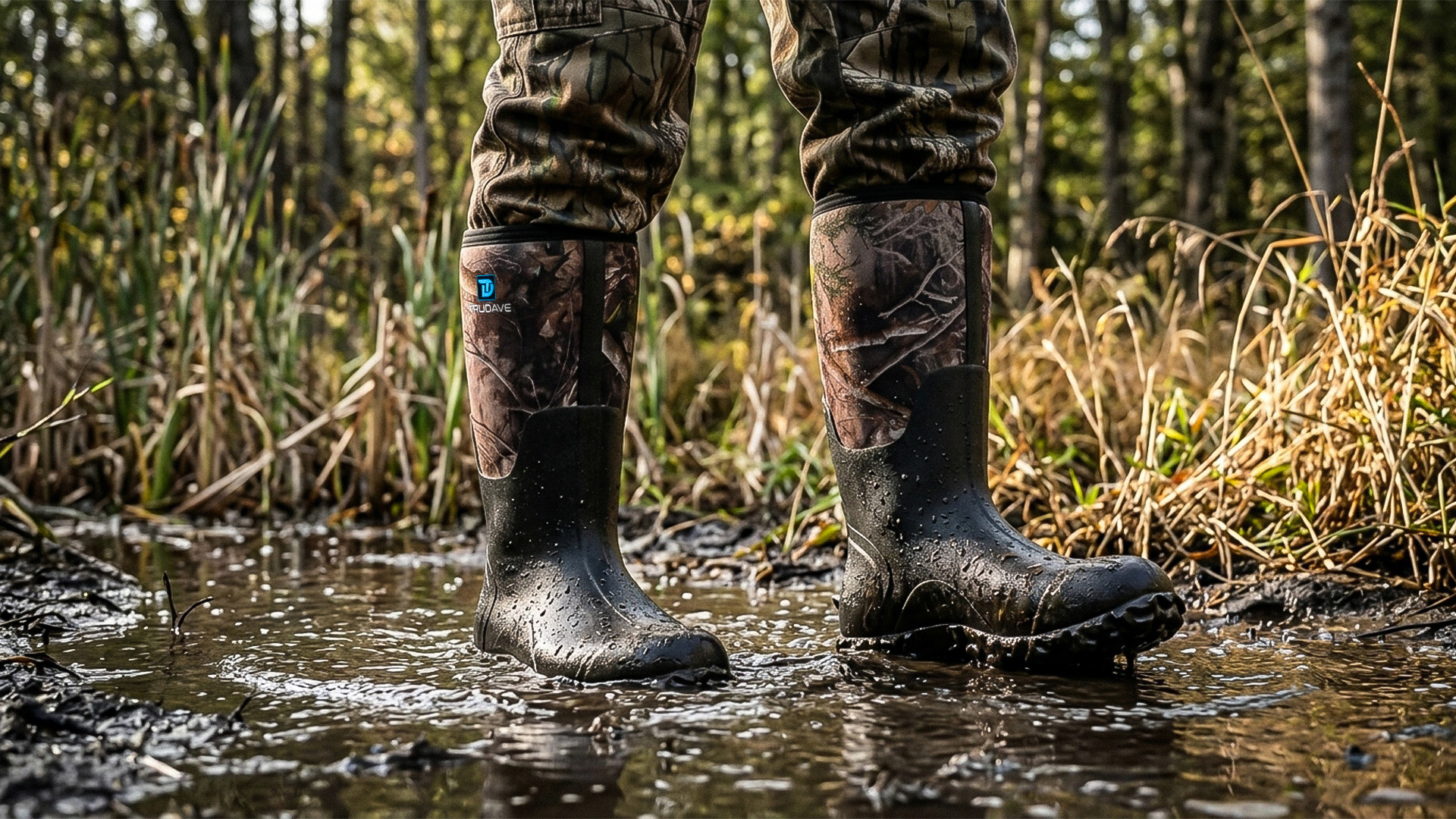
Hunters working these environments may benefit from waterproof hunting boots for blacktail deer hunting that provide secure heel retention, dependable wet-ground traction, and enough support for long days in steep forest.
Waterproofing Is Essential
In Pacific Northwest hunting country, moisture comes from:
- Rain
- Brush
- Dew
- Creeks
- Mud
Even after rain stops, vegetation remains wet.
Non-waterproof footwear can become soaked simply from walking through brush.
Boot Height Should Match Access
Some hunts involve:
- Logging roads
- Shallow mud
Others require:
- Creek crossings
- Wet brush
Moderate-to-tall waterproof boots can add protection.
Scout the route before choosing.
Rubber Hunting Boots Can Work in Extremely Wet Ground
Tall rubber boots provide strong moisture protection around:
- Lowlands
- Mud
- Wet vegetation
But steep mountain terrain demands good fit.
Loose rubber boots may lack the support needed for serious sidehilling.
Lace-Up Waterproof Boots Often Work Better in Mountains
For hunts involving:
- Steep climbs
- Logging slash
- Long walking
a supportive waterproof lace-up hunting boot may provide better control.
Choose the system that matches the majority of your terrain.
Heel Retention Matters on Slopes
Blacktail country often involves constant:
- Climbing
- Descending
- Sidehilling
Poor heel fit creates blisters quickly.
Break boots in before season.
Toe Room Matters on Long Descents
A boot that feels perfect on flat ground can become painful going downhill.
Leave adequate toe room.
Your feet will thank you after several thousand vertical feet.
Traction Matters on Wet Logging Slash
Logs, branches, and roots become extremely slippery after rain.
Do not rush.
Good tread helps.
Careful foot placement helps more.
Wet Ferns Can Hide Obstacles
Dense ferns may conceal:
- Logs
- Holes
- Rock
Lift your feet.
Do not shuffle blindly.
Creek Banks Can Be Slick
Wet clay, moss, and roots create fall hazards.
Use safe crossing locations.
A shorter path is not always the safer path.
Gaiters Can Help in Constant Wet Vegetation
Gaiters can reduce water entering from the top of the boot.
They also protect lower legs from:
- Brush
- Mud
- Seeds
Waterproof Pants Can Be Worth Carrying
Blackberry, salal, and fern transfer enormous amounts of water.
Even without active rain, pants can become saturated.
Appropriate waterproof or water-resistant lower layers can extend comfort.
Brush-Resistant Clothing Helps
Blackberry can tear lightweight clothing quickly.
Choose durable materials for:
- Pants
- Sleeves
if the hunt requires pushing through regeneration.
Eye Protection Can Be Useful
Young conifers and brush frequently reach face level.
Clear protective glasses can reduce:
- Branch scratches
- Eye injuries
especially while moving in darkness.
Logging Slash Requires Slow Movement
Clearcuts can contain hidden:
- Limbs
- Stumps
- Holes
Do not watch only the hillside while walking.
Stop to glass.
Then move.
Old Stumps Can Be Unstable
Rotten stumps may collapse.
Avoid stepping on them when possible.
Wet wood makes footing even worse.
Dogs Are Not Usually Central to Deer Hunting, but Wildlife Awareness Still Matters
Blacktail country can contain:
- Bears
- Elk
- Other wildlife
Stay aware while still-hunting dense cover.
A close encounter may happen with little warning.
Bear Awareness Is Important
Follow current regional guidance for:
- Food
- Carcass handling
- Encounters
A harvested deer can attract scavengers.
Remain alert during recovery.
Cougars Occupy Some Blacktail Habitat
Mountain lion habitat can overlap black-tailed deer country.
Encounters are uncommon, but hunters should understand current wildlife-agency guidance and remain aware in remote terrain.
Remote Country Requires Navigation
Fog, timber, and logging-road networks can become confusing.
Carry reliable navigation.
Mark:
- Vehicle
- Main road
- Creek
- Property boundary
Logging Roads Can Look Identical
A network of old roads may contain:
- Spurs
- Switchbacks
- Dead ends
Download maps beforehand.
Do not rely on remembering “the second left.”
Cell Service May Be Unreliable
Mountain timber blocks signals.
Use offline maps.
Carry appropriate emergency communication for remote hunts.
Carry a Headlamp
Blacktail recovery often happens near darkness.
Bring:
- Headlamp
- Backup power
even on morning hunts.
Fog Can Make the Walk Out Difficult
Once distant ridges disappear, orientation becomes harder.
Check mapping before darkness.
Do not wait until you are already lost inside a clearcut.
Public Timberlands Can Offer Opportunities
Blacktail habitat may occur on:
- National forest
- State forest
- BLM land
- Other public hunting areas
depending on region.
Access rules can vary greatly.
Private Timber Companies May Have Special Access Rules
Some commercial forestlands may permit hunting under specific conditions.
Rules can involve:
- Gates
- Fire season
- Vehicle access
- Permits
Verify current landowner requirements.
Fire Season Can Close Access
Western forests may impose seasonal restrictions due to wildfire danger.
Always check current access before traveling.
Do not assume last week’s open gate is still open.
Active Logging Areas Need Respect
Stay away from:
- Equipment
- Falling operations
- Truck traffic
Follow closures and signage.
A deer is never worth entering an active work zone.
Logging Trucks Require Road Awareness
On active forest roads:
- Drive cautiously
- Follow landowner rules
- Expect heavy trucks
Do not block gates or turnarounds.
Property Boundaries Can Be Complicated
Forest ownership may change across:
- Drainages
- Timber blocks
Use accurate maps.
Do not assume one continuous forest means one ownership.
Safe Shooting Backgrounds Matter
Dense forest may appear to stop everything.
It does not automatically create a safe backstop.
Know what lies beyond:
- Deer
- Brush
- Ridge
Never shoot only because the animal is about to disappear.
Do Not Shoot at Partial Movement
Blacktail cover hides animals.
A patch of brown behind brush is not enough.
Confirm:
- Species
- Legal target
- Safe background
before shooting.
Branches Can Hide More Than the Target
Other animals may stand behind the visible deer.
Wait for a clear opportunity.
Dense cover rewards patience.
Shot Opportunities May Last Only Seconds
Prepare mentally before deer appear.
Know:
- Safe lanes
- Distance
- Shooting position
Do not create a rushed decision after the animal steps out.
Recovery Begins With Marking the Location
After the shot, remember:
- Stump
- Tree
- Brush patch
- Creek
where the deer stood.
Clearcuts look completely different once you enter them.
Do Not Assume You Can Walk Straight to the Spot
A deer visible from across the canyon may require:
- Road detour
- Creek crossing
- Major elevation change
Use mapping.
Mark the exact location before leaving the glassing point.
Rain Can Complicate Blood Tracking
Water may dilute visible sign.
Look for:
- Hair
- Tracks
- Broken vegetation
- Blood where present
Move methodically.
Wet Vegetation Can Transfer Sign
Blood may appear on:
- Ferns
- Brush
rather than the ground.
Search at the correct height.
Do Not Destroy the Trail
If tracking is required, avoid multiple people walking everywhere.
Protect sign.
Mark each confirmed location before continuing.
Thick Brush Can Hide a Deer Only Yards Away
A recovered animal may be extremely close to the last visible point but invisible from only a few steps away.
Search systematically.
Do not rush.
Recovery Terrain Can Be Extremely Steep
A deer may move downhill after the shot.
Do not run after it.
Loose wet slopes can cause serious injuries.
Plan Extraction Before Shooting
Before committing to a difficult location, ask:
How will I get the animal out?
Consider:
- Elevation
- Creek
- Road access
- Brush
Recovery can be much harder than the stalk.
Pack-Out Planning Matters
Remote blacktail hunts may require:
- Multiple trips
- Proper pack equipment
where lawful and appropriate.
Prepare before success.
Mild Coastal Weather Can Still Require Fast Game Care
Cool rainy air does not guarantee ideal meat temperature.
Begin field care promptly.
Use:
- Game bags
- Cooling strategy
according to current conditions.
Humidity Can Slow Cooling
Wet coastal environments may remain relatively mild.
Get meat to suitable cooling conditions as soon as practical.
Follow current official and food-safety guidance.
Regulations Must Be Checked Locally
Black-tailed deer hunting rules vary by:
- State
- Unit
- Season
- Weapon
- Tag type
Before hunting, verify current:
- Tag requirements
- Season dates
- Bag limits
- Legal methods
- Public-land rules
Use current official wildlife-agency information.
Blacktail Regulations May Differ by Region
Coastal and inland management areas may have different rules.
Do not assume regulations from one county or unit apply elsewhere.
Species and Subspecies Identification Matters
Western deer ranges can include:
- Black-tailed deer
- Mule deer
- White-tailed deer
depending on region.
Hunters should understand local identification and legal definitions.
Do Not Rely on Tail Color Alone
Body structure, ear size, antler characteristics, and regional wildlife-agency identification materials can provide better context.
Positive identification comes before the shot.
Habitat Management Shapes Blacktail Hunting
Logging, wildfire, forest succession, and development all change blacktail habitat.
Young forest can create food.
Mature timber creates security.
A healthy hunting landscape often contains both.
Clearcuts Eventually Stop Being Clearcuts
Today’s perfect feeding cut becomes tomorrow’s dense young forest.
Then eventually mature timber.
That constant habitat change is part of blacktail hunting.
Keep scouting new disturbance.
Common Blacktail Deer Hunting Mistakes
Glassing Too Fast
Deer can look exactly like stumps and shadows.
Hunting Only the Middle of Clearcuts
Timber edges are critical.
Ignoring Clearcut Age
Vegetation structure changes rapidly.
Staying Home Because of Light Rain
Wet weather can improve quiet movement and deer activity.
Wearing Leaky or Poorly Fitting Boots
Pacific Northwest brush, mud, creeks, and slopes demand waterproof support.
Walking Continuously Through Timber
Spend more time stopped and searching.
Ignoring Logging-Road Access Changes
Gates and restrictions can change seasonally.
Forgetting Extraction Difficulty
A deer across one canyon may be much farther away than it looks.
Frequently Asked Questions
Where do black-tailed deer usually live?
Black-tailed deer commonly use western coastal and mountain habitats containing conifer forest, clearcuts, young regeneration, brush, creek bottoms, burns, and forest edges.
Are clearcuts good for blacktail hunting?
Yes. Regenerating clearcuts can provide excellent feeding habitat, especially when they are close to mature security timber. The age and vegetation of the cut matter greatly.
Is rain good for blacktail deer hunting?
Light rain can quiet the forest, make tracks easier to read, and sometimes encourage deer to remain active. Heavy rain can reduce visibility and complicate recovery.
What time of day is best for blacktail hunting?
Early morning and late afternoon can be productive, but overcast and rainy conditions may extend deer activity into other parts of the day.
What boots are best for blacktail hunting?
Waterproof hunting boots with secure heel fit, strong traction on wet roots, mud, logs, and slopes, and enough support for long forest walking are practical.
Why are black-tailed deer hard to see?
Their dark coloration, dense brush habitat, short visibility windows, and habit of staying close to mature timber allow them to disappear quickly.
Final Thoughts
Blacktail deer hunting teaches hunters that visibility is not the same thing as habitat quality.
A clearcut may give you visibility.
Dark timber gives the deer security.
The best hunting happens where those two worlds touch.
Find young vegetation.
Study clearcut age.
Glass every stump twice.
Watch timber fingers.
Follow muddy road crossings.
Slow down when rain quiets the woods.
Use fog and overcast weather instead of fighting them.
Wear boots that let you cross wet brush, slick logs, muddy roads, creek bottoms, and steep forest without choosing the easy route around productive cover.
And when a blacktail suddenly appears beside a stump you have been staring at for five minutes, do not assume the deer just walked into the opening.
There is a good chance it was there all along.
Blacktail hunting improves when the hunter finally learns to see slowly enough.
