
A flooded rice field can look like perfect duck habitat.
Shallow water.
Standing stubble.
Open sky.
Plenty of room for birds to land.
A hunter arrives before sunrise, sets decoys, brushes the blind, and waits.
Legal shooting time arrives.
Nothing.
Thirty minutes later, several flocks pass high overhead without even looking down.
The field appears perfect.
The ducks disagree.
That is one of the first lessons in flooded-field duck hunting.
Water alone does not create a productive field.
Birds are constantly evaluating:
Food.
Water depth.
Wind.
Pressure.
Safety.
Location relative to roosting areas.
The hunter who understands those variables has a much better chance than the hunter who simply hunts the prettiest piece of flooded agriculture.
Rice Fields Can Create Excellent Waterfowl Habitat
Harvested rice fields can provide valuable habitat for migrating ducks when water and food conditions are suitable.
Productive fields may offer:
- Waste grain
- Weed seeds
- Aquatic invertebrates
- Shallow water
- Open feeding space
Different duck species may use agricultural habitat differently.
The important point is that birds need a reason to land.
Flooding a field does not automatically create that reason.
Food Is the First Question
Before hunting a flooded field, ask:
What are the birds eating here?
Potential food can include:
- Waste rice
- Weed seeds
- Natural vegetation
- Aquatic food created after flooding
A field that has been heavily cleaned, tilled, or otherwise altered may provide less food than another field nearby.
Scout actual bird use rather than assuming every rice field is equal.
The ducks will show you which fields are producing.
Water Depth Matters More Than Many Hunters Think
Shallow water is often important in agricultural waterfowl habitat.
Different ducks prefer different feeding depths.
A field that becomes too deep may become less attractive to birds that prefer feeding in shallower conditions.
Watch where live ducks land.
If birds consistently concentrate in one shallow corner rather than across the whole field, depth may be part of the explanation.
Small Elevation Changes Create Different Feeding Zones
Agricultural fields are rarely perfectly level.
A change of only a few inches can create:
- Deeper water
- Exposed mud
- Shallow feeding shelves
From a road, those differences may be invisible.
From a duck’s perspective, they can define the best part of the field.
Walk and scout the water.
Do not judge depth only from one location.
Flooding Timing Can Influence Bird Use
Newly flooded fields can become attractive quickly.
Water may expose or redistribute food.
Invertebrate activity can change.
But birds still need time to discover the field.
A field flooded yesterday may not immediately hold large numbers of ducks.
A field flooded several days earlier may already be part of a regular feeding pattern.
Track current use.
Recently Flooded Ground Can Produce Fresh Opportunities
When water first spreads across dry agricultural soil, habitat changes rapidly.
Look for birds using:
- Newly flooded corners
- Shallow stubble
- Field depressions
- Weed patches
New water can create opportunity where there was none before.
This is especially important during active migration periods.
Too Much Water Can Scatter Birds
If many surrounding fields become flooded after heavy rain, ducks suddenly gain more choices.
A field that was heavily used before the storm may receive less activity afterward.
The birds did not necessarily leave the region.
They spread out.
This is why fresh scouting becomes critical after major rainfall.
Rain Can Completely Reset a Rice-Field Pattern
Heavy weather may create:
- New temporary wetlands
- Flooded roadsides
- Water in neighboring fields
- New loafing areas
The old pattern may disappear overnight.
Do not assume yesterday’s field remains the best field.
Scout again.
Waterfowl hunting rewards current information.
Wind Controls the Final Approach
Ducks use wind when landing.
That makes wind one of the most important setup variables.
Before placing decoys, consider:
- Wind direction
- Blind position
- Safe shooting lanes
- Sun angle
The goal is encouraging birds to finish in a location that is both natural and safe.
Set the Blind for the Wind You Actually Have
Hunters often try to force birds into a favorite setup.
Instead, adapt the setup to current conditions.
If the wind changes, decoy orientation and landing zones may need to change too.
A spread that worked yesterday may look awkward today.
The ducks evaluate the entire picture.
Crosswinds Can Be Useful
A direct headwind setup is not always necessary.
A controlled crosswind can provide:
- Better visibility
- Better shooting angles
- Less direct bird focus on the blind
Watch how live birds approach similar fields.
Natural behavior is the best teacher.
Leave an Obvious Landing Pocket
Do not fill every open piece of water with decoys.
Ducks need room to land.
A good landing pocket should be:
- Visible
- Natural
- Safe for shooting
- Positioned with wind in mind
The spread should invite birds.
Not block them.
More Decoys Are Not Always Better
Large spreads can be useful in some situations.
But realism matters more than raw quantity.
A smaller spread in the exact feeding area can outperform a huge spread in the wrong corner.
Scout first.
Then decide how much equipment is actually necessary.
Spread Shape Should Match Bird Behavior
Observe live ducks.
Are they:
- Loosely scattered?
- Packed tightly?
- Feeding in small groups?
- Sitting along one edge?
Try to imitate the general structure.
A spread designed only from diagrams may look less realistic than one copied from birds using the same field yesterday.
Movement Can Add Realism
Completely static water can look unnatural.
Where legal and appropriate, subtle movement can help.
However, excessive or mechanical-looking motion can also make birds suspicious.
Use movement carefully.
The objective is creating life, not distraction.
Concealment Is Difficult in Flat Agriculture
Rice country can offer very little natural vertical cover.
Hunters may use:
- Field-edge vegetation
- Existing levees
- Appropriately concealed blinds
The key is avoiding an obvious artificial outline.
A dark box in a flat flooded field can be visible from long distance.
Brush the Blind With Local Material
Where legal and appropriate, use vegetation that matches the immediate surroundings.
Do not create a blind using material dramatically different from the field.
Color and texture matter.
More importantly, avoid unnecessary movement once birds begin working.
Face and Hand Movement Gives Hunters Away
Waterfowl see movement extremely well.
A perfectly brushed blind can fail because hunters:
- Look up repeatedly
- Move shotguns
- Reach for calls
- Expose faces
Organize equipment before the birds arrive.
When a flock begins circling, stillness matters.
Rice Levees Can Be Excellent Setup Features
Levees create:
- Slight elevation
- Dry footing
- Natural separation between water zones
They can also influence where ducks land.
Scout birds relative to levees.
Some may use protected downwind sections.
Others may avoid heavily traveled levees.
Human pressure changes everything.
Do Not Assume the Closest Levee Is the Best One
Easy access creates hunting pressure.
A more distant field corner may receive less disturbance.
Look for:
- Fresh bird use
- Droppings
- Feather concentrations
- Tracks
Good hunting often starts where vehicle convenience ends.
Morning Scouting Can Reveal the Feed
Watching birds from a distance before hunting is one of the best investments.
Record:
- Which field
- Which corner
- Arrival time
- Wind
- Number of birds
Do not simply note that ducks are “using rice.”
Find the exact place.
Precision matters.
Evening Scouting Can Be Even More Useful
Birds returning from daytime rest to feeding areas can reveal where tomorrow morning may be productive.
Observe until you understand:
- Entry direction
- Field choice
- Preferred water depth
- Group size
Avoid driving directly into the field afterward.
Leave the birds undisturbed.
Migration Weather Can Bring New Birds Overnight
A field that seemed mediocre can suddenly become productive after a strong migration event.
Cold fronts may move new ducks into an area.
These birds may behave differently from heavily pressured local birds.
Continue scouting after major weather changes.
Never assume one week represents the entire season.
New Birds Can Be Less Familiar With Pressure
Recently arrived migrants may not know every blind or hunting location.
That can create opportunities.
But they still have excellent instincts.
Poor concealment, bad wind, and unnatural spreads still matter.
Use the fresh migration as an advantage, not an excuse for sloppy hunting.
Warm Weather Can Slow Movement
During mild periods, ducks may:
- Feed at different times
- Move less aggressively
- Spend more time resting
Do not assume lack of morning movement means the area is empty.
Observe the broader daily pattern.
The birds may simply shift timing.
Cold Weather Can Increase Feeding Urgency
When temperatures drop, birds often need more energy.
Agricultural food can become extremely important.
Watch for increased use during:
- Cold mornings
- Strong weather changes
- Pre-storm periods
But frozen water can complicate everything.
Ice Changes the Field
Shallow flooded agriculture can freeze quickly.
Birds may concentrate around:
- Open water
- Moving water
- Wind-broken ice
- Deeper sections
A field that was excellent yesterday may become unusable overnight.
Weather decides habitat availability.
Thin Ice Is a Serious Hazard
Never assume shallow agricultural water is safe simply because it appears frozen.
Ice thickness can vary.
Hidden:
- Ditches
- Channels
- Drain structures
may weaken it.
Do not walk onto uncertain ice.
Use safe, established access.
Water-Control Structures Can Create Depth Changes
Rice fields may contain:
- Gates
- Pipes
- Drainage ditches
- Water-control boxes
These create uneven depth and hidden footing.
Learn their locations during daylight.
Do not discover them for the first time while walking before sunrise.
Agricultural Mud Can Be Extremely Sticky
Flooded rice soil may be soft and difficult to walk through.
Every step can pull at footwear.
Hunters may encounter:
- Deep mud
- Water
- Stubble
- Ruts
This environment makes footwear especially important.
Waterproof Boots Are Essential in Shallow Rice Fields
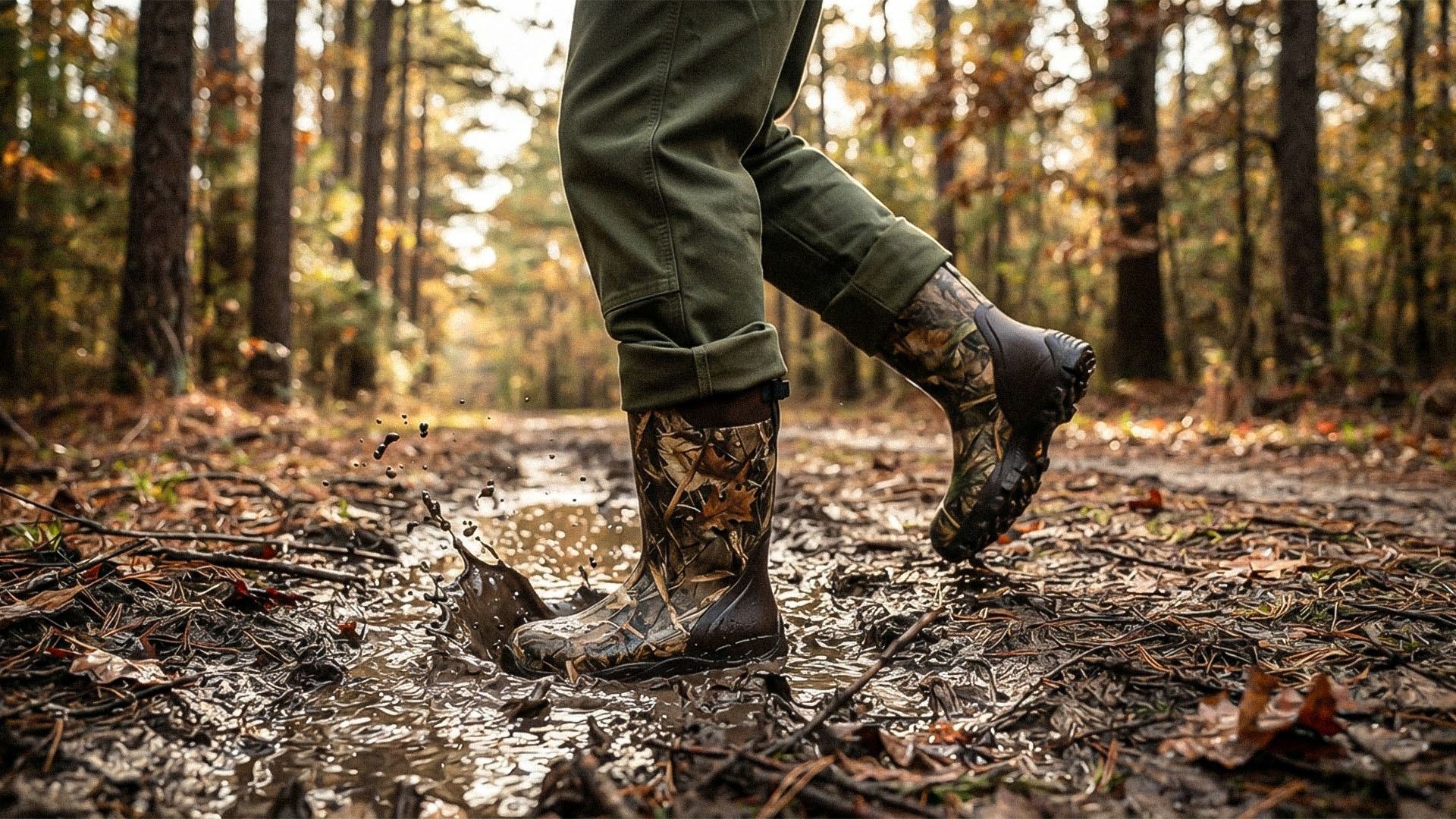
Hunters working these conditions may benefit from waterproof hunting boots for flooded field duck hunting that provide secure heel retention, dependable mud traction, and enough waterproof height for shallow flooded agriculture.
The goal is staying mobile without turning every trip to the blind into a struggle.
Rubber Hunting Boots Can Work Very Well
Tall rubber boots are practical for many flooded-field hunts.
They handle:
- Shallow water
- Mud
- Wet stubble
well.
However, fit matters greatly.
Loose rubber boots can become exhausting in sticky soil.
Secure Heel Fit Prevents Mud Problems
When mud grabs the outsole, the heel wants to lift inside the boot.
Repeated movement creates:
- Blisters
- Fatigue
- Poor balance
Choose boots that stay attached to the foot.
This matters more than many hunters realize.
Boot Height Should Match the Actual Field
Some rice fields remain shallow enough for tall boots.
Others contain:
- Deep ditches
- Channels
- Unexpected holes
Scout before choosing equipment.
Deeper water may require appropriate waders.
Never assume average field depth tells you the depth of every crossing.
Waders Can Be Useful but Bulky
Chest waders provide additional protection where deeper water exists.
But they can be:
- Hot
- Heavy
- Restrictive
during long gear hauls.
If the field is consistently shallow, tall waterproof boots may provide better mobility.
Use the least cumbersome safe option.
Stubble Can Be Hard on Footwear
Harvested rice leaves sharp crop residue.
Boot uppers should handle:
- Repeated abrasion
- Mud
- Water
Durability matters.
A hunting boot that works in a clean marsh may experience more wear in agricultural stubble.
Mud Builds Under Outsoles
Sticky field soil can pack into tread.
Once lugs fill, traction decreases.
Clean excessive mud when necessary.
Be especially careful around:
- Levees
- Drainage slopes
- Vehicle ruts
Frozen Mud Creates Different Hazards
After a cold night, yesterday’s soft tracks may become hard uneven surfaces.
Before sunrise, frozen ruts can twist ankles.
Use adequate lighting.
Watch every step while carrying decoys or firearms.
Carrying Decoys Changes Your Balance
A large bag of decoys can block ground visibility.
Do not overload yourself.
Make additional trips if necessary.
A few minutes saved during setup are not worth a fall.
Plan Gear Transport Before the Hunt
Ask:
- How far is the blind?
- How deep is the mud?
- Is a cart legal and practical?
- Is the field too soft for wheels?
- How many hunters can share gear?
Efficient planning reduces unnecessary exhaustion before legal shooting time.
Avoid Driving Wet Fields Without Permission
Soft agricultural ground can be damaged easily.
Never assume vehicle access is acceptable.
Ask the landowner or manager.
Deep ruts can create:
- Crop damage
- Drainage problems
- Access conflicts
A good hunting relationship is worth more than saving a walk.
Respect Every Levee and Water Gate
Flooded agriculture is managed infrastructure.
Do not:
- Modify gates
- Change water levels
- Damage levees
- Move equipment
without explicit authorization.
Hunters are guests in a working system.
Birds Notice Vehicle Pressure
Repeated truck traffic near a field can change bird behavior.
If possible and permitted, park farther away and walk.
A quiet approach may help preserve the feeding pattern.
Scouting vehicles can educate birds too.
Public Rice Fields Can Have Special Rules
Managed wildlife areas may flood agricultural fields specifically for waterfowl habitat.
These properties may have rules involving:
- Draw systems
- Blind assignments
- Entry times
- Parking
- Ammunition
- Hunting days
Read the specific area regulations.
Do not rely only on general state rules.
Private Rice Access Depends on Relationships
Many productive agricultural waterfowl areas occur on private ground.
Follow landowner instructions exactly.
Respect:
- Crops
- Roads
- Gates
- Equipment
- Livestock
Pick up every shell and piece of trash.
Good behavior protects future access.
Agricultural Baiting Rules Must Be Understood
Migratory bird hunting around agricultural fields is subject to federal and state baiting regulations.
Hunters should understand the difference between lawful normal agricultural practices and illegally manipulated food.
Never add or distribute grain to attract ducks.
If field conditions are uncertain, consult current official wildlife guidance before hunting.
Do Not Assume Every Harvested Field Is Legal
The presence of grain does not automatically mean a hunting situation complies with migratory bird rules.
Specific circumstances matter.
Always verify current regulations.
Legal preparation is part of scouting.
Non-Toxic Shot Requirements Apply to Waterfowl
Hunters must use ammunition compliant with current waterfowl regulations.
Check:
- Federal rules
- State rules
- Property-specific restrictions
before hunting.
Do not bring upland ammunition into a waterfowl setup by mistake.
Species Identification Matters
Flooded rice fields can attract multiple duck species.
Hunters must identify birds before shooting.
Learn:
- Size
- Flight style
- Plumage
- Wing patterns
- Calls
Low morning light makes identification more difficult.
If uncertain, let the flock pass.
Large Mixed Flocks Require Discipline
Migration can produce mixed groups.
Do not assume every bird in the flock has the same legal status or bag-limit implications.
Pick a clearly identified target.
Do not shoot into the group.
Shooting Distance Can Be Deceptive
Open fields lack visual references.
Birds may appear closer than they are.
Maintain disciplined range judgment.
The fact that you can see a duck clearly does not mean it is within an ethical range.
Wait for Birds to Finish
One of the biggest advantages of a good rice-field setup is the ability to bring birds close.
Do not rush.
If birds are still:
- Circling
- Dropping
- Committing
let the setup work.
Better opportunities often develop several seconds later.
Pick One Bird
A flock dropping into a hole creates visual excitement.
Choose one bird.
Track it.
Complete the shot.
This reduces:
- Misses
- Wounding
- Accidental flock shooting
Control beats panic.
Know Where Every Hunter Is
Field blinds may hold several hunters.
Before the hunt, establish:
- Shooting order
- Safe zones
- Dog position
- No-shoot directions
Do not negotiate these things after birds begin dropping.
Low Birds Can Put Farm Infrastructure in the Background
A duck crossing low may have:
- Road
- House
- Barn
- Farm equipment
behind it.
Know the property before shooting.
Flat terrain often hides distant hazards.
Retrievers Can Be Extremely Valuable
A trained dog can help recover birds from:
- Shallow water
- Stubble
- Mud
But agricultural fields create hazards.
Dogs may encounter:
- Deep ditches
- Sharp crop residue
- Ice
- Farm equipment
Know the field layout.
Mud Increases Dog Fatigue
A dog running through sticky mud works much harder than one running over dry grass.
Repeated retrieves can produce significant fatigue.
Give dogs:
- Water
- Rest
- Monitoring
Do not assume cool weather eliminates exhaustion.
Cold Water Can Affect Dogs Quickly
Late-season rice fields may contain near-freezing water.
Watch for:
- Shivering
- Slowed movement
- Reduced coordination
Dry dogs during long breaks where possible.
Use appropriate protective equipment based on conditions and veterinary guidance.
Warm Early-Season Fields Can Cause Overheating
At the other end of the season, shallow flooded fields can be warm and humid.
A retriever working repeatedly can overheat.
Carry clean drinking water.
Do not rely on agricultural water for hydration.
Mark Downed Birds Immediately
A duck falling into stubble may disappear.
Use landmarks such as:
- Blind
- Levee
- Decoy
- Weed patch
Mark the exact fall before looking back at the sky.
Recovery comes first.
Wounded Ducks May Hide in Stubble
A bird may move through:
- Rice stems
- Grass
- Muddy edges
Give the dog or hunter time to search methodically.
Do not assume a bird vanished because it is no longer visible.
Fog Can Make Field Hunting Dangerous
Agricultural lowlands can develop thick fog.
When visibility is poor:
- Identify birds carefully
- Know hunter locations
- Avoid low uncertain shots
Fog can hide roads, livestock, or farm structures.
If the background is unclear, do not shoot.
Lightning Is a Serious Open-Field Hazard
Flooded rice country can offer little shelter.
If thunderstorms approach:
- Leave exposed field positions
- Follow safe weather procedures
Do not remain in an open blind simply because ducks are moving.
A good migration day is not worth lightning exposure.
Wind Chill Can Be Severe
Open agricultural fields provide almost no protection from winter wind.
Hunters may remain stationary for hours.
Manage:
- Core insulation
- Gloves
- Face protection
- Foot warmth
Wet and windy conditions can become dangerous quickly.
Bring Dry Gloves
Handling:
- Decoys
- Mud
- Wet birds
can soak gloves.
Carry a dry backup pair.
Cold hands reduce safe firearm handling.
Layer Footwear Correctly
Avoid crushing circulation with overly thick socks inside tight boots.
Warmth depends on:
- Insulation
- Dryness
- Circulation
Test the full boot-and-sock system before the hunt.
Common Rice Field Duck Hunting Mistakes
Hunting a Pretty Field Instead of a Used Field
Find birds first.
Ignoring Water Depth
A few inches can change feeding suitability.
Setting Up Away From the Exact Feed
The right field can still contain the wrong setup location.
Filling the Landing Hole With Decoys
Give ducks room to finish.
Hunting Yesterday’s Pattern After Heavy Rain
New water changes bird distribution.
Wearing Loose or Leaky Footwear
Rice-field mud punishes poor boot fit.
Driving Soft Agricultural Ground
Respect the land and access rules.
Ignoring Baiting Regulations
Agricultural waterfowl hunting has specific legal considerations.
Frequently Asked Questions
Are flooded rice fields good for duck hunting?
They can be excellent when they provide suitable water depth, natural or lawful agricultural food resources, security, and location within active migration or local bird patterns.
What water depth is best for rice field duck hunting?
The ideal depth varies by species and feeding behavior. Watching where live ducks naturally concentrate is one of the best ways to determine productive depth.
Is duck hunting better after rain?
Rain can create new flooded habitat and change bird distribution. It may improve one field while reducing concentration in another, so fresh scouting is important.
How many decoys should you use in a rice field?
There is no universal number. A realistic spread positioned in the exact area birds want to use is usually more important than simply maximizing decoy quantity.
What boots are best for flooded rice field hunting?
Waterproof hunting boots with secure heel retention, strong mud traction, durable uppers, and sufficient waterproof height are practical for shallow rice fields. Deeper water may require appropriate waders.
Why do ducks stop using a rice field?
Possible reasons include changing food availability, water depth, hunting pressure, weather, freezing conditions, migration, or newly flooded habitat nearby.
Final Thoughts
Flooded rice field hunting teaches hunters that water is only the beginning.
The field can look perfect.
The blind can look perfect.
The decoys can look perfect.
And ducks can still ignore everything.
The answer is usually somewhere in the details.
Water depth.
Food.
Wind.
Pressure.
Migration.
A newly flooded field three miles away.
A shallow corner only six inches different from the rest.
Find where the ducks actually want to feed.
Scout the exact landing zone.
Follow weather changes.
Protect the farmer’s ground.
Wear boots that let you cross mud, shallow water, stubble, and frozen ruts without wasting energy before sunrise.
And remember:
The best flooded field is not the one that looks most like duck habitat to a hunter.
It is the one the ducks already chose.
