
Sagebrush country can fool hunters.
From a distance, the landscape looks open, flat, and easy to read. Low brush rolls across the hills, shallow draws cut through the basin, and distant ridges seem to offer endless glassing opportunities.
Then rain comes through.
The dust settles. Old tracks soften. Clay roads turn slick. Small washes collect water, and the muted gray-green hillsides all begin to look the same.
A hunter may glass for hours and conclude the deer have left.
They usually have not.
Mule deer know how to disappear in sagebrush country. They use shallow draws, small benches, brush pockets, low ridges, and terrain folds that do not look important until you study them carefully.
After rain, those features can become even more important.
Moisture reveals fresh tracks. New green growth appears in protected spots. Deer may move more comfortably through quiet ground, and small drainages can connect bedding cover with feeding areas without exposing animals to open skylines.
The best mule deer hunters do not treat sagebrush country as empty space.
They learn to read the small structure inside it.
Sagebrush Is Not Featureless
New western hunters often look for dramatic terrain.
High cliffs.
Deep canyons.
Obvious saddles.
Big timber pockets.
But many mule deer live in country where the most important features are subtle.
A sagebrush basin may contain:
- Shallow draws
- Low ridgelines
- Brushy pockets
- Small benches
- Rock outcrops
- Greasewood flats
- Cut banks
- Two-track roads
- Dry creek channels
- Tiny north-facing slopes
To a mule deer, a three-foot change in elevation can provide enough cover to bed, travel, or avoid wind.
To a hunter standing upright, that same feature may look meaningless.
The first step is slowing down and accepting that small terrain matters.
Draws Create Hidden Travel Routes
A draw is often the backbone of mule deer movement in open sage country.
Even a shallow drainage can provide concealment, easier walking, moisture, better forage, and a natural route between feeding and bedding areas.
Mule deer may use draws to:
- Travel below the skyline
- Reach water
- Move between basins
- Avoid wind
- Feed on greener plants
- Bed on protected side slopes
- Escape hunting pressure
- Cross open country without being fully visible
The deeper and brushier the draw, the more obvious its value becomes.
But do not ignore small drainages.
A draw barely visible on a map may be the exact route a buck uses to move from a feeding flat into bedding cover before sunrise.
Rain Makes Tracks Easier to Read
Dry sagebrush ground can hide sign.
Wind erases dust. Hard soil records little detail. Old tracks may remain for days without telling you much about current movement.
Rain changes the surface.
Soft mud around washes, two-tracks, cattle trails, and clay openings records fresh deer movement clearly.
After rain, look for tracks in:
- Road crossings
- Wash bottoms
- Seep edges
- Stock tank approaches
- Fence gaps
- Low saddle crossings
- Muddy benches
- Trail intersections
- Field or alfalfa edges where legal access allows scouting
Fresh tracks show sharper edges and clean displacement.
Older tracks may be softened by rain, wind, or sun.
The best information comes from tracks made after the rain stopped.
Track Direction Matters More Than Track Size
A large mule deer track is exciting.
But direction often matters more than size.
Ask where the deer was going.
A track entering a draw from a feeding flat before daylight tells one story.
A track leaving bedding cover toward an evening food source tells another.
A track crossing a road at random may be less useful than several tracks following the same drainage.
Study:
- Direction of travel
- Number of deer
- Whether tracks climb or descend
- Whether the trail follows cover
- Nearby bedding terrain
- Distance to feed
- Wind exposure
- Human access
The goal is not simply finding a buck track.
The goal is understanding the route.
Bucks and Does May Use Different Cover
Mule deer does may feed and bed in more visible groups.
Mature bucks often use smaller, quieter, and less obvious cover.
During early season or outside the rut, a buck may bed alone or with only one other deer in a place that seems too small to matter.
Look for buck bedding cover near:
- Brushy side draws
- Small rock outcrops
- North-facing pockets
- Isolated sage flats near escape terrain
- Cut banks above washes
- Hidden benches
- Edges between sage and juniper
- Patches of taller bitterbrush or mountain mahogany
A basin full of does is useful information, especially during the rut.
But if you are searching for a mature buck before the rut, glass the overlooked pockets away from obvious doe groups.
Bedding Cover Can Be Surprisingly Small
A mule deer does not need a forest to hide.
In sagebrush country, a buck may bed behind a single brush clump, below a small rise, or on the shaded side of a shallow cut.
Good bedding often provides:
- Wind advantage
- Shade
- Visibility
- Quick escape route
- Nearby feed
- Enough cover to break the outline
- Reduced human disturbance
Study every brushy knob and sidehill pocket.
A deer bedded in sage may be visible only as an ear tip, antler point, or patch of gray hair.
The animal may remain motionless for hours.
Glass From Farther Away Than Feels Necessary
Open country tempts hunters to walk.
But mule deer often see movement long before hunters see deer.
Use distance as an advantage.
Choose glassing points that allow you to inspect multiple draws without entering them.
Good glassing positions may include:
- Opposite ridges
- Low knobs
- Rock outcrops
- Roadless overlooks
- Basin edges
- High benches
- Juniper points
Avoid skylining yourself.
Stay below the crest.
Use natural cover.
A hunter standing on top of a ridge with a tripod visible against the sky can alert deer across the basin.
Pick Apart the Shade
After rain, cloud cover may make visibility easier.
When the sun returns, deer often use shade created by brush, terrain, and rock.
Mule deer in sagebrush may bed in tiny shadows.
Glass:
- The shaded side of sage clumps
- The base of cut banks
- North-facing pockets
- Rock shadows
- Juniper shade
- Brushy draw bends
- Small depressions
- The downhill side of ridges
Do not scan only for full deer bodies.
Search for pieces.
An ear flick or antler tip may be the first clue.
Rain Can Create Short-Lived Green-Up
In dry western country, moisture can change forage quickly.
After meaningful rain, some plants may become more attractive, especially in low pockets, draws, and areas where runoff collects.
Mule deer may shift toward fresh growth in:
- Wash bottoms
- Seep areas
- Shaded side slopes
- Grass pockets
- Burn edges
- Old two-track margins
- Low saddles
- Protected benches
This does not mean every wet draw becomes productive.
Look for actual feeding sign, tracks, and deer movement.
The best forage is current, not theoretical.
Forage Diversity Matters
Sagebrush country is not just sagebrush.
Mule deer may feed on a variety of shrubs, forbs, grasses, and seasonal plants depending on region and time of year.
Productive areas may include:
- Bitterbrush
- Mountain mahogany
- Rabbitbrush
- Greasewood edges
- Clover-like forbs
- Green grass after rain
- Agricultural edges where legal access applies
- Burn or disturbance regrowth
- Browse near seeps
Learn the local food sources.
A draw with better plant diversity may hold more deer than a larger drainage dominated by poor cover and limited forage.
Water Can Matter, but It Is Not the Whole Pattern
In arid country, water sources can influence mule deer movement.
Potential water sources include:
- Springs
- Stock tanks
- Seeps
- Creek pockets
- Reservoirs
- Windmill tanks
- Seasonal puddles
- Guzzlers where present
However, rain can temporarily reduce the importance of one main water source.
If puddles and wet vegetation are available across the basin, deer may not need to visit the obvious tank during daylight.
Instead of hunting water alone, study travel between bedding cover, forage, and multiple moisture sources.
Water is part of the pattern, not always the center of it.
Muddy Stock Tank Edges Can Reveal Use
Where legal and appropriate to scout, muddy stock tank edges can show current activity.
Look for:
- Mule deer tracks
- Cattle tracks
- Pronghorn tracks
- Predator tracks
- Direction of approach
- Trails entering sage
- Tracks from different times
- Droppings nearby
Livestock can confuse the sign and change deer behavior.
Mule deer may drink when cattle are absent or approach from a less obvious side.
Do not assume the most trampled tank edge is the best deer route.
Juniper Edges Can Hide Bucks
Sagebrush and juniper often overlap in mule deer country.
Juniper pockets can provide shade, bedding cover, and escape structure.
A buck may feed in open sage and bed just inside scattered junipers where visibility remains good.
Search juniper edges carefully after rain.
Tracks may show deer moving between:
- Open feeding slopes
- Juniper bedding pockets
- Rock outcrops
- Draw bottoms
- Seep areas
- Saddles between basins
Do not glass only the open sage.
The transition between sage and trees often deserves more attention than either habitat alone.
Rock Outcrops Give Deer Security
A small rock outcrop can create shade, wind protection, and a visual barrier.
Mule deer may bed beneath or beside rocks where their body blends into shadow.
Rain can darken rock and make deer harder to distinguish.
Glass slowly.
Look for:
- Horizontal lines
- Ear movement
- Antler tips
- Leg shapes
- A body outline against brush
- Fresh tracks around the base
- Droppings on small benches nearby
A buck bedded near rock may allow a hunter to look directly at him without being noticed.
The challenge is seeing him before he stands.
Wind Shapes Mule Deer Bedding
Mule deer often bed where wind helps protect them.
A buck may choose a position where it can smell danger from one direction and see danger from another.
In broken sagebrush country, this often means bedding:
- Below the ridge crest
- On the leeward side of a draw
- Above a travel route
- Near a sidehill bench
- With escape terrain behind it
- Where swirling wind is difficult for hunters
Rainy weather can alter wind patterns.
Storm fronts, cooling air, and clearing skies can all change airflow through draws.
Use wind indicators often.
Do not trust only the forecast.
Thermals Still Matter in Open Country
Even without tall mountains, thermals can affect scent movement.
Morning sun warms slopes.
Evening air settles into low draws.
Cloud cover and rain can weaken or delay these patterns.
When planning a stalk, consider:
- Time of day
- Slope aspect
- Cloud cover
- Wind strength
- Drainage direction
- Temperature changes
- Storm movement
A stalk that works at noon may fail near sunset when air begins falling into the draw.
Watch grass, dust, milkweed, or powder to see what the air actually does.
Rain Can Help a Stalk
Wet ground can make stalking quieter.
Dry sagebrush stems, brittle grass, and loose gravel often betray a hunter.
After rain, footsteps may soften, and wind may cover small sounds.
This advantage is real, but limited.
Mule deer still see movement extremely well.
A quiet stalk fails if the hunter crosses open ground, skylines a ridge, or moves while the buck is watching.
Use rain-softened ground to move carefully, not carelessly.
Wet Sagebrush Can Soak You Quickly
Sagebrush holds water.
A hunter walking through wet brush may become soaked even after rain stops.
Moisture can run down pants, into socks, and over boot tops.
Long stalks through wet sage can become miserable without proper gear.
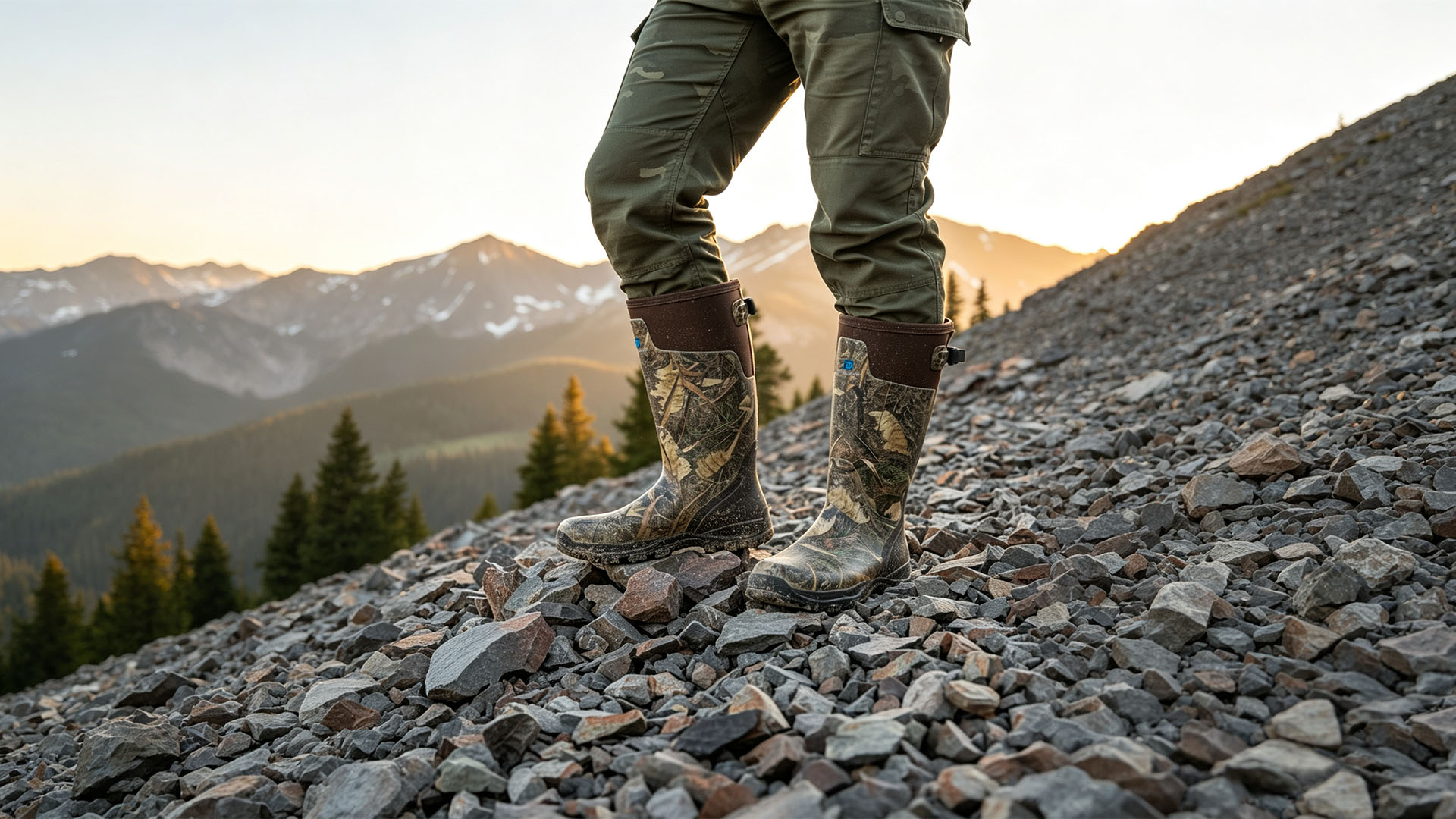
Hunters in these conditions may benefit from waterproof hunting boots for sagebrush mule deer hunting that provide moisture protection, stable traction, and enough comfort for long glassing-and-stalking days.
Boot height should match vegetation and terrain.
In wet sage, the waterproof system should include both boots and lower-body protection so water does not enter from above.
Mud Can Make Western Roads Dangerous
Rain can turn dry two-track roads into slick clay.
A road that looks harmless when dry may become nearly impassable after a storm.
Driving wet roads can damage public or private land and create deep ruts.
Before committing to a road, consider:
- Soil type
- Slope
- Distance to turn around
- Weather forecast
- Land-management restrictions
- Vehicle capability
- Recovery options
- Whether walking is smarter
Do not let a truck problem ruin a hunt or damage access for others.
Footwear Must Handle More Than Mud
Mule deer hunting in sagebrush country can include many surfaces in one day:
- Clay mud
- Sharp rock
- Wet grass
- Sage flats
- Sandy washes
- Snow patches
- Steep sidehills
- Cattle trails
- Frozen ruts
The best boot is not only waterproof.
It must also provide traction, support, secure fit, and manageable weight.
A heavy boot may feel protective but become tiring during long stalks.
A lightweight boot may feel fast but fail on sharp rock or wet sidehills.
Match the boot to the actual terrain.
Gaiters Can Help in Wet Sage
Gaiters can reduce water, seeds, mud, and debris entering boots.
They also help protect lower pants from wet brush and rough vegetation.
Choose gaiters that are quiet enough for stalking.
Loose straps, stiff fabric, or noisy buckles can create unnecessary sound.
Test the full setup before the hunt.
Do not discover on a stalk that your gear sounds like plastic scraping on brush.
Glassing Comfort Matters
A mule deer hunter may spend more time sitting behind optics than walking.
Wet ground, cold wind, and damp clothing reduce patience.
Carry a small seat pad, dry layer, or rain protection when conditions require it.
The hunter who stays comfortable can glass longer and more carefully.
The hunter who is cold, wet, and restless begins moving too soon.
In mule deer country, impatience often saves the deer.
Midday Glassing Can Be Productive
Many hunters glass hard at sunrise and sunset, then quit during the middle of the day.
Mule deer may bed during midday, but they are still findable.
Rain and cloud cover can extend movement or make deer more visible in open draws.
During midday, glass bedding areas:
- Shaded side draws
- Brushy benches
- Juniper pockets
- Rock outcrops
- North-facing slopes
- Small cuts below ridges
- Protected basins
A bedded buck may stand only once to stretch, feed briefly, or change position.
If you are not watching, you miss him.
Do Not Rush the Stalk
Finding a buck creates excitement.
A rushed stalk often fails.
Before moving, study:
- Wind
- Thermals
- Bedding position
- Possible unseen deer
- Route options
- Land ownership
- Distance
- Time remaining
- Shooting position
- Exit route
Mark the buck’s location carefully.
From a new angle, the hillside may look completely different.
Pick landmarks above, below, and beside the deer.
A single bush that looks obvious through the spotting scope may disappear once you begin moving.
Watch for Other Deer
A bedded buck is rarely the only animal that can ruin the stalk.
Does, smaller bucks, pronghorn, cattle, or other wildlife may be between you and the target.
Before starting, glass the full route.
Unseen animals can alert the buck before you reach range.
Move as if the entire basin has eyes.
Because it often does.
Use Terrain Folds
The best stalks use small terrain folds.
In sagebrush country, these may be subtle.
A low ridge, dry wash, shallow depression, or brushy roll can hide most of your body.
Study the land from the glassing point and imagine the stalk at deer-eye level.
Avoid crossing open slopes when a longer hidden route exists.
A longer stalk with cover is better than a short stalk in plain view.
Crawl Only When It Helps
Crawling through sage, rock, and mud is exhausting.
It can also create noise and expose movement if done at the wrong time.
Crawl only when needed for the final approach.
Protect the firearm or bow from mud and debris.
Keep optics secure.
Watch cactus, sharp rocks, and thorny plants.
Move when the deer’s head is down, blocked by brush, or facing away.
Patience beats speed.
Rain Can Erase Blood Sign
If a shot is taken during or before rain, recovery can become more difficult.
Blood may wash into soil, spread on wet vegetation, or disappear in muddy ground.
Before shooting, consider:
- Rain intensity
- Distance to thick cover
- Terrain
- Light remaining
- Shot angle
- Recovery route
- Property boundaries
- Help available
Ethical shot selection matters even more when weather can reduce tracking sign.
Mark the location carefully.
Do not rely on memory alone.
Mark Everything After the Shot
Immediately mark:
- Your shooting position
- The deer’s position at the shot
- Last visible location
- Direction of travel
- First blood
- Tracks
- Landmarks
- Nearby draw or ridge features
Use a map, GPS, or visible reference where legal and appropriate.
Sagebrush country looks repetitive during recovery.
A ridge that seemed obvious before the shot may look like every other ridge afterward.
Meat Care Still Matters in Cool Weather
Rain and cool air can help with temperature, but they do not replace proper field care.
Mud, wet vegetation, and dust can contaminate meat.
Prepare:
- Game bags
- Sharp knives
- Gloves
- Clean working method
- Pack system
- Cooling plan
- Knowledge of evidence-of-sex and tagging rules
Western hunts can require long pack-outs.
Plan before the shot, not after.
Public Land Pressure Changes Deer Behavior
Mule deer on public land learn where hunters glass, park, hike, and stalk.
After opening week, bucks may shift into less obvious cover.
Look for places hunters avoid:
- Small basins near roads but hidden from them
- Brushy draws with poor visibility
- Sidehills requiring awkward access
- Pockets behind popular glassing points
- Areas beyond muddy roads
- Low ridges overlooked by hunters seeking high country
Distance helps only when it reduces real pressure.
Sometimes overlooked cover close to access holds deer because everyone walks past it.
Private Boundaries Must Be Respected
Mule deer cross public and private land freely.
Hunters cannot.
Before beginning a stalk, confirm:
- Land ownership
- Access route
- Where the deer is bedded
- Where it may run
- Recovery permission if needed
- Fence lines
- Road rights
- Special access rules
Do not start a stalk that depends on crossing property you do not have permission to enter.
Mapping tools are helpful but not perfect.
Use current official access information and posted signs.
Regulations Must Be Checked Locally
Mule deer seasons and rules vary widely by state, unit, weapon type, tag, and land status.
Before hunting, verify:
- Season dates
- Tag requirements
- Unit boundaries
- Antler restrictions
- Legal weapon
- Hunter-orange requirements
- Public-land closures
- Motorized access rules
- Chronic wasting disease rules where applicable
- Tagging and reporting requirements
- Meat salvage rules
- Evidence-of-sex requirements
Use current official wildlife-agency information.
Do not rely on old articles, forum posts, or another hunter’s memory.
Common Sagebrush Mule Deer Hunting Mistakes
Treating Sagebrush Country as Empty
Small draws, benches, and brush pockets can hide deer.
Walking Before Glassing Enough
Movement exposes hunters in open country.
Ignoring Rain-Fresh Tracks
Mud after rain can reveal current travel routes.
Focusing Only on Water
Rain may create temporary moisture and change water patterns.
Looking for Whole Deer
Search for ears, antlers, legs, and small movement.
Starting a Stalk Too Quickly
Study wind, thermals, route, and unseen animals first.
Wearing Poor Footwear
Wet sage, mud, rock, and sidehills demand waterproof protection, traction, and secure fit.
Driving Wet Roads Carelessly
Rutting roads damages access and can leave you stuck.
Forgetting Recovery Conditions
Rain and sagebrush can make tracking difficult.
Frequently Asked Questions
Where do mule deer bed in sagebrush country?
They often bed in shallow draws, brush pockets, small benches, juniper edges, rock shadows, and terrain folds that provide wind advantage, shade, visibility, and escape routes.
Is mule deer hunting good after rain?
It can be. Rain softens ground, reveals fresh tracks, quiets stalking conditions, and may create short-lived green-up in draws and low pockets.
How do you glass mule deer in sagebrush?
Glass slowly from a concealed position. Focus on shade, brush edges, small terrain folds, rock outcrops, and pieces of deer rather than full bodies.
Do mule deer use draws?
Yes. Draws provide concealed travel, bedding pockets, forage, wind protection, and routes between basins.
What boots are best for sagebrush mule deer hunting?
Choose waterproof boots with secure fit, reliable traction, and enough support for mud, wet sage, rock, sidehills, and long glassing-and-stalking days.
How do you stalk mule deer in open sage?
Use terrain folds, wind, patience, and landmarks. Avoid skylining yourself, watch for other deer, and move only when the animal cannot see you.
Final Thoughts
Sagebrush mule deer hunting is a game of subtle details.
A shallow draw.
A shaded bush.
A fresh track in clay.
A small bench below a ridge.
A buck bedded behind a brush clump that looked too small to matter.
Rain helps reveal those details, but only to hunters who slow down enough to read them.
Do not rush across open country.
Glass from distance.
Study the draws.
Check muddy crossings.
Watch the shade.
Use terrain before using your legs.
Protect your feet from wet sage, mud, and sharp rock.
And when you finally spot a buck bedded in a place that looked empty for the first two hours, remember the lesson:
Sagebrush country is rarely empty.
It is just better at hiding deer than most hunters are at finding them.
