
Fresh snow can make bobcat country look easier to understand.
A clean line of round tracks crosses a logging road, disappears into thick timber, and reappears near a frozen creek. The prints are sharp, the snow around them is undisturbed, and the trail appears to lead directly into huntable cover.
It is tempting to assume the cat is only a few hundred yards ahead.
That assumption can send a hunter on a long walk through empty woods.
Bobcats can cover surprising distances during a single hunting period. A track that looks fresh may have been made several hours earlier, and a cat traveling steadily may already be miles away.
Successful snow tracking is not simply following footprints.
It requires hunters to judge freshness, recognize changes in movement, identify hunting behavior, understand terrain, and decide when the trail is becoming more promising—or when it is leading nowhere.
Why Snow Is So Valuable for Bobcat Hunters
Bobcats are difficult to observe directly.
They move quietly.
Use thick cover.
Travel during low-light periods.
Often remain motionless when danger approaches.
Without snow, hunters may never realize a cat is using the property.
Snow records movement across:
- Logging roads
- Creek crossings
- Field edges
- Rocky ridges
- Brushy drainages
- Frozen wetlands
- Clear-cut boundaries
A single trail can reveal direction, travel speed, hunting behavior, and habitat preferences.
The challenge is learning to interpret that information correctly.
Learn What Bobcat Tracks Look Like
Bobcat tracks are generally round and compact.
The front tracks are often slightly larger than the rear tracks. Four toes usually appear, and claw marks are commonly absent because cats retract their claws while walking.
The heel pad often shows a broad shape with multiple lobes.
Size varies by animal, snow conditions, and the way the track was made.
Soft snow can make a track appear much larger than the cat’s actual foot.
Hard snow may preserve only part of the print.
Hunters should avoid identifying an animal based on one imperfect track.
Study several tracks in sequence.
Bobcat Tracks vs. Coyote Tracks
Bobcat and coyote trails can be confused when snow conditions are poor.
Coyote tracks tend to look more oval.
Bobcat tracks are usually rounder.
Coyotes commonly leave visible claw marks, while bobcats often do not.
The overall trail pattern also helps.
Coyotes frequently travel with a direct, efficient stride. Bobcats may move in a similarly purposeful way, but their trail can show more frequent investigation of brush, rocks, logs, and cover edges.
When uncertain, follow the trail far enough to find a clearer print.
Do not build a hunting strategy around an identification you are not confident about.
Freshness Is More Complicated Than Sharp Edges
A sharply defined track looks fresh.
Sometimes it is.
Cold, calm conditions can preserve tracks for hours or even longer. Wind, sunlight, temperature changes, and additional snowfall all affect how quickly a track ages.
Evaluate the complete trail.
Fresh signs may include:
- Loose snow pushed outside the print
- Sharp edges
- Snow still falling into depressions
- Recent disturbance on vegetation
- Tracks crossing newer animal trails
- Clean impressions without frost inside them
Older tracks may appear rounded, windblown, partially filled, or covered by new snow.
Compare the bobcat trail with your own tracks.
Return after several minutes and observe how quickly the edges change under current conditions.
A Fresh Track Does Not Mean the Cat Is Nearby
Bobcats can travel several miles while hunting or moving between cover areas.
A trail made before daylight may still look excellent after sunrise.
The cat may already be far ahead.
Before following aggressively, study the movement pattern.
Is the trail straight and purposeful?
Does it cross open ground without hesitation?
Does it follow a road or ridge for a long distance?
These signs may indicate a traveling cat.
A trail that slows, circles cover, approaches logs, checks brush piles, or investigates rocky openings may indicate active hunting.
That behavior gives the hunter a better chance of gaining ground.
Traveling Tracks vs. Hunting Tracks
Recognizing the difference is one of the most important snow-tracking skills.
Traveling Tracks
A traveling bobcat often moves efficiently.
The trail may:
- Follow a relatively straight line
- Use logging roads
- Cross open ground
- Stay on a ridge or bench
- Maintain a consistent stride
- Ignore smaller pieces of cover
A cat traveling steadily can remain difficult to catch.
Hunting Tracks
A hunting bobcat may move differently.
The trail may:
- Enter thick brush
- Circle fallen trees
- Check rock piles
- Follow rabbit trails
- Pause near logs
- Change direction frequently
- Explore creek banks
- Approach field edges
A hunting cat is spending time.
That gives the hunter an opportunity to close the distance or identify a likely calling location.
Watch the Stride Length
Stride length can provide clues about speed.
Long, evenly spaced tracks often indicate purposeful travel.
Shorter steps and frequent direction changes suggest slower movement.
A sudden increase in stride length may indicate the cat chased prey, crossed an exposed area quickly, or reacted to disturbance.
Do not rely on stride alone.
Combine it with terrain and trail behavior.
Look for Places Where the Cat Stopped
A bobcat may pause to listen, watch, or prepare an ambush.
Look for:
- Multiple tracks in one location
- A depression where the cat sat
- Tracks turning toward open ground
- Snow disturbed near a log or rock
- A short side trail ending at cover
- Prints beneath an overhanging branch
These locations reveal how the cat uses the landscape.
They can also identify productive calling setups for future hunts.
Follow the Habitat, Not Every Footprint
A bobcat trail may disappear when snow becomes thin, windblown, or covered by vegetation.
Do not panic.
Look ahead at the terrain.
Ask where the cat is likely to travel next.
Common routes include:
- Creek bottoms
- Brushy draws
- Timber edges
- Rock ledges
- Logging roads
- Saddles
- Beaver ponds
- Field borders
- Young clear-cuts
Move toward the next logical habitat feature and search for the trail again.
Creek Bottoms Are Natural Travel Corridors
Creek systems provide multiple advantages to bobcats.
They contain thick cover.
Concentrate prey.
Create travel edges.
Offer exposed banks where tracks are easy to see.
Bobcats may follow frozen creek edges, cross at narrow points, or move along elevated banks.
Pay attention to:
- Rabbit tracks
- Rodent activity
- Brush piles
- Fallen trees
- Rock outcrops
- Beaver dams
A creek with both prey and security cover can become a consistent travel corridor.
Clear-Cuts Can Hold Prey and Cover
Young clear-cuts often contain dense regeneration.
Rabbits, mice, grouse, and other potential prey may use the same habitat.
Bobcats may travel the edges or enter through logging roads and skid trails.
Fresh snow helps hunters identify which openings receive current use.
Do not walk directly into the thickest cover without a plan.
Study likely exit routes and nearby openings first.
Rock Ledges Deserve Attention
Rocky terrain provides:
- Denning cover
- Vantage points
- Protected resting locations
- Travel edges
- Habitat for small prey
Bobcats may move along the base of cliffs or use narrow ledges.
Snow can be thin around exposed rock, causing tracks to disappear.
Search where the trail reenters snow.
Use binoculars to check ledges and openings before moving closer.
Rabbit Sign Makes a Trail More Interesting
Bobcats follow food.
A trail crossing heavy rabbit activity deserves attention.
Look for:
- Multiple rabbit tracks
- Feeding areas
- Brush piles
- Young timber
- Briar patches
- Tracks entering thick cover
A bobcat repeatedly checking these areas may remain in the general location longer than one simply traveling through.
The presence of prey does not guarantee the cat is nearby, but it improves the habitat’s long-term potential.
Scat and Scrapes Confirm Regular Use
Tracks show one trip.
Other sign may indicate repeated use.
Bobcat scat is often segmented and may contain hair, bone, or other prey remains. Cats may leave scat along trails, logging roads, or elevated objects.
Bobcats can also create scrapes by raking the ground and depositing scent.
Do not disturb these locations unnecessarily.
Mark them on a map.
A trail intersection with repeated sign can become a productive calling area later.
Decide Whether to Follow or Set Up
Hunters do not always need to stay directly on the trail.
Sometimes the better decision is using the track to locate a calling position.
Consider setting up when:
- The cat entered thick cover
- Tracks indicate active hunting
- The wind is favorable
- You can see likely approaches
- Continuing would create too much noise
- The trail enters difficult terrain
- You have identified a natural travel corridor
Following every track may alert the cat before you see it.
Use the trail to predict movement rather than treating it as a path you must walk from beginning to end.
Choose Calling Locations With Downwind Visibility
Bobcats often approach quietly.
Unlike coyotes, they may not circle as widely, but they still use their noses and cover.
Select a location that offers:
- A safe shooting direction
- Visibility into likely cover
- A downwind view
- Concealment behind the hunter
- A quiet access route
Avoid sitting directly on the trail.
Move off to the side where you can watch likely approaches without blocking the animal’s natural path.
Call Longer Than You Would for Coyotes
Bobcats may approach slowly.
They can stop and watch for extended periods.
A short stand may end before the cat arrives.
Many hunters remain on bobcat stands longer than typical coyote setups.
Patience is important.
Scan constantly.
Look for small movements along the edge of cover.
An ear, face, or patch of spotted fur may be the only part of the animal visible.
Use Realistic Sound and Volume
Excessive volume is not always necessary.
A bobcat may already be close.
Common predator-calling sounds imitate:
- Rabbits
- Rodents
- Birds
- Distressed small animals
Start at moderate volume.
Allow pauses.
Avoid constant movement while operating calls.
Electronic calls can help move the sound source away from the hunter where legal.
Always follow local regulations.
Visual Attraction Can Help
Bobcats are visually curious.
A small moving decoy may hold attention and guide the cat’s focus away from the hunter.
Place decoys where:
- They are visible from likely approaches
- The hunter has a safe view
- The movement looks natural
- The setup does not expose excessive human scent
Do not place a decoy where it creates unsafe shooting conditions or conflicts with local laws.
Wind Still Matters
Bobcats depend heavily on smell.
The wind may also shift through mountain terrain, creek bottoms, and dense timber.
Check conditions regularly.
Do not assume the wind at the truck matches the wind at the calling location.
Cold air settles into drainages.
Sunlight can create rising thermals.
Use a wind indicator during the setup.
Snow Makes Human Movement Easier to Detect
Fresh snow records the hunter’s trail too.
Every step leaves disturbance.
Crunchy snow can create significant noise.
Avoid walking directly through the cover where you expect the cat to approach.
Use logging roads, terrain, and wind to plan access.
Stop frequently.
Listen.
A bobcat may remain still rather than immediately running.
Winter Footwear Affects How Long You Can Track
Bobcat tracking often becomes an all-day activity.
Hunters may cross snow, frozen mud, shallow creeks, steep sidehills, brushy drainages, and thawing ground during the same hunt.
Footwear must support both warmth and movement.
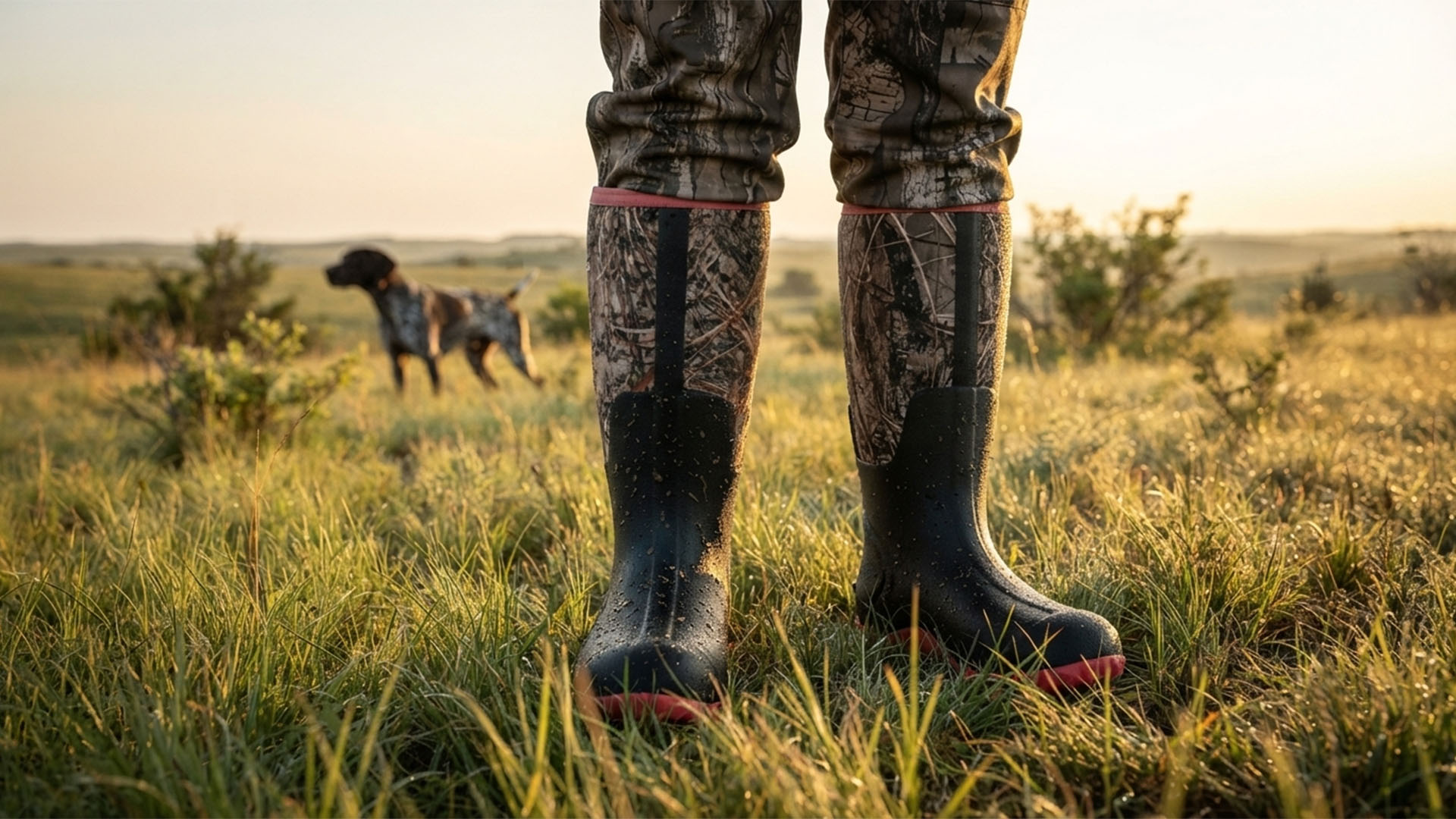
Hunters covering these conditions may benefit from waterproof hunting boots for winter predator hunting that provide dependable traction, secure heel retention, and enough insulation for the temperature without causing excessive sweat during long walks.
A boot designed only for stationary cold-weather hunting may feel too heavy for active tracking.
Match insulation and weight to your actual hunting style.
Carry Spare Socks
Snow can enter over the top of boots.
Feet can also become wet from sweat.
A dry pair of socks stored in a waterproof bag can improve comfort during long hunts.
Change socks before the feet become extremely cold.
Avoid cotton because it absorbs moisture and dries slowly.
Use a sock system compatible with the boots and temperature.
Watch for Ice Beneath Snow
Snow can hide:
- Frozen puddles
- Slick rocks
- Logs
- Holes
- Creek edges
- Steep drop-offs
Do not stare at the tracks so intensely that you stop watching the terrain.
Use shorter steps.
Carry trekking poles when appropriate.
Slow down near creeks, ledges, and steep slopes.
Protect Electronics and Emergency Gear
Winter predator hunts may take hunters far from easy access.
Protect:
- Phone
- GPS device
- Spare batteries
- Fire-starting equipment
- Extra clothing
- First-aid supplies
- Vehicle keys
Cold reduces battery performance.
Use waterproof storage.
Carry a backup navigation method.
Tell someone where you are hunting and when you expect to return.
Avoid Pushing a Cat Across Property Boundaries
Bobcat trails may cross multiple properties.
Know the boundary before following.
Do not assume a visible trail gives permission to continue onto private land.
Use mapping tools and posted signs.
Obtain permission before crossing.
If the trail leaves legal hunting ground, mark the location and use the information for future scouting.
Regulations Vary Widely
Bobcat seasons, licenses, tagging requirements, legal methods, and possession rules vary by state.
Some locations have limited seasons or special permits.
Others may restrict electronic calls or hunting hours.
Always verify current regulations through the responsible state wildlife agency before hunting.
Never rely entirely on older articles or another hunter’s experience.
Common Bobcat Snow-Tracking Mistakes
Assuming Sharp Tracks Mean the Cat Is Close
Cold weather can preserve tracks for hours.
Following a Traveling Cat Too Long
A straight, fast trail may lead miles away.
Looking Only at Individual Prints
Study movement patterns and habitat.
Walking Directly on the Trail
Stay to the side and protect the sign.
Calling for Too Little Time
Bobcats may approach slowly and silently.
Ignoring Downwind Cover
A cat can appear where the hunter cannot see it.
Tracking Without Watching Terrain
Snow hides ice, holes, and steep banks.
Forgetting Property Boundaries
Know where legal access ends.
Frequently Asked Questions
How can you tell whether bobcat tracks are fresh?
Look at edge sharpness, loose snow, weather changes, wind exposure, snow inside the track, and where the trail crosses newer animal or human tracks.
How far can a bobcat travel in one night?
Bobcats can cover several miles depending on food, season, territory, and individual behavior. A fresh-looking trail does not guarantee the animal remains nearby.
What do bobcat tracks look like in snow?
Bobcat tracks are generally round, show four toes, and often lack visible claw marks. Snow conditions can make tracks appear larger or less distinct.
Where should you look for bobcats in winter?
Focus on creek bottoms, brushy draws, clear-cut edges, rock ledges, rabbit habitat, logging roads, and terrain offering both prey and security cover.
Should you follow bobcat tracks or use a predator call?
Both approaches can work. Tracks can lead hunters toward active cover, while calling may be more effective when continuing on the trail would create noise or push the cat.
How long should you call for a bobcat?
Bobcats may approach more slowly than coyotes. Many hunters remain at a promising calling location longer while watching carefully for a silent approach.
Final Thoughts
Fresh snow makes bobcats easier to locate.
It does not make them easy to catch.
A sharp track can be several hours old.
A traveling cat can stay miles ahead.
A hunting cat may circle thick cover, check rabbit trails, and spend enough time in one area to create an opportunity.
Learn to recognize the difference.
Study stride length.
Watch for direction changes.
Identify prey-rich habitat.
Use tracks to predict where the cat is going rather than following every print without a plan.
When the trail enters promising cover, consider setting up and calling.
Watch the wind.
Remain patient.
Scan for small movements.
And protect yourself from winter conditions during long tracking days.
The most successful snow trackers are not the hunters who walk the fastest.
They are the hunters who understand what the trail is telling them before taking the next step.
