
Introduction: The Overlooked Hunter
Walk through any hunting expo, and the message is clear—at least, it’s clear who the industry thinks is buying the gear. The boots are built on men’s lasts. The camouflage patterns are sized for male frames. The marketing photos feature square-jawed men glassing for elk or hauling whitetails out of the timber. Yet according to the National Shooting Sports Foundation, women are the fastest-growing demographic in hunting, making up nearly 20% of all new hunters. They’re not just accompanying partners anymore. They’re leading the hunt.
But here’s the problem that every female hunter learns within her first season: a boot built for a man’s foot doesn’t fit a woman’s foot. It’s not about size. It’s about shape. A man’s boot, even in a smaller size, has a wider heel, a higher instep, and a different arch profile. When a woman wears a unisex boot, her heel slips with every step. Her arch gets no support. Her toes are forced to curl and grip the footbed just to keep the boot stable. On a long stalk or a freezing sit, that’s not a comfort problem—it’s a hunt-ending problem.
Trudave Gear has quietly addressed this with a hunting boot lineup that, while not explicitly labeled “women’s,” offers specific models and features that work exceptionally well for female hunters. The flexible neoprene uppers, the removable EVA insoles, the intentional sizing that accommodates thick socks, and the option to build a customized fit with aftermarket insoles—these features make the WildGuard and TrailGuard series uniquely adaptable to a woman’s foot. This guide is for the female hunter who’s tired of squeezing into men’s boots. We’ll walk through the specific fit challenges women face, which Trudave boots work best for different foot types and hunting styles, how to dial in the perfect fit with socks and insoles, and what real female hunters are saying about their Trudave boots.
Part 1: The Female Foot — Why “Unisex” Doesn’t Work
The differences between men’s and women’s feet are significant and well-documented in biomechanics research. Women generally have narrower heels relative to the forefoot, a higher arch relative to foot length, and a lower overall foot volume. A boot built on a men’s last—the foot-shaped mold around which the boot is constructed—will have a heel cup that’s too wide, causing the heel to lift with every step. That heel lift creates friction, and friction creates blisters. The too-wide heel also forces the toes to grip the insole for stability, leading to arch fatigue and cramping over hours of wear.
The higher arch common in women’s feet requires more targeted support. A unisex boot with a generic arch profile will either leave high arches unsupported (leading to plantar fascia pain) or will press uncomfortably against flatter arches. And because women’s feet typically have less overall volume, a unisex boot can feel cavernous even when the length is correct.
Trudave doesn’t produce a separate “women’s line” of hunting boots, but their design choices make their boots far more adaptable to female feet than the typical unisex offering. The neoprene uppers on the WildGuard and TrailGuard stretch to accommodate different foot shapes and widths. The removable EVA insoles can be swapped for women’s-specific aftermarket insoles that provide the right arch support. And the intentional extra volume—which is designed to accommodate thick socks—can be managed with the right sock system to achieve a snug, secure fit without the sloppiness that plagues women in men’s boots.
The TrailGuard and WildGuard also share features that benefit female hunters beyond fit: a lightweight EVA midsole that reduces fatigue, a self-cleaning outsole that grips on uneven terrain, and 100% waterproof vulcanized rubber construction that doesn’t require a break-in period. There’s no stiff leather to soften, no heavy steel shank to weigh you down. They’re ready to hunt right out of the box.
Part 2: Which Trudave Boot Is Right for Your Hunt?
Not all female hunters need the same boot. Your choice depends on your hunting style, your climate, and your foot type.
The Stand Hunter: TrailGuard Series
If you’re a whitetail hunter who walks a moderate distance to a tree stand or ground blind and then sits motionless for hours in freezing temperatures, the TrailGuard is your boot. It features a 5mm neoprene upper with a fleece liner—a dual-layer insulation system designed for maximum static warmth. When you’re sitting still and your circulation slows, your body stops generating the heat that keeps your feet warm. The TrailGuard’s insulation takes over that job.
The neoprene upper stretches to accommodate different calf sizes and foot widths, which is a significant advantage for women who find men’s boots too stiff and unyielding. The fleece liner is soft against the skin and wicks moisture outward, preventing the cold, clammy feeling that develops when sweat cools against your foot. One female hunter who tested the TrailGuard in single-digit temperatures reported that her feet “stayed warm and comfortable through a four-hour sit, which is something I’ve never experienced before with insulated leather boots.”
The TrailGuard’s vulcanized rubber lower is completely waterproof and scent-free—rubber is non-porous, so it doesn’t absorb or release human odor. For the stand hunter walking the same entry path every day, that scent reduction matters. The aggressive outsole grips on frozen ground and crusted snow, and the reinforced kick-off heel tab makes removal easy at the end of a long, cold day.
The Mobile Hunter: WildGuard Series
If you’re a spot-and-stalk hunter, a still-hunter, or a spring turkey chaser who covers miles on foot in variable conditions, the WildGuard is your boot. It features the same 5mm neoprene upper as the TrailGuard, but with a breathable liner instead of fleece. This liner manages moisture better during active movement, preventing the sweat buildup that turns cold when you stop.
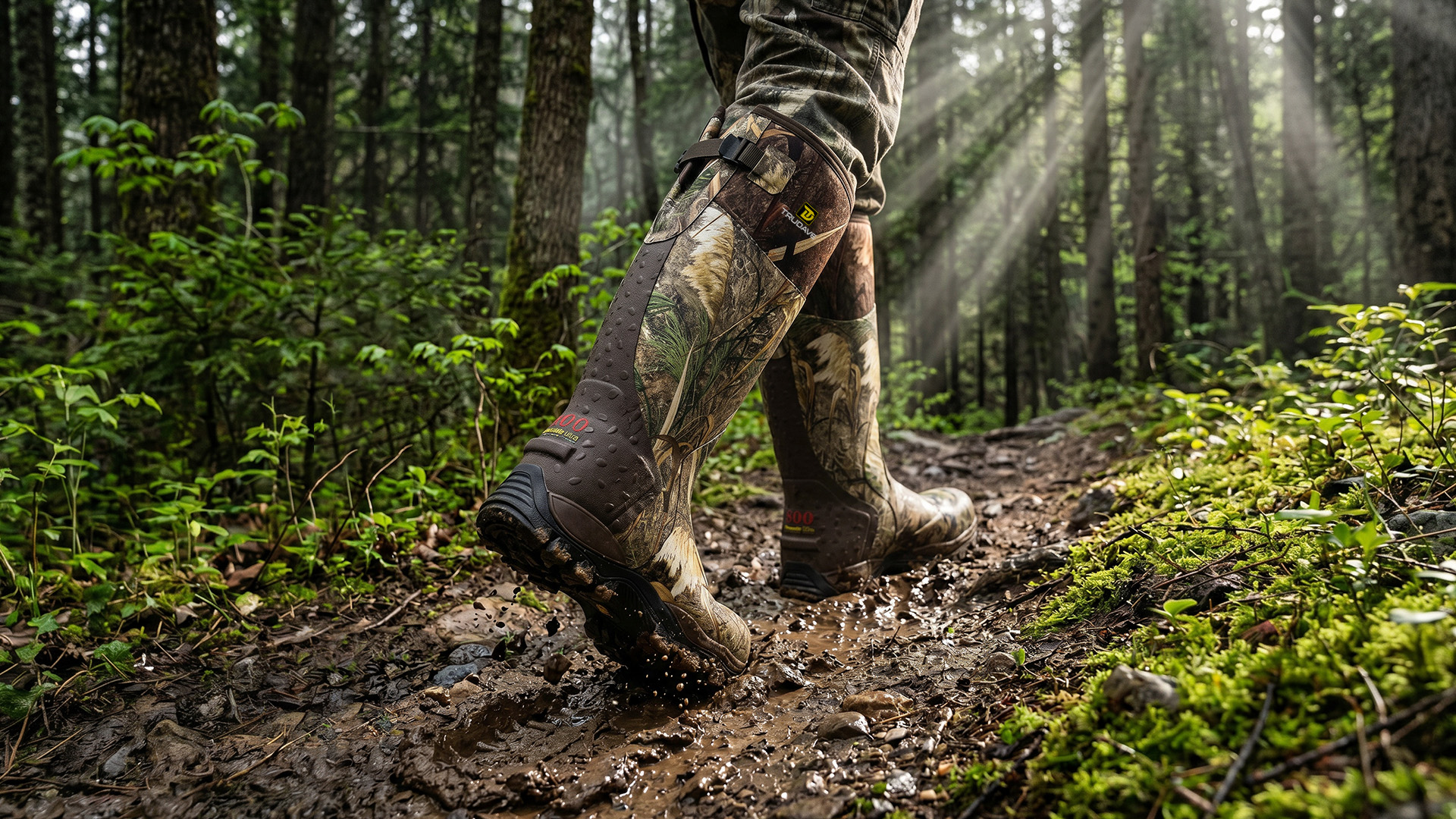
The WildGuard’s camo finish is a functional asset for the hunter who needs to blend into timber, marsh grass, or brush. The deep-lug outsole grips on wet logs, muddy creek banks, and uneven ground—the kind of terrain that defines mobile hunting. The 5mm neoprene provides insulation without overheating during active approaches, making it the right choice for hunts where you’re walking and sitting in roughly equal measure.
For the female hunter with wider feet, the WildGuard’s neoprene upper is particularly accommodating. The material stretches to fit the foot without the painful pinch that comes from rigid rubber or leather. For narrower feet, the extra volume can be filled with thicker socks or a volume-adjusting insole.
The Warm-Weather Specialist: DryFlow Series
For early-season bowhunting, spring turkey, or any hunt where temperatures stay above 45°F and you’re actively moving, the DryFlow is Trudave’s uninsulated option. It’s built from industrial-grade waterproof rubber with a breathable lining and no insulation whatsoever. This is a feature, not a compromise: when your body is generating heat through exertion, insulation traps that heat and causes sweat-soaked feet. The DryFlow lets your body manage its own temperature while keeping external water out.
The DryFlow is the lightest boot in the Trudave hunting lineup, which is a real advantage for female hunters who often carry proportionally more weight relative to their body mass. Every ounce saved on the feet compounds over miles. The structured heel cup locks the foot in place to prevent blisters, and the aggressive cleated outsole sheds mud with each step.
Part 3: Dialing In the Perfect Fit — The Insole and Sock System
The single most important thing a female hunter can do to make a Trudave boot fit perfectly is to use the right insole and sock combination.
Insoles
All Trudave hunting boots come with a removable EVA insole that provides moderate arch support. For many women, this stock insole is adequate. But if you have high arches, the stock insole won’t provide enough support, and your plantar fascia will fatigue over hours of standing or walking. The solution is simple: replace the stock insole with a women’s-specific high-arch aftermarket insole, or upgrade to Trudave’s ToughCush Comfort Insole, which features more pronounced arch support and a deeper heel cup.
If you have flat feet, the stock insole’s arch support may feel intrusive. Replace it with a flatter, more cushioned aftermarket insole. The boot’s generous interior volume accommodates these swaps without making the fit too tight.
For narrow feet, a thicker insole—whether the ToughCush or an aftermarket orthotic—takes up extra volume inside the boot, improving heel lock and overall fit.
Socks
Sock thickness is the easiest variable to adjust. Trudave boots are intentionally built with extra volume for thick insulating socks. This is why they “run slightly large” in reviews—and it’s a feature you can use to your advantage.
For cold-weather stand hunting with the TrailGuard, wear a two-layer sock system: a thin synthetic moisture-wicking liner sock against the skin, and a heavyweight merino wool outer sock. This combination fills the boot’s volume, maximizes insulation, and manages moisture.
For active hunting with the WildGuard, a single midweight merino wool sock usually provides the right balance of warmth and moisture management. If your feet are narrow, step up to a heavyweight sock even in moderate temperatures to fill the extra volume.
For warm-weather hunting with the DryFlow, a lightweight merino or synthetic sock keeps feet cool and dry. The boot will feel roomier, which is appropriate for hot days when feet swell.
Never wear cotton socks. Cotton absorbs moisture, collapses into a cold, wet cloth, and actively accelerates both heat loss and blister formation.
Heel Grips
If you’ve tried thicker socks and a thicker insole and still experience heel slip, a simple adhesive heel grip—about $7 at any drugstore—applied to the inside back of the boot shaft can solve the problem entirely. This is a common fix for women with narrow heels in unisex boots.
Part 4: Real Female Hunters, Real Feedback
The best validation of a boot’s performance comes from the women who wear it in the field. While Trudave’s Trustpilot reviews don’t always identify the gender of the reviewer, patterns emerge from female hunters who have shared their experiences.
One female bowhunter who switched to the WildGuard after years of wearing men’s leather boots reported: “I didn’t realize how much I was compensating until I put these on. The neoprene upper flexes with my foot instead of fighting it, and I can kneel and bend without the boot digging into the back of my calf. My feet were dry and comfortable through a full day of spot-and-stalk in wet conditions.”
Another hunter, a whitetail stand hunter in the Upper Midwest, tested the TrailGuard during a late-season cold snap: “I’ve always had trouble with cold feet—I’d be climbing down by 9 a.m. with numb toes no matter what boots I wore. The TrailGuards kept me in the stand until noon in single-digit temperatures. The fleece liner is warm without being bulky, and the boot is lighter than my old insulated leather boots.”
A spring turkey hunter who covers miles of ridges and creek bottoms noted: “The DryFlow is the first hunting boot I’ve worn that doesn’t feel like a brick on my foot. It’s light, flexible, and my feet don’t sweat through the morning. I pair them with lightweight merino socks, and they’re perfect for the active, warm-weather hunting I do.”
The consistent theme across these accounts is that a boot built with flexible, adaptable materials—neoprene, EVA, removable insoles—can be dialed in to fit a female foot in a way that rigid leather and unisex lasts cannot.
Part 5: Care and Longevity
Trudave boots are built to last, but only if you treat them right. The care protocol is simple and takes two minutes after each hunt. Rinse off mud and debris with clean water. Use a mild soap and soft brush for stubborn grime. Remove the insoles and let them dry separately. Air-dry the boots at room temperature, away from direct sunlight and heat sources—heat is the enemy of vulcanized rubber, breaking down the polymer cross-links that give it strength and flexibility.
Store boots upright in a cool, dark, dry place. Never fold or crumple them, which creates permanent weak points that eventually crack. Condition the rubber exterior with a silicone-free rubber conditioner every couple of months during heavy use to maintain flexibility and waterproof integrity.
With proper care, a pair of Trudave hunting boots can last five or more seasons. For the female hunter who’s investing in gear that works, that kind of longevity makes the direct-to-consumer price an even better value.
Part 6: The Decision Framework
| Your Hunting Style | Your Foot Type | Best Trudave Boot | Key Adjustment |
|---|---|---|---|
| Stand hunting, cold temps | Narrow heel, high arch | TrailGuard | ToughCush insole + heavyweight merino socks |
| Stand hunting, cold temps | Wide feet, flat arches | TrailGuard | Stock insole or flat aftermarket insole + midweight socks |
| Mobile/stalk hunting, variable temps | Narrow heel, high arch | WildGuard | High-arch insole + midweight to heavyweight socks |
| Mobile/stalk hunting, variable temps | Wide feet | WildGuard | Stock insole (neoprene stretches to accommodate width) |
| Warm-weather active hunting | Any foot type | DryFlow | Lightweight merino socks; add insole for arch support if needed |
This framework is a starting point. The beauty of Trudave’s modular design—removable insoles, generous volume, flexible uppers—is that you can fine-tune the fit until it’s exactly right for you.
Conclusion: A Boot That Fits the Huntress
The hunting industry has been slow to recognize that women are not just smaller men. Our feet are shaped differently. Our hunting styles—while just as serious and demanding—often require gear that adapts rather than forces conformity. Trudave Gear hasn’t marketed a “women’s hunting boot,” but they’ve done something arguably more useful: they’ve built boots with the flexibility, adjustability, and comfort architecture that make them an exceptional fit for the female hunter willing to dial in the right insole and sock combination.
The TrailGuard for the freezing stand sits. The WildGuard for the wet, variable stalks. The DryFlow for the warm, active miles. Each can be customized to fit a woman’s foot with a few simple, inexpensive adjustments—a better insole, the right socks, a heel grip if needed. The result is a boot that performs as hard as you do, without the blisters, the cold feet, or the constant awareness that your gear doesn’t quite fit.
To explore the complete Trudave Gear hunting boot lineup and find the right pair for your next hunt, visit trudavegear.com.
