
Introduction: The Right Tool for the Right Hunt
Walk into any hunting camp, and you’ll hear a dozen opinions on boots. Some guys swear by heavy insulation for those freezing November sits. Others won’t wear anything but lightweight, uninsulated rubber for the early season. The truth is, none of them are wrong—they’re just hunting different ways, in different places, at different times of year. The only real mistake is wearing the wrong boot for the job, and that mistake will make itself known by 9 a.m. on opening day when your feet are either freezing and numb or swimming in sweat.
Trudave Gear has built its 2026 hunting boot lineup around a simple, honest idea: one boot cannot do everything. Instead, they offer three purpose-built series—WildGuard, TrailGuard, and DryFlow—each engineered with a specific material profile for a specific hunting style. No gimmicks. No one-boot-fits-all marketing. Just vulcanized natural rubber, 5mm neoprene, EVA midsoles, and sealed construction, applied differently depending on what you’re asking the boot to do.
This is the complete buyer’s guide. We’ll walk through what makes each Trudave hunting boot unique, who it’s for, and how to build a system that covers your entire season without blowing your budget. If you’re trying to decide between the WildGuard, TrailGuard, and DryFlow—or wondering if you need more than one—this is where you’ll find your answer.
Part 1: The Material Foundation—What Every Trudave Hunting Boot Shares
Before we get into the differences, let’s establish what all three Trudave hunting boots have in common. These shared features are the reason they can compete with boots costing twice as much.
Vulcanized Natural Rubber
Every Trudave hunting boot is built on a foundation of vulcanized natural rubber. Vulcanization—a chemical process discovered by Charles Goodyear in 1839—cross-links rubber polymers at the molecular level, creating a single, continuous, permanently waterproof barrier. There are no glued seams to separate. No stitches to rot. Water does not get in because there is no “in” for it to penetrate. The rubber also provides natural scent control: it is non-porous, so it does not absorb or release human odor.
EVA Midsoles
Instead of the heavy steel shanks found in old-school work boots, Trudave uses EVA (ethylene-vinyl acetate) midsoles—the same shock-absorbing foam found in high-performance running shoes. EVA cushions every step, reduces lower back and knee fatigue, and acts as a thermal break between your foot and the frozen ground. Steel shanks conduct cold; EVA does not. Every Trudave hunting boot has a removable EVA insole, so you can replace it with an aftermarket orthotic or Trudave’s own ToughCush Comfort Insole if you need more support.
Terrain-Specific Outsoles
All three boots have aggressive, self-cleaning outsoles designed to eject mud and debris as you walk. But the tread patterns are different—each engineered for the primary terrain the boot was built to handle. We’ll break those down series by series.
Intentional Sizing for Sock Systems
Trudave boots run slightly large by design. This is not a flaw. It is intentional volume to accommodate the thick wool socks that cold-weather hunting demands. As multiple Trustpilot reviewers have confirmed, “The size is slightly larger, but with socks they fit well and comfortably. A size smaller would be too tight.” Plan to wear thick socks? Order your standard size. Between sizes? Size up for heavy socks, down for light socks.
Part 2: WildGuard Series — The Wet-Terrain Stalker
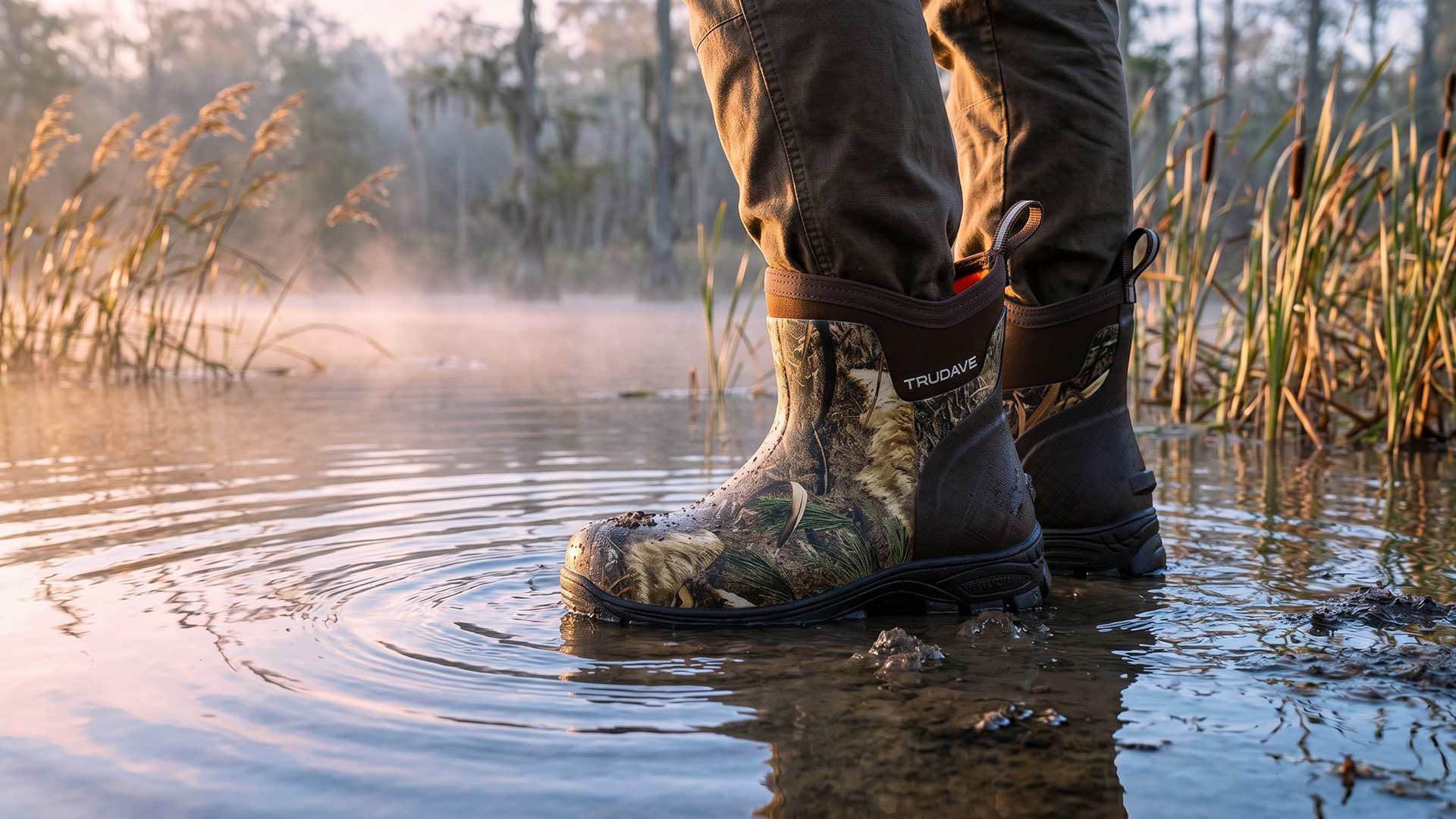
The WildGuard is Trudave’s camouflage hunting boot, built for the hunter whose world is defined by water. Marshes, flooded timber, creek bottoms, wet woods—places where the ground is rarely dry, concealment matters, and you’re as likely to be standing in ankle-deep muck as on solid ground.
Materials and Insulation
The WildGuard features a 5mm neoprene upper bonded to a vulcanized natural rubber lower shell. Neoprene is the same closed-cell foam used in wetsuits—it insulates by trapping millions of air bubbles in its polymer matrix, and it continues to insulate even when wet. The 5mm neoprene provides substantial warmth for cool-to-cold conditions without the bulk of a fleece liner. Inside, a breathable liner wicks moisture away from the skin, preventing the sweat buildup that turns cold the moment you stop moving.
Waterproofing
The vulcanized bond between the neoprene upper and rubber lower is permanent—a chemical fusion at the molecular level. There is no glued seam to separate after repeated submersion. For the hunter who crosses creeks, wades through flooded timber, or sets up in a marsh with standing water, this construction is non-negotiable.
Traction
The WildGuard’s deep-lug outsole is designed to grip on wet logs, mossy rocks, and uneven ground. The lugs are widely spaced to release mud cleanly with each step—a self-cleaning action that prevents the five-pound mud-brick effect. The tread pattern is multi-directional, providing grip whether you’re climbing over a fallen tree or side-hilling above a creek.
Camouflage
The WildGuard’s camo finish is not decorative. It breaks up the boot’s outline against the browns, greens, and grays of marsh grass, reeds, and timber. For the waterfowler who needs concealment from above or the whitetail hunter who needs to disappear against a tree trunk, this is a functional advantage.
Best For:
- Duck and goose hunting in flooded timber and marshes
- Whitetail hunting in wet woods, creek bottoms, and swamps
- Spring turkey hunting in dewy, brushy terrain
- Any hunt where water is the primary obstacle and concealment matters
Pair With: Midweight merino wool socks for most conditions. Heavyweight merino wool socks when temperatures dip below freezing. The breathable liner prevents overheating during active approaches.
Part 3: TrailGuard Series — The Extreme-Cold Stand Hunter
The TrailGuard is Trudave’s maximum-warmth hunting boot. If the WildGuard is a wet-cold specialist, the TrailGuard is a deep-cold specialist, built for the hunter who sits motionless for hours in single-digit temperatures and needs insulation that works when the body isn’t generating heat.
Materials and Insulation
The TrailGuard shares the WildGuard’s 5mm neoprene upper and vulcanized rubber lower, but it adds a fleece liner on top of the neoprene. This dual-layer insulation system is engineered specifically for static warmth—the kind you need when you’re not moving, your circulation has slowed, and your body is generating minimal heat. The neoprene traps body heat in its closed-cell foam structure. The fleece provides immediate warmth against the skin and wicks moisture outward, preventing the cold, clammy feeling that develops when sweat cools against your foot.
In field conditions, this insulation has been validated at the extremes. One reviewer reported walking over a mile in -8°F weather and their feet “stayed warm and comfortable the entire time—even during the early morning hours when temperatures bottomed out.”
Waterproofing
Like the WildGuard, the TrailGuard is fully waterproof with vulcanized construction. The fleece liner does not compromise the waterproof barrier. Water stays out. Seams do not separate.
Traction
The TrailGuard’s outsole is built for frozen, mixed winter terrain. The deep lugs are designed to bite into crusted snow and frozen mud, and the self-cleaning tread spacing sheds the chunky, half-frozen debris that accumulates during late-season approaches. A reinforced kick-off heel tab allows hands-free removal when you’re exhausted and the boots are caked in frozen mud.
Stealth
The TrailGuard is designed for long sits and stealthy approaches. The rugged outsole grips firmly for a stable, quiet stride. The reinforced rubber shell shields against sharp roots and rocks, while the lightweight construction keeps every step silent and fluid.
Best For:
- Late-season whitetail stand hunting in sub-freezing temperatures
- Frozen-marsh duck hunting when the water is ice and the air is bitter
- Predator hunting from stationary positions in extreme cold
- Any hunt where you spend more time sitting than walking and the temperature is below 25°F
Pair With: A two-layer sock system for the coldest conditions—a thin synthetic moisture-wicking liner sock against the skin, and a heavyweight merino wool outer sock for maximum insulation.
Part 4: DryFlow Series — The Active, High-Mileage Hunter
The DryFlow is Trudave’s uninsulated hunting boot, and its philosophy is simple: when your body is a furnace, insulation is the enemy. Built for the hunter who generates heat through continuous movement—spot-and-stalk, still-hunting, scouting, and warm-weather seasons—the DryFlow focuses entirely on keeping water out and letting your body manage its own temperature.
Materials and Construction
The DryFlow is made from industrial-grade waterproof rubber with vulcanized sealed seams. There is no neoprene shaft, no fleece liner, and no insulation of any kind. This is not a cost-saving measure—it is a deliberate engineering choice. Insulation in an active, warm-weather boot traps heat that your body is trying to shed, leading to sweat-soaked socks, blisters, and feet that become dangerously cold the moment you stop moving.
Comfort and Fit
The DryFlow features a structured heel cup that locks the foot in place, preventing the “heel slip” that causes friction blisters on long descents. The EVA midsole provides shock absorption and arch support without the weight of a steel shank. Because there’s no insulation, the boot is noticeably lighter than the TrailGuard or WildGuard—a critical advantage when every ounce compounds over miles.
Traction
The DryFlow’s aggressive cleated outsole is designed to push mud out with every step for constant ground contact. The non-slip, oil-resistant rubber compound grips confidently on wet rock, gravel, and hard dirt—the mixed surfaces that define long approaches and active hunts. The outsole is flexible enough to provide ground feel, which improves balance on uneven terrain.
Best For:
- Early-season bowhunting (September – early October) when temperatures range from 45°F to 75°F
- Spring turkey hunting, with its constant movement and warming afternoons
- Spot-and-stalk western hunting in mild conditions
- Scouting, hanging stands, and preseason preparation
- Any hunt where you cover more miles than you sit still, and the temperature is above 40°F
Pair With: Lightweight merino wool socks for warm days, midweight merino wool socks for cool mornings. The DryFlow has no insulation of its own—the sock is your thermal regulation layer. In temperatures below freezing, switch to the WildGuard or TrailGuard.
Part 5: The Quick-Reference Decision Matrix
| Your Hunting Profile | Temperature Range | Primary Terrain | Best Trudave Boot | Key Feature |
|---|---|---|---|---|
| Late-season stand hunter | Below 25°F | Frozen ground, snow | TrailGuard | Fleece-lined 5mm neoprene for maximum static warmth |
| Wet-terrain stalker | 25°F – 50°F | Marshes, creeks, flooded timber | WildGuard | 5mm neoprene with breathable liner, camo finish |
| Early-season mobile hunter | Above 45°F | Mixed: gravel, dirt, rock, mud | DryFlow | Zero insulation, lightweight, industrial-grade rubber |
| Spring turkey chaser | 35°F – 70°F | Dewy fields, creek bottoms, timber | WildGuard or DryFlow | WildGuard for wet/cold, DryFlow for warm/dry |
| All-season hunter | Variable | Variable | Two-boot or three-boot system | Full temperature and terrain coverage |
The Multi-Boot System
If your season spans September bowhunts at 60°F and December stand sits at 10°F, no single boot will serve you optimally across that entire range. The solution is a small rotation: a DryFlow for early season, a WildGuard for the rut and wet conditions, and a TrailGuard for the deep freeze. At Trudave’s direct-to-consumer pricing, owning all three costs less than a single pair of premium-brand insulated boots from a legacy manufacturer.
Part 6: Socks, Insoles, and Care—The System Around the Boot
A boot is only as good as the system around it. Here’s what you need to complete yours.
Socks
Avoid cotton entirely. It absorbs moisture, collapses, and actively cools your feet. Use merino wool socks matched to your conditions: lightweight for warm weather, midweight for cool, heavyweight for cold. For extreme cold with the TrailGuard, a two-layer system (synthetic liner + heavyweight merino) maximizes warmth and moisture management.
Insoles
All Trudave hunting boots come with removable EVA insoles that provide solid baseline support. If you have high arches, flat feet, or simply want more cushioning for long days on hard ground, Trudave’s ToughCush Comfort Insoles are a direct upgrade. They feature ergonomic arch support, high-density foam, and a shock-absorbing heel pad. Or substitute any aftermarket insole that matches your foot type.
Care
After each hunt, rinse off mud and debris with clean water. Use mild soap and a soft brush for stubborn grime. Remove the insoles and let them dry separately. Air dry the boots at room temperature, away from direct sunlight and heat sources—heat destroys vulcanized rubber. Condition the rubber exterior with a silicone-free rubber conditioner every couple of months during heavy use. Properly maintained, a Trudave boot will deliver five or more seasons of hard service.
Part 7: What Hunters Are Saying
The best validation of any hunting boot comes from the people who wear them in the field. Trudave owners consistently report dry, warm feet through conditions that would have sent them home early in lesser boots.
A Trustpilot reviewer who tested the TrailGuard in -8°F weather wrote: “My feet stayed warm and comfortable the entire time—even during the early morning hours when temperatures bottomed out.” A farmer who wears Trudave boots daily for chores noted: “It has been about two months now and these boots are still going strong and keeping our feet protected.” The consistent feedback on sizing—”runs slightly large, but with socks they fit well”—confirms the intentional volume design.
Independent gear testers have echoed the value proposition. One reviewer described “Exceptional all-day comfort, often compared to slippers or tennis shoes” and “Superior anti-slip traction on diverse, challenging terrains.” Another concluded: “What you trade in price, you gain in honest, dependable performance.”
Conclusion: Know Your Hunt, Choose Your Boot
The hunting boot industry has spent decades trying to convince you that one pair of boots can handle everything. It can’t. The physics of insulation, the demands of terrain, and the reality of temperature swings make a one-boot solution a compromise in every season.
Trudave Gear’s WildGuard, TrailGuard, and DryFlow series offer a clear, honest alternative. Match the boot to your body of work. The TrailGuard for frozen stands. The WildGuard for wet marshes and flooded timber. The DryFlow for the warm, active miles that open and close the season. At direct-to-consumer prices, you can afford to own the right tools for every hunt.
Your feet are the foundation of your hunt. Build that foundation on the right materials, and you’ll stay out there longer—which is where the big bucks always are.
To explore the complete Trudave Gear hunting boot lineup and find the right pair for your next hunt, visit trudavegear.com.
