
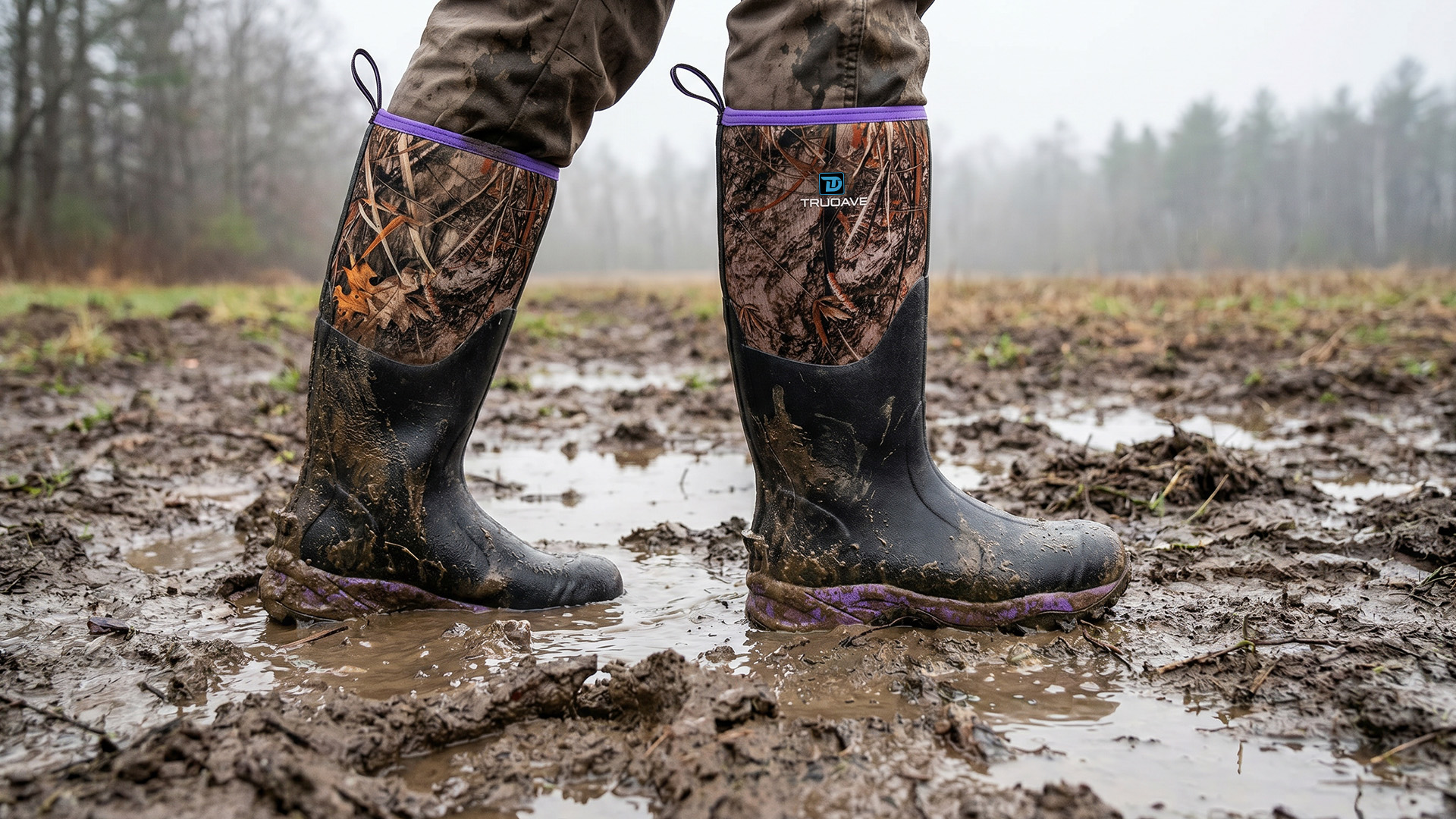
Every hunter has a story about a fall. Not the dramatic kind—the slip on a wet log, the skid down a muddy bank, the ankle-twisting surprise of a rock that shifted underfoot. These aren’t the stories we tell at camp. They’re the ones we keep to ourselves because they feel like mistakes we should have avoided. But the truth is, most of them weren’t caused by carelessness. They were caused by a mismatch between the boot’s outsole and the ground it was asked to grip.
Traction is the most under-discussed performance feature in hunting footwear. Insulation gets the headlines. Waterproofing gets the guarantees. But traction is what keeps you upright when you’re side-hilling across a frozen slope with a pack full of gear, crossing a creek on a submerged log slick with algae, or climbing into a metal tree stand that’s glazed with ice. Lose your footing in any of those moments, and the warmth of your boots becomes irrelevant. You’re on the ground, possibly injured, and your hunt is over.
Trudave Gear’s hunting boot lineup—WildGuard, TrailGuard, and DryFlow—is built on a fundamental insight that most boot brands either ignore or gloss over: different terrains demand fundamentally different traction solutions. The deep, self-cleaning lugs that excel in spring mud are a liability on hard, wet rock. The soft, siped rubber that grips frozen ground can wear down too quickly on abrasive gravel. One outsole cannot optimally serve every hunting environment. This guide breaks down the science of hunting boot traction, explains how Trudave has engineered specific outsole systems for specific terrains, and helps you match the right boot to the ground you actually hunt.
Part 1: The Physics of Grip — Why Some Boots Slip and Others Don’t
Traction isn’t magic. It’s the result of three interacting variables: rubber compound, tread pattern, and surface interaction. When any one of those variables is wrong for the terrain, the boot slips. When all three are dialed in, the boot grips like it’s bolted to the ground.
Rubber Compound: Hard vs. Soft
The hardness or softness of the rubber outsole determines how well it conforms to the surface texture of the ground. Softer rubber compounds grip better on hard, smooth surfaces like rock or ice because they can deform into microscopic crevices, creating mechanical interlock. Harder rubber compounds resist wear on abrasive surfaces like gravel and scree, but they can’t grip smooth surfaces effectively. The trade-off is unavoidable: a compound soft enough for maximum grip on ice will wear down quickly on rock; a compound hard enough to last for miles on gravel will skate across a wet boulder.
Trudave formulates the outsole rubber on each hunting boot series for the terrain it’s designed to encounter. The TrailGuard’s outsole compound is engineered to remain flexible in sub-zero temperatures, maintaining grip when cheaper rubber stiffens and becomes slippery. The DryFlow’s outsole is harder and more abrasion-resistant, built to survive the mixed surfaces—gravel, concrete, rock—that active, mobile hunters encounter over long miles.
Tread Pattern: Lugs, Siping, and Self-Cleaning
The tread pattern determines how the boot interacts with the ground’s macro-texture—the mud, snow, loose dirt, and debris that sits on top of the hard surface beneath. Three tread design elements matter most for hunting boots.
Lug depth and spacing control how well the boot bites into soft terrain and releases cleanly. Deep, widely-spaced lugs dig into mud and snow, providing the mechanical purchase needed to push off without slipping. But those same deep lugs are a liability on hard surfaces: they reduce the rubber-to-ground contact patch, concentrating your weight on the tips of the lugs and increasing the risk of hydroplaning on wet rock.
Siping refers to the thousands of razor-thin slits cut into the rubber outsole. When you put weight on a siped boot, those slits open up and act as miniature water channels, evacuating the water film that causes hydroplaning on hard, wet surfaces. Siping also creates additional biting edges—each slit is an edge that can grip the microscopic texture of a rock or a frozen log.
Self-cleaning channels are the open spaces between lugs that allow mud and debris to eject as the boot flexes. Without them, a deep-lug outsole packs full of mud within a few hundred yards, becoming a smooth, useless platform. With them, the tread maintains its grip through the messiest conditions.
Surface Interaction
The same outsole performs differently on different surfaces. A tread that bites perfectly into soft, greasy clay will fill with snow and become a slick platform in late-season conditions. A lug pattern that grips wet rock beautifully may feel unstable on loose, dry scree. The best outsole is the one that’s been tuned for the specific surface you encounter most often—which is why Trudave builds different outsoles for different hunting styles, rather than forcing the same tread onto every boot.
Part 2: The Trudave Traction Systems — Three Boots, Three Terrains
The WildGuard, TrailGuard, and DryFlow each feature outsole systems engineered for the primary terrain they’re designed to hunt. Understanding the differences is the key to matching the boot to your ground.
TrailGuard Series: Deep Cold and Mixed Winter Terrain
The TrailGuard is Trudave’s maximum-warmth late-season hunting boot, and its outsole is designed for the frozen, mixed terrain of late fall and winter. The rubber compound remains flexible in sub-zero temperatures, so the boot maintains its grip when cheaper rubbers turn into hard, slippery plastic. The aggressive all-terrain lugs are deeply siped to create additional biting edges on frozen ground, crusted snow, and icy patches—surfaces that require as much edge contact as possible.
The self-cleaning tread spacing is calibrated for winter’s unique mud challenge: mud that thaws during the day and re-freezes at night, creating jagged, ankle-turning ruts. The TrailGuard’s lugs bite into this frozen mud and release cleanly, preventing the accumulation that turns boots into five-pound platforms. A reinforced kick-off heel tab allows you to clear the outsole hands-free if debris does accumulate.
Crucially, the TrailGuard’s outsole works in concert with the boot’s insulation. The 5mm neoprene and fleece lining keep the foot warm during stationary sits, which means the foot stays flexible and responsive—a cold, numb foot can’t feel the ground well enough to make micro-adjustments for balance.
WildGuard Series: Wet Ground, Mud, and Submerged Obstacles
The WildGuard is Trudave’s wet-terrain hunting boot, built for marshes, flooded timber, and muddy creek bottoms. Its outsole is designed to grip surfaces that are not just wet, but often submerged and slimy—logs, rocks, and uneven ground that have been under water for weeks and coated in algae and sediment.
The deep-lug outsole grips confidently on these surfaces through a combination of aggressive lug depth and a rubber compound that stays flexible even when cold and wet. The lugs are spaced to release mud cleanly with each step, preventing the weight buildup that makes long approaches through marshland exhausting. The multi-directional tread pattern provides grip in multiple planes of movement—important when you’re climbing over a fallen tree or bracing on a side-slope above a creek.
The WildGuard’s camo finish extends to the outsole’s visual profile, but its function is purely traction-focused. This boot is engineered for the hunter who measures their approach in wet yards rather than dry miles, and whose footing is never guaranteed.
DryFlow Series: Hard Surfaces, Mixed Terrain, and Long Miles
The DryFlow is Trudave’s zero-insulation active hunting boot, and its outsole is tuned for the mobile hunter who covers significant distance over varied terrain. The rubber compound is harder and more abrasion-resistant than the TrailGuard’s, built to survive the gravel, rock, and concrete that long-distance hunters inevitably encounter—whether it’s the gravel road to the trailhead, the rocky ridgeline, or the concrete floor of the equipment shed.
The aggressive cleated outsole pushes mud out with every step for constant ground contact, but the cleats are shallower and more numerous than the deep lugs of the WildGuard, providing a larger contact patch on hard surfaces. This design prevents the “balancing on lug tips” sensation that deep-lug boots create on rock, while still providing enough bite for the mud and soft ground that even the driest hunt occasionally encounters.
The non-slip, oil-resistant rubber compound provides superior grip and stability on wet or oily surfaces—a feature borrowed from Trudave’s industrial work boot line. For the hunter who transitions from a truck cab to a gravel road to a muddy trail to a rocky ridge, the DryFlow’s outsole is designed to handle all of it without packing up or wearing down.
Part 3: The Terrain-Traction Matrix — Matching Your Outsole to Your Hunt
Not every hunter needs a dedicated mud boot or a dedicated ice boot. But every hunter should understand which outsole design serves their primary terrain. Here’s the framework:
| Your Primary Terrain | Traction Challenge | Trudave Match | Key Outsole Feature |
|---|---|---|---|
| Frozen ground, crusted snow, icy patches (late season) | Hard, slick surfaces; cold-stiffened rubber | TrailGuard | Cold-flexible compound, deep siping for ice edges |
| Marshes, flooded timber, muddy creek bottoms (wet season) | Soft mud, submerged slick logs, suction effect | WildGuard | Deep, widely-spaced lugs with self-cleaning channels |
| Mixed terrain: gravel, rock, hard dirt, occasional mud (early season, spot-and-stalk) | Abrasive surfaces, need for large contact patch on hard ground | DryFlow | Harder, abrasion-resistant rubber; cleated outsole for constant ground contact |
| Mountainous terrain: scree, boulder fields, steep slopes | Loose, shifting surfaces; need for multi-directional grip | DryFlow or WildGuard (depending on wetness) | Multi-directional lug pattern; flexible rubber for conforming to rock |
| Icy tree stand platforms, frozen metal ladders | Near-zero friction on smooth metal and ice | TrailGuard + strap-on cleats | Deep siping for edges; always pair with ice cleats on sheer ice |
A critical note: no rubber outsole, no matter how well-engineered, can provide reliable traction on sheer ice. The TrailGuard’s cold-flexible compound and deep siping provide the best possible rubber-on-ice grip, but on the glazed metal of a frozen tree stand platform or the sheer ice of a north-facing creek crossing, supplementary traction devices are a safety necessity. Lightweight ice cleats that slip over the boot take thirty seconds to put on and can prevent the fall that ends your season—or worse.
Part 4: The Self-Cleaning Factor — Why Mud Release Matters as Much as Grip
A boot that grips perfectly in mud but can’t release that mud is a boot that will be five pounds heavier and completely tractionless within a quarter mile. Self-cleaning is not a convenience feature. It’s a core element of outsole design that directly impacts safety and endurance.
Self-cleaning works through tread spacing. When the lugs are spaced widely enough, the boot’s natural flex cycle—the bending that occurs with every step—causes the mud packed between the lugs to crack and fall out. When the lugs are spaced too tightly, the mud stays trapped, accumulating with each step until the outsole becomes a smooth, heavy platform.
All three Trudave hunting boot series incorporate self-cleaning tread spacing, but the spacing is tuned to the specific mud each boot encounters. The WildGuard’s tread spacing is the widest, optimized for the soupy, sticky mud of marshes and creek bottoms. The TrailGuard’s spacing is optimized for the frozen, chunky mud of late-season terrain—mud that breaks apart rather than smearing. The DryFlow’s cleated outsole is designed to push mud out with every step, but its shallower cleats are calibrated for the thinner, less frequent mud of mixed-terrain hunting.
After a hunt, the self-cleaning feature benefits from a quick rinse. Dried mud that has been ejected from the tread channels during the walk may still cling to the edges of the lugs. A thirty-second rinse with a hose removes this residue and restores the outsole to full traction readiness for the next outing. Trudave’s care guidance is consistent: “Rinse off mud with water after each hunt, clean with mild soap, and air dry in the shade. Avoid heat or sunlight to maintain neoprene flexibility and waterproof performance.”
Part 5: Traction Maintenance — Keeping Your Outsoles in Fighting Shape
Traction degrades over time, but the rate of degradation is largely within your control. Three factors cause outsoles to lose grip: wear, hardening, and contamination.
Wear: Every mile you walk removes a microscopic layer of rubber from the outsole. Over time, the lug edges that provide bite become rounded, and the siping slits that channel water become shallow. This is normal and inevitable, but it can be slowed by choosing the right boot for your terrain. Wearing a soft-compound mud boot on abrasive gravel will destroy the outsole in a fraction of the miles it would last on soft ground. Wearing a harder-compound boot on soft terrain will preserve the outsole but sacrifice grip.
Hardening: Rubber compounds harden over time as they oxidize and lose plasticizers. This process is accelerated by heat, UV exposure, and chemical contamination. Storing boots in a hot garage, leaving them in direct sunlight, or failing to rinse off petroleum-based contaminants (fuel, oil, solvent) all accelerate hardening. A hardened outsole cannot conform to surface texture, and its grip degrades even if the tread pattern looks fine.
Contamination: Mud, oil, and debris that are allowed to dry and cake onto the outsole change the tread’s effective shape. A thin layer of dried mud fills the siping channels and rounds the lug edges, reducing traction until the outsole is thoroughly cleaned.
The maintenance protocol is simple but non-negotiable: rinse the outsoles after every hunt. Use a soft-bristled brush to clear debris from the siping channels and lug spaces. Store boots in a cool, dark, dry place—never in direct sunlight or near a heat source. If the rubber begins to look dry or chalky (a normal process called “bloom”), treat it with a silicone-free rubber conditioner to restore flexibility and grip. And when the siping channels have worn smooth or the lugs have rounded to the point that the boot no longer grips on your primary terrain, it’s time to replace the boots—regardless of how the upper looks.
Part 6: The Safety Margin — Why Traction Is the Feature You Never Notice Until It Fails
The best traction system is the one you never think about. You walk across a muddy slope, cross a creek on a wet log, climb into a frozen tree stand, and your feet stay planted. The boot does its job so well that your attention stays on the hunt—the sound of approaching hooves, the gobble on the next ridge, the buck that materialized out of the timber.
That invisible performance is the result of careful engineering: the right rubber compound for the temperature, the right tread pattern for the terrain, the right lug spacing for the mud, the right siping for the hard, wet surfaces. Get any of those elements wrong, and the boot fails. Get them right, and the boot disappears from your awareness.
Trudave Gear has built the WildGuard, TrailGuard, and DryFlow series around this principle. Each boot’s outsole is purpose-matched to its intended hunting environment. The TrailGuard for frozen ground, crusted snow, and the icy edges of late season. The WildGuard for the soupy mud and slick logs of the marsh. The DryFlow for the mixed, abrasive terrain of the long-distance mobile hunter.
The right boot for your terrain keeps you upright. The wrong boot puts you on the ground. Match the outsole to your environment. Maintain it properly. And then forget about it entirely—because the best traction is the traction you never have to test.
To explore the complete Trudave Gear hunting boot lineup and find the right traction system for your hunting terrain, visit trudavegear.com.
