
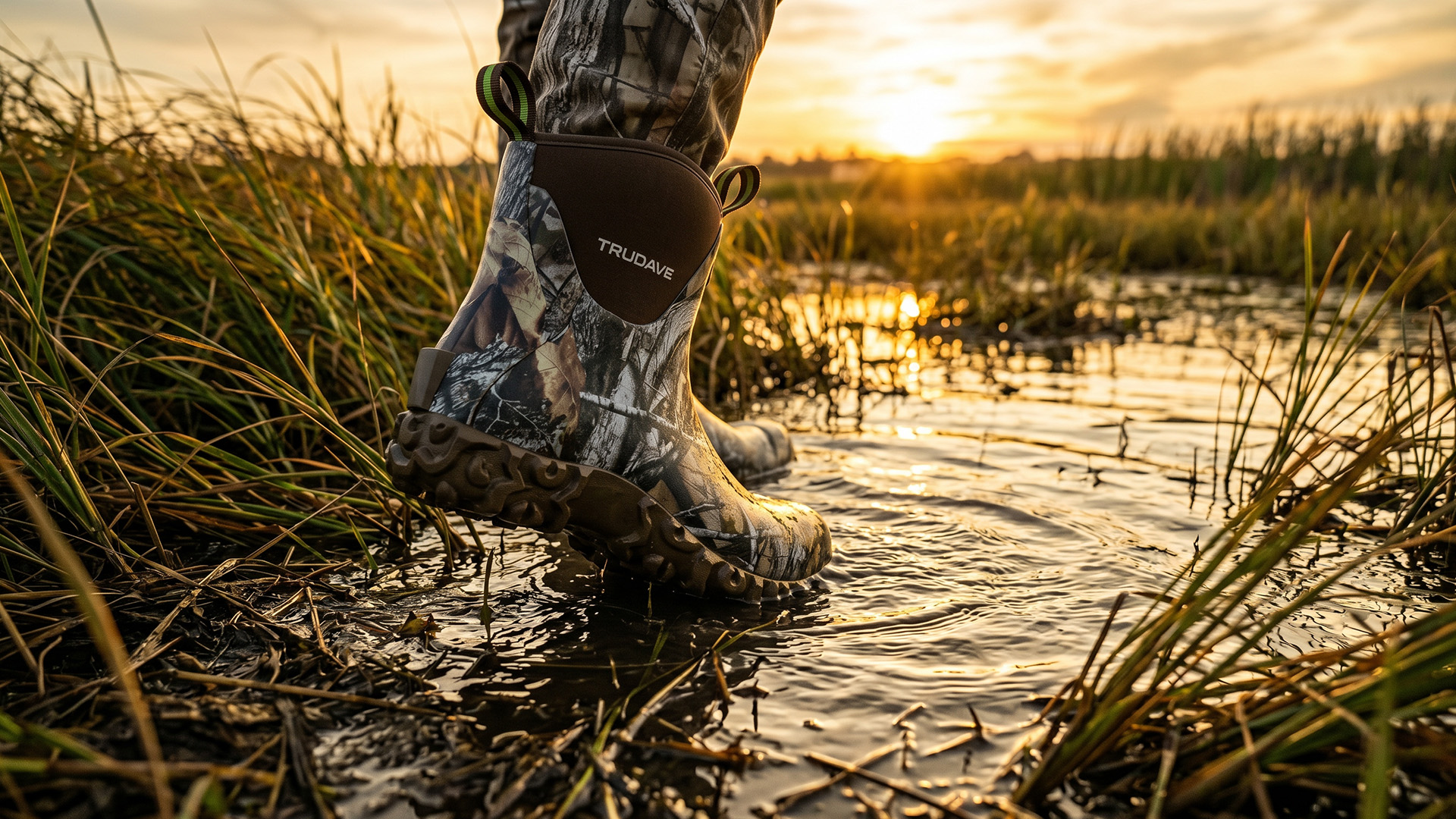
Introduction: The Boots That Carry Your World
A multi-day backcountry hunt is the ultimate test of gear. When you’re miles from the truck, living out of a pack, and waking before dawn to glass a ridge you spent all year dreaming about, every piece of equipment has to earn its place. Nothing—not your rifle, not your glass, not your shelter—matters more than the boots on your feet.
Unlike a day hunt where you can bail out to the truck, dry your boots by the heater, and start fresh in the morning, a backcountry hunter has to manage moisture, warmth, and foot health in a continuous cycle. One blister on day two can cripple you for the rest of the trip. A boot that won’t dry overnight becomes a frozen block by morning. The wrong insulation for the conditions can leave you shivering through the glassing sessions or sweating through the approaches.
Trudave Gear’s hunting boot lineup—TrailGuard, WildGuard, and DryFlow—offers a purpose-built solution for every backcountry scenario. But the boot is only half the equation. How you pack, how you manage your socks, how you dry and maintain your boots in the field, and what you wear in camp all determine whether you come out of the backcountry with a punched tag or with feet too wrecked to hunt. This guide is for the hunter who chases elk, mule deer, sheep, and mountain whitetails across multiple days of grueling terrain—and who needs their boots to go the distance.
Part 1: Choosing the Right Trudave Boot for Your Backcountry Mission
Before you pack your first pair of socks, you need to match your boots to the terrain, temperature, and load you’ll be carrying. The three Trudave hunting boots serve distinctly different backcountry profiles.
The Heavy-Load, Late-Season Hunter: TrailGuard Series
If your hunt involves carrying a 50-pound pack through snow-dusted timber, glassing for hours in sub-freezing temperatures, and making a cold camp above 8,000 feet, the TrailGuard is your boot. Built for maximum static warmth, it pairs 5mm neoprene insulation with a fleece lining—the same principle as a wetsuit, trapping body heat in a flexible, closed-cell foam. “These boots feature 5mm neoprene insulation and a fleece lining that provide excellent warmth and comfort during cold-weather hunts—ideal for deer, duck, or late-season hunting.”
In the backcountry, the TrailGuard’s warmth isn’t just about comfort. It’s about safety. When you’re glassing motionless for two hours at first light, a boot that conducts cold from the frozen ground through the sole will numb your feet and compromise your balance. The TrailGuard’s insulation stops that cold transfer. The aggressive all-terrain outsole with deep siping grips frozen ground and crusted snow, and the self-cleaning tread sheds the mud that freezes overnight. A reinforced kick-off heel tab lets you pull them off hands-free when you crawl into your tent.
The Wet-Terrain, Variable-Condition Hunter: WildGuard Series
For the hunter working creek bottoms, marshy meadows, or the rain-soaked coastal ranges, the WildGuard is the versatile anchor. It’s 100% waterproof, made from 5mm neoprene and a tough rubber shell, keeping feet dry in marshes, mud, and wet woods. The camo finish conceals you when you’re calling elk in dark timber or setting up on a mule deer at the edge of a willow patch.
The WildGuard’s insulation is tuned for active backcountry hunting. The 5mm neoprene provides enough warmth for cold mornings, but the breathable liner prevents the overheating that comes from climbing 2,000 vertical feet with a heavy pack. The deep-lug outsole grips on wet logs, mossy rocks, and greasy clay—the surfaces that define backcountry creek crossings. Cushioned EVA midsoles and arch support reduce fatigue during the long approach marches that backcountry hunts demand.
The Early-Season, High-Mileage Hunter: DryFlow Series
When the backcountry is still warm and dry in September, or when your hunt involves 10-plus miles a day of spot-and-stalk movement, insulation is your enemy. The DryFlow is Trudave’s zero-insulation specialist, built from industrial-grade waterproof rubber with sealed seams. It weighs less than its insulated siblings, and it breathes better—no small advantage when you’re grinding uphill in 60-degree weather with the sun on your back.
The DryFlow’s aggressive cleated outsole pushes mud out with every step, and the non-slip rubber compound grips confidently on the mixed surfaces—gravel, rock, hard dirt—that define high-country approaches. A structured heel cup locks your foot in place, preventing the heel slip that causes blisters during long descents with a heavy pack. For the backcountry hunter who covers serious miles in mild conditions, the DryFlow keeps you moving fast and light.
Part 2: The Sock System for Multi-Day Hunts
In the backcountry, your socks are your most critical piece of foot-management gear. The right system prevents blisters, manages moisture, and keeps your feet warm enough for glassing and cool enough for hiking. A multi-day hunt demands a rotation system, not a single pair.
The Three-Sock System
Pack three pairs of socks for a multi-day hunt, and use them in rotation. Pair One is your hiking sock—the sock you wear during the day’s movement. It takes the most abuse and absorbs the most sweat. At the end of the day, strip it off and hang it to air out in your tent or on your pack. It won’t fully dry overnight, but it will be dry enough to wear again on Day Three while Pair Two is resting.
Pair Two is your sleeping sock. This pair is sacred. It never gets hiked in. You put it on only after you’ve cleaned and dried your feet at the end of the day, and you wear it inside your sleeping bag. It keeps your sleeping bag clean, keeps your feet warm overnight, and gives your hiking sock a full day to dry before you put it back on. Merino wool is the ideal material—it insulates when damp, wicks moisture, and resists odor over multiple days.
Pair Three is your emergency backup. It stays dry in a waterproof bag inside your pack. If you soak Pair One in a creek crossing, you’ve got a dry option. If the weather turns and you need more insulation, you’ve got a second layer. If blisters develop and you need a clean, dry sock against your skin, you’ve got it.
Sock Weight by Season
Pair your sock weight to your boot and conditions. For the TrailGuard in late-season cold, a heavyweight merino wool sock over a thin synthetic liner maximizes insulation and blister prevention. For the WildGuard in mixed conditions, a midweight merino wool sock provides the right balance. For the DryFlow in warm early-season, a lightweight merino or synthetic sock keeps feet cool and dries fast.
Never wear cotton socks in the backcountry. Cotton absorbs moisture, collapses, and becomes a wet, abrasive cloth that blisters your feet within hours. As Trudave’s product guidance warns: “Cotton traps sweat against the skin, rapidly dropping your body temperature.” In the backcountry, that’s not just uncomfortable—it’s dangerous.
Part 3: Camp Footwear — The Boots You Sleep In
One of the most common backcountry mistakes is wearing your hunting boots from sunrise to sleeping bag. Your feet need time to dry and recover from the constant moisture and pressure of being in waterproof boots. A dedicated camp shoe is not a luxury—it’s a foot-health essential.
Your camp shoe should be lightweight, breathable, and easy to slip on and off. The ideal camp shoe lets your hunting boots dry overnight while giving your feet a chance to air out and your arches a break from the structured support of a hunting boot. Many backcountry hunters carry a pair of lightweight sandals, down booties for cold camps, or trail running shoes.
While Trudave does not make a dedicated camp shoe, the principle remains: pack something that separates your feet from your hunting boots for the hours you’re in camp. When you wake in the morning, your feet will be dry, and your hunting socks—aired out overnight—will be ready to go back into your boots for another day.
Part 4: Drying and Maintaining Your Boots in the Field
Waterproof boots keep external moisture out, but they also trap internal moisture in. After a day of hiking, your boots will be damp from sweat, regardless of whether you crossed any creeks. If you don’t dry them overnight, you’ll start the next morning with cold, wet feet—and once your feet are cold and wet in the backcountry, it’s extremely difficult to get them warm and dry again.
The No-Heat Dry
The most important rule of backcountry boot drying is never apply direct heat. Do not put your boots next to a campfire. Do not place them near a propane heater. Heat destroys the polymer cross-links in vulcanized rubber, causing it to become brittle, crack, and lose its waterproof integrity. A pair of boots that’s been fire-dried will fail far sooner than a pair that’s been air-dried in the cold.
Instead, remove the insoles and let them dry separately inside your sleeping bag or against your body heat in your tent. Stuff the boots with crumpled newspaper, a microfiber towel, or a dry wool sock to wick moisture from the neoprene lining. If the boots are wet from external water—a creek crossing, heavy rain—wipe the interior with a dry cloth before stuffing. In freezing conditions, store the boots inside your tent rather than outside, where they will freeze solid. Even a cold boot that hasn’t frozen is easier to put on than an ice block.
Morning Warm-Up
In the morning, your boots will be cold. Put on your dry hiking socks, then slide your feet into the cold boots. Your body heat will warm the rubber and neoprene within a few minutes of walking. If you have chemical toe warmers, activate them and place them in the toe box before you put the boots on—this takes the edge off the initial cold and prevents the numbness that makes the first mile miserable.
Mid-Hunt Care
During a multi-day hunt, take a moment at midday to check your boots. If mud has built up in the tread channels, scrape it out with a stick to restore traction. If your socks feel damp, swap to your spare pair and hang the wet pair on the outside of your pack to dry in the sun and wind. A small investment in foot care during the day prevents the blisters and maceration that end backcountry hunts early.
Part 5: Emergency Repairs in the Backcountry
Even the best boots can sustain damage in rugged terrain. A sharp rock can puncture a sidewall. A misstep can separate a seam. The backcountry hunter needs a minimal repair kit and the knowledge to use it.
A small tube of flexible waterproof adhesive (like Shoe Goo or Aquaseal) is worth its weight in your pack. If a crack or puncture develops, clean the area as best you can with water and a cloth, dry it with a bandana, apply the adhesive, and let it cure for as long as possible—ideally overnight. The repair won’t be perfect, but it will keep water out and prevent the damage from spreading until you can get back to the trailhead.
Carry a few feet of duct tape wrapped around a trekking pole or water bottle. In a pinch, duct tape can seal a crack, cover a puncture, or reinforce a separating seam. It’s not a permanent fix, but it will get you through a day of hunting and back to camp.
If a lace breaks on a laced boot (relevant for some styles, though Trudave’s hunting boots are pull-on), a length of paracord from your pack can replace it. For Trudave’s pull-on WildGuard and TrailGuard, the reinforced kick-off heel tab and flexible neoprene upper are designed to go on and off without laces, eliminating this failure point entirely—a quiet advantage in the backcountry.
Part 6: The Post-Trip Protocol — Recovering Your Boots for the Next Hunt
When you get back to the truck—or home—your boots need attention before they go back into storage. The care you give them after a multi-day backcountry hunt determines whether they’ll be ready for the next one.
Rinse the boots thoroughly with clean water to remove mud, salt, and the organic acids that degrade rubber over time. Use a soft brush and mild soap on stubborn grime. Remove the insoles and let them dry separately. Stuff the boots with crumpled newspaper to wick moisture from the neoprene lining, and store them upright in a cool, dry, well-ventilated area. Never store boots in a hot garage, direct sunlight, or near a furnace—heat accelerates the hardening and cracking that kills vulcanized rubber.
Condition the rubber exterior with a silicone-free rubber conditioner every few months during heavy use. This restores the protective layer and maintains the flexibility that keeps the boots waterproof and comfortable. Inspect the outsole for wear, the seams for integrity, and the neoprene for any signs of damage. A small crack caught early can be sealed. A crack left to grow will end the boot’s life before the next season.
Conclusion: The Foundation of a Backcountry Hunt
A backcountry hunt is a thousand small decisions that add up to a single outcome. Most of those decisions are about strategy—where to glass, when to move, how to play the wind. But the decisions you make about your feet are the foundation that makes every other decision possible. If your feet are wet, blistered, or frozen, none of the rest matters.
Trudave Gear’s TrailGuard, WildGuard, and DryFlow boots give the backcountry hunter a set of purpose-built tools for managing the single most vulnerable part of the body. The TrailGuard for late-season warmth when the snow flies and the glassing sessions last for hours. The WildGuard for wet, variable conditions when the creeks are high and the mud is deep. The DryFlow for early-season miles when speed and lightness are the primary weapons.
Pack the right socks. Dry your boots at night. Bring a camp shoe. Carry a small repair kit. And then focus on the hunt—because when your feet are dialed in, the rest of you can be, too.
To explore the complete Trudave Gear hunting boot lineup and find the right pair for your next backcountry adventure, visit trudavegear.com.
