
Public land hunters love talking about distance.
Walk farther.
Go deeper.
Get away from the road.
Find the place nobody else is willing to reach.
Sometimes that strategy works.
A long hike can separate you from hunting pressure, especially in areas where most hunters stay close to parking lots and easy trails.
But distance alone does not make a hunting spot good.
Some of the most overlooked places on public land are surprisingly close to roads, trailheads, campgrounds, boat ramps, and heavily used access points.
Hunters miss them because they look too obvious, too wet, too small, too steep, too difficult to enter quietly, or simply not worth checking.
Finding overlooked public land hunting spots requires a different approach.
Instead of asking how far you need to walk, ask a better question:
What keeps other hunters from spending time here?
The answer can reveal productive ground that receives far less hunting pressure than its distance from the parking lot would suggest.
Hunting Pressure Is Not Distributed Evenly
Public land may contain thousands of acres, but hunters rarely use all of it equally.
Pressure tends to concentrate around convenience.
Easy parking areas receive attention.
Maintained trails receive attention.
Obvious food sources receive attention.
Large fields receive attention.
Well-known ridges, creek crossings, and funnels receive attention.
Once you understand this, you can begin looking for areas where hunting pressure drops.
The key is not always traveling farther.
The key is finding barriers.
A barrier is anything that makes another hunter hesitate, turn around, or choose an easier route.
Common examples include:
- Mud
- Standing water
- Thick vegetation
- Steep terrain
- Difficult creek crossings
- Limited parking
- Long walks without trails
- Small isolated parcels
- Uncomfortable access routes
- Areas close to human activity that appear unattractive
A good public land hunter learns to recognize these barriers.
Then he determines whether deer are using the ground behind them.
Start With Parking Areas, Not Deer Sign
Before studying bedding areas and food sources, look at access.
Open your mapping application and identify every legal parking area.
Then ask where hunters are likely to go.
Most people naturally choose routes that are simple to understand.
A parking area connected to a maintained trail will pull hunters in one direction.
A visible field edge may attract hunters in another.
A large ridge with easy walking conditions may receive more pressure than a smaller piece of cover located behind a drainage ditch.
Draw imaginary lines from each access point.
Where would the average hunter walk?
Which routes require the least effort?
Which locations look attractive from the map?
Those are areas where you should expect competition.
Now look between those routes.
Small pieces of ground that fall between popular access patterns can become overlooked.
Look for Short Distances With Difficult Access
One of the biggest mistakes public land hunters make is assuming that hunting pressure decreases evenly with distance.
It does not.
A spot 1.5 miles from the road with an easy trail may receive more hunting pressure than a location 500 yards from the parking lot that requires crossing mud, water, or thick vegetation.
Hunters naturally avoid inconvenience.
That creates opportunity.
Look for locations where a short distance requires disproportionate effort.
Examples include:
- A bedding area behind a muddy creek bottom
- A small ridge surrounded by marsh
- Timber separated from a road by thick young growth
- A dry island inside wet ground
- A steep bench above an easy walking trail
- A small parcel with poor parking access
These areas may not look impressive on a map.
That is exactly why they can be useful.
Scout the Places That Look Too Small
Large public land properties attract attention.
Small pieces are often ignored.
A 300-acre parcel may appear less attractive than a 10,000-acre wildlife management area.
But smaller parcels can hold deer, especially when they connect agricultural fields, private land, bedding cover, or larger blocks of timber.
The challenge is hunting them carefully.
Small public parcels cannot absorb unlimited pressure.
One careless access route can affect a significant percentage of the property.
Study:
- Neighboring private land
- Food sources
- Water
- Security cover
- Terrain edges
- Legal access points
Do not dismiss a parcel because it lacks impressive acreage.
Sometimes limited access and overlooked cover matter more than size.
Use Water as a Filter for Hunting Pressure
Wet terrain discourages hunters.
Mud is slow.
Standing water makes access complicated.
Creeks create obstacles.
Marshes make navigation difficult.
Many hunters simply choose another location.
That does not mean every wet area holds deer.
You still need bedding cover, food, security, and usable travel routes.
But water can create separation between deer and hunting pressure.
Look for dry ground surrounded by wet terrain.
Even small elevation changes can matter.
An old roadbed, narrow ridge, elevated patch of timber, beaver dam, or strip of firm ground can concentrate movement.
Study satellite imagery and topographic maps.
Then verify conditions on the ground.
Maps do not always show seasonal water levels accurately.
Do Not Be Afraid to Get Your Boots Dirty
Some public land locations are overlooked because reaching them is uncomfortable.
The first hundred yards may involve deep mud.
The access route may follow a flooded trail.
A creek crossing may require extra time.
Hunters who regularly use these routes need equipment that allows them to stay mobile.
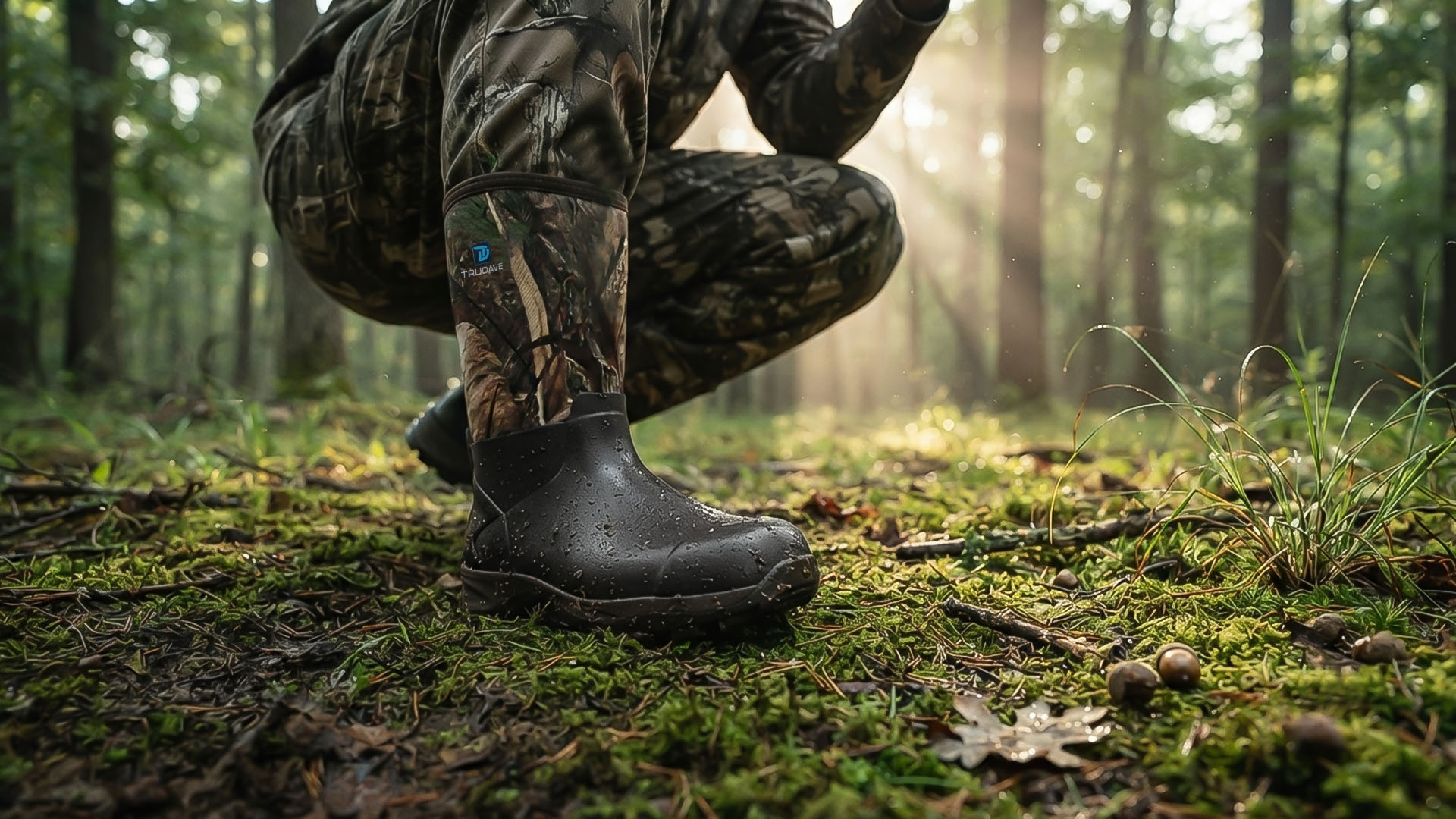
For wet public land, that often means carrying lightweight rain protection, dry socks, waterproof storage, and wearing waterproof hunting boots made for wet terrain when access involves repeated exposure to mud, shallow water, marsh edges, or flooded trails.
The purpose of good footwear is not to make a hunter invincible.
It is to prevent manageable terrain from becoming the reason you abandon an otherwise productive hunting location.
If poor equipment forces you to turn around every time the ground becomes wet, your hunting options become limited.
Check Areas Close to Roads
This sounds wrong.
Public land hunters are constantly told to get away from roads.
But some deer live surprisingly close to human activity.
The important distinction is between visibility and access.
A piece of thick cover may sit 200 yards from a road but require a difficult approach.
Another area may be a mile deep but connected directly to a maintained trail.
Which location receives more pressure?
The answer is not always obvious.
Look for:
- Thick cover behind roadside vegetation
- Steep slopes near roads
- Small drainage systems
- Areas without convenient parking
- Locations where road noise hides hunter movement
- Parcels hunters drive past on the way to larger properties
Always follow local regulations regarding legal access, parking, and required distances from roads.
Find Places Hunters Walk Past
Hunters often travel through productive ground while trying to reach somewhere better.
This happens near trailheads.
A hunter parks, checks his map, and immediately begins walking toward a distant ridge.
Another hunter follows the same trail toward a large marsh.
Someone else walks two miles toward a remote clear-cut.
Meanwhile, the first piece of secure cover near the access route receives very little attention.
Do not assume deer avoid every area near human activity.
Instead, look for places where hunters move quickly and predictably.
Deer can adapt to repeated patterns.
If people consistently walk down the same trail, deer may bed in cover that allows them to monitor that movement.
The key is finding a different access route.
Hunt the Edges of Recreational Activity
Public hunting land may also be used by:
- Hikers
- Dog walkers
- Anglers
- Mountain bikers
- Campers
- Horseback riders
Hunters often avoid these areas completely.
Deer may not.
In locations with regular recreational activity, deer can become accustomed to predictable human movement.
They may tolerate people on trails while avoiding off-trail movement.
This creates an interesting opportunity.
Look for security cover near established recreational corridors.
Then find a way to access the area without following the same pattern as other users.
Do not interfere with other recreational activities.
The goal is understanding how deer respond to predictable human pressure.
Use Terrain to Hide Your Access
An overlooked hunting spot is only valuable if you can enter it without disturbing deer.
Terrain can help.
Creek beds, ditches, ridges, standing corn, thick vegetation, and elevation changes can hide movement.
Study visibility from likely bedding areas.
If deer can watch your entire approach, distance may not help.
Sometimes a longer route allows you to stay hidden.
Other times, a short route through a drainage provides better access.
Good public land hunting is not about minimizing walking distance.
It is about minimizing disturbance.
Pay Attention to What Other Hunters Leave Behind
Hunter sign provides useful information.
Look for:
- Reflective trail markers
- Cut branches
- Boot tracks
- Tree stand straps
- Flagging tape
- ATV tracks
- Ground blinds
- Trail camera straps
- Trash
- Heavily used parking areas
Finding hunter sign does not automatically mean you should leave.
The age and location of the sign matter.
An old tree stand near an easy trail tells a different story from fresh boot tracks leading toward the bedding area you planned to hunt.
Use hunter sign the same way you use deer sign.
Interpret it.
Do not simply react to it.
Scout During Hunting Season
Summer scouting is useful.
In-season scouting shows current conditions.
Hunting pressure changes deer behavior.
A location covered in deer sign during August may become empty after opening weekend.
Meanwhile, an overlooked piece of cover may begin holding deer after pressure increases.
Mobile hunters should continue scouting throughout the season.
Look for:
- Fresh tracks
- Fresh rubs
- Active scrapes
- Recently used beds
- Current food sources
- Changes in hunter activity
If the sign disappears, move.
Public land rewards hunters who adjust.
Use Bad Weather to Explore New Ground
Rain, wind, and changing conditions can reduce hunting pressure.
They can also create better scouting opportunities.
Wet leaves allow quieter movement.
Rain can reveal fresh tracks.
Muddy access routes show where hunters have been walking.
Bad weather is not always the best time to sit in your favorite stand.
Sometimes it is the best time to learn the property.
Carry appropriate gear.
Protect essential equipment.
Use the conditions to investigate places you have been ignoring.
Do Not Hunt a Spot Just Because It Is Hard to Reach
Difficult access is not enough.
This is an important point.
Hunters sometimes become so focused on escaping pressure that they hunt poor habitat simply because nobody else is there.
Deer still need reasons to use the area.
Look for:
- Bedding cover
- Food
- Water
- Security
- Travel corridors
- Terrain features
- Current sign
An inaccessible location without deer is still a bad hunting spot.
The best overlooked areas combine reduced hunting pressure with habitat deer actually use.
Consider Multiple Access Routes
A good spot may require different access depending on wind direction.
Do not rely on one trail.
Identify alternative approaches.
One route may follow a creek.
Another may use a ridge.
A third may require walking farther around the property boundary.
Multiple access routes allow you to hunt the same general area under different conditions.
They also reduce repeated ground scent along one trail.
Common Mistakes Public Land Hunters Make
Assuming Farther Always Means Better
Distance can reduce pressure, but difficult access, poor parking, water, and terrain can create overlooked spots much closer to the road.
Ignoring Small Parcels
Small properties may provide quality hunting when they offer security cover and limited access.
Walking Through Good Cover to Reach a Distant Spot
Do not destroy a productive location because you are focused on reaching somewhere farther away.
Hunting Difficult Terrain Without Fresh Deer Sign
Hard access is only useful when deer are using the area.
Using the Same Access Route Every Hunt
Repeated entry patterns can educate deer.
Develop alternatives when possible.
Leaving When You Find Hunter Sign
Not all hunter sign represents current pressure.
Evaluate how fresh it is and where it leads.
Frequently Asked Questions
How far should you walk on public land to find deer?
There is no correct distance.
Some productive locations are several miles from access points, while others are close to roads but protected by difficult terrain, water, vegetation, or poor access.
Focus on hunting pressure and deer sign rather than mileage alone.
How do you escape hunting pressure on public land?
Look for barriers that discourage other hunters.
These may include wet ground, steep terrain, thick vegetation, difficult access, small parcels, or locations that appear too close to roads.
Then confirm deer are using the area.
Are small public hunting areas worth hunting?
Yes.
Small parcels can provide good hunting when they contain security cover, food, travel routes, and limited access.
They should be hunted carefully because they are more sensitive to pressure.
Is wet terrain good for public land hunting?
Wet terrain can reduce hunting pressure and create isolated areas of dry ground that deer use.
However, hunters should scout to confirm current deer activity rather than assuming every marsh or creek bottom is productive.
Should you avoid areas with other hunters?
Not necessarily.
Other hunters can influence deer movement.
Understanding where people enter, how they travel, and which areas they avoid can help identify overlooked locations.
How can you tell if a public land hunting spot is overlooked?
Look for limited hunter sign, difficult or inconvenient access, fresh deer activity, and terrain features that cause other hunters to travel elsewhere.
Scouting during hunting season is the best way to confirm current conditions.
Final Thoughts
Finding overlooked public land hunting spots is not a contest to see who can walk the farthest.
Distance is only one form of separation.
Water creates separation.
Mud creates separation.
Steep terrain creates separation.
Thick vegetation creates separation.
Poor parking creates separation.
Small parcels create separation.
Even areas close to roads can create separation when other hunters assume they are not worth investigating.
Study access before studying deer.
Identify where hunters naturally travel.
Find the barriers that make people choose another route.
Then scout the ground behind those barriers.
If you find fresh deer sign, secure cover, and an access route that allows you to hunt without unnecessary disturbance, you may have found something more valuable than a remote location.
You may have found a place everyone else keeps walking past.
