
I used to think I was being efficient.
One pair of boots. All season. Treestand sits, spot-and-stalk, scouting trips, and camp chores — the same boots, day after day. I told myself I was saving money. I told myself I was keeping things simple.
But here’s the thing about hunting: it’s never simple. The terrain changes. The weather changes. The way you move changes. And if your boots don’t change with it, you’re not being efficient — you’re being lazy.
And lazy costs you deer.
Here’s the hard truth: a boot that’s perfect for a 20°F treestand sit will cook your feet during a 60°F spring turkey hunt. A boot that’s great for covering miles in the backcountry is overkill for checking trail cams. A boot that’s tough enough for barnyard chores is too clunky for a stealthy stalk.
The smart hunter doesn’t buy one boot. They build a quiver.
⚠️ Disclosure: This article is based on product specifications, independent gear reviews, and verified customer feedback from multiple sources. Our goal is to provide honest, practical information — not to sell you anything.
The Three Boots Every Hunter Needs
Here’s the reality check most hunting gear guides won’t give you: you need at least three different types of boots to cover a full season.
1. The Tall Insulated Boot (For Cold Sits). When you’re sitting still in a treestand or duck blind for hours in freezing temperatures, your body isn’t generating much heat. You need serious insulation — 5mm neoprene at minimum — to trap your body heat and keep your feet from turning into ice blocks.
2. The Lightweight Boot (For Movement). When you’re covering miles — spot-and-stalk, scouting, run-and-gun turkey hunting — you need something that moves with you. Too much insulation becomes a sweat box. Too much weight becomes a drag. You need breathability, flexibility, and enough traction to handle whatever terrain you’re crossing.
3. The Quick-Release Boot (For Everything Else). Trail cam checks. Stand prep. Camp chores. Launching the boat. Grabbing firewood. These aren’t hunts — they’re the work that makes hunts possible. You need something you can slip on and off quickly, hose off at the end of the day, and not worry about.
The good news? You don’t need to spend a fortune to build this quiver. Trudave Gear has built each of these boots — and they all punch well above their price point.
The Tall Insulated Boot: TrailGuard Series
Best for: Late-season deer, duck hunting, and any hunt where you’re sitting still in cold, wet conditions.
The TrailGuard is built for long sits and stealthy approaches. From wet grass to forest trails, the rugged outsole grips firmly for a stable stride.The reinforced rubber shell shields against sharp roots, rocks, and debris, while its lightweight construction keeps every step silent and fluid.
These boots are 100% waterproof, made from premium rubber and sealed seams to keep your feet dry during hunting in wetlands, rain, or muddy terrain.They feature 5mm neoprene insulation and a fleece lining that provide excellent warmth and comfort during cold-weather hunts — ideal for deer, duck, or late-season hunting.
The deep-lug outsole locks onto wet ladders, metal rungs, and soft ground, giving you reliable traction when setting stands or tracking game.And with cushioned EVA insoles, breathable lining, and shock-absorbing midsoles, they provide lasting comfort for all-day wear in rugged environments.
Who it’s for: The hunter who spends hours on stand in freezing temperatures. The one who needs warmth without bulk, traction without noise, and waterproofing that actually works.
The Lightweight Boot: WildGuard Series
Best for: Turkey hunting, waterfowl, and any hunt where movement and concealment matter as much as warmth.
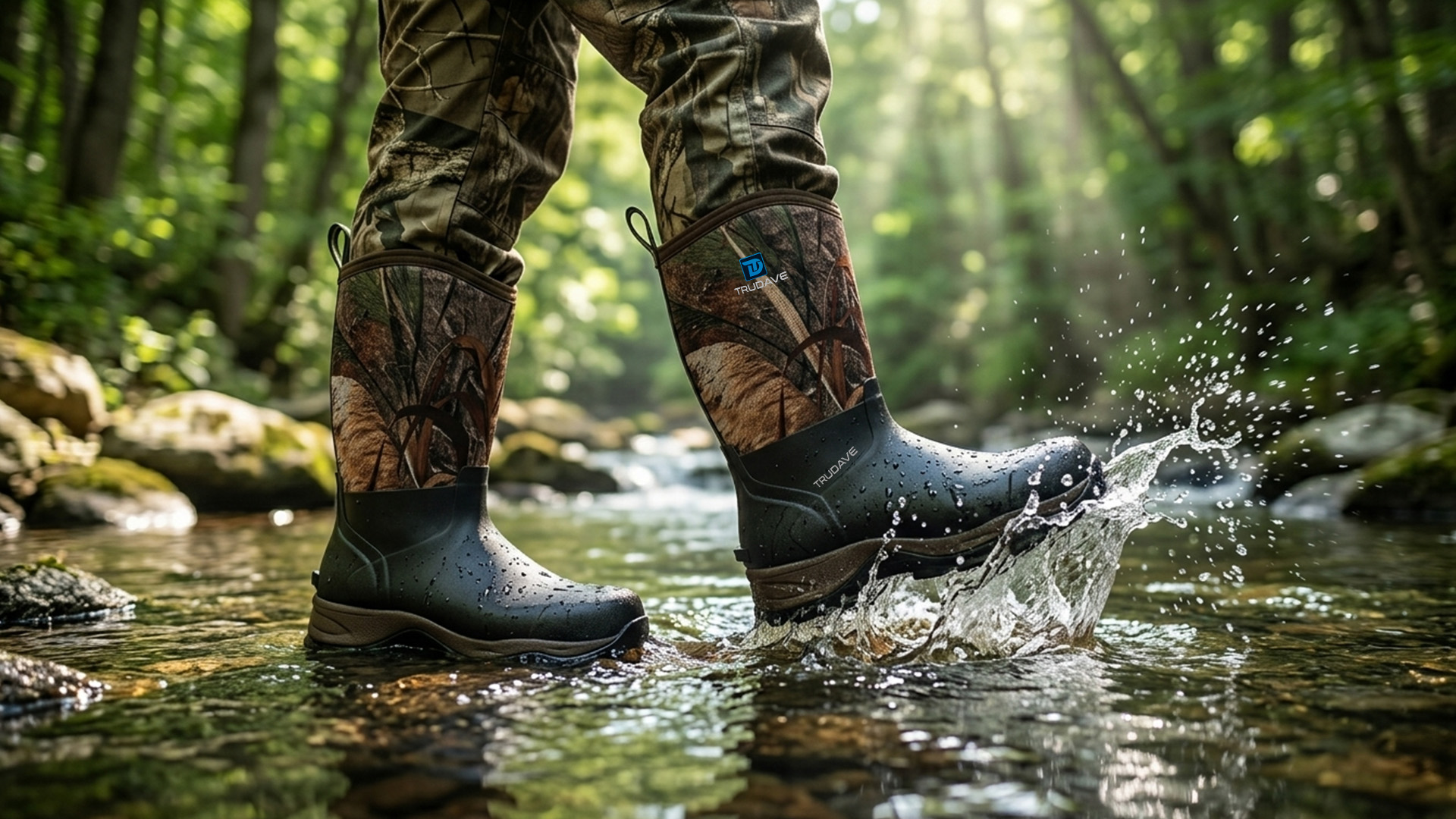
The WildGuard is designed to blend seamlessly with the landscape. The full camo finish keeps you hidden in timber, reeds, or brush.The deep-lug outsole grips confidently on wet logs, rocky trails, and uneven ground.Reinforced protection and flexible ankle support help you stay focused on your shot — not the terrain beneath your feet.
These boots are 100% waterproof, made from 5mm neoprene and a tough rubber shell.They keep your feet dry and steady in marshes, mud, and wet woods — ideal for deer, duck, and upland hunting.
The 5mm neoprene insulation with a breathable liner traps warmth without overheating — perfect for early morning or winter hunts in cold, wet conditions.Cushioned EVA midsoles and arch support reduce fatigue on long treks.
Who it’s for: The hunter who needs to move. The one covering miles through marsh, field, and forest, who needs concealment and comfort without the bulk of a heavy insulated boot.
The Quick-Release Boot: Low-Cut Waterproof Garden Boot
Best for: Trail cam checks, stand prep, camp chores, and every task that isn’t the hunt itself.
This is the boot that surprised me the most. It’s essentially an ankle-height rubber boot, similar to the popular slip-on muck-style boots many use around the farm or yard.They’re built with a flexible, waterproof rubber exterior and come in a range of patterns — including camo.
But don’t confuse them with your classic knee-high hunting boots: these only cover to just above the ankle.They’re not intended for deep water crossings, thick brush busting, or all-day backcountry treks. What they are built for is the everyday grind: checking trail cams, working around the cabin, launching a boat at fish camp, or slogging through springtime mud while hanging stands and clearing lanes.
In field testing, they “shrugged off rocks, sand, and messy fish slime with no trouble.”The only visible wear came on the camo print itself — a cosmetic issue that didn’t affect waterproofing or structural integrity.
Who it’s for: Every hunter who does pre-season work. The one who needs something quick, waterproof, and tough enough to handle anything — without spending five minutes lacing up tall boots every time they step out the door.
The 7-Day Torture Test: Proof in the Mud
Trudave didn’t just claim their boots were tough. They proved it.
A brand new pair of Trudave boots was worn for 7 days straight — 168 hours of field scouting, truck driving, warehouse work, and trudging through flooded timber. No backup shoes. No babying.
Day 1 — The Break-In Myth. “Right out of the box, the flexibility of the upper and the EVA midsole felt completely dialed in.” After 8 hours on concrete and a 2-mile gravel hike: zero hot spots or blisters.
Day 3 — The Mud & Water Assault. The tester stood in a creek for ten minutes. The aggressive tread pattern cleared thick mud with every step. Socks? Bone dry.
Day 5 — The “Sweat Box” Check. Fast-paced hiking in 75°F weather. The moisture-wicking lining pulled sweat away from the skin, avoiding the dreaded “swamp foot.”
Day 7 — The Aftermath. After 168 hours, the boots were beaten to crap visually. But a garden hose revealed an upper that was fully intact. No blown seams. No peeling soles. No cracked rubber at the toe flex point.
The final verdict: “A 7-day continuous wear test is stupid. You should rotate your boots to let them dry and recover. But this test proved exactly what we built Trudave gear to do: survive when you don’t have the luxury of a backup plan.”
The Steel Shank: The Feature That Separates Trudave from the Pack
Across every series, there’s one feature that sets Trudave apart from almost every other boot in its price range — and many that cost twice as much: the steel shank.
Most cheap hunting boots have flat rubber footbeds. Nothing between your foot and whatever’s beneath you. Step on a nail, a sharp rock, or a thorn, and you’re going to feel it.
Trudave installs a steel shank between the insole and outsole. This piece of steel does three things that matter every time you step into the woods:
- Puncture protection — stops nails, thorns, and sharp rocks from punching through
- Arch support — provides structural support that reduces fatigue during long treks
- Sole stability — prevents the boot from twisting or collapsing under heavy loads
Finding a steel shank in a sub-$100 boot is rare. Most manufacturers reserve it for premium-priced models. Trudave includes it as standard equipment.
Important clarification: The steel shank provides underfoot puncture protection — it is not the same as certified steel toe protection for workplace impact safety. If your job requires ASTM-certified steel toe footwear, verify the specific model’s certifications before purchase.
What Real Hunters Are Saying
Trudave holds a 4.1/5 rating on Trustpilot based on verified purchaser reviews. Here’s what actual owners emphasize about their boots:
“We purchased waterproof boots back in May for working on our little farm as we were constantly dealing with wet, muddy and otherwise soiled shoes while tending our livestock. The boots have made our jobs and lives sooo much better and easier. And best of all, our feet stay DRY!!! It has been about two months now and these boots are still going strong and keeping our feet protected. Would recommend these boots 100%.”
“Bought some boots from Trudave, These boots are well made and comfortable. The size is slightly larger, but with socks they fit well and comfortably. A size smaller would be too tight.”
“I order from Amazon twice and got the wrong size both times. I order from Trudave and got the right size First time.”
“Sizing Chart was correct. Medium fit me perfect and I am 5’10”, 185 lbs with a standard build.”
Common patterns from verified feedback:
- Sizing runs slightly large. Most owners recommend wearing medium-to-heavy socks for optimal fit.
- Dry feet is the consistent win. Across hundreds of reviews, the one feature everyone agrees on is that Trudave boots keep feet dry.
- Heels can rub with thin socks — easily addressed by wearing proper sock thickness.
- Order directly from Trudave rather than third-party retailers for accurate sizing.
How to Keep Your Boots Alive
Proper care doubles the lifespan of any boot. Here’s the simple routine that works across all Trudave boot series:
Rinse after every hunt. “After use, rinse off mud and debris with clean water, wipe with mild soap, and air dry naturally.”
Air dry naturally — never use heat. “Avoid direct sunlight or heaters to preserve waterproof protection and neoprene flexibility.”Heat cracks rubber and ruins the waterproof seal.
Use mild soap only. For heavy dirt, use mild dish soap and a soft brush. Avoid degreasers, bleach, or harsh chemicals — these strip essential oils from the rubber and cause premature cracking.
Store upright in a cool, dry place away from direct sunlight. Don’t fold or crease the boots, which creates weak points.
Check your tread periodically. When the lugs wear down and the sole feels hard like plastic instead of grippy rubber, it’s time for new boots.
The Bottom Line: Build Your Quiver
Here’s the honest truth about hunting boots in 2026.
The old approach — one pair of boots, worn for everything — forces you into compromises that cost you opportunities. You’re either too hot, too cold, too loud, or too tired.
The smarter approach is a quiver of boots, each optimized for a specific scenario. The TrailGuard for cold sits. The WildGuard for movement and concealment. The low-cut garden boot for pre-season work and camp chores.
And here’s the best part: you can build that quiver for less than the price of a single pair of premium boots from legacy brands.
| Boot | Best For | Key Feature |
|---|---|---|
| TrailGuard | Cold sits, late-season | 5mm neoprene + fleece, deep-lug traction |
| WildGuard | Movement, concealment | Camo finish, breathable 5mm neoprene |
| Low-Cut Boot | Pre-season, camp chores | Quick on/off, versatile, budget-friendly |
The deer don’t care what logo is on your boots. The ducks don’t check the brand tag. They only care if you’re still in the field when they finally move — warm, dry, and planted on the ground.
Trudave keeps you there. Without emptying your wallet.
Now stop reading and go build your quiver. Your feet — and your hunt — will thank you.
