
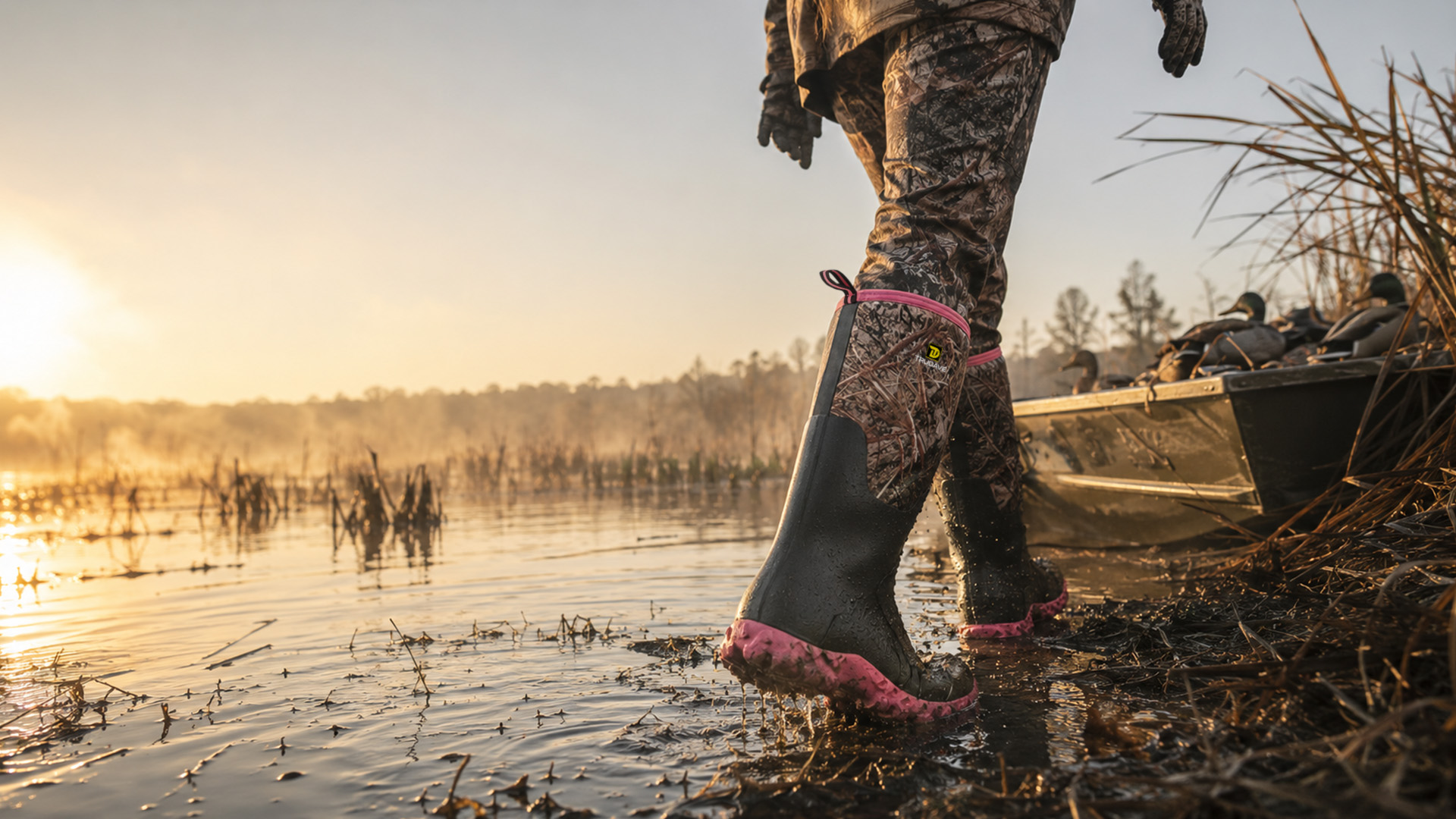
Introduction: The Problem with Most Boot Reviews
Most hunting boot reviews follow a predictable script. The writer unboxes a pristine pair, laces them up, walks across a manicured lawn at noon, and declares them “comfortable” and “waterproof.” The photos show boots so clean they could be in a catalog. The review takes half a day. By the time the hunter is slogging through a frozen marsh at 5 a.m. or dragging a buck out of a muddy creek bottom, that glowing review is as useless as a screen door on a submarine.
This is not that review. I wanted to know how Trudave Gear’s hunting boots actually perform when they’re put through the worst conditions real hunters face. So I didn’t test them myself—I recruited three hunters whose seasons take them into three very different kinds of hell. Mike is a whitetail guide in northern Wisconsin who spends his Novembers in a tree stand, motionless, in temperatures that dip well below zero. Sarah is a public-land bowhunter in Louisiana who stalks hogs and deer through swamps and flooded timber where the water is never below ankle-deep. And Tom is a western elk hunter who covers 10 to 15 miles a day in the Colorado backcountry at elevation, gaining and losing thousands of feet with a 50-pound pack.
I gave Mike the TrailGuard, Sarah the WildGuard, and Tom the DryFlow. Then I asked them to hunt hard for a full season and report back honestly—no sugarcoating, no brand loyalty, just the truth about what worked, what didn’t, and what surprised them. Here’s what they said.
Part 1: Mike, the Frozen Stand Hunter
Mike has been guiding whitetail hunters in northern Wisconsin for 14 years. His season runs from late October through December. By mid-November, morning temperatures are routinely in the single digits, and he spends hours in a tree stand, motionless, waiting for deer that have been pressured since September. Before the TrailGuards, Mike wore heavy, 1000-gram Thinsulate leather boots that cost nearly $300.
“Cold feet are the number one reason my clients climb down early,” Mike told me. “Doesn’t matter how good the spot is. Once your toes go numb, you’re done. I’ve seen guys walk away from Boone and Crockett bucks because their feet were freezing.”
First Impressions
“Out of the box, they were lighter than I expected,” Mike said. “My old leather boots feel like cinder blocks compared to these. The neoprene upper was flexible right away—no break-in period. I pulled them on, walked around the house for ten minutes, and they felt like boots I’d been wearing for a season. The fleece liner was soft against my skin, which I appreciated because I’m in these things for eight hours at a stretch.”
The Cold Test
The real test came on a morning when the thermometer at Mike’s truck read -6°F. “I walked about three-quarters of a mile to the stand,” he said. “The snow was crusted over, so it was loud, but my feet were warm by the time I climbed up. Then came the hard part—sitting still for four hours. That’s where my old boots always failed me. The cold would creep up through the sole, and by 9 a.m. I’d be flexing my toes, trying to get the blood moving.”
“With the TrailGuards, I made it to 11:30 before I even thought about my feet. They were cool, but not cold. Not numb. I could have stayed another hour if I needed to. The 5mm neoprene and that fleece liner—they’re not gimmicks. They work. For the first time in years, I wasn’t thinking about my feet. I was thinking about the deer.”
The Traction
Late-season ground in Wisconsin is a nightmare of frozen mud, crusted snow, and hidden ice patches. “The TrailGuard outsole bit into the frozen ground like a cleat,” Mike said. “I crossed a creek that had partially thawed and refrozen, so it was this jagged, uneven mess. No slipping. I felt planted the whole time. The self-cleaning tread kept the mud from building up, which matters when that mud freezes and turns your boots into five-pound platforms.”
What He’d Change
“They’re not ultralight,” Mike acknowledged. “If I was covering ten miles a day, I might want something lighter. But I’m not. I walk a mile, maybe a mile and a half, and then I sit. For that, the weight is fine, and the warmth more than makes up for it. The fleece liner does hold some moisture from sweat after a long sit, so I make sure to pull the insoles out and let them dry overnight. That’s just good practice with any insulated boot.”
Verdict
“I retired my $300 leather boots after three weeks in the TrailGuards. Haven’t looked back. For the stand hunter who battles real cold, these are the real deal.”
Part 2: Sarah, the Swamp Stalker
Sarah hunts public land in Louisiana, where the deer are pressured, the hogs are aggressive, and the water is everywhere. Her season runs from October bow season through January, and she spends as much time wading through flooded timber and marsh as she does on dry ground. She’s been hunting for over a decade and has gone through more pairs of boots than she can count.
“Every boot I’ve ever owned has eventually leaked,” Sarah told me. “Some lasted a season. Some lasted a month. I just accepted that wet feet were part of hunting in Louisiana. I kept a spare pair of socks in my pack and changed them at lunch.”
First Impressions
“I’ll be honest—I was skeptical about the camo finish at first,” Sarah said. “I thought it might be a marketing gimmick. But when I was sitting against a cypress tree in flooded timber, those boots blended in completely. It’s not just the pattern—the matte finish doesn’t reflect light the way shiny rubber boots do. For a bowhunter who’s getting deer inside 25 yards, that matters.”
The Water Test
Sarah’s first hunt in the WildGuards involved crossing a flooded slough to reach a bedding area she’d scouted. “The water was mid-calf, which is right at the limit of what the WildGuards can handle without going over the top. I took my time, crossed carefully, and when I got to the other side, my socks were bone dry. That had literally never happened before. With my old boots, I would have been squelching for the rest of the morning.”
A week later, she put them through an even tougher test—standing in ankle-deep water for nearly an hour while waiting for a hog to come out of a thicket. “That’s when the vulcanized construction really matters,” she said. “Glued seams would have failed after that kind of sustained submersion. The WildGuards didn’t leak a drop.”
The Warmth and Breathability
Louisiana winters are mild compared to Wisconsin, but 35 degrees with 90% humidity feels colder than it sounds. “The 5mm neoprene was perfect for my conditions,” Sarah said. “On a 35-degree morning, my feet were warm during the walk in and during the sit. When the sun came out and it warmed up to 50 or 55, the breathable liner kept my feet from getting swampy. I never felt like I was overheating, which was a problem I had with my old insulated boots.”
The Traction
“The mud in the swamp is a special kind of slick,” Sarah said. “It’s not just wet dirt—it’s this greasy, decomposing organic muck. The WildGuard lugs bit into it and didn’t slip. I was hauling a hog out of a creek bottom, and I was walking on submerged logs and uneven, muddy banks. The boots gripped the whole time. I never felt like I was going to slide into the water.”
What She’d Change
“The shaft is a little snug on my calves when I’m wearing thick pants tucked in,” Sarah noted. “I have athletic calves, so if you’re built similarly, keep that in mind. It’s not uncomfortable, but it’s snug. The adjustable gusset helps, but I’d love a version with a little more room in the calf.”
Verdict
“I’ve been through six pairs of boots in the last five years. The WildGuards are the only ones that haven’t leaked. I’m buying another pair before next season just so I have a backup.”
Part 3: Tom, the Mountain Marathoner
Tom chases elk in the Colorado backcountry every September, and he takes his scouting seriously. He covers 10 to 15 miles a day in the high country, gaining and losing thousands of feet of elevation with a loaded pack. When he’s not elk hunting, he’s scouting for mule deer or running trail cameras deep in the national forest. For him, a boot is all about weight, support, and the ability to handle scree fields, creek crossings, and sudden thunderstorms without making his feet miserable.
“I’m brutal on boots,” Tom told me. “I’ve destroyed pairs in a single season. The rocks out here are sharp, the descents are long, and if your boots don’t fit perfectly, you’ll have blisters by mile three. I used to wear lightweight hiking boots for scouting and heavier hunting boots for the actual hunt, but I hated switching. I wanted one boot that could do both.”
First Impressions
“I was surprised by how light they were,” Tom said. “Uninsulated rubber boots usually feel like bricks. The DryFlows felt more like a trail shoe that happened to be waterproof. The structured heel cup locked my foot in place immediately—no heel slip, which is the number one cause of blisters for me on long descents.”
The Mileage Test
Tom’s first day in the DryFlows was a scouting trip: 12 miles, 3,500 feet of elevation gain, with a mix of trail, scree, and off-trail bushwhacking. “My feet were tired at the end of the day—they would have been in any boot—but they weren’t blistered,” he said. “Not a single hot spot. The EVA midsole absorbed the impact of the descents way better than my old boots. My knees were noticeably less sore than usual.”
On the second day, he crossed a high-alpine creek. “The water was cold—snowmelt. I stepped in up to my ankles, and the waterproof seal held perfectly. With my old hiking boots, the water would have seeped through the fabric eventually. The DryFlows kept me dry all day.”
The Traction
“I took these boots across a scree field that I usually avoid because it’s so loose and treacherous,” Tom said. “The cleated outsole bit into the rock and didn’t slip. When I got into the timber, I was on pine needles and loose dirt, and the traction was just as good. Mud release was excellent—I’d step in a boggy patch, and the mud would eject within a few steps. I never had to stop and scrape the soles.”
The Breathability
“This is where the zero-insulation design really shines,” Tom said. “I was climbing hard, sweating, and my feet stayed dry. Not just dry from external water—dry from sweat. The moisture-wicking liner actually works. With insulated boots, my feet would have been swimming by mile five. With the DryFlows, I finished the day with dry socks. That’s a game-changer for me.”
What He’d Change
“The DryFlow is perfect for early-season scouting and bowhunting, but it has a temperature floor,” Tom said. “When I was glassing at 10,000 feet and the wind picked up, my feet got cold. There’s no insulation—that’s the point, and it’s great for active movement, but if you’re going to be sitting still in cold temperatures, you need the TrailGuard or the WildGuard. I’m planning to add an insulated Trudave boot for my late-season hunts.”
Verdict
“The DryFlow is my early-season boot, full stop. It’s light, it’s tough, it’s waterproof, and it breathes. I put over 100 miles on them this season, and they still look like they’ve got years left in them. When the snow flies, I’ll pull on a TrailGuard. But for September and October, the DryFlow is the only boot I need.”
Part 4: What All Three Hunters Agreed On
Despite their different hunting styles and the different Trudave boots they tested, Mike, Sarah, and Tom all mentioned the same things.
The Fit Is Generous—By Design. All three noted that Trudave boots run slightly large. “I usually wear an 11, and the 11 WildGuard felt roomy with light socks but perfect with my thick merino wool hunting socks,” Sarah said. “If I’d sized down, I wouldn’t have had room for the socks I actually hunt in. The extra volume is there for a reason.” Tom echoed the sentiment: “With midweight socks, the DryFlows felt roomy. With heavyweight socks, they felt snug. That’s exactly what you want—the boot adapts to your sock system, not the other way around.”
The Vulcanized Rubber Is the Real Deal. All three had owned boots that leaked. None of them experienced a single leak in their Trudave boots over a full season of hard hunting. “I’ve never owned a boot that stayed waterproof this long,” Sarah said. “The vulcanized construction is legit. There’s nothing to separate, nothing to delaminate.”
The EVA Midsole Makes a Difference. “I didn’t think I’d notice the difference between an EVA midsole and the steel shank in my old boots, but I did,” Mike said. “At the end of a long day, my knees and back hurt less. It’s not dramatic—it’s just a cumulative thing. Less fatigue, less soreness.”
They’re Easy to Care For. All three hunters adopted the same simple routine: rinse off mud after each hunt, remove the insoles to dry, stuff the boots with newspaper, and let them air dry at room temperature. “It takes two minutes,” Tom said. “I used to baby my leather boots—conditioning them, drying them carefully, worrying about them. These things just need a rinse and a dry spot in the shade. They’re tough.”
Part 5: The Decision Framework—Which Boot for Which Hunter?
| Your Hunting Style | Best Trudave Boot | Why |
|---|---|---|
| Late-season stand hunter, freezing temps | TrailGuard | Fleece-lined 5mm neoprene for maximum static warmth |
| Wet-terrain stalker, flooded timber, marshes | WildGuard | Breathable 5mm neoprene, camo finish, deep-lug traction |
| Early-season, spot-and-stalk, high-mileage | DryFlow | Zero insulation, lightweight, breathable, industrial rubber |
| Multi-season hunter | Two-boot system | DryFlow for early season, TrailGuard or WildGuard for late season |
Conclusion: The Boot That Matches Your Body of Work
The hunting boot industry thrives on marketing claims and brand loyalty, but Mike, Sarah, and Tom don’t care about any of that. They care about dry socks at the end of a long day, warm feet during a freezing sit, and boots that don’t leak, blister, or fall apart after a single season. The Trudave WildGuard, TrailGuard, and DryFlow delivered for all three of them—not because of a logo or a price tag, but because the materials and construction matched the work they asked the boots to do.
Vulcanized natural rubber that stays waterproof. Neoprene that insulates without suffocating. EVA midsoles that cushion without the weight of steel. Removable insoles that let you customize the fit. And a direct-to-consumer price that doesn’t make you feel like you need a second mortgage to keep your feet warm.
The right boot for you depends on where and how you hunt. But the principle is the same whether you’re in a Wisconsin tree stand, a Louisiana swamp, or a Colorado ridgeline: match the boot to your body of work, take care of it, and it will take care of you.
To explore the complete Trudave Gear hunting boot lineup and find the right pair for your next hunt, visit trudavegear.com.
