
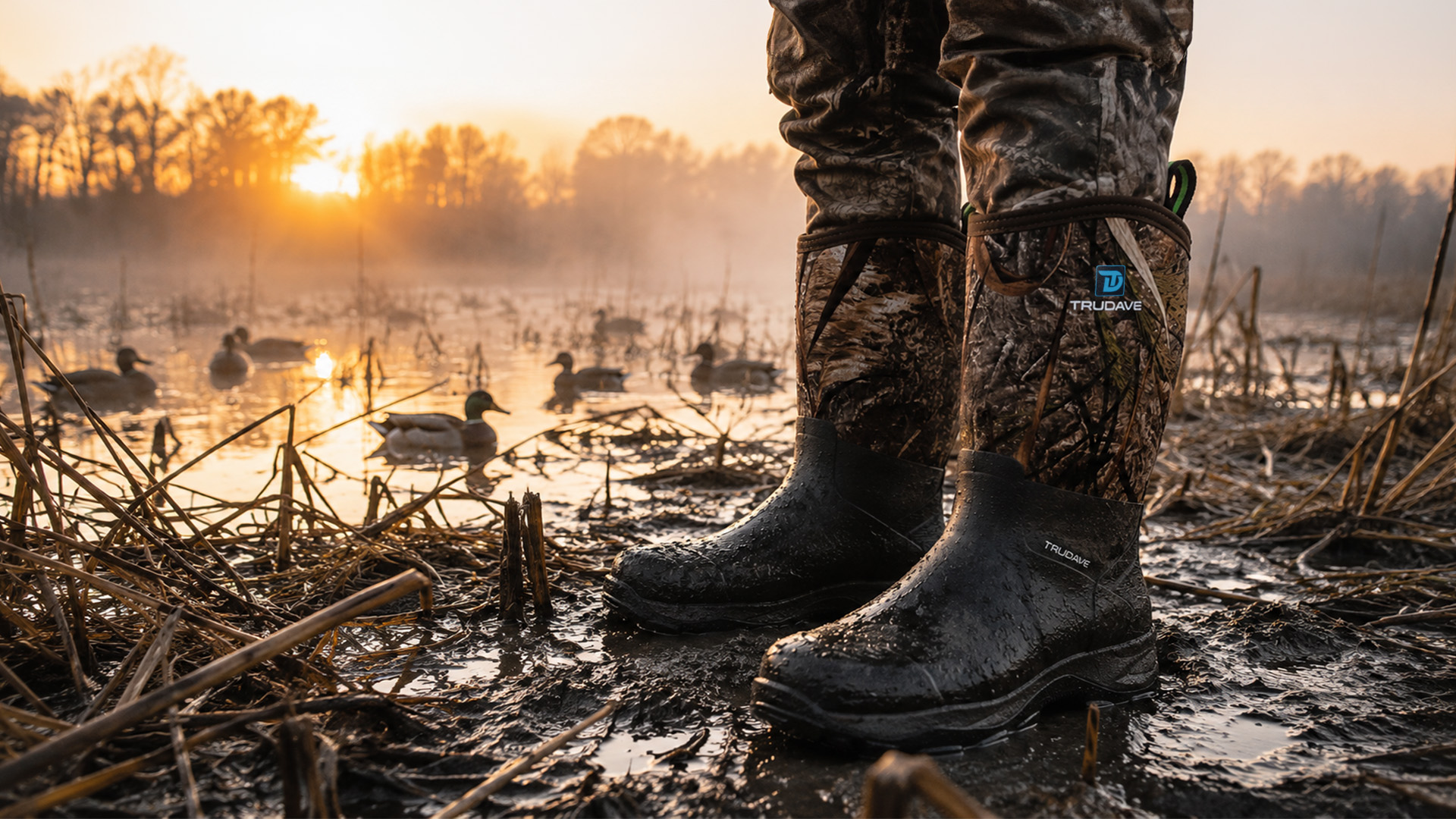
Introduction: The Enemy Inside
Every hunter knows the threat of external water—the creek that overflows its banks, the steady drizzle that soaks through leather, the standing puddle at the edge of the marsh. We spend hours researching waterproof ratings, treating seams, and selecting vulcanized rubber boots specifically to block that outside moisture. But we rarely give the same attention to an equally dangerous source of wetness: the moisture our own feet produce.
Your feet contain more sweat glands per square inch than almost any other part of your body. During a long hike into a stand or a strenuous spot-and-stalk, they can release up to half a pint of perspiration. In a traditional waterproof boot, that moisture has nowhere to go. It soaks into your socks, saturates the insole, and pools against your skin. The moment your activity level drops—when you settle into the stand, when the sun goes down, when the temperature dips—that trapped sweat becomes a serious liability. Water conducts heat 25 times faster than air, turning your socks into a cold compress that leeches warmth from your feet. What started as a little perspiration on the hike in becomes the reason you’re shivering, stomping, and climbing down three hours early.
This is the sweat trap, and it’s one of the most common yet least discussed reasons hunters suffer from cold feet. It’s not a failure of insulation. It’s a failure of moisture management. Trudave Gear’s hunting boot lineup—WildGuard, TrailGuard, and DryFlow—is engineered to address this problem at the material level. From breathable neoprene liners that wick moisture to fleece layers that actively pull vapor away from the skin, each boot is built to keep your feet dry from the inside out. In this guide, we’ll explore the science of internal moisture, how Trudave boots manage it, and the sock and care protocols that turn a potential liability into a non-issue.
Part 1: The Physiology of Foot Sweat
To manage moisture, you first have to understand where it comes from and why it’s such a problem once you stop moving. Your body’s thermoregulation system is designed to keep your core temperature stable. When you exert yourself—hauling a stand, climbing a ridge, or simply walking with a heavy pack—your muscles generate heat. To prevent overheating, your body releases sweat, and a significant portion of that comes from your feet. In a breathable shoe, much of that sweat evaporates. In a waterproof rubber boot, it doesn’t.
Why is this so dangerous? Water is a thermal conductor. The damp sock that forms during your walk in becomes a pathway for heat to escape your body the moment you stop generating warmth through activity. It’s the same principle that makes a wet wetsuit dangerous for a stationary diver. Your body can keep the moisture warm as long as you’re moving, but once you stop, that same moisture becomes an active cooling system—exactly the opposite of what you want in a cold-weather stand sit.
The physiology also explains why some hunters are more prone to the sweat trap than others. People who sweat heavily, who walk long distances to their stands, or who hunt in variable temperatures where they warm up on the move and then cool down dramatically are the most vulnerable. But even a moderate sweater can experience the effect if the boot’s interior can’t manage the moisture load.
Part 2: How Trudave Boots Manage Moisture
Trudave tackles the sweat trap with a multi-layer strategy. It begins with the liner—the material against your skin—and extends to the midsole, the neoprene shaft, and even the removable insole.
The Breathable Liner (WildGuard)
The WildGuard features a breathable mesh liner inside its 5mm neoprene upper. This liner is designed to wick moisture vapor away from the sock and toward the neoprene layer, where it can dissipate more effectively. It doesn’t trap sweat against the skin the way a non-wicking fabric would. For the hunter who walks significant distances before settling in, or who still-hunts between sits, this moisture management is critical. It prevents the buildup of dampness during the active phase and minimizes the cooling effect when activity stops.
The Fleece Liner (TrailGuard)
The TrailGuard takes a different approach, using a fleece liner atop the 5mm neoprene. Fleece is hydrophobic—it repels water—and actively moves moisture from the inner surface to the outer face, where it can evaporate or be absorbed by the neoprene. The fleece also provides a warm, soft feel against the skin and adds a second layer of insulation. For the stationary hunter facing extreme cold, this dual-layer system wicks moisture away while retaining maximum heat. The trade-off is that fleece is slightly less breathable than the WildGuard’s mesh liner, but in sub-freezing temperatures, the insulation advantage outweighs the breathability difference.
The Uninsulated, Breathable Approach (DryFlow)
The DryFlow has no insulation at all, and that’s a deliberate moisture-management choice. By stripping away the neoprene and fleece, the boot allows the foot’s climate to equalize more readily with the outside environment, reducing condensation inside the boot. The DryFlow’s interior is lined with a moisture-wicking fabric that keeps the skin surface dry. In warm-weather active hunts, this is the most effective way to avoid the sweat trap: don’t create a sealed, impermeable environment in the first place.
EVA Midsoles and Removable Insoles
All three Trudave hunting boots use EVA (ethylene-vinyl acetate) midsoles and removable insoles. EVA is a closed-cell foam that doesn’t absorb water. Unlike leather or felt insoles, which can become saturated and stay wet for days, an EVA insole dries quickly and retains its cushioning properties even after exposure to sweat. Removing the insoles after a hunt allows them to dry completely overnight—a simple habit that prevents the slow moisture accumulation that leads to cold feet and degraded cushioning.
The Neoprene Shaft
The 5mm neoprene used in the WildGuard and TrailGuard is a closed-cell foam that is naturally water-resistant. It doesn’t absorb sweat or external moisture. Combined with a breathable or fleece liner, it forms a moisture-management system that moves vapor away from the foot and toward the rubber outer shell, where it condenses harmlessly away from the skin. This is a significant upgrade over older rubber-and-fabric boot designs, where moisture would soak into the shaft lining and remain there for the duration of the hunt.
Part 3: The Sock System—Your First Line of Defense
Even the best moisture-wicking boot liner can’t compensate for the wrong sock. The sock is the layer directly against your skin; it determines whether sweat is pulled away or trapped. The three rules of a moisture-managing sock system are simple: avoid cotton, choose merino wool, and match the sock weight to your activity level and the boot’s insulation.
Why Cotton Fails
Cotton is hydrophilic—it loves water. It absorbs sweat, swells, and collapses into a dense, wet fabric that clings to the skin and actively accelerates heat loss. Once wet, cotton loses all insulating properties and becomes a breeding ground for blisters. There is no scenario in which a cotton sock belongs inside a hunting boot.
The Merino Advantage
Merino wool is hydrophobic at the fiber surface and hydrophilic at the core, which means it wicks moisture away from the skin while absorbing very little into the fiber itself. It can hold up to 30% of its weight in water before feeling wet, and it continues to insulate even when damp. It’s also naturally antimicrobial, reducing odor buildup on multi-day hunts. For the hunter looking to manage internal moisture, merino wool is the foundation.
Matching Sock to Boot
For the TrailGuard’s fleece-lined insulation in cold, stationary conditions, a heavyweight merino wool sock—or a two-layer system with a thin synthetic liner and a heavyweight merino outer—maximizes warmth and moisture wicking. The liner pulls sweat away from the skin, and the merino traps heat and moves moisture outward toward the fleece. For the WildGuard’s breathable liner, a midweight merino sock is often the ideal balance. It manages moisture during active movement and provides enough insulation for cool-weather sits. For the DryFlow, where the boot itself has no insulation, the sock is doing all the work. Lightweight merino for warm days, midweight for cool mornings, and always a change of socks in your pack for when you get back to the truck.
Part 4: Post-Hunt Drying and Maintenance
The moisture battle doesn’t end when the hunt is over. A boot that’s put away damp will still be damp on opening morning. Over time, that lingering moisture degrades the liner, the insole, and the neoprene itself.
Trudave’s care guidance is simple: remove the insoles after every hunt and let them air dry separately. Stuff the boots with crumpled newspaper, which wicks moisture out of the neoprene and liner. Leave them in a well-ventilated area at room temperature, never near a heat source. Direct heat—radiators, campfires, boot dryers with high heat settings—can damage the vulcanized rubber and cause the neoprene to lose its closed-cell structure. A low-heat convection dryer or simply room-temperature air is all you need.
For hunters who experience significant sweat buildup, carrying a spare pair of socks and swapping them after the hike in but before the sit can be transformative. A dry sock against a dry liner eliminates the damp layer that causes the sweat trap. The damp pair can be hung on your pack to dry, or tucked inside your jacket to warm up for the hike out.
At the end of the season, before storing boots, ensure they are completely dry inside. Any residual moisture can lead to mold and mildew that permanently damage the liner and create odors that are difficult to remove. A thorough interior cleaning with mild soap and water, followed by complete air drying, is a small investment that pays off when you pull the boots out next fall and they’re fresh, dry, and ready to hunt.
Part 5: The Moisture Management Matrix
| Boot | Insulation | Liner Type | Best Sock Match | Ideal Activity Profile |
|---|---|---|---|---|
| WildGuard | 5mm Neoprene | Breathable mesh | Midweight merino | Mixed walking/sitting, variable conditions |
| TrailGuard | 5mm Neoprene + Fleece | Fleece | Heavyweight merino or two-layer system | Stationary sits in extreme cold |
| DryFlow | None | Moisture-wicking fabric | Lightweight merino (warm) or midweight (cool) | Active movement, early season, warm weather |
Conclusion: Dry From the Inside Out
The industry spends a fortune marketing waterproof membranes and sealed seams to keep external moisture out, but the water that ruins a hunt is often the water your own body creates. Managing that internal moisture is not a luxury—it’s a core hunting skill. It requires understanding your own sweat profile, choosing a boot with a liner that actively wicks rather than passively absorbs, pairing it with merino wool socks, and developing the discipline to dry your gear between uses.
Trudave Gear’s WildGuard, TrailGuard, and DryFlow series address internal moisture at every level: breathable liners that move vapor, fleece that wicks without chilling, EVA insoles that don’t hold water, and removable footbeds that dry fast. Combined with the right sock and a simple drying routine, these boots help you escape the sweat trap—so you can stay in the stand, on the stalk, or in the blind longer, with feet that are warm because they’re truly dry.
To explore the full Trudave Gear hunting boot lineup and find the moisture-management system that fits your hunt, visit trudavegear.com.
