
Sage grouse country can overwhelm a hunter.
The landscape seems endless.
Sagebrush stretches from one ridge to another.
Open basins disappear into distant mountains.
There may be miles of habitat that all looks exactly the same.
A hunter walks for an hour.
Nothing.
Then the vegetation changes slightly.
The sage gets taller.
A damp meadow appears below a ridge.
Green plants grow along the edge.
Several large grouse suddenly rise from the brush.
The entire flock had been sitting in a patch of habitat that looked only slightly different from everything surrounding it.
That is one of the biggest lessons in sage grouse hunting.
The birds live in enormous sagebrush landscapes.
But they do not use every acre equally.
Successful hunters learn to identify the places where food, moisture, sage structure, elevation, weather, and seasonal needs overlap.
Find those differences and the landscape becomes much smaller.
Sage Grouse Depend on Sagebrush
Greater sage-grouse are closely associated with sagebrush ecosystems across portions of western North America.
Sagebrush provides:
- Food
- Security
- Winter habitat
- Cover from weather
This relationship is much stronger than the habitat connection of many other upland birds.
If good sagebrush disappears, sage grouse habitat disappears with it.
That is why hunters should stop thinking of sage merely as brush.
For these birds, it is the foundation of the landscape.
Not All Sagebrush Is Equal
A huge sage flat can contain many different habitat conditions.
Look for changes in:
- Sage height
- Sage density
- Ground vegetation
- Moisture
- Terrain
- Forb abundance
One section may be dry and sparse.
Another may have better grass and green plants underneath.
Those subtle differences influence bird use.
The hunter who simply walks straight across a uniform basin may spend miles in low-probability habitat.
Seasonal Habitat Changes the Hunt
Sage grouse do not necessarily use the same exact habitat all year.
Their seasonal needs can shift between:
- Breeding areas
- Brood habitat
- Summer feeding areas
- Fall transition habitat
- Winter sagebrush
Hunters should understand where birds are likely to be during the legal season in the specific region.
A spring lek location may help identify a broader population area.
It does not automatically mean birds will be standing on that exact location months later.
Wet Meadows Can Be Extremely Important
During warmer periods, moist areas can provide valuable green vegetation and insects.
Productive habitat may include:
- Wet meadow edges
- Springs
- Seep zones
- Creek corridors
- Irrigated transitions where legally accessible
The key is often the edge.
Birds may feed near moisture and then retreat into surrounding sagebrush for security.
Search the transition rather than only the wettest center.
Green Vegetation Is a Strong Clue
When the surrounding high desert becomes dry, patches of green vegetation stand out.
Sage grouse may be attracted to areas containing:
- Forbs
- Insects
- Moist plants
This can make late-summer and early-fall scouting easier.
From a high point, glass for green zones before walking.
A small strip of productive vegetation can concentrate birds from a much larger surrounding basin.
Follow the Moisture Gradient
Do not think only in terms of “wet” or “dry.”
Look at how moisture changes across the landscape.
For example:
A spring may feed a narrow green drainage.
The drainage may transition into taller sage.
Then into dry open sage flats.
Birds can move between each of these zones throughout the day.
That sequence is more valuable than the spring alone.
Morning Feeding Areas Can Be Productive
Cool mornings may find birds feeding in or near open habitat.
Search around:
- Meadow edges
- Low basins
- Forb-rich sage
- Gentle slopes
Early light can make movement easier to detect.
Do not immediately start walking through the center.
Glass first.
A group of sage grouse can be visible from far away if you know what to look for.
Sage Grouse Can Be Surprisingly Large
Hunters familiar with quail or Hungarian partridge may be surprised by sage grouse size.
Their larger body can make them seem easy to spot.
That is misleading.
Sagebrush hides birds exceptionally well.
A grouse can sit beneath one plant and disappear completely.
Look for:
- Head movement
- Neck profile
- Dark body shape
- Walking birds between bushes
Movement is often easier to detect than the full bird.
Glassing Saves Miles
Binoculars are extremely useful in open sage country.
From a ridge, scan:
- Meadow edges
- Short sage
- Open spaces between brush
- Water-associated vegetation
You may not identify every bird immediately.
But groups moving through open patches can reveal a productive zone.
Ten minutes of glassing can save an hour of random walking.
Use Elevation to Understand the Basin
A small ridge or hill provides perspective.
From above, hunters can identify:
- Drainages
- Green patches
- Sage height changes
- Terrain breaks
These details are harder to understand from ground level.
Before entering a large basin, gain enough elevation to read it.
Then choose the route.
Low Ridges Can Hide Entire Flocks
Open terrain creates a visual illusion.
A basin may look completely visible.
A subtle rise can hide dozens of birds.
When approaching likely habitat, remember that the landscape has more relief than it appears to from distance.
Move carefully over ridges.
Do not walk directly on the skyline.
Sage Grouse Often Walk Before Flushing
Like several prairie birds, sage grouse may move on foot when pressured.
A group can drift through sagebrush without immediately flying.
Watch for:
- Heads between bushes
- Sage movement
- Birds crossing small openings
If birds are walking away, avoid simply following directly behind.
Change the angle when terrain allows.
Do Not Push Birds Across the Entire Basin
One of the easiest mistakes is turning a hunt into a long chase.
Birds flush.
Hunter follows.
Birds land farther away.
Hunter follows again.
Eventually both hunter and birds have crossed miles of habitat.
Instead, watch the first flush carefully.
Ask whether the landing zone provides:
- Better cover
- Food
- A realistic second approach
Sometimes the smarter move is finding another group.
Watch Every Bird Until It Lands
Large sage grouse can cover significant distance.
Use landmarks such as:
- Lone juniper
- Rock outcrop
- Fence corner
- Meadow edge
- Distinct ridge
Do not rely on “somewhere near that sage patch.”
Everything looks similar once you begin walking.
Precise observation creates the second opportunity.
Scattered Birds Can Behave Differently
A flock may split after flushing.
Singles or smaller groups may settle into separate sage pockets.
These birds may hold tighter.
Approach slowly.
Let them settle first.
The second flush can be much closer than the first.
Midday Cover Can Be Different
As temperatures rise, birds may move toward:
- Taller sage
- Shaded slopes
- Moist cover
- Wind-protected habitat
A meadow edge that produced at sunrise may look empty by noon.
Do not assume the birds left the region.
They may have shifted only several hundred yards into security cover.
Heat Changes Bird and Hunter Behavior
Early sage grouse seasons can occur during warm conditions.
Open high desert offers little shade.
Hunters and dogs can overheat.
Start early.
Carry enough water.
Take breaks.
Heat can become dangerous even at moderate elevation.
Dogs Need Extra Water
Bird dogs may cover several times the distance walked by hunters.
Carry clean water.
Do not rely entirely on:
- Stock tanks
- Springs
- Ponds
Some may be dry, contaminated, or far from the hunting route.
Hydration is part of dog management.
Dog Range Should Match Open Country
Sage country can tempt dogs to range very wide.
Open visibility makes long range seem manageable.
But birds may also run.
A dog working too far ahead can push birds before hunters arrive.
Balance range with control.
Watch the dog carefully.
Pointing Dogs Can Help Locate Hidden Birds
A trained pointing dog can transform the hunt.
Sage grouse may be invisible beneath brush.
The dog reveals where the scent is.
But strong winds and dry conditions can make scenting difficult.
Give the dog time.
Do not assume an uncertain point means no birds.
Dry Conditions Can Make Scenting Harder
High-desert air can be:
- Dry
- Warm
- Windy
These conditions may reduce scenting consistency.
Birds may also leave little ground moisture.
Work into or across the wind when practical.
Observe dog behavior instead of expecting perfect textbook points all day.
Rain Can Improve Conditions
Rain may change sage grouse hunting in several ways.
It can:
- Reduce dust
- Improve scenting conditions
- Create soft tracking surfaces
- Refresh vegetation
After rain, look for activity around:
- Wet meadow edges
- Roads
- Low ground
Fresh tracks can help confirm current use.
Mud Can Appear Quickly in Sage Country
High desert does not always mean dry walking.
After storms, hunters may encounter:
- Clay mud
- Wet grass
- Standing water
- Soft two-track roads
These conditions can make ordinary footwear uncomfortable very quickly.
Waterproof Footwear Helps After Storms
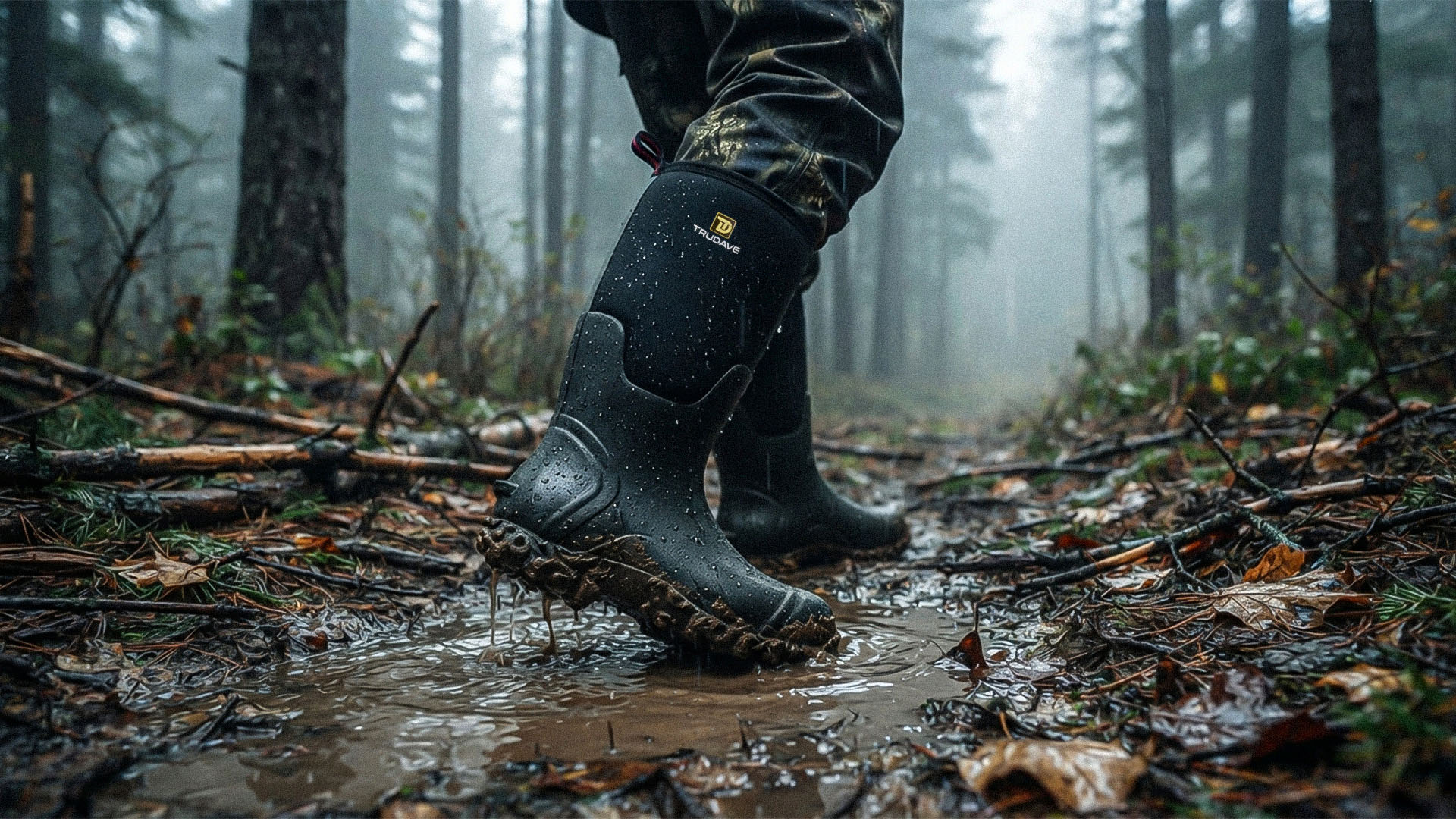
Hunters covering these conditions may benefit from waterproof hunting boots for sagebrush upland hunting that provide secure fit, dependable traction, and enough moisture protection for wet grass, clay mud, and shallow drainage crossings.
The key is maintaining mobility.
Sage grouse hunting may require many miles of walking.
Lightweight Boots Usually Make Sense
This is active upland hunting.
Every extra pound moves thousands of times over the course of a day.
Choose footwear that balances:
- Weight
- Support
- Waterproofing
- Durability
A heavy winter boot can become exhausting during mild early-season conditions.
Boot Height Depends on Habitat
Some sage basins are extremely dry.
Others include:
- Wet meadow edges
- Creek crossings
- Mud
A moderate waterproof boot may provide enough protection without the bulk of taller marsh footwear.
Choose based on actual scouting.
Heel Fit Matters Over Long Distances
Rolling sage country creates constant small climbs and descents.
A loose heel can cause:
- Blisters
- Hot spots
- Fatigue
Break footwear in before hunting.
Test it over real uneven ground.
Clay Mud Can Fill Outsole Tread
After rain, high-desert clay may stick aggressively to boots.
When tread fills:
- Traction decreases
- Weight increases
Clean excessive mud when necessary.
Be cautious on slopes and wet roads.
Sagebrush Can Be Hard on Clothing
Constant walking through sage can wear on:
- Pants
- Boot uppers
- Gaiters
Durable clothing matters.
You do not necessarily need heavy brush gear.
But extremely fragile materials can suffer after repeated contact.
Gaiters Can Help
Low gaiters may reduce:
- Seeds
- Dust
- Gravel
- Wet vegetation
entering footwear.
They can also protect lower pant legs from constant sage contact.
Grass Seeds Can Be a Dog Hazard
High-desert vegetation may contain awns and seeds capable of irritating dogs.
Check:
- Eyes
- Ears
- Nose
- Paws
- Coat
after hunting.
Persistent irritation should receive veterinary attention.
Cactus May Appear in Some Sage Regions
Depending on location, prickly pear or other cactus may occur.
Watch the ground.
A dog moving fast through low vegetation can encounter spines before the handler notices the plant.
Carry appropriate first-aid supplies.
Snakes Can Still Be Active in Warm Weather
Early-season sage hunting may overlap warm temperatures.
Depending on region, venomous snakes can remain active.
Use caution around:
- Rock
- Brush
- Warm slopes
Know local risks.
Control dogs.
Water Sources Can Become Scouting Hubs
During dry periods, available water can concentrate wildlife.
Sage grouse may use areas around:
- Springs
- Stock water
- Wet meadows
- Creek corridors
Do not assume birds need to stand directly beside water.
Search the surrounding sage and feeding vegetation.
Stock Tanks Can Confirm Activity
Mud around stock water may show:
- Tracks
- Droppings
- Bird movement
However, livestock can heavily disturb the surface.
Use multiple clues.
A few bird tracks in cattle mud are useful only when habitat around the tank also makes sense.
Livestock and Sage Grouse Can Share Landscapes
Many sage grouse areas are working ranchlands.
Hunters should respect:
- Cattle
- Fences
- Gates
- Water infrastructure
Do not disturb livestock unnecessarily.
Leave gates exactly as instructed.
Good access depends on responsible behavior.
Grazing Can Change Habitat Structure
Livestock grazing affects vegetation height and density.
Some areas may become:
- More open
- Easier to walk
- Different in food composition
The effect varies with intensity, timing, and local ecology.
Observe which pasture structures birds actually use.
Do not assume grazed or ungrazed is automatically better.
Fence Lines Can Influence Movement
Sage grouse may encounter extensive fencing across western landscapes.
Hunters should watch for areas where birds regularly travel near:
- Fence corners
- Low crossings
- Open lanes
Fence awareness is also important for dogs.
Old wire can be difficult to see in sagebrush.
Barbed Wire Requires Constant Attention
When crossing fences:
- Use gates where permitted
- Handle firearms safely
- Protect dogs
- Avoid damaging wire
Do not rush because birds landed on the other side.
The fence is part of the landowner’s working infrastructure.
Two-Track Roads Are Useful for Scouting
Remote dirt roads can help hunters inspect huge sage basins.
Look for:
- Tracks
- Droppings
- Bird sightings
- Meadow access
But do not turn the hunt into continuous driving.
Once productive habitat is located, hunting on foot becomes the real strategy.
Roads Can Become Dangerous After Rain
High-desert dirt roads may turn from dusty to impassable quickly.
Clay can become:
- Slick
- Deep
- Easy to rut
Respect closures.
Avoid damaging wet roads.
Parking and walking is often the better choice.
Public Land Can Offer Large Hunting Landscapes
Sage grouse country often includes public land.
Research:
- Open units
- Access
- Road systems
- Private inholdings
- Regulations
A huge parcel does not automatically mean good hunting.
Habitat quality still matters.
Remote Country Requires Navigation
Sagebrush basins can become surprisingly confusing.
One drainage resembles another.
A ridge seen from the vehicle may disappear once you descend.
Carry reliable navigation.
Mark:
- Vehicle
- Main roads
- Water
- Property boundaries
Do not depend entirely on cell service.
Carry a Headlamp
A late covey relocation can extend the return walk.
Open desert feels simple until darkness removes distant landmarks.
A headlamp and backup power should be part of the pack.
Weather Changes Quickly
High-desert weather can bring:
- Wind
- Rain
- Cold fronts
- Early snow
A warm morning can become uncomfortable quickly at elevation.
Carry layers.
Monitor changing conditions.
Early Snow Can Reveal Bird Movement
Fresh snow provides valuable scouting information.
Tracks may reveal:
- Feeding areas
- Travel routes
- Roosting or loafing habitat
Birds may also shift toward vegetation with easier food access.
Follow current snow conditions.
Deep Snow Changes the Landscape
During later seasonal conditions where legal hunting overlaps snow, birds may use areas where sage remains exposed above the snowpack.
Sage itself becomes especially important as other food disappears.
This reinforces why protecting large connected sagebrush landscapes matters.
Wind Can Make Shooting Difficult
Open sage country often means strong wind.
Bird flight can become:
- Faster
- Angled
- Unpredictable
Do not compensate for poor positioning by taking overly ambitious shots.
Better habitat strategy should create closer opportunities.
Pick One Bird From the Flush
A group of large grouse rising together can create visual overload.
Choose one legal bird.
Track it clearly.
Maintain awareness of:
- Dogs
- Partners
- Background
Controlled shooting is more effective than reacting to the whole flock.
Sage Grouse Can Flush Low
Low birds in open terrain create safety concerns.
A ridge may hide:
- Another hunter
- Livestock
- Road
Know the background before shooting.
If uncertain, let the bird go.
Multiple Hunters Need Clear Spacing
Open terrain allows hunters to spread effectively.
Establish:
- Direction
- Spacing
- Shooting zones
- Dog position
before entering likely habitat.
Do not converge suddenly when birds are near.
Blaze Orange Can Improve Visibility
Follow current legal requirements.
Even in open sage, hunters can disappear behind terrain folds.
Visible clothing improves partner awareness.
Mark Downed Birds Immediately
Sage grouse are large, but a downed bird can disappear beneath brush.
Mark:
- Distinct sage plant
- Rock
- Ridge line
- Dog location
Walk directly to the fall.
Do not focus on the rest of the flock until recovery begins.
Wounded Birds Can Move Through Sage
A bird may run after landing.
Search:
- Feathers
- Tracks
- Dog behavior
- Disturbed vegetation
Give recovery serious effort.
Small game and upland birds deserve the same ethical attention as larger game.
Warm Weather Requires Game Care
Early seasons may remain warm.
Keep harvested birds:
- Clean
- Cool
- Shaded
Follow current legal requirements for transport and species identification.
Sage Grouse Regulations Can Be Highly Restrictive
This is especially important.
Greater sage-grouse hunting opportunity may be:
- Limited
- Closely managed
- Closed in some areas
- Subject to short seasons
- Restricted by unit
Population status and conservation concerns can affect regulations.
Hunters must verify current official rules before planning a hunt.
Never Assume Sage Grouse Are Open Everywhere
The presence of birds does not mean hunting is legal.
Check:
- State regulations
- Open hunt units
- Season dates
- Bag limits
- Permit requirements
- Land-specific restrictions
Use current official wildlife-agency information.
Do not rely on an older article.
Species Identification Matters
Other grouse or prairie birds may overlap in portions of the West.
Learn to identify:
- Body shape
- Tail
- Size
- Plumage
- Habitat associations
before hunting.
Positive identification is required.
Conservation Is Central to Sage Grouse Hunting
Sage grouse depend on large connected sagebrush ecosystems.
Threats can include:
- Habitat fragmentation
- Wildfire
- Invasive plants
- Development
- Loss of wet meadow habitat
Hunters benefit directly from sagebrush conservation.
Protecting habitat protects wildlife and future hunting opportunity.
Avoid Damaging Fragile Habitat
High-desert soil can be vulnerable to unnecessary vehicle traffic.
Stay on legal roads.
Avoid creating new tracks.
Respect seasonal closures.
A responsible hunt should leave as little impact as practical.
Common Sage Grouse Hunting Mistakes
Treating Every Sage Flat the Same
Look for moisture, food, and vegetation differences.
Walking Before Glassing
Use high points to read the basin first.
Ignoring Wet Meadow Edges
Moisture can create critical feeding habitat.
Chasing the Same Flock for Miles
Watch where birds land and decide whether a second approach actually makes sense.
Wearing Heavy or Leaky Boots
Sage hunting requires lightweight mileage plus protection after rain.
Ignoring Heat and Dog Hydration
Open high desert can be physically demanding.
Failing to Check Regulations Carefully
Sage grouse seasons can be extremely limited.
Forgetting Habitat Conservation
There is no sage grouse hunt without healthy sagebrush.
Frequently Asked Questions
Where do greater sage-grouse live?
They are strongly associated with sagebrush ecosystems containing suitable seasonal feeding, nesting, brood-rearing, and winter habitat.
What is the best habitat to hunt sage grouse?
During legal seasons, productive habitat may include sagebrush near wet meadow edges, forb-rich areas, water-associated vegetation, and seasonal transition zones. Local conditions matter greatly.
Are sage grouse hard to find?
They can be. The landscape is enormous and birds may concentrate in relatively small high-quality habitat patches within otherwise similar-looking sagebrush.
Can you hunt sage grouse with a dog?
Where legal, trained bird dogs can help locate birds hidden in sagebrush. Heat, distance, water availability, and ground hazards require careful dog management.
What boots are best for sage grouse hunting?
Lightweight waterproof hunting boots with secure fit, durable construction, and dependable traction for sagebrush, wet grass, clay mud, and long-distance walking are practical.
Are sage grouse hunting seasons open everywhere?
No. Hunting opportunity varies significantly by state, unit, and population status. Some areas may be closed or highly restricted, so current official regulations must always be checked.
Final Thoughts
Sage grouse hunting teaches hunters that a landscape can look uniform without being uniform at all.
One sage flat is dry.
Another has green forbs underneath.
One drainage holds moisture.
Another does not.
One wet meadow edge feeds birds.
One ridge provides security.
The difference may be subtle to a person.
It is not subtle to a sage grouse.
Glass before walking.
Find the moisture.
Study sage structure.
Watch how birds use meadow edges.
Carry enough water.
Protect dogs from heat and seeds.
Wear boots that let you cross miles of sage, wet grass, clay mud, and uneven high-desert terrain without avoiding the habitat you need to hunt.
And most importantly, verify that the season and area are legally open before going.
Because sage grouse hunting depends on something larger than finding birds.
It depends on keeping enough healthy sagebrush country on the landscape for those birds to remain there.
