
Introduction: The Size on the Box Isn’t the Whole Story
Ordering hunting boots online can feel like a gamble. You know your sneaker size, but hunting boots are a different animal. They’re built with thick insulation, rigid rubber shells, or flexible neoprene uppers that change the fit equation. If you get the wrong size, your feet will pay the price on every step—pinched toes, blistered heels, or sloppy, unstable footing that can turn a dream hunt into a miserable slog.
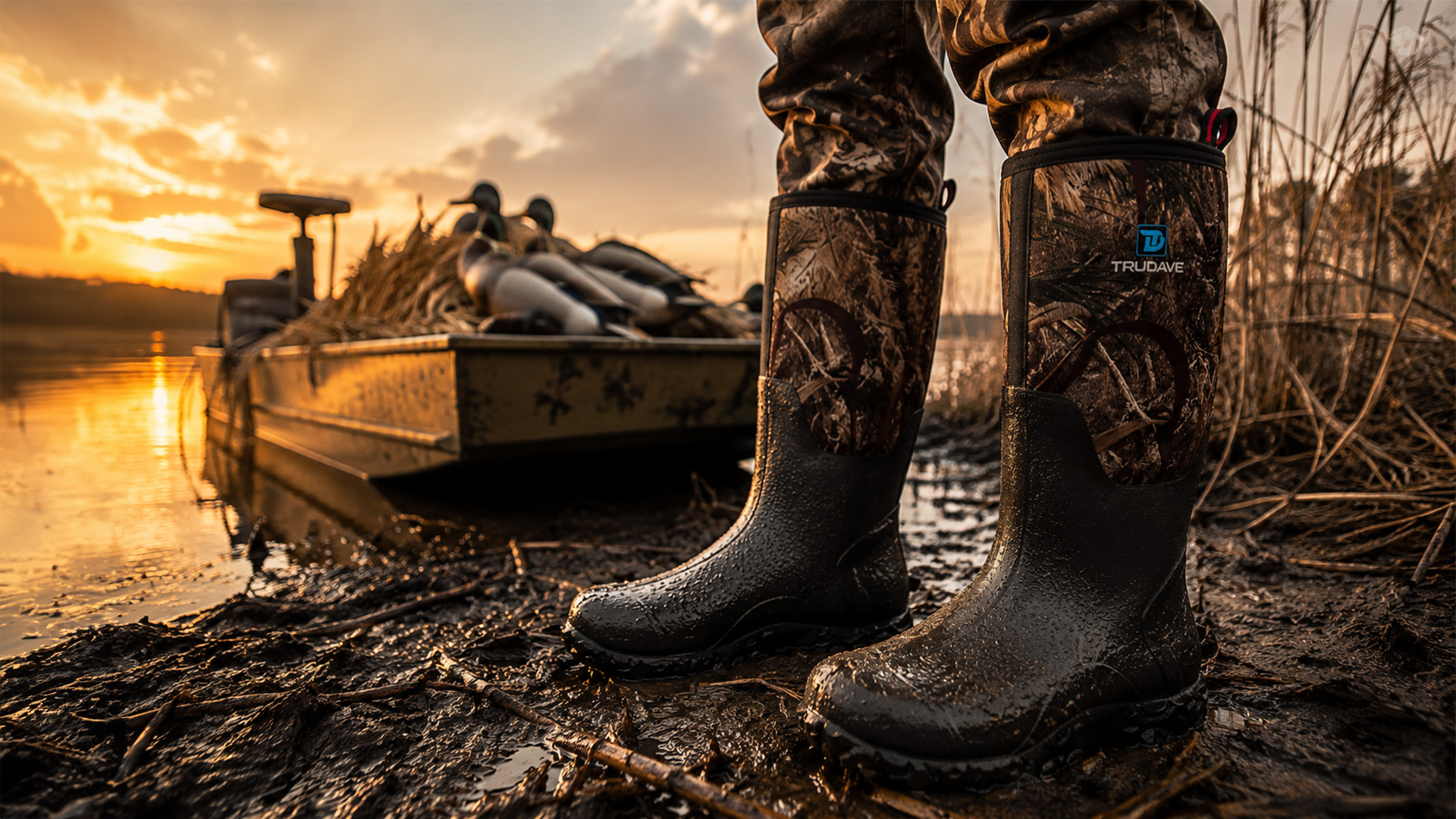
Trudave Gear’s WildGuard, TrailGuard, and DryFlow hunting boots are engineered for comfort and performance, but only if you nail the sizing. The good news is that Trudave’s intentionally generous fit (that “runs slightly large” feedback you see in reviews) is a feature, not a flaw. It’s designed to accommodate the thick merino wool socks your feet need in cold weather and to leave room for custom insoles. But to make it work for you, you need to start with the right size and then fine-tune it.
This guide will walk you through exactly how to measure your feet, how to interpret Trudave’s size charts, what to expect from each boot series, and how to dial in the perfect fit with socks and insoles—so the boots you pull on at 5 a.m. feel like they were made for you.
1. Forget Your Sneaker Size. Start with a Ruler.
Shoe sizes are a mess. A size 10 in one brand can be a 9.5 or 10.5 in another, especially when comparing athletic sneakers to vulcanized rubber boots. Trudave builds its boots with a specific insole length for every marked size, and that insole length is your true north.
How to Measure Your Feet at Home:
- Put on the exact socks you plan to wear hunting. For most cold-weather hunts with WildGuard or TrailGuard boots, that’s a midweight or heavyweight merino wool sock.
- Tape a piece of paper to a hard floor, flush against a wall.
- Stand on the paper with your heel touching the wall, your weight evenly distributed.
- Have someone mark the tip of your longest toe (it’s often the second toe, not the big one). If you’re alone, carefully bend down and make the mark while keeping your foot firmly planted.
- Measure from the edge of the paper (the wall) to the mark in inches. Do this for both feet—most people have one slightly larger, and you should fit to the larger foot.
Now, check the Trudave size chart. Each boot’s product page lists insole lengths. A general guide (using the StreamTrek chart, which mirrors the hunting line) shows that a Men’s 9 has a roughly 10.6-inch insole, a size 10 is about 10.9 inches, and a size 11 is around 11.2 inches. For a comfortable fit, your measured foot length should be at least 0.3 to 0.5 inches shorter than the insole length. This margin prevents your toes from jamming against the front when you’re walking downhill or when your feet swell during a long day.
If your foot measures 10.5 inches, a size 10 (10.9-inch insole) will give you roughly 0.4 inches of toe room—perfect. If you’re right at the borderline, size up.
2. The “Runs Large” Factor: Why It’s a Feature, Not a Bug
Across Trustpilot and independent reviews, you’ll read that Trudave boots “run slightly large.” This is intentional, and here’s why.
When you’re sitting motionless in a tree stand at 15°F, your feet aren’t generating much heat. You depend on thick wool socks to keep your toes warm, and those socks need room. A boot that fits snugly with thin cotton socks will be painfully tight—and dangerously cold—with the heavyweight merino wool you actually need. Trudave builds in extra volume so that you can layer socks without compromising circulation. A boot that’s too tight restricts blood flow, which makes your feet colder, not warmer.
The neoprene uppers on the WildGuard and TrailGuard add another layer of forgiveness. Neoprene has some natural stretch and will conform to the shape of your calf and forefoot over the first few wears. This means even if the boot feels slightly roomy out of the box, it will settle into a more customized, secure fit once it’s warmed by your body heat and flexed through a few hikes.
However, if you have narrow feet or low-volume feet, the extra room can be too much of a good thing. That’s where the next section comes in.
3. Dialing In: Socks, Insoles, and Heel Grips
A boot that’s 90% right can be made 100% right with a few simple adjustments.
Sock Thickness Is Your Volume Control.
- Maximum volume (cold weather): Heavyweight merino wool socks. These fill the extra space completely, provide maximum insulation, and give a snug, secure feel. Ideal for the TrailGuard in late-season stands.
- Moderate volume (cool to cold): Midweight merino wool socks. The sweet spot for the WildGuard during mixed activity. Enough cushion and warmth without making the boot feel too tight.
- Minimum volume (warm weather or narrow feet): A lightweight merino sock paired with a thicker insole. Use this if you’re hunting early season in the DryFlow and find the boot too roomy with lighter socks.
Insoles Take Up Space and Add Support.
All Trudave hunting boots have removable EVA insoles. If you need to take up volume because your feet are narrow or you’re between sizes, swapping the stock insole for a thicker one makes a huge difference. Trudave’s own ToughCush Comfort Insole is an excellent upgrade—it’s denser than the stock insole, adds arch support, and fills about an extra half-sock’s worth of volume. For even more volume reduction, a high-volume aftermarket orthotic can be used.
If you find the boot slightly too tight with thick socks, you can do the reverse: switch to a thinner insole (or use the stock insole without additional inserts) and go down one sock weight. The removability of the insole makes this a versatile system.
Heel Grips Stop Slippage.
If your heel lifts more than a quarter-inch inside the boot even after adjusting socks and insoles, an adhesive heel grip applied to the inside back of the shaft will solve the problem. These cost about $7 and can be the difference between a blister-free hunt and a painful walk out. They’re especially useful for women or hunters with narrow heels.
4. Series-Specific Fit Notes
Not all Trudave hunting boots fit the same way. Here’s what you need to know for each.
TrailGuard (Fleece-Lined, Maximum Insulation)
The fleece liner on the TrailGuard adds significant interior volume, so this boot fits slightly snugger than the WildGuard at the same marked size. It’s designed for extremely cold conditions with heavy socks. If you’re between sizes, you may want to size up to accommodate the fleece and thick wool socks you’ll be wearing. If you’re a half-size and plan to wear heavyweight socks, go up; if you’re wearing midweight socks, you may be fine in the smaller size. The neoprene upper will stretch slightly with wear, but the fleece takes up space initially.
WildGuard (Breathable Liner, Neoprene Upper)
The breathable liner is thinner than fleece, so the WildGuard feels slightly more spacious out of the box. It’s the most versatile fit, accommodating a wide range of sock weights. Most hunters will be happy in their standard size with midweight socks. If you have narrow feet, use a thicker insole and a heavier sock to dial it in.
DryFlow (Zero Insulation, Industrial Rubber)
The DryFlow has no neoprene or fleece, so the fit is determined entirely by the vulcanized rubber shell. It runs true to size but with that same intentional volume for work socks. Because it’s uninsulated, you’ll often wear it with lighter socks in warmer weather. If you’re between sizes and plan to wear lightweight socks, size down. If you plan to wear it as a cool-weather work boot with thick socks, order your standard size. The structured heel cup does a great job of locking the foot in place, so even if there’s a bit of extra room in the toe box, you shouldn’t experience heel slip.
5. The Golden Rule: Try Them On at Home
Never take new boots straight into the field. When your Trudave boots arrive, do this:
- Put on the exact sock system you’ll hunt in.
- Slide the boots on and walk around your house (on carpet to keep the soles clean) for at least 15-20 minutes.
- Walk up and down stairs or a sloped surface if possible. Your toes should not touch the front of the boot on a downhill step. Your heel should lift no more than a quarter-inch. The fit should feel snug around the ankle and midfoot but roomy enough to wiggle your toes.
- If anything feels off—pinching, excessive slipping, pressure points—stop. Exchange them for a different size or try the insole/sock adjustments described above. It’s much better to wait a week for the right size than to suffer through a season in the wrong one.
Trudave’s direct-to-consumer model means you can’t try before you buy, but their sizing guidance and exchange process make it easy to get it right. Pay attention to the size chart, trust your measurements, and don’t be afraid to order two sizes if you’re between them and return the one that doesn’t fit.
Conclusion: Fit Is a Process, Not a Guess
A hunting boot that fits is a boot you’ll forget you’re wearing. Your mind stays on the game, not on your feet. Achieving that perfect fit isn’t luck—it’s a process of measuring your feet, understanding the boot’s design philosophy, and then fine-tuning with socks and insoles until the boot feels like it’s part of you.
Trudave Gear’s WildGuard, TrailGuard, and DryFlow boots are built with that process in mind. The removable insoles, the stretchable neoprene, and the intentional volume for thick socks aren’t design flaws—they’re invitations to customize. Take the time to dial yours in, and your feet will reward you with mile after mile of dry, warm, blister-free hunting.
To find your perfect fit and explore the complete Trudave Gear hunting boot lineup, visit trudavegear.com.
