
Introduction: The Decision at the Water’s Edge
It’s a moment every hunter knows. You’re half a mile from the truck, the morning is still dark, and the creek that was barely a trickle on your scouting trip is now running fast and murky from last night’s rain. The far bank is where the good bedding area begins, where the big buck you’ve been patterning all summer is likely moving just before first light. But between you and that buck is ten feet of cold, thigh-deep water.
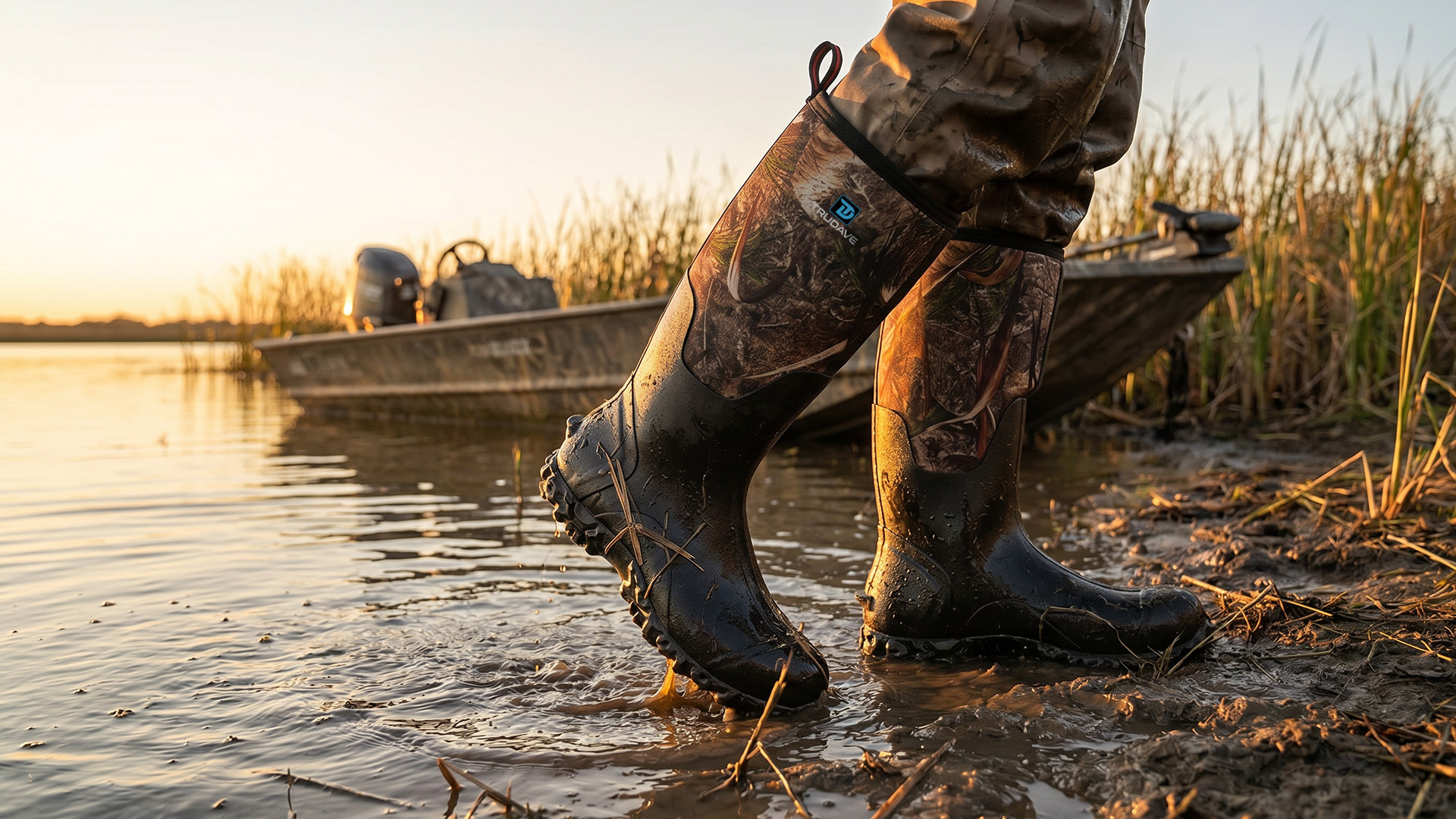
Do you cross? If your boots are all-leather, the answer is probably no—the long, squelching walk out after a saturated boot will be miserable at best and dangerously cold at worst. If your boots are cheap rubber with glued seams, you might risk it, only to feel that icy trickle of a failed seal halfway across. But if you’re wearing Trudave Gear’s hunting boots—WildGuard, TrailGuard, or DryFlow—the calculus changes. These boots are engineered with vulcanized natural rubber, sealed seams that can’t delaminate, and insulating neoprene that stays warm even when submerged. A creek crossing isn’t a hunt-ender; it’s just another obstacle to manage.
This guide dives deep into the art and science of wet-weather hunting. We’ll explore how Trudave boots handle full immersion, why neoprene is the secret to staying warm when wet, the exact step-by-step method for crossing water safely, and the post-crossing routine that gets your feet dry and back in the hunt within minutes.
1. Why Waterproof Isn’t Enough—The Case for Vulcanized Seams
Most hunting boots are labeled “waterproof,” but the term is applied so loosely it’s almost meaningless. A boot with a waterproof membrane stitched into a leather upper can keep moisture out during a light rain or a walk through dewy grass. Submerge that same boot in a creek, however, and the weaknesses appear. Water seeps through the stitching holes. The membrane, compressed by the pressure of the water, fails. The leather soaks through, becoming a heavy, sodden weight on your feet.
Trudave’s WildGuard, TrailGuard, and DryFlow take a completely different approach. The lower shell of each boot is made from vulcanized natural rubber—a material that has been chemically cross-linked with sulfur and heat to become a single, continuous, impermeable barrier. There are no stitched seams for water to penetrate. The bond between the rubber lower and the neoprene upper on the WildGuard and TrailGuard is vulcanized as well, meaning it’s a molecular fusion, not a glued joint that can separate over time.
What this means in the field is simple. Step into a creek, stand in a flooded marsh, walk through standing water that laps at your calves—the water stays out. The seal doesn’t weaken. The boot doesn’t get heavier as the day wears on. When you climb out on the far bank, your socks are as dry as they were when you left the truck. This absolute waterproofing is what turns a hunt-threatening obstacle into a manageable inconvenience.
2. The Neoprene Advantage: Insulation That Works When Wet
Crossing a creek isn’t just about staying dry; it’s about staying warm. Water pulls heat from your body 25 times faster than air. If your feet are submerged in cold water, even for a few seconds, the conductive heat loss can leave you with numb toes and a rapidly dropping core temperature. This is where the WildGuard and TrailGuard’s 5mm neoprene uppers provide a critical advantage.
Neoprene is the same closed-cell foam used in wetsuits. It insulates by trapping millions of microscopic air bubbles in its polymer matrix. Because the cells are closed, the insulation remains effective even when the boot is fully submerged. The 5mm thickness provides substantial warmth, maintaining a layer of body-warmed air around your foot and lower leg. Combined with the right merino wool sock, the neoprene in a Trudave boot will keep your feet from going numb during a quick creek crossing, and will continue to insulate even if a small amount of water splashes over the top.
The TrailGuard adds a fleece liner to the neoprene equation, boosting warmth even further for late-season hunts when the water is near freezing. The fleece wicks any incidental moisture away from the skin while trapping body heat in its fibers. For the hunter who faces icy water in November or December, the TrailGuard is the safer choice.
For the early-season hunter, the DryFlow takes the opposite approach: zero insulation, but the same absolute waterproofing. It’s built for warm-weather creek crossings where the water is cool but not dangerously cold, and you’ll generate enough body heat through movement to keep your feet comfortable. Paired with lightweight merino socks, the DryFlow will keep you dry and blister-free without overheating you on the long walk in.
3. Crossing the Creek: A Step-by-Step Guide for Hunters
The best waterproof boots in the world won’t save you from a careless crossing. Technique matters. Here’s how to get across safely and keep the water where it belongs—outside your boots.
Step 1: Scout the Crossing Before You Commit.
Take a moment to study the creek. Look for the widest, shallowest section, where the current is slowest. Avoid deep pools, swift chutes, and slick rock beds. A wide, gravel-bottomed riffle is ideal. Use a trekking pole or a sturdy stick to probe the depth and test the footing before you put your weight on it.
Step 2: Open Any Adjustable Gussets.
The WildGuard and TrailGuard feature an adjustable gusset at the top of the neoprene shaft. Before crossing, loosen it to its widest setting. This will allow you to tuck your pant legs up and create the maximum possible seal around your calf once you tighten it on the other side.
Step 3: Face Upstream and Shuffle.
The most stable way to cross a creek is to face the current and move sideways like a crab. Plant your upstream foot firmly, then bring your downstream foot to meet it. Keep two points of contact with the streambed at all times. Your trekking pole or stick is your third point of contact—plant it upstream of your body and lean into it slightly. Go slowly. Rushing is what leads to slips and dunkings.
Step 4: Keep the Boot Tops Clear of the Water Line.
The Trudave mid-calf height is designed to give you substantial clearance for creek crossings—more than an ankle boot, without the bulk of a knee-high. Know the depth of the water relative to the tops of your boots. If the water is going to overtop them, you may choose to remove your socks and insoles, cross barefoot or in the boots with bare feet, and then dry and re-dress your feet on the far bank. This is a time-consuming but effective technique for deep crossings in cold weather.
Step 5: Tighten the Gussets and Drain Any Splash.
Once you’re on the far bank, immediately tighten the gussets back down to seal the boot around your calf. If you did happen to take on a little water over the top, tip the boot upside down to drain it, wipe out the interior with a bandana or a spare sock, and wring out your socks if they’re damp. This is where the removable EVA insoles in Trudave boots are invaluable—pull them out, squeeze them dry, and they’ll be ready to go.
4. The Post-Crossing Dry-Out Routine
A successful creek crossing doesn’t end when you reach the far bank. What you do in the next ten minutes determines whether your feet stay comfortable for the rest of the hunt or become a blister-ridden, frozen mess.
Step 1: Change Your Socks if You Took on Water.
If your socks got wet during the crossing, change them immediately. A dry pair of merino wool socks in a waterproof bag inside your pack is one of the lightest, most valuable pieces of insurance you can carry. Put the wet pair in a plastic bag to keep it from soaking the rest of your gear, and hang it on the outside of your pack to dry as you walk.
Step 2: Wipe Down and Reinsert the Insoles.
Pull the insoles out, wipe them dry with a bandana or an extra shirt, and reinsert them. Trudave’s EVA insoles don’t absorb water, so they dry quickly and won’t become a soggy, compressed mess like a traditional felt or leather footbed.
Step 3: Walk to Generate Heat.
If your feet are cold after the crossing, walk. The movement will generate body heat that warms the boot from the inside out. The neoprene in your WildGuard or TrailGuard will trap that heat and help dry any remaining moisture on your socks or the boot lining. Avoid the temptation to start a fire or pull out a chemical heater—just keep moving for ten or fifteen minutes, and your feet will return to a comfortable temperature.
Step 4: Dump Any Debris.
Before you resume the hunt, tip each boot upside down and give it a shake to dislodge any sand, gravel, or sticks that may have gotten in during the crossing. Even a small pebble can create a blister over miles of walking. The wide shaft opening of the Trudave design makes it easy to dump debris and check the interior.
5. The Right Sock System for Wet Hunts
Your sock is the final layer of defense against wet-weather misery. With Trudave boots, which are intentionally sized with a little extra volume for thick socks, the right sock can mean the difference between a comfortable, dry-footed hunt and a blister-filled trudge.
For Cold Water (Below 45°F): A two-layer system is the gold standard. A thin, synthetic moisture-wicking liner sock against the skin, paired with a heavyweight merino wool outer sock. The liner pulls sweat away and prevents blisters; the merino traps heat and continues to insulate even if it gets damp. This system, combined with the TrailGuard’s fleece-lined neoprene, will keep your feet functional even after a brief immersion in icy water.
For Cool Water (45°F to 60°F): A single heavyweight merino wool sock is usually sufficient. The WildGuard’s 5mm neoprene with breathable liner provides insulation without overheating, and the sock fills the boot’s volume for a secure fit.
For Warm Water (Above 60°F): A lightweight merino or synthetic moisture-wicking sock paired with the DryFlow. The emphasis here is on staying dry and blister-free in a warm, wet environment where overheating is the bigger threat.
The Golden Rule: Never wear cotton. Cotton absorbs water, collapses into a cold, abrasive mess, and actively accelerates both heat loss and blisters. It has no place in a hunting boot, especially one that’s going to see water crossings.
6. Caring for Boots After a Wet Hunt
Wet crossings don’t just test your boots’ waterproofing—they introduce mud, sand, and organic debris into every crevice. Proper post-hunt care is what keeps your Trudave boots performing for multiple seasons.
Rinse Thoroughly: As soon as you’re back from the field, rinse the boots with clean water. Pay special attention to the outsole tread and the junction between the rubber lower and the neoprene upper. A soft brush will remove any grit that could abrade the rubber over time.
Remove and Dry the Insoles: Pull the insoles out and let them air dry separately. The interior of the boot should be stuffed with crumpled newspaper to wick moisture from the neoprene or fleece liner.
Air Dry Only: Never put your boots near a radiator, a campfire, or in direct sun to speed up drying. Heat destroys the polymer cross-links in vulcanized rubber, causing it to become brittle and crack.
Inspect for Damage: Check the boot for any punctures, cracks, or signs of delamination. Small cuts can be sealed with a flexible waterproof adhesive; catching them early prevents a small problem from becoming a big one.
Conclusion: Own the Crossing
The hunter who can cross a creek confidently and safely is the hunter who can access the spots that other hunters avoid. The isolated benches, the overlooked funnels, the bedding areas tucked behind a wet barrier—these are the places where the big bucks go when the pressure mounts. Trudave’s WildGuard, TrailGuard, and DryFlow boots are built to get you there and back with dry, warm feet. Their vulcanized rubber seals never quit, their neoprene insulation works when submerged, and their smart design—removable insoles, adjustable gussets, mid-calf height—makes managing a creek crossing as simple as possible.
The water is just another obstacle. With the right boots on your feet, it’s an obstacle you can own.
To explore the complete Trudave Gear hunting boot lineup and find the right pair for your wet-weather hunts, visit trudavegear.com.
