
Every late-season whitetail hunter knows the clock. You climb into your stand at 5:45 AM, still warm from the half-mile walk through frozen CRP grass. By 6:30, the first tendril of cold curls around your toes. By 7:15, you’re flexing your feet inside your boots, trying to generate circulation. By 8:30, you’re climbing down—not because the deer stopped moving, but because your feet have crossed from uncomfortable to numb, and the hunt is effectively over.
This isn’t a comfort problem. It’s a physiology problem with a physics solution. And it’s the single most common reason hunters pack up early during the late season.
The global hunting boots market reached US$8.1 billion in 2026, driven in part by hunters demanding better performance from their gear in extreme conditions. Yet the fundamental challenge of the stand hunter—staying warm while motionless for hours in freezing temperatures—remains poorly understood. Most hunters blame their socks. They add chemical warmers. They buy thicker insoles. These are band-aids on a bullet wound. The problem isn’t what’s inside the boot. It’s what the boot is made of.
Trudave Gear has built its stand-hunting boot lineup—the TrailGuard and WildGuard series—around a specific understanding of how heat leaves your body when you’re sitting still, and how material choice can stop that heat loss at the source. This article is about the science of the stand sit: why your feet get cold, why traditional solutions fail, and how Trudave’s approach to vulcanized natural rubber, 5mm neoprene, and moisture-wicking liner architecture is engineered specifically for the hunter who measures their day in hours of stillness rather than miles of movement.
Part 1: The Physiology of the Stand Sit — Why Your Feet Get Cold First
When you’re walking to your stand, your body is a furnace. Your heart rate is elevated. Blood is pumping vigorously to your extremities. Your feet are generating heat through muscle activity, and that heat is being trapped inside your boots. Even a moderately insulated boot feels warm during the walk in.
Then you stop moving. Within 20 minutes of sitting still, your heart rate drops to near-resting levels. Your circulation slows. Blood flow to your extremities—your fingers, your toes, the tip of your nose—decreases as your body prioritizes keeping your core warm. This is a survival mechanism as old as humanity, and it works beautifully for keeping you alive. It’s terrible for keeping you in a tree stand.
As your circulation slows, your feet stop generating their own heat. From this point forward, they are entirely dependent on the insulation in your boots to retain whatever residual warmth remains. And here’s the critical physics: rubber is an excellent conductor of cold. The frozen ground beneath your stand, or the metal platform your feet rest on, is conducting cold upward through the rubber sole of your boot and into your foot. Your body heat is simultaneously escaping downward through the same pathway.
This is the cold soak. It’s not dramatic. There’s no sudden failure. It’s a slow, creeping loss of warmth that most hunters don’t notice until their toes start going numb. By then, it’s too late—sensation has already diminished, and the only solution is to climb down and walk around to generate new heat.
For the stationary treestand hunter, maximum warmth is the priority. A heavier, warmer boot is an acceptable trade-off because you’re not covering miles—you’re sitting still. The insulation doesn’t need to be lightweight and breathable. It needs to be thick, dense, and capable of blocking the cold soak through hours of stillness.
Part 2: The Material Solution — Why Neoprene Changed Stand Hunting Forever
Pure rubber boots dominated the hunting market for decades. The LaCrosse Grange, introduced in 1957, established rubber as the best scent-free, 100% waterproof option available. But rubber has a fatal flaw for the stand hunter: it’s a thermal conductor. It transfers cold from the ground directly into your foot with ruthless efficiency. A hunter in pure rubber boots, sitting still at 20°F, will have cold feet within an hour regardless of sock thickness.
The introduction of neoprene changed the equation. Neoprene is a closed-cell foam—the same material used in wetsuits for cold-water diving. Its structure contains millions of microscopic air bubbles trapped within a synthetic rubber matrix. Air is one of the poorest conductors of heat in nature, which makes it an exceptional insulator. When Trudave bonds a 5mm neoprene upper to a vulcanized natural rubber lower shell—as they do in the TrailGuard and WildGuard series—they’re creating a thermal barrier that pure rubber alone cannot provide.
This combination was a deliberate engineering choice, not a marketing decision. Natural rubber provides a completely waterproof and durable shell, while the flexible neoprene upper offers insulation and comfort, creating a boot optimized for wet and cool conditions. The rubber lower handles abrasion from frozen ground, sharp rocks, and the general punishment of late-season approaches. The neoprene upper breaks the thermal bridge between the cold air and your foot, trapping body heat in the millions of air pockets within the foam.
The thickness of the neoprene matters enormously. Trudave uses 5mm neoprene in both the TrailGuard and WildGuard—not the thinner 3mm found in budget alternatives. That extra 2mm represents significantly more trapped air and significantly more insulation value. For the stand hunter sitting motionless at 15°F, that difference is the gap between finishing the sit and walking back to the truck.
Part 3: The Sweat Trap — Why Waterproof Boots Can Make Your Feet Colder
The second problem that plagues stand hunters is less obvious than the cold soak but equally destructive. It’s the sweat trap, and it works like this:
During the walk to your stand—often a half-mile to a mile through snow, mud, or wet grass—your body generates significant heat. Your feet sweat. If your boot’s interior traps that moisture against your skin, two things happen. First, water is roughly 25 times more thermally conductive than air. The moisture that accumulated during your hike now serves as a direct thermal bridge between your skin and the cold boot materials. Second, when you stop moving and your body temperature drops, that moisture becomes cold and clammy, accelerating heat loss precisely when you need insulation most.
This is the cruel irony of the waterproof boot: it keeps external water out so effectively that it also keeps internal moisture in. The boots didn’t leak. They were too waterproof. “If you hike a mile to your stand and your feet sweat inside a sealed boot, that moisture will cool down the moment you stop moving. Within 20 minutes, your feet will be freezing.”
Trudave addresses this with a breathable mesh layer inside the neoprene structure, designed to wick moisture away from the skin and facilitate air movement. The TrailGuard’s fleece lining adds a moisture-wicking surface against the foot while providing an additional insulation layer. The WildGuard’s breathable liner prioritizes moisture management for hunters who walk longer distances before settling into a stand. Both approaches recognize that insulation without moisture management is a half-solution—keeping external cold out while trapping internal moisture in.
This is where the material science differentiates Trudave from both premium leather boots and cheap PVC alternatives. Full-grain leather offers natural breathability but cannot match the waterproof integrity of vulcanized rubber and cannot match neoprene’s static insulation performance. PVC boots offer waterproofing but trap moisture completely, with none of the moisture-wicking infrastructure that neoprene-lined boots provide.
Part 4: The TrailGuard — Engineered for the Extreme Stand Sit
The TrailGuard is Trudave’s maximum-warmth hunting boot, purpose-built for the late-season stand hunter who faces single-digit to sub-zero temperatures with hours of complete stillness. “These boots feature 5mm neoprene insulation and a fleece lining that provide excellent warmth and comfort during cold-weather hunts—ideal for deer, duck, or late-season hunting.”
The dual-layer insulation system is the engineering centerpiece. The 5mm high-density neoprene is the same material used in deep-sea diving suits, trapping body heat and creating a warm pocket of air around the legs while remaining flexible. The fleece liner adds a second thermal layer and provides a soft, moisture-wicking surface against the skin. Together, they create an insulation profile that’s specifically calibrated for static warmth—the kind of warmth you need when your body isn’t generating heat through movement.
In field conditions, the TrailGuard has been validated at the extremes. One reviewer reported that after walking over a mile in -8°F weather, their feet stayed warm and comfortable the entire time—even during the early morning hours when temperatures bottomed out. That’s not marketing language. That’s a data point from someone who tested the boots in conditions that would send most hunters back to the truck.
The TrailGuard is fully waterproof, made from premium rubber and sealed seams to keep feet dry during hunting in wetlands, rain, or muddy terrain. The vulcanized construction means no glued seams to separate—the bond between the rubber lower and neoprene upper is a chemical fusion at the molecular level, not an adhesive joint that can degrade over time.
The outsole is built for the unique challenges of late-season terrain. The aggressive all-terrain lugs with self-cleaning tread pattern shed mud and debris as you walk, preventing the accumulation of frozen mud that would otherwise add weight and reduce traction. A reinforced kick-off heel tab allows hands-free removal at the end of a long, cold day when bending over feels like a negotiation.
“For late season, you need a barrier. Neoprene has become the industry standard because it traps tiny air bubbles within the material, creating a thermal shield around your foot. However, not all insulation is created equal. You need enough density to block the ground freeze when you’re sitting motionless in a stand for hours.” The TrailGuard’s 5mm neoprene provides that density—not the thinner, less insulative neoprene found in budget alternatives.
Part 5: The WildGuard — The Transition Zone Stand Boot
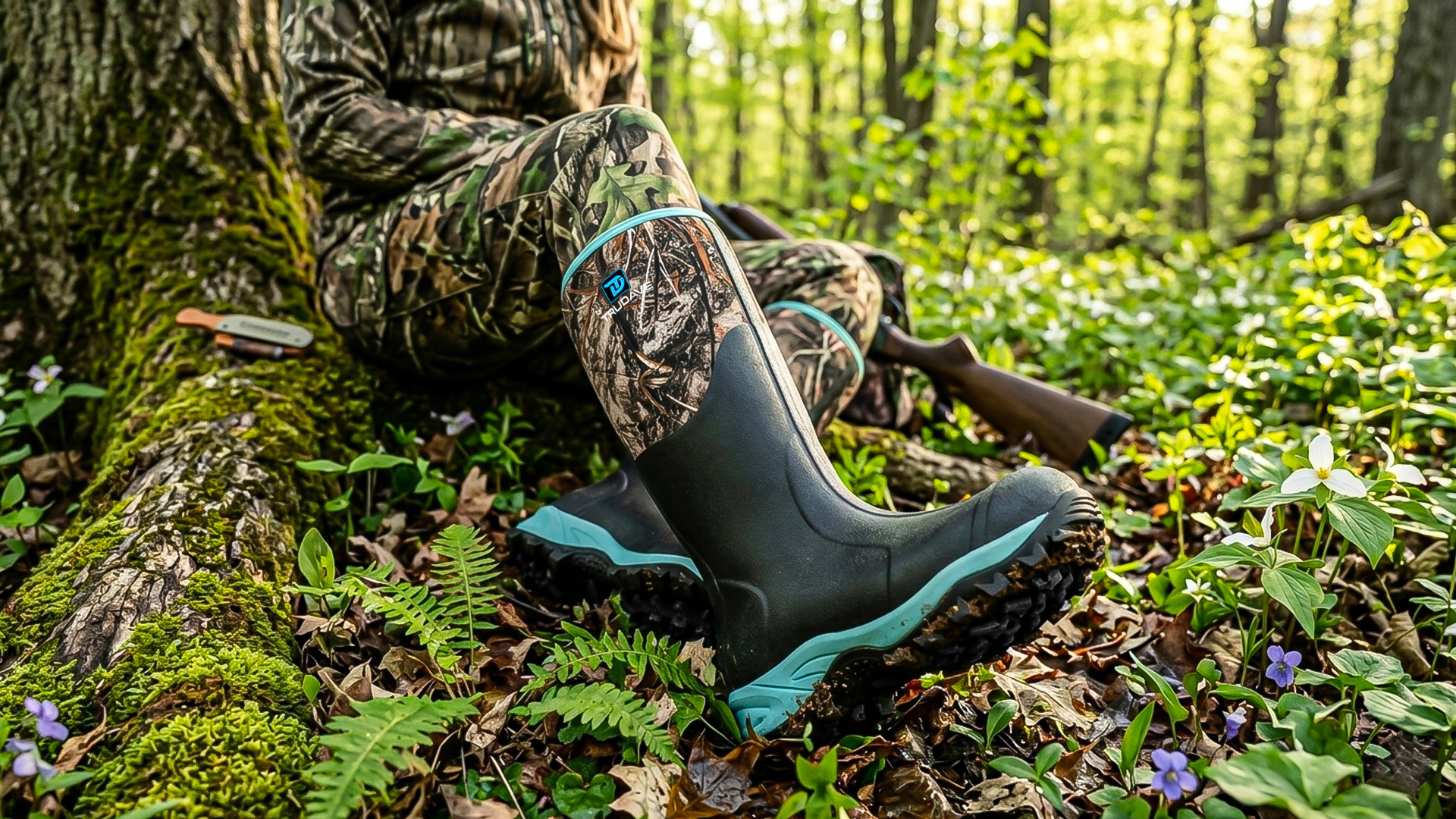
The WildGuard is Trudave’s camouflage hunting boot for marshes, flooded timber, and wet woods—environments where water is the primary challenge and cold is a close second. It occupies the transition zone between the TrailGuard’s extreme-cold specialization and a mobile hunting boot.
The WildGuard features 5mm neoprene insulation with a breathable liner that traps warmth without overheating. This is the right profile for the hunter who walks a mile or more through wet terrain before settling into a stand, and who may still-hunt between sitting locations during midday. The breathable liner manages moisture during the walk in, preventing the sweat accumulation that would otherwise turn cold during the sit.
The camo finish is functional, not cosmetic. It keeps you hidden in timber, reeds, or brush. The deep-lug outsole grips confidently on wet logs, rocky trails, and uneven ground. The tall neoprene upper provides flexibility and protection through brush and wetlands. Cushioned EVA midsoles and arch support reduce fatigue on long treks—important for the hunter who covers ground as well as sits still.
The WildGuard is 100% waterproof, made from 5mm neoprene and a tough rubber shell, keeping feet dry and steady in marshes, mud, and wet woods. Like the TrailGuard, the vulcanized construction creates a permanent bond that cannot delaminate—critical for boots that are regularly submerged in standing water and exposed to the freeze-thaw cycles of late-season marsh hunting.
Part 6: The Sock-System Framework — The Other Half of Stand-Hunting Warmth
The best-insulated boot in the world will still leave your feet cold if your sock system is wrong. Trudave’s stand-hunting boots are designed with intentional volume to accommodate thick insulating socks, and the sock choice is where you dial in the final layer of warmth.
The Two-Sock System
For stand hunting in temperatures below 25°F, use a thin synthetic moisture-wicking liner sock against the skin, and a heavyweight merino wool outer sock. The liner wicks sweat away from your skin, preventing the moisture accumulation that causes the sweat trap. The merino wool provides the bulk of the insulation, trapping warm air in its fibers. Merino wool continues to insulate even when damp—a critical property that synthetic insulations lack.
The Single-Sock System
For temperatures above 25°F, a single pair of heavyweight merino wool socks is usually sufficient. The sock should be thick enough to fill the boot’s intentional volume without constricting your foot. Tight socks restrict circulation, and restricted circulation accelerates heat loss regardless of insulation quality.
The Cotton Warning
Cotton socks should be avoided entirely in cold conditions. Cotton absorbs moisture, loses all insulating properties when wet, and becomes a heat sink against the skin. “Absolute waterproofing means external moisture cannot get in, but internal perspiration struggles to get out. Cotton traps sweat against the skin, rapidly dropping your body temperature.”
Sizing for Your Sock System
Trudave boots run slightly large by design to accommodate thick insulating socks. As one Trustpilot reviewer explained: “The size is slightly larger, but with socks they fit well and comfortably. A size smaller would be too tight.” The practical guidance: order your standard size if you plan to wear heavyweight merino wool socks for stand hunting. If you’re between sizes, size up for thick socks, size down for thin socks. The intentional volume is a feature designed for insulation, not a sizing error.
Part 7: The Care Protocol — Maintaining Insulation Performance
The insulation value of a neoprene boot depends on the neoprene remaining clean, dry, and structurally intact. Trudave’s official care guidance is consistent across the TrailGuard and WildGuard series: “Rinse off mud with water after each hunt, clean with mild soap, and air dry in the shade. Avoid heat or sunlight to maintain neoprene flexibility and waterproof performance.”
The “avoid heat” instruction is the one most often violated and most costly to ignore. Heat breaks down the polymer cross-links in neoprene, causing it to lose its closed-cell structure. A boot that’s been dried next to a wood stove or radiator will lose insulation value faster than a boot that’s been properly air-dried. The neoprene’s foam cells collapse under extreme heat, and once they collapse, they don’t recover.
For the fleece-lined TrailGuard, interior moisture management between hunts is equally important. Pull the insoles out after each hunt and let them dry separately. Stuff the boots with crumpled newspaper to wick moisture from the fleece lining. This prevents the musty buildup that eventually compromises both comfort and insulation performance.
Part 8: The Decision Framework — TrailGuard or WildGuard for Your Stand Hunt
The choice between the TrailGuard and WildGuard comes down to two factors: your temperature range and your walking distance.
Choose the TrailGuard if:
- Your primary hunt is late-season stand sitting in temperatures below 20°F, down to sub-zero.
- You walk moderate distances to your stand—a mile or less—and spend the vast majority of your hunt motionless.
- You need maximum static insulation. The fleece liner adds a second thermal layer that the WildGuard’s breathable liner doesn’t provide.
- You hunt in snow, frozen ground, and extreme cold where insulation is the single most important performance characteristic.
Choose the WildGuard if:
- You hunt in temperatures above 20°F, or your hunts involve significant walking between sitting locations.
- You hunt wet terrain—marshes, flooded timber, wet woods—where waterproofing is the primary challenge and cold is secondary.
- You need camouflage. The WildGuard’s camo finish provides concealment that the solid-color TrailGuard doesn’t.
- You walk longer distances to your stand and need moisture management during the approach. The breathable liner wicks sweat more effectively than the fleece-lined TrailGuard.
Consider a two-boot system if your season spans both wet, moderate-cold hunts and dry, extreme-cold sits. A WildGuard for November marsh hunts and a TrailGuard for late-December stand sits in single-digit temperatures. At Trudave’s direct-to-consumer pricing, owning two purpose-built stand boots costs less than a single pair of premium-brand insulated boots from legacy manufacturers sold through traditional retail.
Conclusion: The Stand Hunter’s Equation
The stand hunter’s challenge is unique in the outdoor world. No other activity demands that a person remain completely motionless for hours in freezing temperatures, often perched on a metal platform that conducts cold upward with industrial efficiency. The boots that work for this challenge are not the same boots that work for spot-and-stalk hunting, still-hunting through timber, or any other active pursuit. The insulation requirements are fundamentally different.
Trudave Gear’s TrailGuard and WildGuard series address the stand hunter’s specific physiology: the cold soak that begins when you stop moving, the sweat trap that turns your own body’s moisture against you, and the need for insulation that blocks ground-freeze cold without adding so much bulk that the walk to the stand becomes a misery. The 5mm neoprene provides the thermal barrier. The vulcanized natural rubber provides the waterproof shell. The moisture-wicking liner manages internal humidity. Together, they form a system that’s engineered for the hunter who measures their day in hours of stillness rather than miles of movement.
Cold feet end hunts. The right insulation keeps you in the stand when the big bucks are moving and the casual hunters have already gone home. Match the boot to your body of work. Know your temperature range. And stay out there longer.
To explore the complete Trudave Gear hunting boot lineup and find the right pair for your next stand sit, visit trudavegear.com.
