
Introduction: Two Hunts, Two Worlds
Ask a western elk hunter and a Midwestern whitetail hunter to describe a typical day, and you’ll hear two completely different stories. The elk hunter talks about climbing 2,000 vertical feet before sunrise, covering eight miles of rocky terrain, glassing from ridge tops, and stalking through timber at 10,000 feet. The whitetail hunter describes a half-mile walk through frost-covered CRP grass in the dark, then four hours of absolute stillness in a tree stand, waiting for the woods to wake up.
Same sport. Same species family. Completely different physical demands. Yet for decades, the hunting industry has largely marketed the same boots to both of these people. The result? Elk hunters end up with feet swimming in sweat inside over-insulated boots that weigh like cinder blocks after mile six. Whitetail hunters end up with frozen toes because their “all-terrain” boots conduct cold straight through the sole during hours of motionless sitting.
This is not a comfort problem. It’s a physics problem. The boot that keeps you warm when you’re sitting still will overheat you when you’re covering ground. The boot that’s light and breathable enough for an all-day stalk will leave you shivering when your heart rate drops and the cold creeps up from the frozen ground. These are direct physical contradictions. One boot literally cannot do both.
Trudave Gear has built its 2026 hunting boot lineup—WildGuard, TrailGuard, and DryFlow—on the recognition that these two hunting styles make fundamentally different demands on footwear. Not better or worse. Just completely different. This article is about understanding which camp you belong in, what your boots actually need to do for your specific body of work, and how Trudave has engineered a solution for each.
Part 1: The Physiology of the Long Walk
When you’re covering serious miles on foot—spot-and-stalk elk hunting, still-hunting whitetails through big timber, or chasing mule deer across open country—your body becomes a furnace. Your heart rate elevates. Your circulation surges. Your feet generate heat that, if trapped inside a heavily insulated boot, turns into sweat within the first hour.
Hunting is rarely a stationary sport. Even if you spend a few hours in a blind, getting there—or stalking your target—often requires logging serious miles. This is the fundamental challenge of the mobile hunter: the insulation that sounds appealing at 5 AM when you’re lacing up in the cold becomes a liability by 9 AM when you’ve covered three miles and the sun is climbing. As Trudave’s gear team frames it, “If your feet fail, your hunt ends. Period.”
The physics are straightforward. Every ounce on your feet compounds across thousands of steps. Over ten miles of walking with 10,000 strides, lifting a boot that’s just four ounces heavier means lifting an extra 2,500 pounds cumulatively over the course of a day. Weight matters enormously. But equally important is breathability: a boot that traps heat and moisture creates the conditions for blisters, and blisters end hunts faster than any weather event.
Traction needs are different for the mobile hunter, too. “Walking five miles on flat pavement is easy; walking five miles on slick mud is an athletic event. You need an aggressive outsole that cleans itself (sheds mud) so you maintain grip step after step”. A boot that packs full of mud after a creek crossing becomes a five-pound anchor on each foot, sapping energy with every stride.
The Trudave Solution for the Long Walk: DryFlow Series
The DryFlow was built for exactly this profile: the hunter who generates their own heat through continuous movement. It’s a zero-insulation boot—and that’s a feature, not a cost-saving measure. Built from industrial-grade waterproof rubber with sealed seams, the DryFlow keeps water out without trapping heat in. The aggressive cleated outsole pushes mud out with every step, ensuring constant ground contact whether you’re on a muddy creek bottom or a frozen ridge. Rugged soles keep you planted on the ground while reducing leg fatigue.
For early-season bowhunters, spring turkey hunters, and anyone covering serious miles in mild-to-cool conditions, the DryFlow provides waterproof protection without the weight and heat penalty of insulation that would actively work against the hunter’s needs. The zero-insulation approach may sound counterintuitive for a hunting boot, but for the mobile hunter, it’s the difference between finishing the stalk and turning back with hot, blistered feet.
The Trudave Solution for the Stalk: WildGuard Series
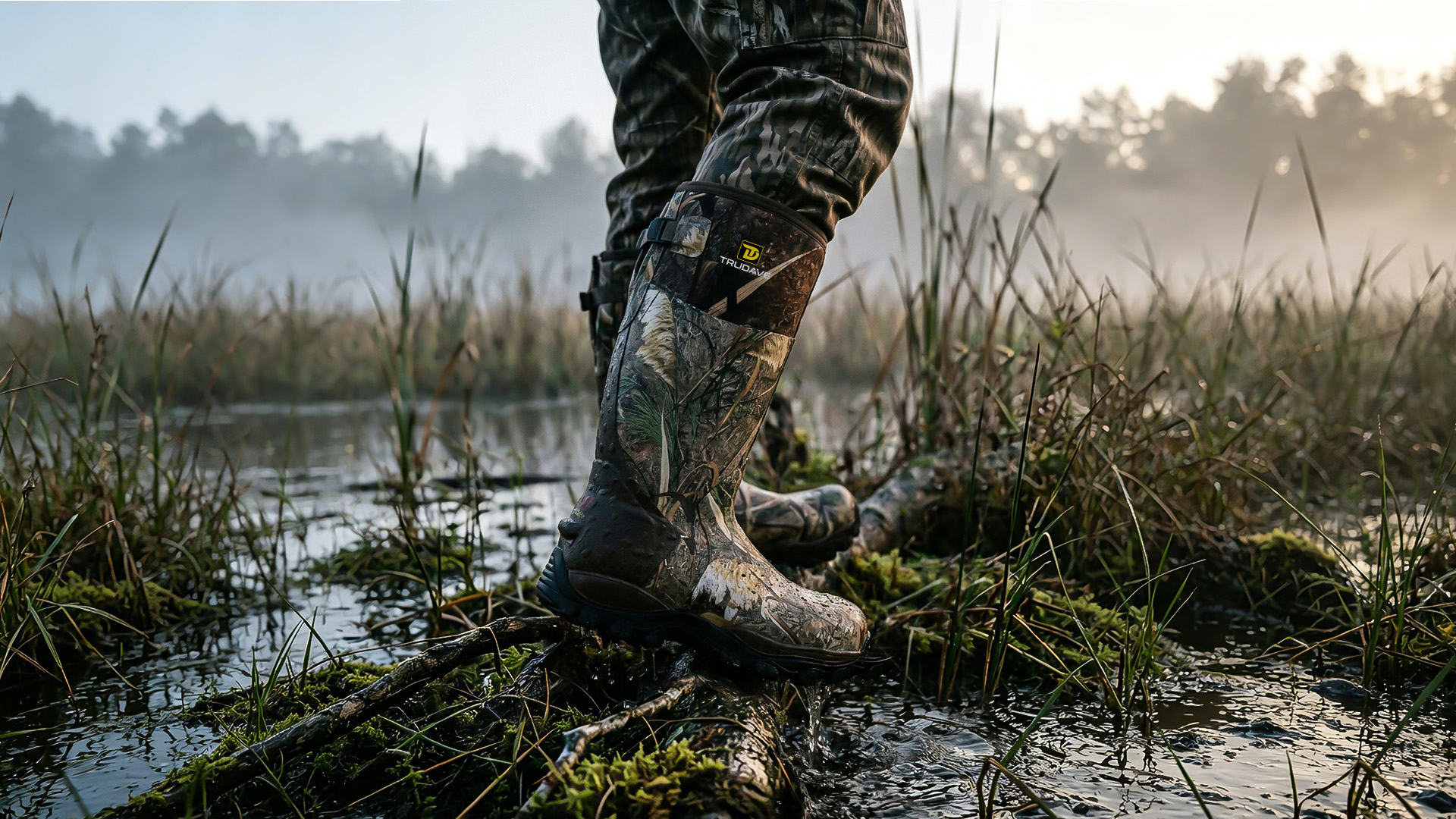
For the hunter who needs to blend in while covering ground through wet, brushy terrain, the WildGuard Camo Series is purpose-built. “Designed to blend seamlessly with the landscape, the camo finish keeps you hidden in timber, reeds, or brush”. The deep-lug outsole grips confidently on wet logs, rocky trails, and uneven ground, while the tall neoprene upper provides flexibility and protection through brush and wetlands.
The WildGuard is 100% waterproof, made from 5mm neoprene and a tough rubber shell, keeping feet dry and steady in marshes, mud, and wet woods. The 5mm neoprene insulation features a breathable liner that traps warmth without overheating—critical for the hunter who walks long distances through wet terrain at dawn and then may sit for extended periods. Cushioned EVA midsoles and arch support reduce fatigue on long treks.
Part 2: The Physics of the Long Sit
Now flip the scenario entirely. You’re not moving. You walked a mile to your stand in the dark, and now you’re 15 feet up a tree, motionless, for the next four hours. The temperature is 18°F and dropping. Your heart rate has returned to resting. Your circulation has slowed. Your body is generating minimal heat through metabolism. And beneath your feet, the metal platform of your tree stand—or the frozen ground if you’re in a blind—is conducting cold upward with ruthless efficiency.
This is where most hunting boots fail, and the failure mode is always the same: the sweat trap. “If you hike a mile to your stand and your feet sweat inside a sealed boot, that moisture will cool down the moment you stop moving. Within 20 minutes, your feet will be freezing”. The boots didn’t leak. They were too waterproof—trapping internal moisture while keeping external water out. The sweat that accumulated during the walk in, which your body heat kept warm while you were moving, turns into a refrigerated layer against your skin the moment you stop generating heat.
The insulation challenge for stand hunters is fundamentally different than for mobile hunters. Rubber naturally conducts cold—that’s why a standard rain boot feels like an icebox in December. For late season, you need a barrier. Neoprene has become the industry standard because it traps tiny air bubbles within the material, creating a thermal shield around your foot. However, not all insulation is created equal. You need enough density to block the ground freeze when you’re sitting motionless in a stand for hours.
The most common reason hunters pack up early during late season isn’t that the deer stopped moving. It’s cold feet. When the mercury drops below 20°F, your gear is no longer just about comfort—it’s about safety.
The Trudave Solution for the Long Sit: TrailGuard Series
The TrailGuard was built specifically for static warmth. These boots feature 5mm neoprene insulation and a fleece lining that provide excellent warmth and comfort during cold-weather hunts—ideal for deer, duck, or late-season hunting. The TrailGuard series combines heavy-duty rubber with a premium insulating lining that retains body heat without adding excessive bulk.
The insulation performance has been validated in genuinely extreme conditions. One reviewer reported that after walking over a mile in -8°F weather, their feet stayed warm and comfortable the entire time—even during the early morning hours when temperatures bottomed out. From everyday use to long walks in freezing temperatures, these boots are built to deliver warmth, comfort, and dependable performance when it matters most.
Critically, Trudave engineered the TrailGuard with an internal lining designed to wick moisture away from the skin. Their boots utilize a breathable mesh layer inside the neoprene structure to facilitate air movement. This addresses the sweat trap directly: by managing the moisture that accumulates during the walk to the stand, the insulation can do its job without being compromised by the clammy, wet cold that ruins late-season sits.
The TrailGuard’s outsole is built for the unique challenges of late-season terrain. “Mud freezes into uneven, rock-hard ruts. Snow turns into slush. You need an outsole that does two things: bites into the ice and self-cleans. If your tread fills up with mud, you lose traction”. The deep-lug outsole locks onto wet ladders, metal rungs, and soft ground, giving you reliable traction when setting stands or tracking game.
The TrailGuard is also engineered for stealth during those critical approach hours. From wet grass to forest trails, the rugged outsole grips firmly for a stable stride. The reinforced rubber shell shields against sharp roots, rocks, and debris, while its lightweight construction keeps every step silent and fluid. For the stand hunter who needs to arrive quietly and stay warm, the TrailGuard is designed for long sits and stealthy approaches, letting you move quietly and stay warm through hours in the wild.
Part 3: The Transition Zone — When Your Hunt Doesn’t Fit Neatly Into Either Camp
Here’s where things get complicated. A lot of hunters—probably most—don’t fit neatly into the “always moving” or “always sitting” categories. You might walk two miles to your stand, sit for three hours, still-hunt to a new location at midday, and sit again until dark. Your day includes both the long walk and the long sit.
For these hunters, the WildGuard Series occupies the transition zone. The 5mm neoprene insulation with breathable liner traps warmth without overheating—a balance that serves the hunter who walks and sits in roughly equal measure. The cushioned EVA midsoles and arch support reduce fatigue during the walking portions, while the neoprene upper provides the warmth retention needed during stationary sits.
For hunters whose season spans multiple temperature and activity profiles, the honest answer is that one boot cannot cover everything optimally. An early-season DryFlow for September bowhunting when overheating is the primary threat. A WildGuard for November rut hunts when you’re covering ground and sitting in roughly equal measure. A TrailGuard for late-December stand sits when extreme cold makes insulation non-negotiable. At Trudave’s direct-to-consumer pricing, owning the right tool for each job costs less than a single pair of premium-brand boots from legacy manufacturers.
Part 4: The Decision Framework — Which Camp Are You In?
By now the pattern should be clear: the right hunting boot depends entirely on an honest assessment of your hunting style. Here’s the framework.
Choose the DryFlow if you’re primarily a mobile hunter—spot-and-stalk, still-hunting, covering miles in mild-to-cool conditions. You generate your own body heat through continuous movement, and insulation would trap that heat and cause sweat buildup. The zero-insulation design is the right tool for hunters who cover ground rather than sitting still. Ideal for early-season archery, spring turkey, and active hunts where the walk is the hunt.
Choose the WildGuard if you hunt wet terrain and need both mobility and concealment. You’re moving through marshes, flooded timber, and wet woods—walking significant distances through water-logged terrain. You need waterproofing that can handle standing water, insulation that provides warmth without overheating during active approaches, and camouflage that breaks up your outline. The 5mm neoprene with breathable liner occupies the transition zone between the extremes.
Choose the TrailGuard if you’re primarily a stand hunter—walking moderate distances to a fixed location and then sitting motionless for hours in cold to extreme-cold temperatures. Your primary threats are the cold soak and the sweat trap. You need maximum static insulation and moisture management. The 5mm neoprene with fleece liner is built specifically for stationary warmth in freezing conditions.
Consider a two-boot or three-boot system if your season spans multiple hunting styles and temperature ranges. A DryFlow for early-season active hunts, a WildGuard for the rut when you’re walking and sitting in wet conditions, and a TrailGuard for late-season stand sits when extreme cold demands maximum insulation.
Part 5: The Value Framework — Why Specialization Doesn’t Have to Break the Bank
The hunting boot market has a pricing problem. Premium boots from legacy brands sold through traditional retail channels can command 200to450 or more. The global hunting boots market is projected to grow significantly, reaching an estimated US$4.25 billion by 2035, driven by increasing participation in outdoor recreation and demand for specialized performance footwear.
Trudave operates on a direct-to-consumer model that fundamentally changes this equation. “By adopting a Direct-to-Consumer model, brands like TruDave Gear bypass the retail middlemen entirely. We take the same premium materials used by the $200 brands and deliver them straight to your door”. The distinction between “budget” and “direct value” is crucial. Premium vulcanized natural rubber—high-flex, 100% waterproof, no cheap plastics. Purpose-built designs that avoid the clunky, one-size-fits-all profiles that legacy brands often force on consumers. Sold direct, at prices that reflect the materials and construction rather than the brand heritage and retail markup.
For hunters who need different boots for different phases of the season, this pricing model means owning the right tool for each job doesn’t require a second mortgage. A DryFlow for early season, a WildGuard for the rut, and a TrailGuard for late season—all three can be purchased for less than the cost of a single pair of top-tier premium boots from legacy manufacturers sold through traditional retail.
Conclusion: Know Your Hunt
The hunting boot industry has spent decades trying to convince hunters that one pair of boots should handle every condition—that if you spend enough money, you’ll get a boot that’s warm enough for the coldest sit, light enough for the longest walk, and waterproof enough for the deepest marsh. It’s a compelling promise. It’s also not true.
The physics of the long walk and the physics of the long sit are fundamentally different. The boot that keeps you warm when you’re motionless will overheat you when you’re covering ground. The boot that’s light and breathable for an all-day stalk will leave your toes numb during a freezing stand sit. These are not minor trade-offs—they are direct physical contradictions.
Trudave Gear’s three-series hunting boot lineup—DryFlow for the mobile hunter, WildGuard for the wet-terrain stalker, and TrailGuard for the stationary stand hunter—represents an honest acknowledgment of this reality. Rather than asking one boot to be all things to all hunters, each series is built around a specific set of material properties matched to a specific hunting profile.
The right boot isn’t the one with the highest price tag or the longest brand heritage. It’s the one whose materials and design match the body of work you’re asking it to do. Know which kind of hunter you are. Choose accordingly. Stay out there longer.
To explore the complete Trudave Gear hunting boot lineup and find the right pair for your next hunt, visit trudavegear.com.
