
Introduction: The Silent Language of the Hunt
There is a moment in every stalk when the world narrows to a single point of focus. The wind is in your face. The light is low and angled. Somewhere ahead, hidden in the timber or bedded in the sage, is an animal that has spent its entire life learning to detect predators. Every step you take from this moment forward is a conversation between your feet and the ground, and the animal you’re approaching is listening to every word.
Stalking—whether it’s closing the final 200 yards on a bedded mule deer, slipping through the hardwoods after a rutting whitetail, or easing into bow range of a spring gobbler—is the most intimate form of hunting. It strips away the technology, the distance, and the margin for error. It’s just you, your boots, and the animal. And in that equation, your boots are either your greatest ally or your loudest liability.
Most hunters think about their boots in terms of warmth and waterproofing—and those matter. But the art of the approach demands something more: silence, scent control, ground feel, and the ability to move with precision through terrain that seems designed to betray you. Trudave Gear’s WildGuard, TrailGuard, and DryFlow hunting boots are engineered with materials that address these demands at a fundamental level. This guide is about mastering the approach—how to use your Trudave boots to move quieter, smell less, feel the ground, and close the distance when it matters most.
1. The Sound of Silence: How Trudave Boots Keep You Quiet
The first rule of stalking is simple: be quiet. But “quiet” in the woods is not one thing—it’s a complex acoustic environment where different sounds travel differently. The snap of a twig underfoot is sharp and percussive, carrying hundreds of yards through still air. The scrape of a boot against brush is a higher-frequency sound that grabs attention. The dull thud of a heel strike on hard ground is a low-frequency vibration that animals can feel through their feet as much as hear.
Traditional leather hunting boots are full of noise sources. Leather is fibrous—when it flexes, millions of microscopic fibers slide against each other, producing the creaks and squeaks that every hunter knows. Laces pull through eyelets. The tongue rubs against the upper. A glued sole can develop gaps that click or flap as you walk.
Trudave boots eliminate most of these noise sources through material choice and construction. Vulcanized natural rubber is non-fibrous—it’s a single, continuous, homogeneous material that flexes silently because there are no internal fibers to rub together. Neoprene, the closed-cell foam used in the WildGuard and TrailGuard uppers, goes a step further: its millions of air pockets absorb vibration rather than transmitting it, dampening the sound of footfalls and the rustle of the boot shaft against brush and briars.
The vulcanized construction also eliminates the noise of separate components. A Trudave boot is chemically fused into one continuous unit at the molecular level. There is no separate sole to flap or peel. No glued seams to squeak as they degrade. No tongue to rub against the upper. The boot is silent in its structure before you even think about how you place your feet.
In the field, this translates to a tangible advantage. A hunter wearing WildGuard boots can slip through a marsh edge at dawn, the neoprene shaft bending silently with every step, the rubber outsole releasing from mud without the sucking sound that a tighter tread pattern would produce. A hunter in TrailGuards can shift weight in a frozen stand without the creak of cold leather. A hunter in DryFlows can pick their way through a rocky creek bed, the flexible rubber outsole conforming to the rocks without the sharp impact sound of a harder compound.
The technique matters, too. Even the quietest boot can be made loud by a careless step. The heel-to-toe roll—placing the outside edge of the heel down first and rolling through to the toe in a smooth motion—minimizes the impact noise of each step. It requires a boot flexible enough to allow that natural rolling stride, which is exactly what Trudave’s rubber-and-neoprene construction provides. Stiff boots force a flat-footed, clunky walk that is inherently louder. Trudave boots flex with your foot, enabling the kind of slow, deliberate, silent movement that closes the final yards.
2. The Invisible Trail: Scent Control from the Ground Up
A whitetail deer’s nose is legendary for good reason. With hundreds of millions of olfactory receptors and a brain region dedicated to scent processing that dwarfs a human’s, a deer can detect and interpret odors at concentrations measured in parts per trillion. It can distinguish between a scent deposited minutes ago and one deposited hours ago. And it can follow that scent trail directly to its source—or away from it.
The ground-scent trail you leave as you stalk is a roadmap of your movements. Every step deposits a signature—not just from your feet, but from the disturbance of vegetation, the transfer of oils from your skin, and the invisible cloud of human odor that seeps from even the most fastidious hunter. Controlling that scent trail is not about eliminating it entirely—that’s impossible—but about minimizing it to the point where it doesn’t trigger alarm.
Trudave boots are built from materials that are naturally scent-resistant. Vulcanized natural rubber is non-porous. It doesn’t absorb moisture from your feet, and it doesn’t absorb the volatile organic compounds that make up human scent. Your foot odor stays inside the boot. The exterior of the boot contacts the ground without transferring a scent-loaded moisture layer. This is a permanent, passive property of the material—it doesn’t wash off, wear out, or require reapplication like a chemical spray.
Neoprene, the material used in the WildGuard and TrailGuard uppers, is also non-porous. It doesn’t absorb or release odor. And because the neoprene shaft conforms to your calf, it reduces the “bellows effect”—the pumping of scent-laden air out of the top of the boot with every step that occurs in loose-fitting rubber boots. A snug, well-fitted Trudave boot contains your foot odor effectively, releasing minimal scent into the environment as you stalk.
For the stand hunter walking the same entry path every day, this passive scent reduction is a meaningful edge that compounds over the course of a season. For the stalker closing the distance on a bedded buck, it’s the difference between the deer remaining at rest and the deer rising, stretching, and melting into the timber before you ever see it.
The practical application is simple: let the boots do the work. You don’t need to spray them down with scent eliminators (though some hunters choose to). You don’t need to store them in a carbon bag (though it doesn’t hurt). The rubber itself is the scent-control system, and it’s permanent.
3. The Ground Game: Traction, Terrain, and Staying Upright
A stalk is only as good as the footing it’s built on. Lose your balance, slip on a wet log, or snap a branch you didn’t see because you were looking at the animal instead of the ground, and the stalk is over. The animal is gone, and you’re left with nothing but adrenaline and regret.
Traction on varied terrain—the mud of a creek bottom, the loose rock of a ridgeline, the wet grass of a meadow edge, the frozen crust of a late-season approach—requires an outsole that’s matched to the surface. Trudave engineers different outsoles for each of its hunting boots because the surfaces a marsh hunter encounters are fundamentally different from those a mountain hunter navigates.
The WildGuard features deep, widely spaced lugs with a multi-directional pattern. The wide spacing is designed to release mud cleanly with every step—a self-cleaning action that prevents the accumulation that turns standard boots into slippery, heavy platforms. The lugs bite into soft, wet ground and grip on submerged logs and mossy rocks. For the hunter stalking through a swamp or along a creek edge, this outsole provides the confidence to move deliberately without constantly scanning for the next solid foothold.
The TrailGuard adds deep siping—thousands of razor-thin slits cut into the rubber—that creates additional biting edges on frozen ground and crusted snow. The rubber compound stays flexible in sub-zero temperatures, maintaining grip when cheaper rubber hardens into a slick, unresponsive surface. For the late-season stalker easing through a frozen cattail marsh, this traction is the difference between a silent approach and a noisy slip.
The DryFlow uses a cleated outsole with a harder, more abrasion-resistant rubber compound. The cleats push mud out with every step and provide constant ground contact on the mixed surfaces—gravel, rock, hard dirt—that define long approaches and active stalks. The structured heel cup locks the foot in place, preventing the internal foot slip that can throw off balance on uneven terrain.
Regardless of which Trudave boot you’re wearing, the principles of quiet, stable movement on varied terrain are the same. Step over obstacles rather than on them. Use the edge of the boot—the lateral side—to feel the ground before committing your full weight. Keep your knees slightly bent and your weight centered to absorb unexpected shifts in the terrain. And when a step feels uncertain, find another one. The boot will support you, but the decision of where to place it is always yours.
4. The Art of Stillness: When the Approach Becomes the Wait
Not every stalk ends in a shot. Often, the final stage of the approach is a wait—a pause behind cover while the animal moves into position, a freeze in mid-stride when a deer lifts its head and tests the wind, a long, motionless sit against a tree while a gobbler works closer. These moments of stillness are as critical to the stalk as the movement that preceded them, and they demand something different from your boots.
When you’re moving, your body generates heat, and your boots need to manage moisture and prevent overheating. When you stop—whether for 30 seconds or 30 minutes—the equation flips. Your body stops generating heat. Any moisture trapped in your socks or your boot’s lining begins to cool. If your boots aren’t insulating, that cooling accelerates, and your feet become cold, numb, and less responsive. A cold foot can’t feel the ground as well. It’s slower to react to uneven terrain. It makes you a less effective stalker when you resume movement.
The WildGuard’s 5mm neoprene with breathable liner provides a balance of insulation for these transitional moments. It keeps your feet warm during a pause without overheating you during the active stalk. The TrailGuard’s fleece-lined neoprene provides more static warmth for longer waits in colder temperatures. The DryFlow, with its zero-insulation design, is best for stalks in mild weather where the pauses are brief and the movement is constant.
The ability to remain motionless is also a function of comfort. If your feet are aching or your boots are pinching, you’ll shift your weight, adjust your stance, and make the small movements that catch an animal’s eye. Trudave’s cushioned EVA midsoles and the ability to swap in an aftermarket insole like the ToughCush Comfort Insole mean your feet are supported during long periods of stillness. A comfortable, supported foot stays still. A still hunter is an invisible hunter.
5. Stalking by Boot: Matching Your Footwear to Your Quarry
Different game animals demand different stalking strategies, and your choice of Trudave boot should reflect the animal you’re pursuing and the terrain you’re pursuing it in.
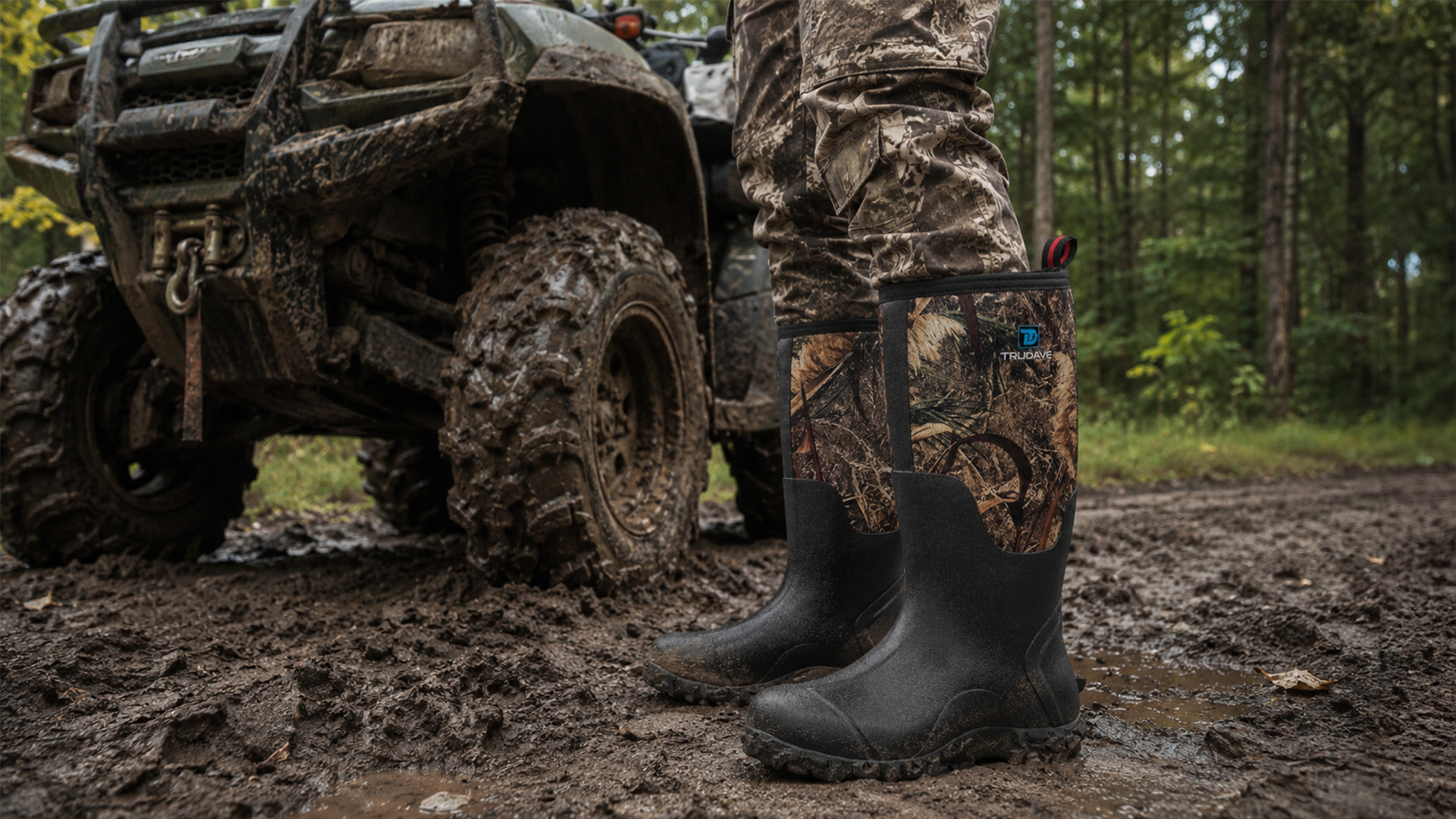
Whitetail Deer: Stalking whitetails in the big woods or the agricultural Midwest requires silence and scent control above all else. The WildGuard, with its quiet neoprene upper, scent-proof rubber shell, and camo finish, is the boot for this work. The deep-lug outsole releases from mud cleanly, allowing you to move through creek bottoms and marshy edges without the sucking, squelching sounds that spook deer.
Mule Deer and Antelope: Western spot-and-stalk hunting for mule deer and pronghorn often involves covering miles of open country, then closing the final distance on foot. The DryFlow’s lightweight construction saves energy on the long approach, and its cleated outsole grips on the rocky, uneven terrain of the high desert and foothills. When the stalk begins in earnest, the flexible rubber outsole provides the ground feel needed to navigate loose scree and hard-packed dirt without noise.
Elk: Stalking elk in the timber or the high basins of the Rockies is a game of wind, silence, and patience. The DryFlow is the early-season choice for September bowhunts, when you’re climbing and calling and covering ground. In the late season, when the snow flies and the temperatures drop, the TrailGuard’s insulation keeps feet warm during the long, still moments of glassing and calling, and its self-cleaning outsole handles snow and frozen mud.
Spring Turkey: The run-and-gun nature of spring turkey hunting demands a boot that’s light, flexible, and quiet. The DryFlow, with its zero insulation and lightweight construction, is ideal for the active, warm-weather miles. The WildGuard’s camo finish and neoprene upper provide concealment and silence for the sit-and-call moments. Both boots allow the kind of quiet, deliberate movement that’s essential when a gobbler is just over the next rise.
6. The Stalker’s Care Routine
A quiet, scent-free boot doesn’t stay that way by accident. After every stalk, rinse the mud and debris from the outsole and the rubber shell with clean water. Pay special attention to the tread channels—dried mud caked in the lugs will alter the boot’s acoustic signature and can create unexpected noise on the next stalk. Remove the EVA insoles and let them dry separately. Stuff the boots with crumpled newspaper to wick moisture from the interior, and let them air dry at room temperature, away from direct heat.
Periodically condition the rubber exterior with a silicone-free rubber conditioner. This keeps the rubber flexible and prevents the micro-cracks that can eventually become leaks. Inspect the toe crease and the seam between the rubber and neoprene for any signs of cracking. A small crack caught early can be sealed with a flexible waterproof adhesive; ignored, it becomes a leak and a potential noise source.
Store your boots in a clean, scent-free environment. Rubber can absorb ambient odors over time—gasoline, diesel, scented detergents—and release them slowly in the field. A plastic tote with a carbon filter is an affordable insurance policy for the dedicated scent-control hunter. Keep your boots away from strong-smelling materials, and they’ll remain as scent-neutral as the day you bought them.
Conclusion: The Boot That Closes the Distance
Stalking is the purest expression of hunting. It’s slow. It’s deliberate. It requires you to read the wind, read the terrain, and read the animal—all while managing your own body’s noise, scent, and movement. Every piece of gear you carry either helps you in that effort or works against you.
Trudave Gear’s WildGuard, TrailGuard, and DryFlow boots are built to be helpers, not hindrances, in the art of the approach. Their vulcanized natural rubber flexes silently and seals out water. Their neoprene uppers absorb vibration and contain scent. Their outsoles grip the terrain you stalk without announcing your presence. Their cushioned EVA midsoles keep you comfortable during the long waits and the longer walks.
The final 200 yards belong to the hunter who moves quietest, smells least, and stays the most patient. Give yourself the advantage of boots that were engineered for exactly that moment. Then take a breath, feel the wind on your face, and close the distance.
To explore the complete Trudave Gear hunting boot lineup and find the right pair for your next stalk, visit trudavegear.com.
