
Coastal blacktail country can humble even experienced deer hunters.
The woods are wet, steep, dark, and crowded with vegetation. Ferns cover the ground. Moss grows on logs, branches drip water hours after the rain stops, and visibility may be limited to a few yards in the thickest cover.
A hunter can spend all morning moving through good habitat and never see more than a flash of brown slipping through salal, alder, cedar, or young timber.
That does not mean the deer are gone.
Blacktail deer are built for this country.
They know how to use rain, fog, timber edges, clear-cuts, creek drainages, and dense cover to stay hidden. Wet weather may reduce hunter comfort, but it can also quiet the woods, soften scent conditions, and encourage movement during parts of the day many hunters overlook.
The mistake is hunting blacktails like open-country mule deer or agricultural whitetails.
Coastal blacktail hunting requires patience, slow movement, careful glassing, and an understanding of how deer use wet edge habitat to remain nearly invisible.
Rain Does Not Shut Down Blacktail Movement
Many hunters avoid wet days because the conditions are uncomfortable.
Blacktail deer do not have that option.
They still need to feed, bed, travel, and respond to seasonal changes.
Rain may influence where and when they move, but it does not stop daily activity entirely.
Light rain can actually improve hunting conditions by reducing leaf noise and masking small sounds made by the hunter.
Heavy rain, strong wind, and severe storms may push deer toward more protected cover.
The key is matching the hunt to the weather intensity.
A steady drizzle and a cold sideways storm should not be hunted the same way.
Quiet Ground Can Be a Major Advantage
Dry coastal forest can be surprisingly noisy.
Snapping sticks, crunchy leaves, dry sword ferns, and loose bark make stalking difficult.
Rain changes that.
Wet vegetation becomes softer.
Footsteps are quieter.
Sound carries differently through damp timber.
This gives still-hunters a better chance of moving slowly through cover without alerting deer from a long distance.
However, quiet ground can also make hunters careless.
Move deliberately.
Place each foot carefully.
Avoid brushing loudly against wet branches.
The forest may be quieter, but blacktails are still listening.
Visibility Is the Real Challenge
Rain rarely bothers blacktail hunters as much as poor visibility.
Water on binocular lenses, fogged glasses, dark timber, and thick brush all reduce the ability to detect deer before they detect you.
Successful hunters learn to search for pieces of deer rather than complete animals.
Look for:
- A horizontal back line
- One ear flicking
- The white edge of a tail
- A dark nose
- A leg between ferns
- Antler tips above brush
- A patch of wet hair
- Movement that does not match the wind
A blacktail standing motionless in shadow can look like part of the forest.
Slow observation matters more than constant walking.
Hunt Edges, Not Empty Timber
Coastal forests contain many edges.
Some are obvious.
Others are subtle.
Blacktails often use transitions where feeding opportunity and security cover meet.
Productive edges may include:
- Clear-cut borders
- Young timber beside mature forest
- Alder patches beside conifers
- Creek bottoms meeting benches
- Logging-road margins
- Old burns
- Brushy slides
- Fern openings inside timber
- Old orchard or homestead edges
- Regenerating cuts beside dark timber
The deer may feed in the opening and step back into cover within seconds.
A hunter watching only the middle of a large clear-cut may miss deer using the shaded timber edge.
Clear-Cuts Can Be Productive, but Age Matters
Fresh clear-cuts may provide visibility but limited cover.
Older cuts can become a jungle of blackberry, salmonberry, young alder, fir seedlings, fireweed, and brush.
Different stages attract deer for different reasons.
A younger cut may produce green browse.
A slightly older cut may provide both food and security.
A cut that has become too tall and dense may hold deer but become difficult to hunt from inside.
Scout the edges, old skid roads, benches, and pockets of visibility.
The best blacktail setup is often not in the center of the cut.
It is where deer enter, exit, or stage before crossing open ground.
Glass More Than You Walk
In thick blacktail country, walking feels productive.
But constant movement often pushes deer before you ever see them.
A better strategy is to locate a position where you can watch multiple pieces of habitat carefully.
Glass:
- Clear-cut edges
- Brushy openings
- Logging roads
- Small benches
- Alder pockets
- South-facing breaks
- Creek crossings
- Regeneration lines
Do not scan once and move on.
Pick apart the cover.
Return to the same patch of brush repeatedly as light changes.
A deer may stand, stretch, feed for a few seconds, and vanish again.
Rain Makes Optics Management Important
Wet-weather glassing requires preparation.
Keep lenses protected.
Carry a lens cloth in a dry pocket.
Use a brimmed hat to reduce water on binoculars.
Avoid wiping lenses with wet sleeves or dirty gloves.
If you cannot keep optics clear, you lose one of the biggest advantages available in coastal deer country.
Blacktails are hard enough to see in good conditions.
Rain makes disciplined glassing even more important.
Fog Can Help and Hurt
Fog can make blacktail hunting feel impossible.
Visibility shrinks.
Landmarks disappear.
Sound becomes confusing.
But fog can also make deer feel more secure in openings.
During breaks in fog, watch clear-cuts, brushy slopes, and logging-road edges carefully.
A deer may step into view only briefly before the fog closes again.
Do not rush through a foggy morning.
Use safe navigation, remain aware of terrain, and wait for visibility windows.
Creek Drainages Are Worth Studying
Coastal blacktail habitat is often shaped by water.
Small creeks, seeps, and drainages create vegetation diversity and travel corridors.
Deer may use creek systems for:
- Concealed travel
- Water
- Cooler cover
- Browse
- Escape routes
- Bedding nearby
Look for trails crossing at shallow points or moving along the upper bank.
Wind can be unstable in creek bottoms, so avoid assuming the forecast tells the whole story.
Cold air, flowing water, and steep terrain can all redirect scent.
Benches Break Up Steep Country
A bench is a relatively flat section of ground on a slope.
In coastal terrain, benches can provide easier travel for deer and hunters.
Blacktails may use benches to move between bedding cover and feeding areas without climbing directly up or down steep ground.
Look for benches near:
- Clear-cut edges
- Creek drainages
- Old logging roads
- Thick cover
- Rub lines
- Fern openings
- Regenerating timber
A bench does not need to be large.
A narrow shelf only several yards wide can become a regular travel route.
Old Logging Roads Create Quiet Travel
Abandoned logging roads are valuable blacktail features.
They create openings, edges, and easier travel through dense country.
Deer may feed along the edges or cross them quickly when moving between cover types.
Look for:
- Fresh tracks in mud
- Droppings
- Rubs on young trees
- Trails entering thick cover
- Browsed vegetation
- Small openings where roads bend
Avoid walking loudly down the middle of the road.
Still-hunt slowly along the edge.
Stop often and scan ahead.
A blacktail may be standing just off the road where brush hides most of its body.
Mud Reveals Fresh Movement
Rain creates mud, and mud records deer activity.
Check:
- Logging-road puddles
- Creek crossings
- Skid trails
- Soft clear-cut edges
- Springs
- Trail intersections
- Gate openings
Fresh tracks can reveal direction and timing.
A single track does not guarantee a deer is nearby.
Repeated tracks in the same direction suggest a travel pattern.
Use tracks to identify active corridors, then slow down before entering the cover they lead toward.
Waterproof Footwear Is Not Optional in Coastal Deer Country
Coastal blacktail habitat is hard on footwear.
A single hunt may include wet grass, mud, moss-covered logs, creek crossings, soaked brush, steep slopes, and standing water on old logging roads.
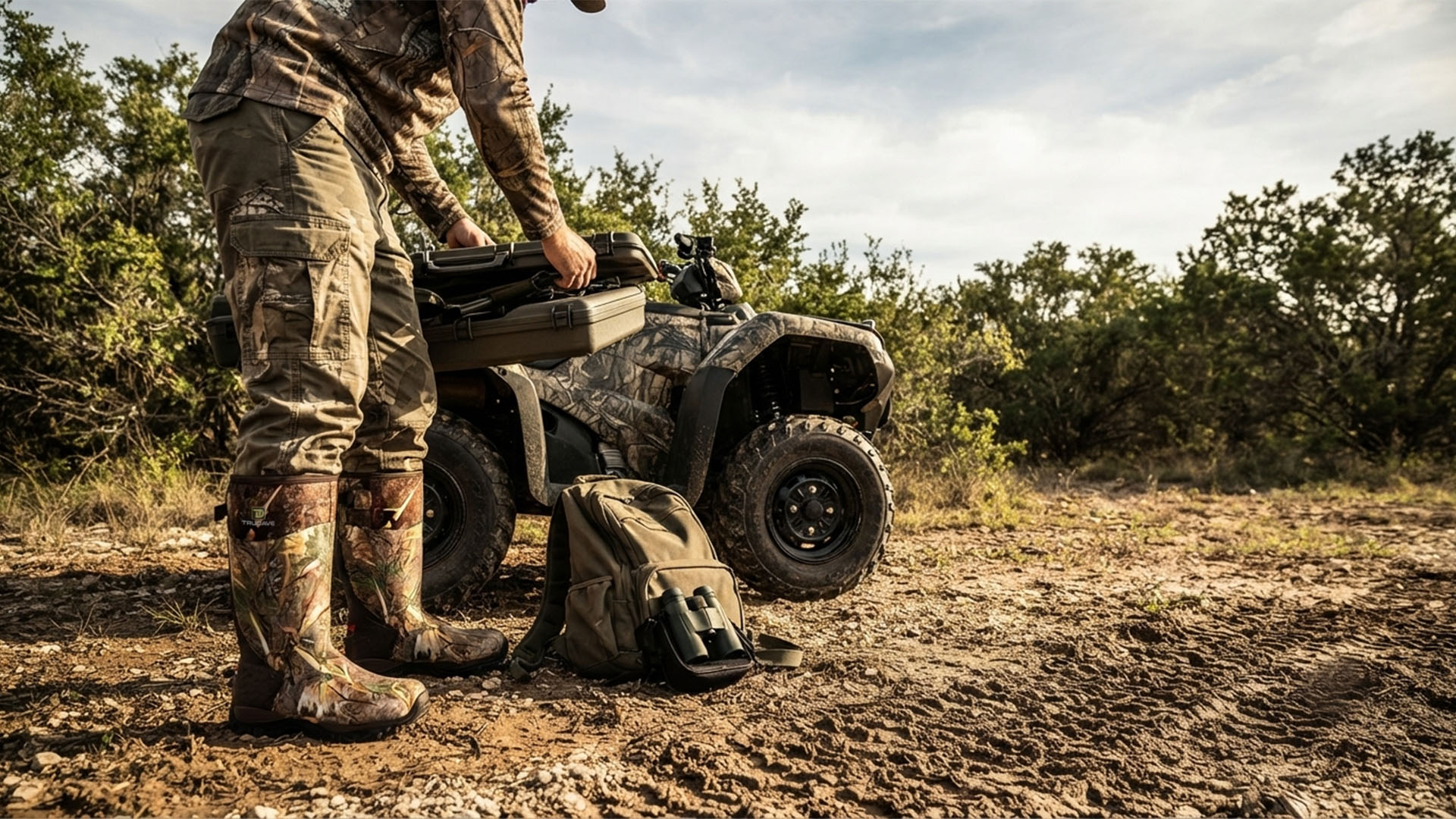
Hunters covering this terrain often benefit from waterproof hunting boots for wet coastal deer hunting that provide dependable traction, secure heel retention, and enough comfort for long days in saturated cover.
The best boot should match the terrain.
Steep country may require ankle support and aggressive traction.
Lowland wet country may require more shaft height.
Long still-hunts require a balance between waterproof protection and manageable weight.
Dry feet do not guarantee a filled tag, but wet feet can end a good hunt early.
Wet Logs Are Dangerous
Coastal forests are full of fallen timber.
When covered in moss and rain, logs become slick.
Avoid stepping directly on wet logs when possible.
If you must cross, test the surface first.
Watch the far side for hidden holes, unstable bark, and loose branches.
Many blacktail hunters become so focused on deer sign that they stop paying attention to footing.
A fall can end the hunt faster than an empty clear-cut.
Move Slower Than Feels Necessary
Blacktail still-hunting requires patience.
A useful rhythm is:
Take several steps.
Stop.
Watch.
Listen.
Glass.
Then move again.
Do not measure progress by miles covered.
Measure progress by how much habitat you actually inspected.
In thick coastal cover, a hunter walking too fast may pass within twenty yards of a bedded deer and never know it.
Watch Behind You
Blacktails do not always run straight away.
A deer may step aside, circle, or allow the hunter to pass before moving.
Turn around occasionally.
Look back through the timber you just walked through.
The angle may reveal a deer that was hidden from the original direction.
This is especially useful in wet brush where deer can move quietly.
Rain Can Reduce Human Pressure
Many hunters stay home when the forecast looks miserable.
That creates opportunity.
Public roads may have fewer vehicles.
Popular clear-cuts may receive less glassing pressure.
Deer may move more naturally when human activity decreases.
However, do not assume wet weather means no one else is in the woods.
Wear required hunter orange where applicable.
Know safe shooting directions.
Expect other hunters around road systems, gates, and clear-cuts.
Heavy Wind Changes the Plan
Wind-driven rain can make glassing difficult and reduce a deer’s ability to detect sound.
It also makes the forest more dangerous.
Falling limbs, unstable trees, and poor visibility can become serious hazards.
During strong wind, deer may seek:
- Leeward slopes
- Dense conifers
- Creek bottoms
- Protected benches
- Brushy pockets out of direct exposure
Hunters should also prioritize safety.
Avoid standing under dead trees or storm-damaged timber.
Conifer Cover Becomes Important in Bad Weather
Dense conifers can reduce rainfall reaching the ground and provide wind protection.
Blacktails may bed or travel near conifer edges during rough weather.
Look for:
- Cedar pockets
- Fir benches
- Hemlock edges
- Thick reprod
- Wind-protected draws
- Dark timber beside feeding openings
The deer may not be deep inside the darkest timber.
They may be near the edge where protection and browse overlap.
Fresh Rubs Can Reveal Buck Travel
Blacktail buck sign can be subtle.
Rubs may appear along logging roads, clear-cut edges, benches, and trails through young timber.
Look for fresh bark damage, exposed wood, and disturbed ground nearby.
One rub is interesting.
Several rubs forming a line suggest a route.
During wet weather, fresh rubs may stand out because exposed wood looks brighter against dark wet bark.
Scrapes Can Be Hard to Maintain in Heavy Rain
Rain can wash away scrape detail.
A scrape may look less active after a storm even if bucks recently used the area.
Look for the licking branch, tracks nearby, and trail location.
In wet coastal forests, scrapes along covered edges may remain more visible than those fully exposed to rainfall.
Do not rely only on the appearance of the ground.
Context matters.
Blacktails May Bed Closer Than Expected
Because cover is so thick, coastal blacktails do not always need to travel far from roads, cuts, or human activity to feel secure.
A buck may bed:
- Above a logging road
- Inside young timber
- On a brushy point
- Below a bench
- Near a creek crossing
- Behind a slash pile
- In a small patch of dark timber
Hunters walking past “too close” cover may miss deer that survive by staying where people do not expect them.
Bedding Cover Often Looks Unhuntable
Good blacktail bedding cover may include:
- Salal
- Blackberry
- Young fir
- Blowdowns
- Sword ferns
- Alder tangles
- Steep brush
- Cedar pockets
It is not always practical to hunt inside this cover.
Instead, locate the edges, exits, and nearby feeding areas.
The goal is to intercept movement without blowing deer out of the bedding cover.
Rut Hunting Requires More Patience
During the rut, blacktail bucks may become more visible, but they rarely become easy.
They may move through thick cover checking does, cross roads at odd times, or appear briefly on the edge of a cut.
Hunters should spend more time watching doe groups, travel corridors, and brushy funnels.
A buck may trail a doe several minutes behind.
Do not leave immediately after seeing does pass through an opening.
Does Can Reveal the Pattern
Blacktail does often use reliable feeding and bedding routes.
During the rut, bucks monitor those same areas.
If you consistently see does entering a clear-cut from one brushy corner, pay attention.
A buck may eventually use the downwind side of that route.
Hunt the does carefully, but avoid pressuring them out of the area.
Trail Cameras Need Low-Impact Placement
Trail cameras can help identify blacktail movement, but checking them too often can hurt the pattern.
Good camera locations include:
- Logging-road crossings
- Creek trails
- Clear-cut entrances
- Rub lines
- Benches
- Skid-road intersections
- Narrow funnels between cover types
Place cameras where you can access them with minimal disturbance.
In wet country, make sure cameras are protected from constant moisture and positioned above splash zones.
Scent Control Is Hard in Wet Terrain
Rain can reduce some scent concerns, but it does not make hunters invisible.
Wet clothing, sweating during climbs, and shifting thermal currents all affect scent movement.
Pay attention to:
- Wind
- Thermals
- Creek drainages
- Steep slopes
- Dense timber edges
- Evening cooling
Avoid climbing aggressively to a stand and then sitting in wet layers while scent drifts into bedding cover.
Slow access and good wind still matter.
Morning Thermals Can Be Complicated
Coastal hillsides do not always behave like textbook mountain terrain.
Cloud cover, fog, rain, canopy density, and temperature changes can weaken or alter thermal movement.
Still, air can move differently along drainages and slopes than the general forecast suggests.
Use a wind indicator.
Watch fog movement, drifting mist, and falling leaves.
The air is often showing you more than the weather app.
Dress for Movement, Not Just Rain
A common mistake is wearing heavy waterproof clothing that traps heat.
Blacktail hunting often requires climbing, still-hunting, glassing, and sitting in wet conditions.
Use layers that allow moisture management.
Avoid sweating heavily on the way in.
Carry insulation in a dry bag if you plan to glass from one location.
Staying dry means managing both rain and perspiration.
Protect Your Hands
Wet hands become cold quickly.
Cold fingers reduce shooting control, zipper use, map handling, and basic comfort.
Carry gloves suited to rain.
Consider a backup pair in waterproof storage.
If gloves become soaked during the approach, change before settling into a glassing position.
Small comfort details can extend the hunt by hours.
Keep Navigation Simple and Reliable
Coastal forest can be disorienting.
Fog, rain, timber, logging roads, and repeating drainages make it easy to lose direction.
Carry:
- Offline maps
- GPS or phone navigation
- Compass
- Backup battery
- Headlamp
- Marked vehicle location
Do not rely entirely on memory.
A logging road that looks obvious in daylight may become confusing after fog or darkness arrives.
Logging Road Systems Can Be Misleading
Old roads often split, fade, or become overgrown.
Some appear passable on maps but are blocked by gates, slides, washouts, or vegetation.
Scout access before hunting deep.
Mark important turns.
Do not assume you can drive to a location shown on satellite imagery.
Road access in coastal country can change quickly after storms.
Slides and Washouts Create Both Habitat and Hazards
Heavy rain can trigger small landslides, road washouts, and eroded banks.
These disturbed areas may eventually create fresh vegetation and edge habitat.
They also create danger.
Avoid unstable slopes.
Do not walk below loose banks during heavy rain.
Be cautious around washed-out roads and culverts.
A shortcut across a slide can become a serious mistake.
Blacktail Recovery Can Be Difficult
A deer that runs fifty yards into coastal cover may be hard to find.
Blood can wash away in heavy rain.
Ferns hide sign.
Steep ground changes the path.
Before the shot, consider:
- Distance to thick cover
- Rain intensity
- Light remaining
- Shot angle
- Recovery route
- Help available
- Property boundaries
- Terrain hazards
Ethical shot selection becomes even more important in wet, dense habitat.
Mark the Shot Location Immediately
After a shot, mark:
- Hunter position
- Deer position
- Last visible location
- Direction of travel
- Blood sign
- Tracks
- Trail intersections
Use a mapping app, flagging where legal and removed later, or natural landmarks.
Rain can erase evidence quickly.
Do not rely on memory alone.
Move Carefully During Recovery
Excitement and wet terrain are a dangerous combination.
Slow down.
Watch for:
- Slick logs
- Holes under ferns
- Steep drop-offs
- Loose rock
- Creek banks
- Hidden branches
- Barbed wire near old homesteads
A recovery is not complete until both the deer and the hunter are safely out of the woods.
Meat Care Still Matters in Cool Rain
Wet, cool weather does not eliminate game-care responsibility.
Rain can introduce contamination.
Mud and vegetation can cling to the animal.
Prepare game bags, knives, gloves, and a clean transport plan.
If temperatures are mild, cool the meat promptly.
Understand current tagging and reporting rules before the hunt.
Regulations Vary by State and Unit
Blacktail hunting rules vary across states, units, seasons, weapon types, and tag systems.
Hunters should verify current regulations through the responsible wildlife agency before hunting.
Important details may include:
- Season dates
- Tag requirements
- Legal weapon
- Antler restrictions
- Hunter-orange rules
- Public-land access
- Road closures
- Reporting requirements
Do not rely on old information or advice from another state.
Common Rainy Blacktail Hunting Mistakes
Walking Too Fast
Wet ground is quieter, but deer still detect careless movement.
Watching Only Big Clear-Cuts
Small edges and brushy pockets can produce better daylight movement.
Ignoring Optics Care
Rainy lenses make already hidden deer nearly impossible to detect.
Hunting Old Trails After Habitat Changes
Logging, storms, and regrowth can shift movement quickly.
Assuming Rain Eliminates Scent
Wind and thermals still matter.
Wearing Clothing That Traps Sweat
Internal moisture can become as uncomfortable as rain.
Using Poor Footwear
Wet coastal terrain demands waterproof protection, traction, and secure fit.
Neglecting Recovery Planning
Rain and thick cover make tracking more difficult.
Trusting Road Access From Old Maps
Storms, gates, and washouts can change access.
Frequently Asked Questions
Is rain good for blacktail deer hunting?
Light to moderate rain can improve stalking conditions by quieting the forest and reducing some human activity. Heavy storms may push deer into protected cover.
Where do blacktail deer go during rain?
They may use thick conifer cover, brushy edges, protected benches, creek drainages, and areas where food remains close to security cover.
How do you still-hunt blacktails in wet timber?
Move slowly, stop often, glass small openings, watch for partial deer shapes, use favorable wind, and focus on habitat edges.
Are clear-cuts good for blacktail hunting?
Yes, especially when they provide browse and border thick security cover. The age of the cut and the quality of surrounding cover are important.
What boots are best for coastal blacktail hunting?
Waterproof boots with reliable traction, secure heel fit, and terrain-appropriate support are useful because coastal deer habitat often includes mud, wet brush, steep slopes, and creek crossings.
Does rain wash away deer blood trails?
Heavy rain can reduce or erase blood sign quickly, making careful shot selection, immediate marking, and organized recovery especially important.
Final Thoughts
Coastal blacktail hunting is rarely comfortable.
The woods are wet.
The brush is thick.
The deer are quiet.
Visibility is limited, and every trail seems to disappear into darker timber.
But rain does not make blacktails vanish.
It helps them use the habitat they already understand.
The successful hunter slows down.
Watches edges.
Glasses openings repeatedly.
Studies mud, rubs, creek trails, clear-cut borders, and benches.
Protects optics.
Manages moisture.
Plans recovery before the shot.
And accepts that the best blacktail country is often the country that soaks your legs, grabs your pack, and hides deer at bow range.
In wet coastal forests, patience is not just a virtue.
It is the main strategy.
