
The first snow of the season can make familiar grouse country look completely different.
Logging roads disappear beneath several inches of white. Brushy hillsides become quieter, small tracks appear around timber edges, and high-elevation openings that held birds during early fall suddenly seem empty.
Many hunters assume the grouse moved completely off the mountain.
Sometimes birds do shift elevation.
More often, they adjust how they use the same general landscape.
Early snow changes food availability, temperature, ground access, wind exposure, predator visibility, and the amount of human pressure in the woods. Dusky grouse may leave open feeding areas, move toward conifers, use south-facing slopes, or concentrate along transitions where snow depth and cover are more manageable.
Finding them requires more than following the first set of bird tracks you see.
Hunters need to understand which mountain features continue providing food and protection after winter begins changing the habitat.
Dusky Grouse Do Not Use One Elevation All Season
Dusky grouse, historically grouped with what many hunters still call blue grouse, occupy mountain habitats across parts of western North America.
Their exact movements vary by region, weather, elevation, food, and local habitat.
During early fall, hunters may find birds around:
- Open slopes
- Berry-producing shrubs
- Aspen edges
- Logging roads
- Young timber
- Mountain meadows
- Forest openings
As temperatures fall and snow accumulates, birds may shift toward conifer cover and different feeding resources.
This does not always require a long-distance migration.
A bird may move from a brushy opening into nearby fir or spruce timber only a few hundred yards away.
Hunters who continue walking the same early-season road edges may assume the area is empty when the birds have simply moved uphill, downhill, or deeper into the trees.
Start With the Cover Closest to Previous Bird Activity
If a location consistently held grouse before snow arrived, do not abandon it immediately.
Study the nearest winter cover.
Look for:
- Fir stands above the opening
- Spruce pockets along the drainage
- Conifer edges near aspen
- Timbered benches
- Protected draws
- South-facing slopes
- Areas with less snow beneath the canopy
Birds often shift toward nearby cover rather than leaving the entire mountain.
The most productive search may begin fifty yards beyond the last early-season flush.
Conifers Become More Important
Conifer trees provide several winter advantages.
Their branches reduce snow reaching the ground, block wind, create overhead security, and may provide seasonal feeding opportunities.
Dusky grouse may spend significant time in or around trees such as:
- Douglas fir
- Spruce
- Subalpine fir
- Lodgepole pine
- Other regional conifers
The exact tree species matters less than current bird activity.
Search for droppings, tracks, feathers, feeding evidence, and birds sitting on lower limbs.
Do not focus only on the forest floor.
A grouse may remain above eye level and flush from a tree after the hunter has already walked beneath it.
Look Up More Often
Many upland hunters train themselves to search ground-level cover.
Mountain grouse require a wider field of attention.
After snow arrives, birds may roost or feed in conifers.
Watch for:
- A rounded body shape on a branch
- Movement inside dense needles
- Snow falling from a limb
- A bird walking along a horizontal branch
- Droppings beneath trees
- Wingbeats overhead
Pause before entering a likely conifer pocket.
Scan each tree carefully.
Binoculars can help separate a grouse from dark branches and deep shade.
Snow Depth Changes Ground Movement
A few inches of snow may make tracks easier to find without significantly limiting bird movement.
Deep, soft snow creates a different situation.
Walking through it requires more energy.
Birds may spend less time on the ground and use areas where snow remains shallower.
Look beneath:
- Dense conifers
- Overhanging branches
- Rock ledges
- Fallen logs
- Brushy edges
- Wind-protected timber
- Steep slopes where snow slides away
A location with only half the surrounding snow depth can become disproportionately valuable.
South-Facing Slopes Can Offer Better Conditions
South-facing slopes typically receive more direct sunlight.
After early snow, these slopes may warm faster and lose snow sooner than shaded terrain.
This can expose:
- Grass
- Seeds
- Berries
- Low vegetation
- Bare ground
- Insects during warmer periods
Grouse may use sunlit slopes during late morning or afternoon while remaining close to conifer security cover.
Do not search every south-facing hillside equally.
Focus on those containing a combination of:
- Food
- Conifers
- Brush
- Benches
- Limited pressure
- Protected pockets
Sunlight alone does not make good habitat.
North-Facing Timber Still Matters
South-facing terrain receives attention because of warmth.
North-facing cover may remain cooler, quieter, and more protected from hunters.
Dense timber can hold birds even when snow remains deeper.
During warm afternoons or periods of limited snow, shaded cover may still provide useful security.
Mountain grouse habitat is often a combination of different slope aspects within a relatively small area.
Search the transitions rather than treating one compass direction as a universal answer.
Timber Edges Provide Multiple Resources
The edge between conifer forest and a meadow, clear-cut, aspen stand, or brushy slope can be productive.
Birds can move between feeding and security cover without traveling far.
Useful transitions include:
- Fir and aspen
- Spruce and willow
- Conifer timber and logging roads
- Pine edges above mountain meadows
- Young regeneration beside mature forest
Walk slowly along the edge.
Pause to scan both the ground and the trees.
A grouse may flush from only a few yards inside the darker timber.
Aspen Pockets Can Continue Holding Birds
Aspen habitat does not become irrelevant after snowfall.
Aspen stands often contain shrubs, open understory, edge structure, and nearby conifers.
Small pockets mixed into evergreen forest can produce birds throughout changing conditions.
Check:
- Aspen-conifer transitions
- Sunny aspen benches
- Brush beneath mature trees
- Logging roads crossing the stand
- Areas with exposed ground
Pure open aspen without nearby security cover may become less productive as weather worsens.
The surrounding habitat determines its value.
Mountain Meadows Are Better Scouted From the Edge
A snow-covered meadow may appear empty.
Grouse can feed near its edge while remaining only a few steps from timber.
Instead of walking through the center, circle the perimeter.
Look for:
- Tracks entering from conifers
- Exposed berry shrubs
- Windblown grass
- South-facing corners
- Creek entrances
- Small timber points
The best location may be a narrow strip where food remains available beneath less snow.
Windblown Ridges Can Expose Food
Strong mountain wind moves snow.
Some ridge tops and open slopes remain partially exposed even after a storm.
These areas may reveal vegetation and seeds unavailable under deeper snow nearby.
Grouse may visit them during suitable weather.
However, exposed ridges can become uncomfortable and dangerous for hunters.
High wind reduces balance, increases cold stress, and makes tree-fall hazards more serious.
Use sheltered approaches.
Do not remain on an exposed ridge during severe weather simply because bird tracks are present.
Leeward Cover Offers Protection
The leeward side of a ridge receives less direct wind.
Snow may accumulate deeply in some protected locations, but timber and terrain can create comfortable pockets.
Look for:
- Fir benches below the ridge
- Brushy draws
- Small clearings behind terrain
- Conifer edges protected from prevailing wind
- Sunlit pockets on the sheltered slope
Birds often choose a combination of wind protection and available food rather than one feature alone.
Fresh Tracks Are Useful—but Easy to Misread
Snow reveals grouse movement.
Tracks can lead hunters toward feeding areas, roosts, cover transitions, and current habitat.
But tracks do not guarantee the bird remains nearby.
A grouse may walk for a short distance before flying into a tree.
Wind can preserve old tracks.
New snow can partially cover fresh tracks.
Study the entire pattern.
Fresh sign may include:
- Sharp track edges
- Loose snow around prints
- Droppings
- Wing marks
- Recently disturbed powder
- Tracks ending beneath a likely roost tree
If the trail ends suddenly, look up.
Grouse Tracks Can Be Confused With Other Birds
Mountain country may contain turkey, ptarmigan, forest birds, and other wildlife depending on the region.
Track size, shape, habitat, and trail pattern all contribute to identification.
Do not rely on one unclear print.
Follow the trail until better evidence appears.
Look for droppings, feathers, wing marks, and the type of cover being used.
Correct identification matters for both hunting strategy and legal compliance.
Wing Marks Can Reveal Recent Activity
A grouse taking flight from soft snow may leave a clear impression.
Wing tips create lines beside the tracks, and the body may disturb a larger patch.
This can show where the bird flushed or launched toward nearby timber.
Stand at the mark and examine the surrounding trees.
The bird may have flown only a short distance.
Move slowly.
A second flush can happen quickly if the grouse landed nearby.
Droppings Beneath Trees Deserve Attention
Repeated droppings beneath a conifer can indicate regular roosting or feeding activity.
Look for concentrations rather than one isolated dropping.
Check:
- Low horizontal limbs
- Dense tree crowns
- Nearby tracks
- Feathers
- Snow disturbed beneath the branches
Do not assume the bird is currently present.
Mark the location and revisit under similar conditions.
Several active roost trees can reveal a productive winter-use zone.
Logging Roads Can Still Produce
Mountain logging roads remain useful after early snow.
They provide navigation, easier walking, and habitat edges.
Snow may be shallower where wind, vehicles, or tree cover reduce accumulation.
Focus on:
- Road bends
- Conifer intersections
- Aspen patches
- Creek crossings
- Roadside berry cover
- Overgrown spur roads
- South-facing cuts
Main roads often receive more human pressure.
Secondary spurs and abandoned roads may hold more birds.
Road Cuts Can Create Warm Pockets
A road cut exposing soil or rock may receive direct sunlight and lose snow faster.
Vegetation along the upper and lower edges can provide food and cover.
Search carefully around:
- Brushy cut banks
- Small seeps
- Exposed gravel
- Conifer points
- Fallen trees
- Switchbacks
Road cuts can also contain loose rock and ice.
Do not stare at the cover while ignoring unstable footing.
Snowy Roads Can Hide Ice
A thin layer of snow can cover frozen ruts, compacted vehicle tracks, and ice beneath shaded sections.
Use shorter steps.
Avoid walking directly on smooth tire tracks when better footing exists beside them.
Trekking poles may help on steep or icy access roads.
The easiest-looking path is not always the safest.
Mountain Footwear Must Balance Warmth and Mobility
Dusky grouse hunting can involve hours of active walking, elevation changes, snow, mud, wet grass, loose rock, and frozen ground.
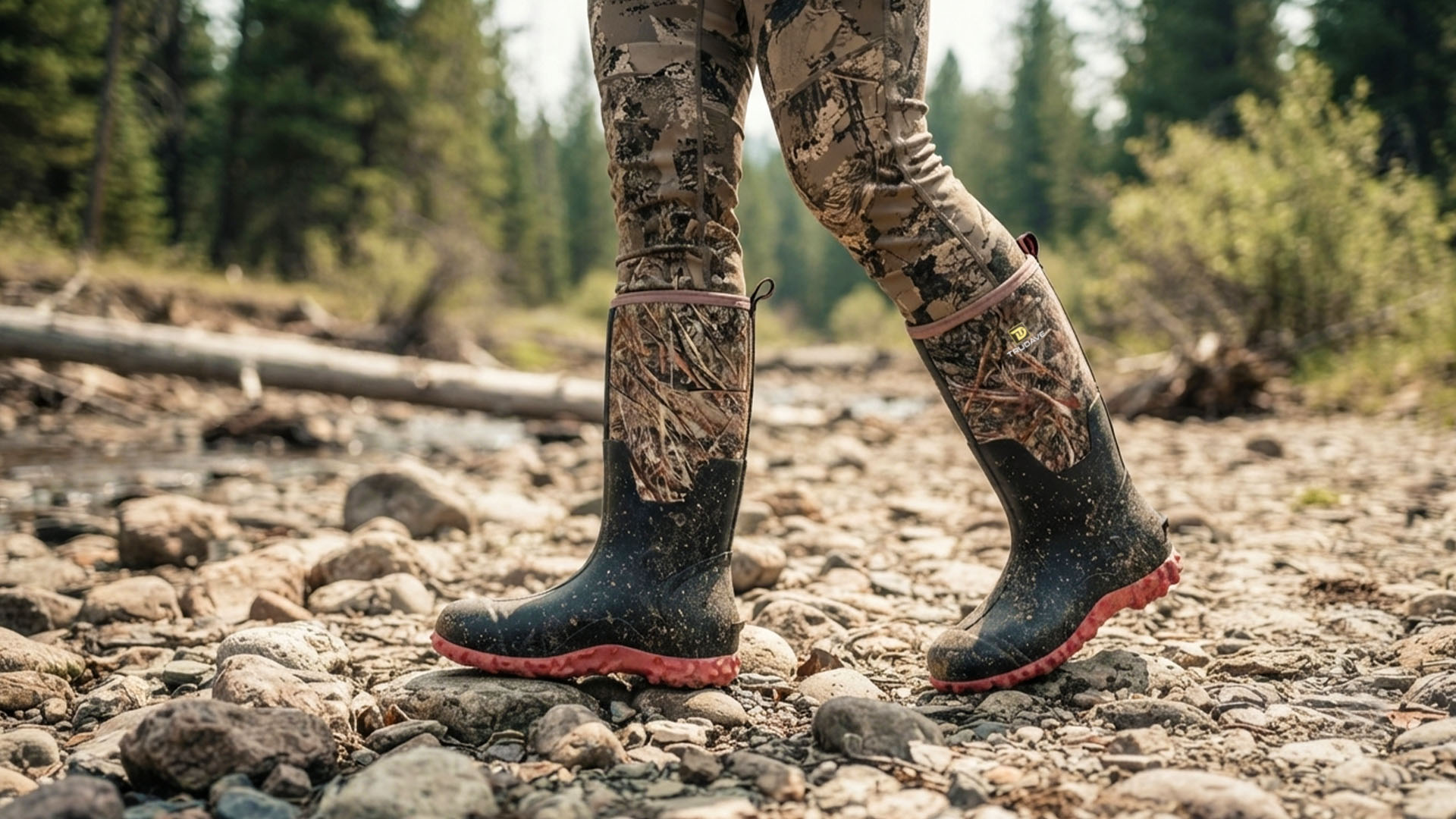
Hunters may benefit from waterproof hunting boots for snowy mountain bird hunting that provide reliable traction, secure heel retention, and enough insulation for the conditions without becoming excessively heavy during long climbs.
The correct boot depends on:
- Snow depth
- Temperature
- Elevation
- Expected mileage
- Pack weight
- Terrain steepness
- Activity level
A heavily insulated stationary-hunting boot may cause overheating during continuous uphill walking.
A lightweight boot without adequate waterproof protection can leave feet cold once snow begins melting.
Balance matters.
Gaiters Can Help Keep Snow Out
Even waterproof boots become uncomfortable when snow enters over the top.
Gaiters can reduce snow, mud, and debris entering the footwear.
They may also protect lower pants from wet brush.
Choose a design that fits securely without restricting movement.
Check that straps and buckles do not catch on branches.
Gaiters do not replace proper boot height or waterproof construction, but they can improve the overall system.
Carry Spare Socks in Waterproof Storage
Moisture can come from outside or from sweat.
A long uphill walk may leave socks damp even when the boots do not leak.
Carry a dry pair in a sealed bag.
Change them before feet become chilled or blisters develop.
Avoid waiting until discomfort becomes severe.
Sock choice should match the boot fit.
Excessively thick socks can reduce circulation and make feet colder.
Avoid Overdressing for the Climb
Cold temperatures encourage hunters to start with every layer on.
Uphill walking generates heat quickly.
Sweat becomes dangerous when the hunter stops.
Begin slightly cool.
Vent clothing during climbs.
Add insulation when glassing or waiting.
A simple layering system allows hunters to remain comfortable through changing activity.
Footing Matters More During Descents
Hunters often focus on climbing strength.
Downhill travel creates different risks.
Snow can hide loose rocks, roots, and holes.
Toe pressure increases.
Slips become more likely.
Choose controlled routes.
Take shorter steps.
Avoid descending directly through the steepest opening simply because it provides the shortest distance.
A longer switchback may be safer and quieter.
Pause Before Crossing Fallen Timber
Snow-covered logs can be slick and difficult to judge.
Step around them when practical.
If crossing is necessary, test the surface and avoid placing full weight on rotten wood.
Fallen trees can hide holes on the downhill side.
Keep the firearm controlled and use available hands for balance according to safe handling practices.
Dense Conifers Create Sudden Flushes
A grouse can remain hidden inside a fir until the hunter walks directly beneath it.
The resulting flush may be loud, close, and difficult to track visually.
Do not swing the shotgun through branches or toward unclear background.
Identify the bird.
Confirm the shot path.
Know where hunting partners and dogs are located.
Passing on a poor opportunity is part of safe mountain bird hunting.
Watch for Birds Running Uphill
Mountain grouse may move through cover on foot before flushing.
Hunters may see tracks or brief movement leading uphill.
Do not rush after the bird.
Move slowly.
Pause.
Watch nearby trees.
A bird that disappears behind brush may stop, fly, or climb onto a low branch.
Maintaining awareness is more useful than chasing movement aggressively.
Hunt With the Contour When Possible
Sidehill travel along a bench or contour often requires less energy than repeatedly climbing and descending.
It can also allow hunters to search a consistent elevation band where birds are using winter cover.
Good contour routes may include:
- Benches
- Logging roads
- Timber edges
- Old game trails
- Narrow shelves below ridges
Sidehills still require careful footing.
Snow can hide uneven ground, and repeated angled steps can fatigue ankles.
Use Elevation Bands as a Scouting Tool
When you locate a bird after snow, record the elevation.
Other grouse may be using similar cover at the same general height.
Search nearby slopes for matching combinations of:
- Conifers
- Sun exposure
- Snow depth
- Food
- Wind protection
- Human pressure
Elevation alone does not create habitat.
It helps narrow the search when combined with current cover.
One Flush Can Identify a Productive Zone
Mountain grouse may occur at relatively low density across large areas.
One bird can confirm that the habitat and elevation are worth investigating.
After a flush, study why the bird was there.
Was it near:
- Fir cover?
- Exposed food?
- A road edge?
- A sunny bench?
- Aspen?
- A creek?
- A wind-protected pocket?
Finding the pattern is more valuable than focusing only on the exact tree.
Revisit Cover After Weather Changes
A productive location can change after:
- New snowfall
- Warm temperatures
- Strong wind
- Rain
- Freeze-thaw cycles
- Increased hunting pressure
Fresh snow may push birds toward denser cover.
A warm spell may reopen ground-feeding opportunities.
Wind may move birds to protected slopes.
Return to good habitat under different conditions.
One empty hunt does not prove the area no longer holds grouse.
Early Snow Can Reduce Hunting Pressure
Snow discourages some hunters.
Road access becomes more difficult.
Steep trails require greater effort.
Birds may experience less disturbance in locations that were heavily hunted during warm weather.
This can improve opportunities for prepared hunters.
It can also increase isolation.
Carry appropriate emergency equipment and avoid overestimating your ability simply because the woods are quiet.
Public-Land Access Can Change Overnight
A mountain road open during scouting may become snow-covered, muddy, gated, or unsafe.
Check current conditions.
Do not drive around gates.
Avoid damaging wet roads.
Park only in legal locations that do not block access.
A vehicle becoming stuck at the end of the day can turn a short bird hunt into a serious problem.
Four-Wheel Drive Does Not Eliminate Risk
Snow, ice, clay, steep grades, and limited turnaround space can stop capable vehicles.
Carry:
- Chains where appropriate
- Shovel
- Recovery equipment
- Warm clothing
- Communication device
- Emergency supplies
Know when to park and walk.
Road damage and personal safety matter more than reducing the approach by one mile.
Mountain Weather Changes Quickly
A clear morning can become windy, snowy, or foggy.
Before hunting, evaluate:
- Forecast temperature
- Expected snow
- Wind
- Sunset time
- Road conditions
- Elevation differences
Carry enough clothing and navigation support for worse conditions than expected.
Do not rely entirely on cell service.
Fog Can Make Familiar Cover Confusing
Mountain fog reduces visibility and makes terrain features difficult to recognize.
A hunter following one timber edge can unknowingly enter another drainage.
Use offline maps and a compass.
Mark the vehicle and important trail intersections.
Avoid climbing onto exposed ridges when visibility and weather create unsafe conditions.
Tell Someone Where You Are Hunting
Mountain grouse hunts can cover large areas and remote roads.
Share:
- Trailhead or access road
- Expected route
- Vehicle description
- Return time
- Hunting partner information
Update the contact when plans change.
A delayed return may be caused by weather, vehicle problems, injury, or navigation mistakes.
Bird Dogs Need Cold-Weather Monitoring
Dogs working mountain cover face snow, ice, sharp crust, hidden wire, steep terrain, and cold temperatures.
Monitor:
- Paw condition
- Ice between toes
- Cuts
- Fatigue
- Shivering
- Hydration
- Reduced coordination
Carry water even when snow is available.
Eating snow does not always provide adequate hydration and may lower body temperature.
Use canine protective gear when appropriate.
Check Paws Frequently
Snow can hide sharp rock and logging debris.
Ice balls can form between pads.
Stop during the hunt and inspect the dog.
Remove ice carefully.
Address small cuts before they worsen.
A dog continuing enthusiastically may still have developing paw damage.
Know Where the Dog Is Before Shooting
Conifers and terrain can hide a dog within seconds.
Use bells, beepers, tracking collars, or other legal tools appropriate to the hunting style.
Do not fire unless the dog’s location is known.
Mountain terrain can place the dog above or below the hunter without being visible.
Snow Can Hide Wire and Fencing
Mountain grazing areas, old logging sites, and abandoned homesteads may contain wire.
Snow conceals:
- Barbed wire
- Woven fencing
- Metal posts
- Loose cable
- Equipment debris
Move slowly near old clearings and meadow edges.
Keep dogs close.
Do not step over snow-covered obstacles without identifying them.
Identify the Bird Completely
Several grouse species may occupy overlapping or nearby mountain habitats depending on the region.
Hunters must understand legal species identification.
Consider:
- Plumage
- Tail pattern
- Size
- Habitat
- Range
- Flight behavior
Do not shoot solely because a grouse-shaped bird flushes.
Verify current seasons, bag limits, and identification guidance from the responsible wildlife agency.
Regulations Vary by State and Region
Dusky grouse seasons and rules can differ by jurisdiction.
Hunters should verify current requirements involving:
- Season dates
- Bag limits
- Possession limits
- Licenses
- Legal methods
- Public-land restrictions
- Firearm transport
- Hunter-orange rules
Regulations can change.
Use official agency information rather than relying on an older article or another hunter’s memory.
Common Early-Snow Dusky Grouse Hunting Mistakes
Hunting Only the Same Early-Fall Openings
Birds may shift into nearby conifer cover.
Looking Only at the Ground
Grouse may sit or feed in trees after snow arrives.
Following Every Track Too Far
A trail may end when the bird flies into nearby timber.
Ignoring South-Facing Pockets
Sun can expose food and reduce snow depth.
Wearing Excessively Heavy Boots
Active mountain hunting requires a balance of warmth, waterproofing, traction, and weight.
Climbing Straight Up Every Slope
Contour routes conserve energy and search habitat more efficiently.
Trusting Old Road Conditions
Snow and mud can change access overnight.
Shooting at an Unidentified Grouse
Know the legal species and confirm a safe shot.
Ignoring the Dog’s Paws
Snow, ice, and rock can cause injuries quickly.
Frequently Asked Questions
Where do dusky grouse go after snow?
They may move toward conifer cover, protected slopes, timbered benches, exposed feeding pockets, and areas where snow remains shallower.
Do dusky grouse move downhill in winter?
Some birds shift elevation, but movements vary by region, habitat, weather, and food. They may also move only a short distance into nearby winter cover.
Are logging roads good for dusky grouse hunting?
Yes. Logging roads create edges, provide easier walking, and connect aspen, conifers, clear-cuts, and feeding habitat. Secondary roads may receive less pressure.
Should hunters look for dusky grouse in trees?
Yes. After snow and during colder periods, birds may spend more time around or inside conifers. Hunters should scan branches as well as ground cover.
What boots are best for snowy mountain bird hunting?
Choose boots based on temperature, snow depth, walking distance, and terrain. Waterproof protection, secure fit, traction, and manageable weight are important.
Is fresh snow useful for grouse hunting?
Fresh snow can reveal tracks, wing marks, feeding areas, and roost locations. Hunters should use the sign to identify productive habitat rather than following every print indefinitely.
Final Thoughts
Early snow does not make dusky grouse disappear.
It changes the mountain.
Open feeding areas become covered.
Conifers gain value.
Sunlit slopes expose food.
Wind pushes birds toward protected cover.
Tracks reveal where they walked—and where they left the ground.
Start near habitat that held birds earlier in the season.
Then search the nearest fir, spruce, pine, aspen transition, bench, or protected slope.
Look up.
Watch for tracks ending beneath trees.
Move along elevation bands.
Protect your feet, dog, and emergency margin as conditions become colder and more remote.
The hunter who keeps walking the same open road may conclude the mountain is empty.
The hunter who understands how snow rearranges food and security may find the birds only one timber edge away.
