
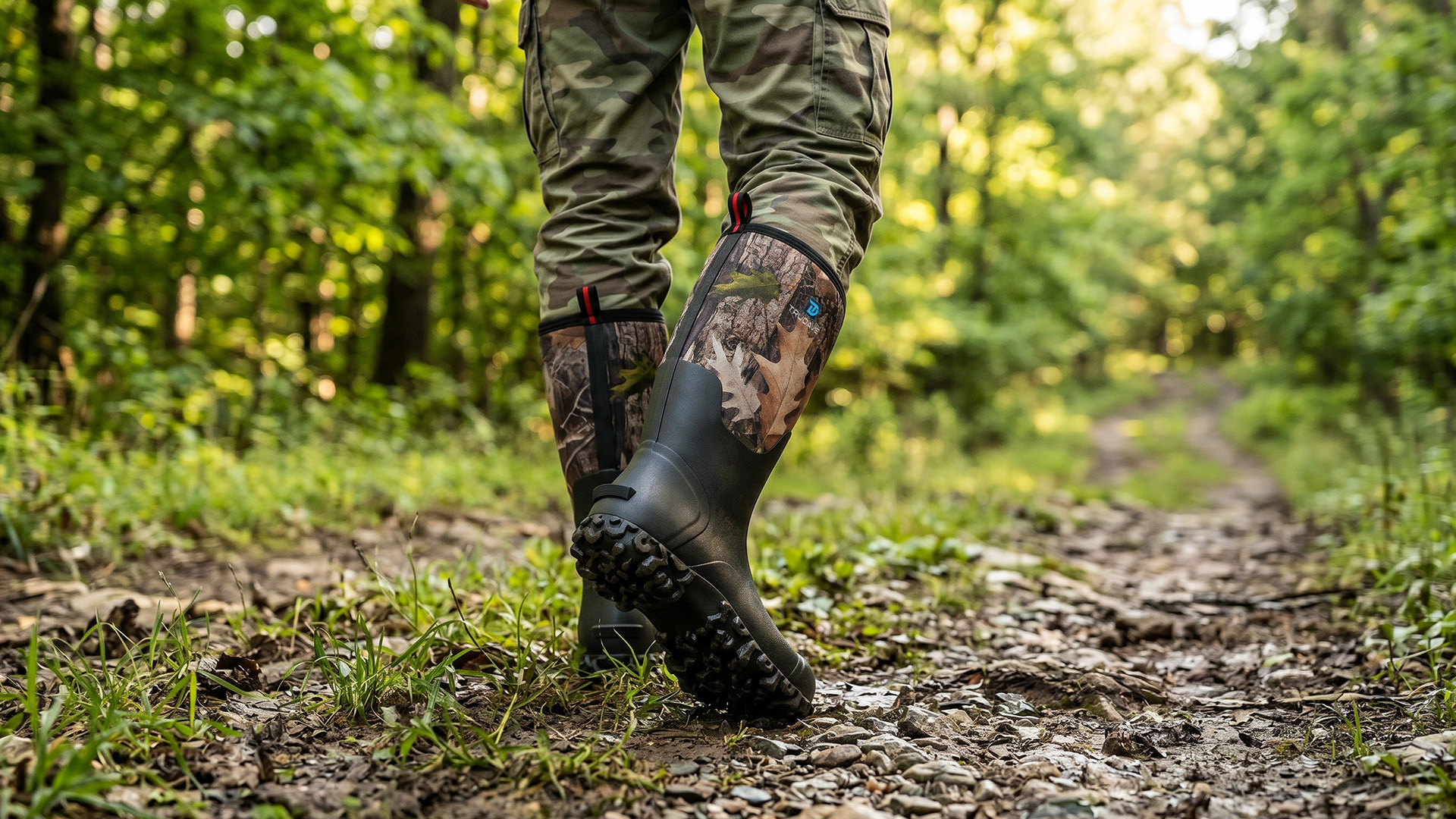
Introduction: The Boot Built for the Deep Freeze
Most hunting boots are designed for the middle of the bell curve—moderate cold, moderate activity, moderate conditions. But the hunter who stays in the stand when the mercury drops below zero, who pushes through frozen cattails to reach a duck blind, who sits motionless for hours while the wind howls through the timber—that hunter needs a boot that doesn’t compromise. That hunter needs the Trudave TrailGuard.
The TrailGuard isn’t Trudave’s only cold-weather boot. The WildGuard handles wet, variable conditions with its breathable liner. The DryFlow is the lightweight specialist for early-season miles. But the TrailGuard is the maximum-warmth anchor of the lineup—the boot you reach for when the forecast says single digits and you plan to be out in it from dark to dark. This is a deep dive into what makes the TrailGuard different, how it performs when the temperature plummets, and why it’s earned a place in the gear rooms of serious late-season hunters across the country.
1. The Insulation System: 5mm Neoprene and Fleece
The heart of the TrailGuard is its dual-layer insulation. The foundation is a 5mm neoprene upper—the same material found in wetsuits. Neoprene is a closed-cell foam, meaning it contains millions of microscopic air bubbles that trap body heat. Unlike open-cell foams or synthetic fiber insulations (like Thinsulate), neoprene’s closed cells don’t collapse when wet. Cross a creek. Stand in slush. The insulation keeps working.
But Trudave didn’t stop at neoprene. Inside the boot, a fleece liner adds a second thermal layer. Fleece is hydrophobic—it repels water—and actively wicks moisture from the sock toward the neoprene, where it can dissipate. The fleece also provides immediate warmth against the skin. No “cold shock” when you slide your foot in at 5 a.m. This dual-layer system—structural insulation from the neoprene, moisture-wicking warmth from the fleece—is engineered specifically for static warmth. It’s the kind of insulation you need when you’re sitting still, your circulation has slowed, and your body isn’t generating much heat of its own.
In field conditions, the insulation has been validated at extremes that would send most hunters back to the truck. One reviewer reported walking over a mile in -8°F weather with warm, comfortable feet throughout the entire sit—even during the early morning when temperatures bottomed out. That’s not marketing language. That’s a data point from someone who tested the TrailGuard in conditions that would destroy lesser boots.
2. The Waterproof Barrier: Vulcanized Natural Rubber
Insulation is useless if it gets wet. The TrailGuard’s lower shell is made from vulcanized natural rubber—a material that has been chemically cross-linked with sulfur and heat to become a single, continuous, permanently waterproof unit. There are no glued seams to separate. There are no stitches to rot. The bond between the rubber lower and the neoprene upper is vulcanized as well, meaning it’s a molecular fusion, not an adhesive joint that can degrade over time.
This construction matters most in the late season, when standing water has frozen and thawed and refrozen into a treacherous mix of ice, slush, and mud. Step into a half-frozen puddle. Stand in the slush at the edge of a frozen marsh. The water stays out. The seams don’t separate. The boot doesn’t get heavier as the day wears on. The TrailGuard’s waterproofing is absolute, and it’s built into the structure of the boot itself—not applied as a coating that can wear off or a membrane that can crack.
The rubber is also non-porous, which provides a passive scent-control advantage. It doesn’t absorb or release human odor, meaning the ground-scent trail you leave on your way to the stand is minimized. For the whitetail hunter walking the same entry path every day, this is a meaningful edge that compounds over the course of a season.
3. The Outsole: Traction for Frozen Ground
Late-season terrain is uniquely unforgiving. Mud that thawed during the day refreezes into jagged, ankle-turning ruts overnight. Crusted snow hides ice patches. Creek banks are slick with frozen slush. The TrailGuard’s outsole is built for this.
The deep, aggressive lugs are designed to bite into frozen ground, crusted snow, and loose dirt. The tread pattern is widely spaced—a deliberate choice that enables self-cleaning. As the boot flexes during a normal stride, mud, snow, and debris are ejected from the channels. This prevents the accumulation that turns lesser boots into heavy, slippery platforms. A boot that packs full of frozen mud within a few hundred yards loses its traction and gains several pounds of weight. The TrailGuard sheds that mud and stays grippy.
The rubber compound itself is formulated to remain flexible in sub-zero temperatures. Cheap rubber stiffens in the cold, becoming a hard, slick surface that can’t conform to the ground. The TrailGuard’s outsole stays pliable, maintaining its grip when the mercury drops. On sheer ice, no rubber outsole provides reliable traction—supplementary ice cleats are always recommended for those conditions—but for the frozen ground, packed snow, and mixed surfaces that define most late-season hunts, the TrailGuard’s traction is purpose-built and effective.
A reinforced kick-off heel tab at the back of the boot allows hands-free removal. When you’re exhausted after a long, cold day and the boots are caked in frozen mud, you step on the heel of one boot with the toe of the other and slide out. No bending over. No wrestling with frozen laces. It’s a small detail that becomes significant at the end of a brutal day.
4. The Fit: Room for the Right Socks
The TrailGuard, like all Trudave hunting boots, runs slightly large by design. This is not a sizing error—it’s intentional volume built into the boot to accommodate the thick wool socks that late-season hunting demands. A boot that fits snugly with thin cotton socks will be painfully tight, and dangerously cold, with the heavyweight merino wool you actually need when the temperature is in the single digits.
The neoprene upper provides natural stretch, conforming to the shape of your calf and ankle. This creates a secure fit without the stiff, unyielding feel of a pure rubber boot. The fleece liner adds a small amount of interior volume, so the TrailGuard fits slightly snugger than the WildGuard at the same marked size. If you’re between sizes and plan to wear heavyweight socks with a liner, size up. If you wear a single midweight sock, your standard size should work well.
The removable EVA insole allows further customization. Swap in a thicker insole like Trudave’s ToughCush Comfort Insole to take up volume if you have narrow feet, or to add more arch support for long sits. The insole is also the first line of defense against the cold ground—the EVA foam acts as a thermal barrier, breaking the conductive pathway between the frozen earth and your foot. Traditional boots with steel shanks conduct cold directly into the foot; the TrailGuard’s EVA midsole does the opposite.
5. In the Field: The TrailGuard in Action
The TrailGuard earns its keep in the moments that define late-season hunting. Consider a December whitetail hunt in the Upper Midwest. The hunter walks three-quarters of a mile to a stand through crusted snow and frozen marsh grass. The temperature at the truck reads -2°F. During the walk, the hunter’s body generates heat, and the TrailGuard’s neoprene and fleece keep that warmth from escaping. When the hunter settles into the stand and sits motionless for the next four hours, the insulation continues to work passively—the neoprene trapping body heat, the fleece wicking moisture, the EVA midsole blocking the cold that creeps up from the frozen platform.
Or consider a late-season duck hunt in a frozen marsh. The hunter stands in ankle-deep slush at the edge of the water, waiting for first light. The TrailGuard’s vulcanized rubber shell keeps the slush out completely. The self-cleaning outsole sheds the frozen muck that clings to the tread with every step. When the hunt is over and the hunter is exhausted, the kick-off heel tab makes removal effortless.
In both scenarios, the TrailGuard’s quiet flex is an underappreciated asset. Unlike leather boots, which can creak with every shift of weight, the neoprene and rubber upper flex silently. In the still, cold air of a winter morning, that silence is the difference between a deer that walks past your stand and one that stops, listens, and melts back into the timber.
6. What TrailGuard Users Are Saying
Real-world feedback from hunters who have put the TrailGuard through genuine late-season conditions confirms the design.
A whitetail hunter from northern Wisconsin wrote: “I’ve spent 20 years fighting cold feet. I’ve tried every insulated boot on the market. The TrailGuards are the first boots that kept my feet warm through a four-hour sit at -5°F. The fleece liner is the difference—it’s warm the moment you put it on, and it doesn’t get clammy as the day goes on.”
A duck hunter from the Mississippi Flyway reported: “I hunt frozen marshes in December and January. Standing in slush for hours used to mean wet, frozen feet by 9 a.m. The TrailGuards have changed that. The rubber shell doesn’t leak, and the insulation keeps me warm even when I’m standing still. I bought a second pair just to have a backup.”
An elk hunter who uses the TrailGuard for late-season cow hunts in Colorado noted: “I don’t wear these for the hike in—I pack them in and put them on when I start glassing. For sitting still in the snow, they’re the warmest boots I’ve owned. The self-cleaning tread is a bonus. I’ve walked through some nasty frozen mud and the lugs stay clear.”
The consistent theme is that the TrailGuard delivers what it promises: maximum static warmth, absolute waterproofing, and reliable traction in the frozen, mixed terrain of late-season hunting.
7. Who the TrailGuard Is For—And Who It Isn’t
The TrailGuard is the right boot for the hunter whose primary battle is extreme cold during stationary sits. This includes late-season whitetail stand hunters, frozen-marsh duck hunters, predator hunters calling from stationary positions in frigid weather, and any hunter who spends more time sitting than walking in temperatures below 25°F.
It is not the right boot for the active, warm-weather hunter. For early-season bowhunting, spring turkey, or spot-and-stalk hunts in mild conditions, the DryFlow’s zero-insulation design is the better tool. For wet-terrain hunting in moderate cold—marshes, flooded timber, creek crossings—the WildGuard’s breathable liner provides the right balance of warmth and moisture management.
For the hunter whose season spans multiple conditions, the TrailGuard is the deep-cold anchor of a larger system. A DryFlow for September and October, a WildGuard for November and early December, and a TrailGuard for the deep freeze of late December and January. At Trudave’s direct-to-consumer pricing, owning all three costs less than a single pair of premium boots from a legacy brand sold through traditional retail.
8. Care and Maintenance
The TrailGuard’s vulcanized construction and fleece liner require basic care to reach their full lifespan. After each hunt, rinse off mud and debris with clean water. Pay special attention to the outsole, clearing the lug channels of any packed mud or snow. Remove the EVA insole and let it dry separately. Because the fleece liner can hold moisture, stuffing the boots with crumpled newspaper after a hunt wicks moisture from the interior and speeds drying. Never place the boots near a radiator, wood stove, or campfire to dry—heat is the enemy of vulcanized rubber. Air dry at room temperature in a shaded, well-ventilated area.
Periodically—every couple of months during heavy use—apply a silicone-free rubber conditioner to the exterior. This replenishes the natural oils that keep the rubber flexible and crack-resistant. Inspect the toe crease and the seam between the rubber and neoprene for any signs of cracking or separation. Small cracks can be sealed with a flexible waterproof adhesive; catching them early prevents them from becoming leaks.
With proper care, a pair of TrailGuards can deliver five or more seasons of hard late-season service. The vulcanized rubber won’t delaminate. The neoprene won’t compress and lose its insulating properties. The fleece liner, if kept clean and dry, will continue to wick moisture and provide warmth for years.
Conclusion: The Deep-Cold Specialist
The hunting boot industry is full of boots that claim to be “all-season,” but the laws of thermodynamics don’t bend to marketing copy. A boot that keeps you warm when you’re sitting still at -5°F will overheat you when you’re climbing a ridge in September. The right tool for the deep freeze is not a compromise boot—it’s a specialist.
The Trudave TrailGuard is that specialist. Its 5mm neoprene and fleece liner provide the static warmth that stationary hunters need when the mercury plummets. Its vulcanized rubber shell provides absolute waterproofing that doesn’t degrade over time. Its self-cleaning outsole maintains traction on the frozen, mixed terrain of late-season approaches. And its direct-to-consumer price makes it accessible to hunters who can’t justify spending $300 or $400 on a single pair of boots.
When the forecast says single digits and the big bucks are finally moving, the TrailGuard is the boot that keeps you in the stand. That’s what it was built to do.
To explore the complete Trudave Gear hunting boot lineup and find the right pair for your next late-season hunt, visit trudavegear.com.
