
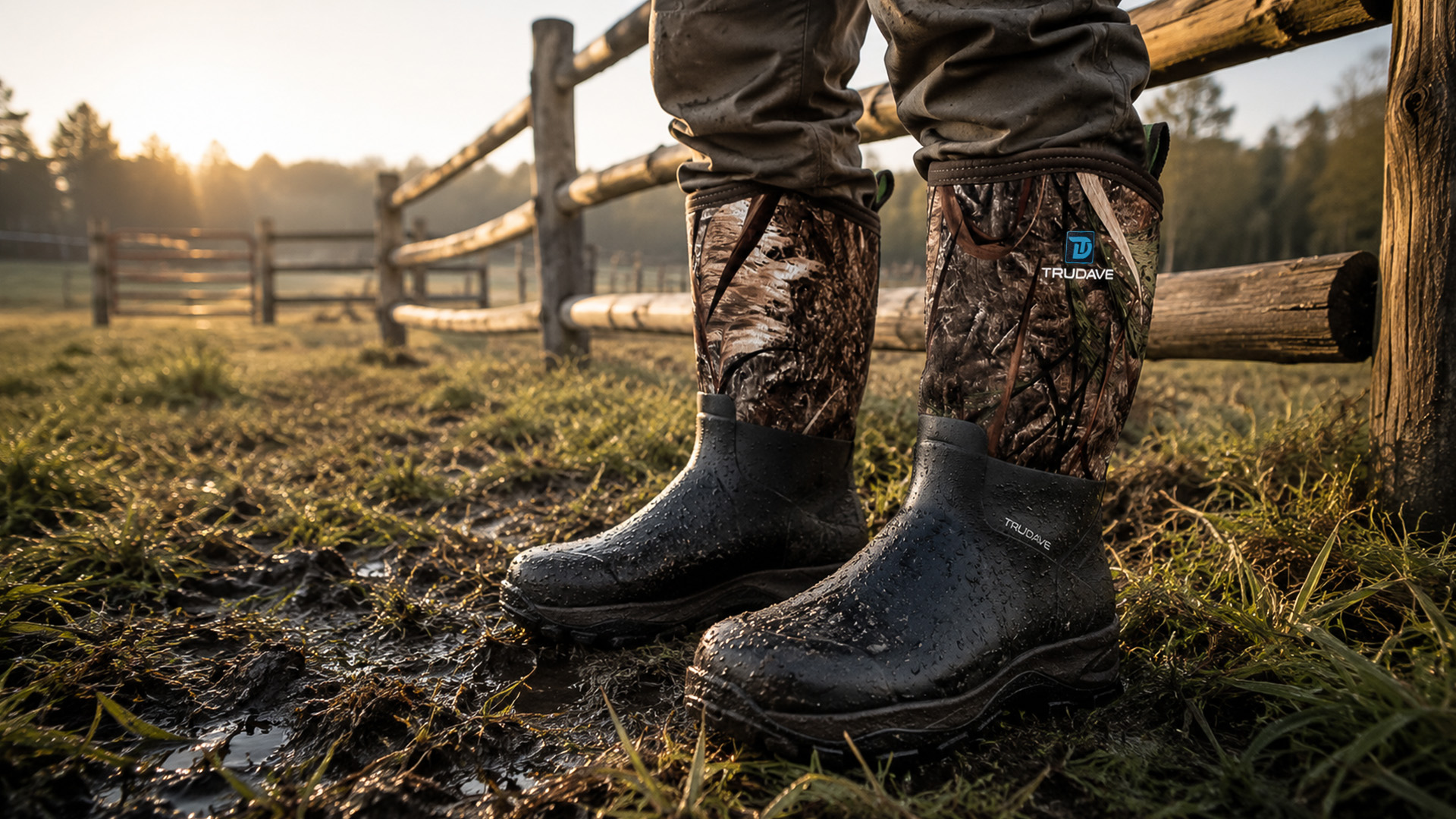
Introduction: The Cold Feet Conundrum
There’s a question that haunts every late-season hunter, usually around 8:30 a.m. on a frozen November morning. You walked a mile to your stand in the dark. Your heart was pumping, your body was generating heat, and your feet felt perfectly comfortable inside your boots. But now you’ve been sitting motionless for two hours. The temperature hasn’t changed—it’s still 18°F—but your toes have gone from warm to cool to cold, and the first tendril of numbness is creeping across the ball of your foot.
Why? The boots didn’t leak. The socks are the same merino wool pair you’ve trusted for years. The walk in wasn’t any longer than usual. So what changed?
The answer is insulation—specifically, how your boot’s insulation works when you stop working. Understanding this is the key to understanding why Trudave Gear’s hunting boot lineup (WildGuard, TrailGuard, and DryFlow) is built the way it is, and why the materials inside your boots matter just as much as the conditions outside them. This is a deep dive into the science of staying warm, from closed-cell neoprene foam to the humble air bubble, and how Trudave engineers it all to keep you in the stand longer.
Part 1: The Physics of a Cold Foot
To understand insulation, you first have to understand what you’re insulating against. Heat always moves from warmer objects to colder ones. Your foot, at roughly 85°F to 90°F inside a boot, is a furnace compared to the 18°F ground you’re standing on. Left unchecked, that heat will flow relentlessly out of your foot and into the frozen earth until your foot reaches the same temperature as the mud beneath it.
Insulation doesn’t “create” heat. It slows the rate of heat loss. It does this by trapping air—one of the poorest conductors of heat in nature—in millions of tiny pockets. The more still air you can trap around your foot, the longer your body’s own heat will keep you warm. This is why a tightly laced boot feels warmer than a loose one (less air exchange with the outside), and why a boot that’s too tight can actually make your feet colder (it restricts blood flow, which is what delivers heat to your feet in the first place).
The challenge for hunting boots specifically is that they must insulate while also being waterproof, flexible, durable, and—in many cases—scent-free. This combination of demands is what drove the evolution from pure rubber boots to the neoprene-and-rubber hybrids that dominate the modern market.
Part 2: Neoprene—The Accidental Insulator
Neoprene was invented by DuPont scientists in 1930 as an oil-resistant synthetic rubber. Its original applications were industrial: gaskets, hoses, corrosion-resistant coatings. But neoprene had a secret. When manufactured as a foam, it becomes a closed-cell structure—each cell is a sealed bubble of gas trapped within a polymer matrix. Those bubbles are what make neoprene an insulator, and they’re also what make it the material of choice for wetsuits, which keep divers warm by trapping a thin layer of body-warmed water against the skin.
For hunting boots, the same principle applies, but in air rather than water. The 5mm neoprene used in Trudave’s WildGuard and TrailGuard boots contains millions of air pockets per square inch. Because these pockets are sealed (closed-cell), they can’t be displaced by water or compressed permanently the way an open-cell foam or a synthetic fiber insulation can. This is critical: neoprene insulates even when wet, a property that Thinsulate and similar fiber insulations cannot reliably match.
Thinsulate works by trapping air between synthetic fibers. It’s lightweight and effective—when dry. But if moisture penetrates the boot (from external water or internal sweat), those fibers can mat down, losing loft and with it, much of their insulating ability. Neoprene’s closed-cell structure doesn’t collapse when wet. The air pockets remain intact, and the insulation value holds. For the hunter crossing a creek at dawn or sweating through a long approach, this difference matters enormously.
Part 3: Why 5mm Matters
Not all neoprene is created equal. The thickness of the neoprene layer directly determines how much insulation it provides. More thickness equals more trapped air equals slower heat loss. Many budget neoprene boots use 3mm neoprene, which provides some insulation but significantly less than the 5mm neoprene Trudave uses in its insulated hunting boots.
That extra 2mm represents roughly 66% more trapped air. In a tree stand at 15°F, that’s the difference between finishing a four-hour sit and climbing down after two hours with numb toes. Trudave’s 5mm neoprene is the same material used in deep-sea diving suits, chosen specifically for its ability to create a warm pocket of air around the foot and lower leg while remaining flexible enough to walk naturally. The neoprene also extends up the shaft, insulating the calves—an often-overlooked factor in overall foot warmth, since blood circulating through cold calves arrives at the feet already chilled.
Part 4: The Liner Strategy—Breathable vs. Fleece
Neoprene provides the structural insulation, but the liner inside the boot determines how that insulation interacts with your foot’s own moisture and heat output. This is where Trudave’s WildGuard and TrailGuard diverge.
The WildGuard uses a breathable liner against the 5mm neoprene. This liner is designed for the hunter who walks significant distances before settling into a stand, or who still-hunts between sitting locations. The breathable liner allows moisture vapor from sweat to move away from the skin and toward the neoprene layer, where it can dissipate more effectively. This prevents the sweat-soaked sock that becomes a cold compress the moment the hunter stops moving.
The TrailGuard adds a fleece liner on top of the 5mm neoprene. Fleece is soft, moisture-wicking, and adds a second layer of trapped air for additional insulation. This liner is engineered for the hunter whose primary activity is sitting still in extreme cold. The fleece provides immediate warmth against the skin—no “cold shock” when you first slide your foot in—and its wicking properties move moisture outward, though with slightly less breathability than the WildGuard’s dedicated breathable liner.
The choice between them depends on your activity profile. Walk more than you sit? The WildGuard’s breathable liner manages moisture better. Sit more than you walk, in temperatures that would make a penguin shiver? The TrailGuard’s fleece-lined neoprene is the warmer choice for static conditions.
Part 5: The Zero-Insulation Philosophy—DryFlow
The DryFlow takes the insulation question and answers it with a radical proposition: none. This isn’t a cost-saving measure. It’s a deliberate engineering decision for the hunter whose body is a furnace. Spot-and-stalk elk hunters, early-season whitetail bowhunters, and spring turkey chasers generate enormous amounts of body heat through continuous movement. In these conditions, insulation of any kind becomes a liability—it traps heat that the body is trying to shed, causing excessive sweating that leads to blisters and, eventually, cold feet when the hunter finally stops.
The DryFlow is built from industrial-grade waterproof rubber with a breathable, moisture-wicking liner and absolutely no insulation. The boot’s job is to keep external water out while allowing the foot’s natural thermoregulation to work unimpeded. Paired with the right sock (lightweight merino for warm days, midweight for cool mornings), the DryFlow keeps feet comfortable through the high-output hunts that define early fall and spring. It reaches its thermal limit when the temperature drops below freezing and the hunter stops moving—which is exactly when you’d switch to a WildGuard or TrailGuard.
Part 6: Wet Insulation—The Test That Matters Most
Here’s a scenario that separates good insulation from great: you’re crossing a creek on a late-season morning. The water is deeper than you thought. It doesn’t come over the top of the boot, but the neoprene upper is submerged for a few seconds. In a boot with Thinsulate or another synthetic fiber insulation, that brief exposure can be catastrophic. The fibers soak up water, collapse, and lose their loft. The insulation value plummets, and your foot is now surrounded by a cold, wet layer that actively conducts heat away.
Neoprene doesn’t absorb water. Its closed-cell structure remains intact even when fully submerged. The millions of air pockets stay air pockets. The insulation value holds. This is why neoprene is the material of choice for wetsuits, and it’s why Trudave builds its insulated hunting boots around 5mm neoprene rather than relying on synthetic fiber insulation alone. For the whitetail hunter crossing a creek bottom or the duck hunter standing in flooded timber, this wet-insulation performance isn’t a luxury—it’s the difference between a successful hunt and a long, cold walk back to the truck.
Part 7: The EVA Midsole—The Insulator You Can’t See
There’s one more layer of insulation in a Trudave boot that most hunters never think about: the EVA (ethylene-vinyl acetate) midsole. EVA is a lightweight, shock-absorbing foam that Trudave uses in place of the heavy steel shanks found in traditional work boots. But EVA does more than cushion your stride. It’s also a thermal barrier.
Steel shanks conduct cold from the frozen ground directly into the foot. EVA does not. The same closed-cell structure that makes EVA a good shock absorber also makes it a poor conductor of heat. By replacing steel with EVA, Trudave eliminates a direct thermal pathway between the frozen ground and your foot. This is why the WildGuard and TrailGuard specify “cushioned EVA midsoles and arch support that reduce fatigue on long treks”—the “fatigue” they’re reducing isn’t just muscular. It’s thermal fatigue, the slow, creeping cold that seeps up through the soles of lesser boots.
The DryFlow also uses an EVA midsole, though without the neoprene upper. The EVA in the DryFlow is tuned for shock absorption and ground feel rather than insulation, but it still provides a thermal break between the foot and the ground that a steel shank boot cannot match.
Part 8: The Sock System—Your Customizable Insulation Layer
No boot’s insulation works in isolation. The sock you choose is the final, customizable layer that determines whether your feet are warm, cool, or just right.
Trudave boots are intentionally designed with a little extra volume to accommodate thick insulating socks. This is a feature, not a sizing flaw. As one Trustpilot reviewer explained: “The size is slightly larger, but with socks they fit well and comfortably. A size smaller would be too tight.” Another noted, “I sized up because I want to be able to wear thick handmade socks in the fall and winter. They fit beautifully.”
For cold-weather stand hunting with the TrailGuard, a two-layer sock system—a thin synthetic moisture-wicking liner under a heavyweight merino wool outer sock—maximizes the insulation of the fleece-lined neoprene. The liner wicks sweat away from the skin, preventing the moisture buildup that accelerates heat loss. The merino wool traps heat and continues to insulate even if it becomes damp.
For active hunting with the WildGuard, a single midweight merino wool sock is usually sufficient. The neoprene provides structural insulation, the breathable liner manages moisture, and the sock fills the boot’s intentional volume without overheating.
For warm-weather hunts with the DryFlow, a lightweight merino or synthetic sock keeps feet cool and dry. The boot has no insulation of its own, so the sock is doing all the thermal regulation.
Avoid cotton socks entirely. Cotton absorbs moisture, collapses into a cold, wet cloth, and actively conducts heat away from the foot. As Trudave’s product guidance warns, “Cotton traps sweat against the skin, rapidly dropping your body temperature.”
Part 9: The Decision Matrix—Matching Insulation to Intention
| Your Hunt Profile | Insulation Need | Trudave Match | Why |
|---|---|---|---|
| Late-season stand sits (below 25°F) | Maximum static warmth, moisture-wicking | TrailGuard | 5mm neoprene + fleece liner; EVA midsole breaks thermal bridge |
| Mixed walking/sitting in wet, cold conditions | Moderate warmth with breathability | WildGuard | 5mm neoprene + breathable liner; vulcanized rubber stays dry |
| Early-season, spot-and-stalk, spring turkey (above 45°F) | No insulation, maximum breathability | DryFlow | Zero-insulation design; body heat regulates temperature |
| All-season hunter | Variable | Two- or three-boot system | Match insulation to activity and temperature |
The hunters who benefit most from a multi-boot system aren’t gear-obsessed. They’re hunters whose season spans enough conditions that one insulation profile cannot serve every hunt. At Trudave’s direct-to-consumer pricing, owning the right insulation for every phase of the season costs less than a single pair of premium-brand boots from a legacy manufacturer.
Conclusion: Warmth Is a Science, Not a Slogan
The hunting industry is full of claims about “extreme cold weather performance” and “maximum insulation.” But warmth isn’t a feature you can add with a thicker label. It’s the result of careful material choices—closed-cell neoprene that doesn’t collapse when wet, fleece liners that add a second thermal layer, EVA midsoles that break the thermal bridge to frozen ground, and the intentional volume to accommodate a smart sock system.
Trudave Gear’s WildGuard, TrailGuard, and DryFlow series are built on this materials science, not on marketing slogans. The 5mm neoprene in the WildGuard and TrailGuard. The zero-insulation philosophy of the DryFlow. The EVA midsoles under every boot. The moisture-wicking liners that prevent the sweat trap. None of it is accidental. All of it is physics.
The right boot for your hunt is the one whose insulation profile matches your body’s heat output and the air temperature around you. Know your profile. Choose your insulation. And stay out there longer.
To explore the complete Trudave Gear hunting boot lineup and find the right insulation for your hunt, visit trudavegear.com.
