
Introduction: The Overheating Problem Nobody Talks About
Every September, the same scene plays out in treestands and trailheads across the country. A bowhunter, layered in merino wool and camouflage, settles in for an evening sit. The temperature is a mild 62 degrees. The walk in was a mile and a half through rolling hardwood timber. And by the time the hunter reaches the stand, their feet are swimming in sweat inside heavily insulated boots that were purchased for the rut in November.
The boots didn’t fail. They were the wrong tool for the job. The 800 grams of Thinsulate that felt so reassuring on a late-season morning in December is a liability in early fall, turning the boot into a personal sauna. The sweat that accumulates during the walk doesn’t just make for an uncomfortable sit—it rapidly cools as the sun goes down, creating a clammy, cold environment that saps body heat and cuts hunts short.
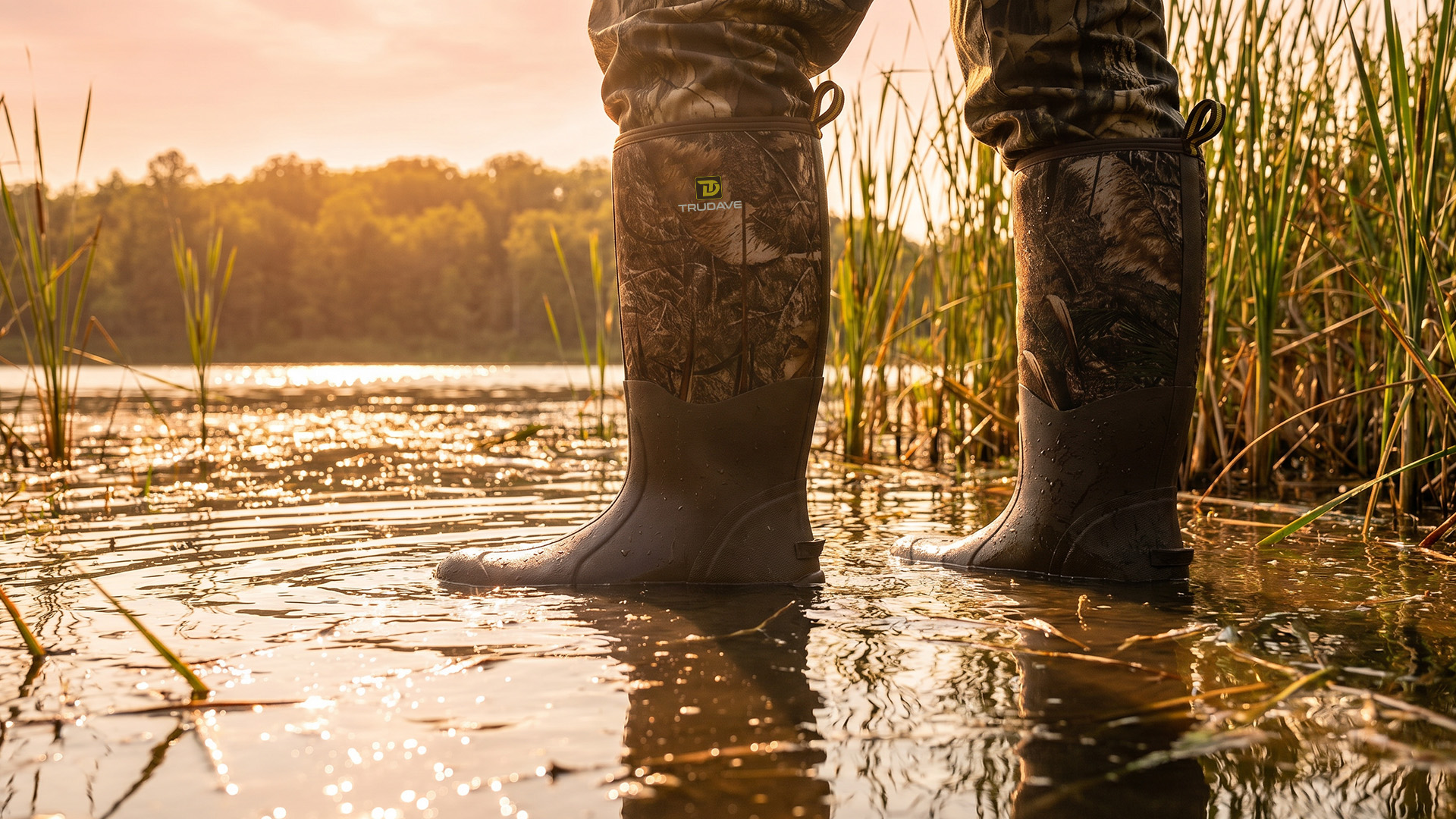
This is the problem that Trudave Gear’s DryFlow Series was engineered to solve. It’s a hunting boot built on a radical premise: in the right conditions, the best insulation is none at all. By stripping away every gram of unnecessary warmth and replacing it with pure, 100% waterproof, industrial-grade rubber, the DryFlow delivers a lightweight, breathable, and utterly dependable platform for the hunter who generates their own heat through movement.
This is the definitive guide to the DryFlow. We’ll break down its unique design philosophy, the materials and construction that separate it from typical rubber boots, the specific hunting scenarios where a zero-insulation boot is the smartest choice, and how to pair it with the right sock system to extend its effective temperature range well into the fall.
Part 1: The Philosophy of Zero Insulation
To understand the DryFlow, you first have to unlearn the assumption that more insulation is always better. For the hunter who sits motionless in a treestand for hours in sub-freezing temperatures, maximum insulation—like the 5mm neoprene and fleece lining in Trudave’s own TrailGuard Series—is non-negotiable. The body is at rest. It generates very little heat. The boot must do all the work of trapping whatever warmth remains.
But for the mobile hunter, the equation is inverted. Spot-and-stalk elk hunters, still-hunting whitetail bowhunters, and spring turkey chasers cover serious miles over varied terrain. Their bodies are furnaces, generating substantial heat through exertion. In these conditions, insulation doesn’t just add unnecessary weight—it actively works against the body’s natural thermoregulation by trapping heat that needs to be shed. The result is excessive sweating, which leads to macerated skin, blisters, and—counterintuitively—cold feet the moment the hunter stops moving.
The DryFlow rejects the insulation paradigm entirely. Instead of adding layers to trap heat, it focuses entirely on keeping external water out while allowing the foot’s own climate to remain as stable as possible. It’s a return to the purity of the original vulcanized rubber hunting boot, refined with modern materials and construction techniques that the hunters of the 1950s could only dream of.
This isn’t a budget-driven compromise. It’s a deliberate, performance-driven design choice. The DryFlow is a specialist’s tool for the hunter whose primary challenge is staying cool and dry rather than staying warm.
Part 2: Industrial-Grade Construction—Rubber That Works as Hard as You Do
At the heart of the DryFlow is its material: industrial-grade waterproof rubber. This isn’t the same rubber compound found on a lightweight garden boot or even a standard neoprene-and-rubber hunting boot. It’s a denser, more abrasion-resistant formulation that has more in common with the boots worn on construction sites and farm fields than on a casual hike.
Trudave constructs the DryFlow from this rubber using sealed, vulcanized seams. The vulcanization process chemically cross-links the rubber polymers at the molecular level, creating a single continuous waterproof barrier that cannot delaminate. There are no glued joints to separate after a season of hard use. There are no stitches to rot. The boot is one piece, impermeable, and built to withstand the sharp rocks, abrasive gravel, and punishing underbrush that come with covering ground off-trail.
The interior is lined with a breathable, moisture-wicking fabric. This is a critical detail, because a 100% waterproof rubber boot without a wicking liner becomes a sweatbox. The liner actively moves moisture away from the skin toward the outer shell, where it can evaporate more effectively—or at least not pool against your sock. Combined with a proper merino wool sock, this system keeps feet drier and more comfortable than unlined rubber boots can manage.
A defining feature of the DryFlow is its structured heel cup. This locks the heel in place, preventing the “heel slip” that causes friction blisters on long descents and the toe-gripping reflex that fatigues the arches. For the hunter covering ten miles a day in pursuit of elk or mule deer, this level of foot security is not a luxury—it’s a prerequisite.
Part 3: The Outsole—Traction That Cleans Itself
The best insulation in the world is useless if your boot can’t keep you upright on a greasy, dew-slicked hillside or a muddy creek crossing. The DryFlow is equipped with an aggressive, cleated outsole that’s engineered to do two things exceptionally well: bite into soft terrain and release mud instantly.
The cleats are widely spaced, a design feature that allows mud, snow, and debris to be ejected with each step. This self-cleaning action prevents the buildup that turns other boots into heavy, slick platforms. It’s a feature that matters just as much on a muddy September morning in a whitetail creek bottom as it does on a rocky, dusty ridge in the high country.
The rubber compound used in the outsole is oil-resistant and non-slip, a trait borrowed directly from Trudave’s industrial work boot line. This makes the DryFlow unusually sure-footed on wet wooden steps, algae-slicked rocks, and the diamond-plate surfaces of truck beds and ATV trailers.
Importantly, the outsole’s flexibility works in concert with the boot’s zero-insulation design. Without a thick layer of neoprene or felt in the midsole, you have greater ground feel—your foot can more accurately sense the angle of a slope, the texture of a rock, and the give of soft ground. That proprioception is a genuine safety advantage when you’re moving fast and covering technical terrain.
Part 4: The Active Hunter’s Sweet Spot—Where the DryFlow Excels
The DryFlow is the right call whenever your hunt demands more movement than stillness, and whenever the temperature is more likely to be above 45 degrees than below it. It dominates in a few specific scenarios that cover a huge portion of the hunting year.
Early-Season Whitetail Bowhunting (September – Early October)
This is the DryFlow’s time to shine. The woods are still green, the temperatures often climb into the 70s, and deer are on predictable early-season patterns. You’re walking in with a stand on your back, sweat is inevitable, and insulation is a curse. The DryFlow keeps your feet protected from the dew without turning into a sauna.
Spring Turkey Hunting (April – May)
Turkey hunting is the definition of run-and-gun. You’re covering miles of ridges, creek bottoms, and field edges, sitting against trees for brief calling sequences before moving again. The DryFlow’s lightweight construction, flexible feel, and zero insulation profile are a perfect match for this high-output style.
Spot-and-Stalk Western Big Game (Early Archery Season)
When you’re chasing elk or mule deer in the mountains during August and September, every ounce on your feet matters. The DryFlow is significantly lighter than an insulated neoprene boot, and its breathable liner helps manage the sweat generated by climbing 2,000 vertical feet to reach a glassing knob.
Scouting and Preseason Preparation
Hanging treestands, clearing shooting lanes, checking trail cameras—these are high-output, warm-weather tasks that demand waterproof protection from wet grass and mud without the weight and heat of an insulated boot. The DryFlow is the boot that lives in your truck all summer for this very reason.
The Sock System That Extends Its Range
With the right socks, the DryFlow’s comfortable temperature range can be pushed surprisingly low. In 50-degree weather, a midweight merino wool sock provides enough insulation for active walking. In 40-degree weather, a heavyweight merino wool sock can keep you comfortable as long as you’re moving. Once the temperature drops below freezing and your activity level drops to sitting still, the DryFlow reaches its thermal limit—and that’s exactly when you’d switch to a TrailGuard or WildGuard. The key is knowing that the DryFlow’s insulation comes from your body heat and your socks, not from the boot itself.
Part 5: Care and Longevity—Keeping Your DryFlows in the Fight
The same industrial-grade construction that makes the DryFlow tough also makes it easy to maintain. After a hunt, the protocol is simple: rinse off mud and debris with clean water, use mild soap and a soft brush for stubborn grime, and let the boots air dry naturally in a shaded area away from direct sunlight or heat sources.
The no-heat rule is essential. Vulcanized rubber’s worst enemy is a hot radiator, a campfire, or the scorching bed of a pickup truck in summer. Heat breaks down the polymer cross-links that give the rubber its flexibility and strength, leading to cracks and loss of waterproof integrity. A boot that’s simply rinsed and left to dry at room temperature will outlast a heat-dried boot by years.
Periodically—every couple of months during heavy use—apply a silicone-free rubber conditioner to the exterior. This restores the protective layer, prevents the rubber from drying out, and keeps it supple. The white, chalky film that sometimes appears on natural rubber (called “bloom”) is a normal characteristic of high-quality rubber and can be wiped away with a damp cloth and conditioner.
The removable EVA insole should be taken out after each hunt to dry separately. Over time, the insole will compress and lose its cushioning. Replacing the insoles annually with a fresh set of EVA or Trudave’s own ToughCush Comfort Insoles will keep the boots feeling like new for multiple seasons.
Part 6: How the DryFlow Fits Into a Complete Hunting Boot System
No single boot covers every hunting scenario, and the DryFlow doesn’t pretend to. It is one specialized tool in a system that might also include an insulated neoprene boot for cold-weather sits and a heavily insulated, fleece-lined boot for the most extreme late-season conditions.
A serious hunter might build a Trudave rotation like this:
- DryFlow (Zero Insulation): For early-season scouting, bowhunting, spring turkey, and any hunt where heat buildup is the primary threat.
- WildGuard (5mm Neoprene + Breathable Liner): For the rut and mid-season hunts where you’re walking and sitting in roughly equal measure, often in wet conditions, and need both warmth and camouflage.
- TrailGuard (5mm Neoprene + Fleece Liner): For late-season, sub-freezing stand sits where maximum static insulation is the only thing between you and numb feet.
At Trudave’s direct-to-consumer prices, building a complete three-boot system costs less than a single pair of premium-brand insulated boots from a legacy manufacturer sold through traditional retail. This is the economic reality that makes specialization practical: you’re not paying for three pairs of boots. You’re paying for the right tool for each phase of the season, at a price that reflects the materials and construction, not a brand-name tax.
Conclusion: The Boot That Gets Out of Its Own Way
For too long, the hunting boot industry has sold the fantasy of the “one perfect boot” that can handle everything from a September scouting trip to a January deep-freeze sit. It’s a story that sells boots, but it’s not how materials science works. Insulation is a trade-off, not a universal good. The best boot for a given hunt is the one whose thermal profile most closely matches your body’s heat output and the air temperature around you.
The DryFlow is Trudave Gear’s purest expression of that principle. It doesn’t try to insulate. It doesn’t try to be warm. It tries to be completely waterproof, exceptionally durable, remarkably lightweight, and unobtrusively comfortable—so that you can move fast, cover ground, and let your body do what it was designed to do. For the active hunter who spends more time walking than sitting, more time sweating than shivering, the DryFlow is the boot that gets out of your way and lets you focus on the hunt.
To explore the complete Trudave Gear hunting boot lineup—including the DryFlow, WildGuard, and TrailGuard series—and find the right pair for your next hunt, visit trudavegear.com.
