
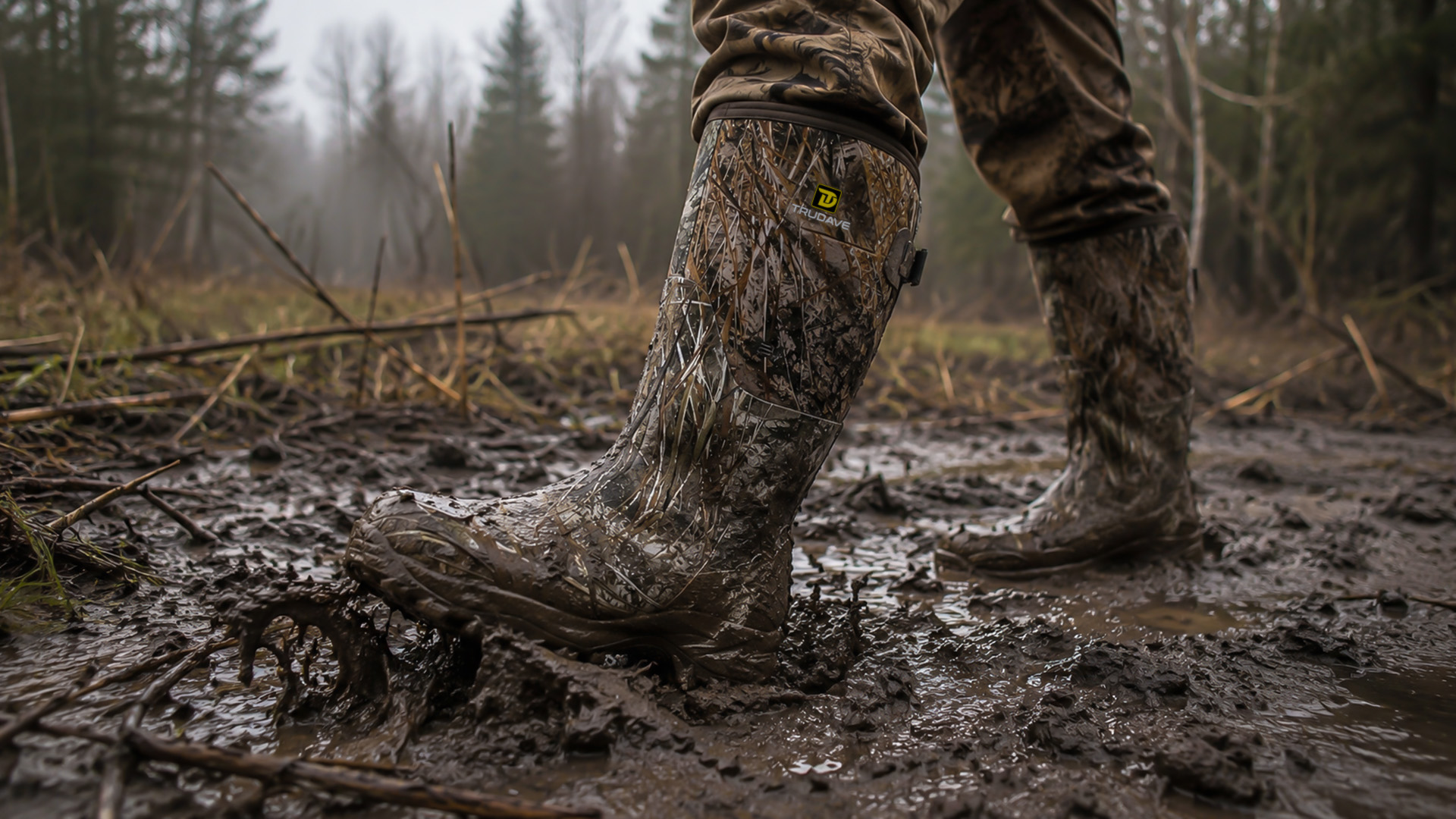
Introduction: A Different Kind of Wet
Duck and goose hunters live in a world defined by water. It’s in the pre-dawn mist rising off the flooded timber, in the soupy muck that grabs at your boots with every step into the marsh, and in the cold spray that sheets across the layout blind when the wind picks up. For the waterfowler, staying dry isn’t just about comfort—it’s about survival. Wet feet at 5:30 a.m. in a freezing cornfield pond can ruin a hunt before legal shooting light.
Yet for decades, waterfowl hunters have been forced to choose between two imperfect options: knee-high rubber boots that are 100% waterproof but heavy, stiff, and cold; or insulated leather boots that offer better warmth but eventually soak through and become waterlogged anchors. Neither fully solved the problem. The rubber boot kept water out but conducted cold straight from the frozen mud into your feet. The leather boot breathed but leaked. Both compromised.
Trudave Gear’s hunting boot lineup—WildGuard, TrailGuard, and DryFlow—approaches the waterfowler’s challenge from a different angle. By combining vulcanized natural rubber with insulating neoprene in specific configurations matched to hunting conditions, Trudave has built boots that don’t ask you to choose between dry and warm. This guide is written specifically for the duck and goose hunter, breaking down which Trudave boot belongs in your blind bag and why the materials matter more for waterfowling than for almost any other type of hunting.
Part 1: The Waterfowler’s Unique Demands
Before matching a boot to a hunt, it’s worth understanding why waterfowl hunting is so punishing on footwear. Three factors combine to create a uniquely demanding environment.
The Water Is Everywhere
Unlike a whitetail hunter who may cross a single creek on the way to a dry stand, the waterfowler stands in water for hours. Layout blinds in flooded cornfields have an inch or two of standing water beneath them. Timber hunts mean wading through waist-deep sloughs to reach the tree line. Marsh hunting involves slogging through ankle-deep muck for hundreds of yards before you even reach the blind. The waterproofing requirement is absolute—there is no margin for error.
The Cold Is Relentless
Waterfowl seasons run late. The best hunting often happens when temperatures are plummeting and ice is forming at the edges of the marsh. Standing in near-freezing water saps body heat faster than standing on frozen ground, because water conducts heat 25 times more efficiently than air. Insulation that would be adequate for a dry-land sit becomes dangerously inadequate when water is involved.
The Terrain Is Treacherous
The bottom of a marsh pond is not a stable surface. It’s soft, uneven, and often littered with submerged logs, rocks, and tangles of vegetation. Mud that looks solid from above can be thigh-deep and sticky enough to pull a boot clean off your foot. A boot needs to release from mud cleanly without creating suction, and it needs to grip on submerged logs that are slick with algae. The traction demands are different from those of a dry forest floor or a frozen hillside.
Concealment Matters
Ducks and geese look down. A flash of unnatural color—a bright rubber sole, a shiny black boot shaft—can flare birds that were otherwise committed. Camouflage is not cosmetic for the waterfowler; it’s a functional requirement.
Trudave’s WildGuard Camo Series was designed with these four demands in mind. It’s not a repurposed upland boot. It’s a purpose-built waterfowling tool.
Part 2: The WildGuard Camo Series — Built for the Marsh
The WildGuard Camo is Trudave’s flagship waterfowl boot. “Designed to blend seamlessly with the landscape,” Trudave notes, “the camo finish keeps you hidden in timber, reeds, or brush.” But concealment is just the beginning.
Waterproofing
The WildGuard is 100% waterproof, constructed from 5mm neoprene bonded to a tough natural rubber shell. The bond is vulcanized—a chemical fusion at the molecular level, not a glued seam that can separate over time. For the waterfowler standing in flooded timber or a marsh pond for hours, this is the most critical feature. Glued seams fail when constantly submerged. Vulcanized bonds don’t. The neoprene upper extends well above the waterline for most wading scenarios, and the rubber lower provides an impermeable barrier against the mud and debris of the marsh bottom.
Insulation
The 5mm neoprene upper is the same material used in wetsuits—a closed-cell foam that traps millions of insulating air bubbles. This keeps warmth in even when the outside temperature drops. The WildGuard features a breathable liner that traps warmth without overheating during the walk to the blind, which can be a significant calorie burn when you’re hauling decoys, a shotgun, and gear across a muddy field in waders. Once you settle into the blind and your activity level drops, the neoprene continues to insulate passively, keeping feet warm through hours of stillness.
Traction
The deep-lug outsole “grips confidently on wet logs, rocky trails, and uneven ground.” The tread is designed to release mud cleanly as you walk, preventing the weight buildup that turns standard boots into five-pound anchors by the time you reach the blind. The lugs are aggressive enough to bite into soft marsh muck but spaced widely enough to shed debris with each step.
Concealment
The camouflage finish is functional, not decorative. It breaks up the boot’s outline against the reeds, cattails, and timber that define waterfowl habitat. In a layout blind, where minimal movement is the rule, a camo boot that blends with the surroundings is one less thing to flare birds.
On-and-Off Ease
The WildGuard features a kick-off heel tab for hands-free removal—a small detail that becomes significant when you’re exhausted, wet, and trying to peel off muddy boots in the dark at the boat ramp. The neoprene upper flexes for easy slip-on, even with thick socks.
Part 3: When the Freeze Hits — The TrailGuard for Late-Season Waterfowl
Late-season duck hunting often coincides with the coldest temperatures of the year. When the marsh starts to freeze and snow blows across the decoys, the WildGuard’s breathable liner may not be enough for hunters who sit motionless for hours in extreme cold.
This is where the TrailGuard comes in. Originally designed as a stand-hunting boot for late-season whitetail, the TrailGuard’s insulation profile also serves the waterfowler who hunts frozen conditions. It features the same 5mm neoprene upper as the WildGuard, but adds a fleece lining—a dual-layer insulation system that provides significantly more static warmth. “These boots feature 5mm neoprene insulation and a fleece lining that provide excellent warmth and comfort during cold-weather hunts—ideal for deer, duck, or late-season hunting,” Trudave states.
The TrailGuard is fully waterproof with the same vulcanized rubber construction. The aggressive all-terrain outsole with self-cleaning tread sheds frozen mud and snow. The boot is not available in a camo finish, so for the waterfowler who prioritizes concealment above all else, the WildGuard Camo may still be the preferred choice. But for the late-season hunter who needs maximum warmth and is hunting from a fully enclosed blind where camouflage is less critical, the TrailGuard’s fleece liner can be the difference between staying until sunset and packing up at 10 a.m. with frozen toes.
One reviewer who tested the TrailGuard in -8°F weather reported that their feet “stayed warm and comfortable the entire time—even during early morning cold.” That’s the kind of performance that matters when you’re sitting in a frozen marsh waiting for the morning flight.
Part 4: Early Season and Active Hunts — The DryFlow Option
For September teal seasons and early goose hunts, when temperatures are mild and the water is still relatively warm, insulation can be a liability. The DryFlow Series, with its zero-insulation design, is the right tool for these conditions.
The DryFlow is made from industrial-grade waterproof rubber with sealed seams. It’s light, flexible, and completely waterproof—ideal for the active waterfowler who is moving constantly, setting and picking up decoys, and generating body heat through physical work. Without a neoprene lining, the boot breathes better and doesn’t trap heat the way insulated boots do. Paired with lightweight merino wool socks, it keeps feet dry and comfortable through early-season hunts where overheating is the bigger threat.
The DryFlow’s aggressive cleated outsole pushes mud out with every step for constant ground contact, and the oil-resistant rubber compound grips well on boat ramps, dock surfaces, and the mixed terrain of early-season hunting areas. For the waterfowler who hunts from September into November, a two-boot system—DryFlow for early season, WildGuard or TrailGuard for late season—covers the full temperature spectrum without compromise.
Part 5: The Sock System for Waterfowlers
Standing in water amplifies the cold. The sock system that works for a dry-land stand sit may not be sufficient when you’re in a flooded blind. For waterfowling, the sock strategy is critical.
For early season (40°F to 60°F): Midweight merino wool socks. Enough cushion for comfort, enough insulation for standing in cool water, but not so thick that your feet sweat during active setup and teardown.
For mid-season (25°F to 45°F): Heavyweight merino wool socks with the WildGuard. The 5mm neoprene provides insulation, and the socks fill the boot’s intentional volume.
For late season (below 25°F): A two-layer system: a thin synthetic moisture-wicking liner sock against the skin, and a heavyweight merino wool outer sock. This combination maximizes insulation while managing moisture. With the TrailGuard’s fleece lining, this system keeps feet warm through hours of stillness in freezing conditions.
Avoid cotton entirely. Cotton absorbs water, collapses, and actively cools your feet. “Cotton traps sweat against the skin, rapidly dropping your body temperature,” Trudave’s guidance warns. This is doubly true in a waterfowl environment, where the humidity inside the boot is higher than in a dry-land hunt.
Part 6: Care for Boots That Live in Water
Waterfowl boots endure more water exposure than almost any other hunting boot. Proper care is what prevents a one-season boot from becoming a multi-season investment.
Trudave’s care protocol is straightforward and essential: rinse the boots with clean water after every hunt, even if they don’t look muddy. Marsh mud contains organic acids that degrade rubber over time. Use mild soap and a soft brush for stubborn grime. Remove the insoles and let them dry separately. Stuff the boots with crumpled newspaper to wick moisture from the neoprene lining, and store them upright in a well-ventilated area at room temperature.
Never dry boots with direct heat—no heaters, no radiators, no campfires. Heat destroys the polymer cross-links in vulcanized rubber, causing it to become brittle and crack. Air drying takes longer but preserves the boots’ waterproof integrity and flexibility.
For the neoprene uppers on the WildGuard and TrailGuard, pay special attention to interior drying. The newspaper trick is essential: it pulls moisture from the neoprene cells and prevents the musty odor that develops when boots are stored damp. Every few weeks, a mild enzyme cleaner can be used to break down any bacteria that have accumulated in the lining.
Part 7: The Decision Framework for Waterfowlers
| Your Waterfowl Season | Primary Conditions | Trudave Boot | Key Advantage |
|---|---|---|---|
| Early teal / early goose (September – October) | Mild temps, active hunting | DryFlow | Lightweight, zero insulation, breathable |
| Mid-season ducks (November – December) | Cold water, mixed activity | WildGuard Camo | 5mm neoprene warmth, camo concealment, deep-lug traction |
| Late-season / frozen marsh (January) | Extreme cold, frozen ground | TrailGuard | Fleece liner + 5mm neoprene, maximum static warmth |
| All-season waterfowler | Variable | Two-boot system | DryFlow for early, WildGuard or TrailGuard for late |
The two-boot system is not overkill—it’s matching the right tool to the right conditions. A DryFlow for September teal, a WildGuard Camo for November mallards, and a TrailGuard for January geese when the marsh is frozen solid. At Trudave’s direct-to-consumer pricing, owning all three costs less than a single pair of premium-brand boots from a legacy manufacturer.
Conclusion: Dry Feet, Warm Feet, Dead Birds
Duck hunting has a saying: “You don’t shoot ducks with cold feet.” It’s half joke, half truth. When your feet are wet and freezing, your focus drifts from the sky to your toes. You fidget. You lose patience. You pack up early. The boots you wear are the difference between a limit and a long, cold walk back to the truck with nothing.
Trudave Gear’s WildGuard, TrailGuard, and DryFlow series give waterfowlers a clear, purpose-built set of tools for the specific demands of their sport. Vulcanized natural rubber that won’t delaminate after a season of standing in water. Neoprene insulation that keeps warmth in even when temperatures plummet. Camouflage that conceals from above. Traction that grips mud and releases cleanly. And a direct-to-consumer model that puts the money into the materials, not the retail markup.
Match the boot to the marsh. Match the sock to the temperature. Take care of the gear that takes care of you. Then settle into the blind, watch the eastern sky lighten, and wait for wings.
To explore the complete Trudave Gear hunting boot lineup and find the right pair for your next waterfowl hunt, visit trudavegear.com.
