
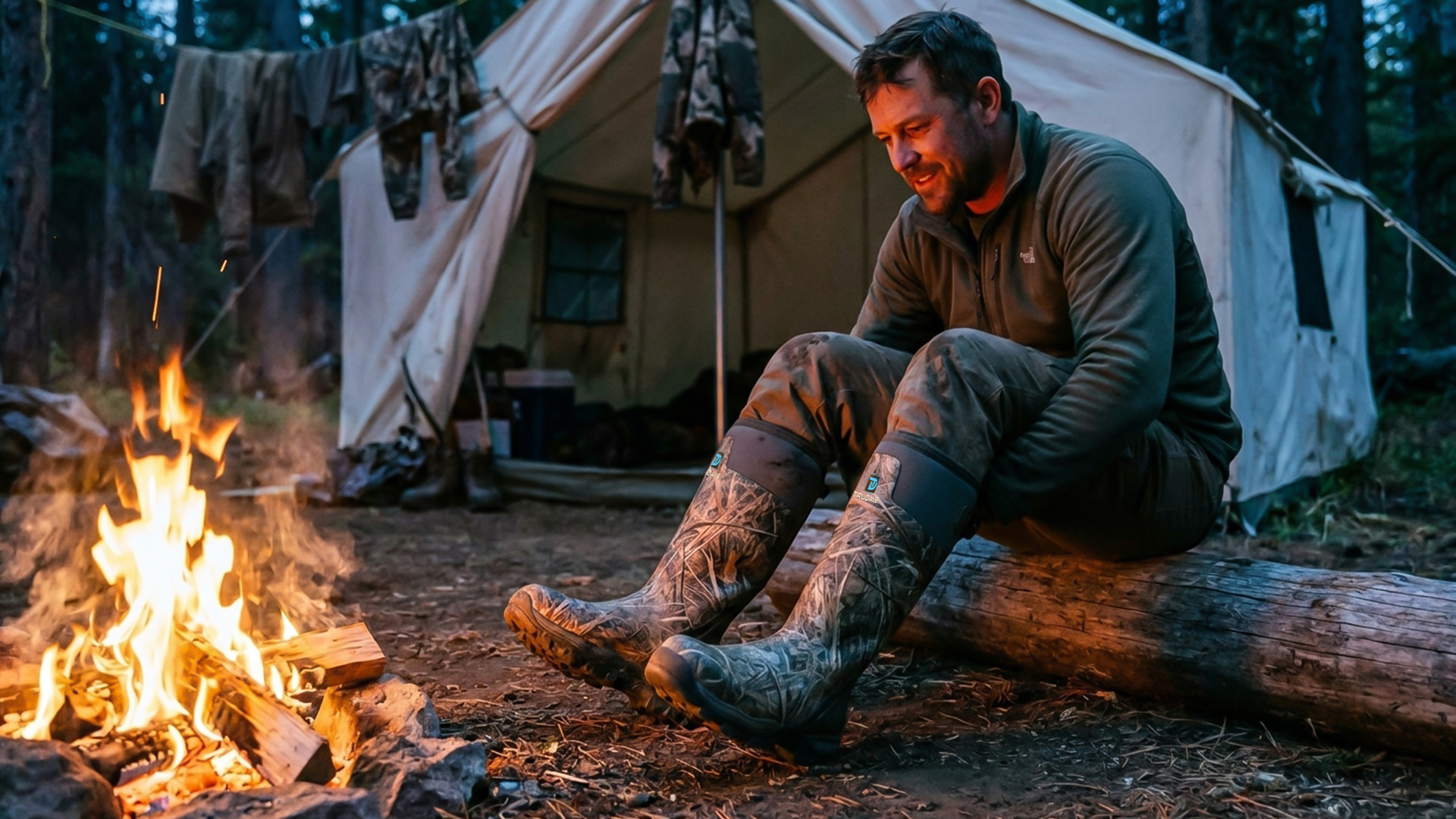
Introduction: The Missing Pieces
Walk into any hunting camp in late October, and you’ll see the same scene: a hunter sitting on a tailgate, lacing up a brand-new pair of boots, complaining that something doesn’t feel right. The boots are premium vulcanized rubber and 5mm neoprene — the right tools for the job. But the hunter is wearing thin cotton athletic socks, the factory insoles haven’t been swapped, and the gaiters that should be keeping debris out are still in the gear closet. The boot system is incomplete, and the hunter will pay for it with cold, wet, aching feet by noon.
A hunting boot is only as effective as the system around it. Socks manage moisture and insulation. Insoles determine arch support and impact absorption. Gaiters seal the gap between boot and pant leg. Traction devices keep you upright on ice. When these components are chosen thoughtfully and matched to the conditions, the result is a seamless platform that disappears from your awareness, letting you focus entirely on the hunt. When they’re ignored, even a $400 boot will leave you miserable.
Trudave Gear’s hunting boot lineup — WildGuard, TrailGuard, and DryFlow — is engineered to anchor just such a system. The boots are built with intentional volume to accommodate thick insulating socks, removable EVA insoles that can be upgraded or replaced, and sturdy rubber shells that accept aftermarket traction devices and gaiters. This guide is about the complete system that surrounds those boots. We’ll walk through the sock protocols, insole upgrades, gaiter and traction add-ons, and care habits that turn a properly fitted Trudave boot into the most comfortable, reliable piece of gear you own.
Part 1: The Sock System — The Foundation of Warmth and Comfort
The single biggest mistake hunters make with their footwear is treating socks as an afterthought. Your sock is the layer that directly touches your skin. It determines whether the boot’s insulation can do its job, whether moisture is wicked away or trapped against your foot, and whether the intentional volume built into Trudave boots feels perfectly filled or sloppily cavernous.
The Two-Layer Protocol for Cold Hunts
For stationary stand hunting below 30°F, a single thick sock is not the best solution. The superior approach is two layers: a thin synthetic or merino wool liner sock against the skin, and a heavyweight merino wool outer sock over it. The liner’s job is moisture management — it wicks sweat away from your skin and transfers it to the outer sock, where it can evaporate rather than pooling against your foot. The outer sock provides the bulk of the insulation and fills the boot’s intentional volume, creating a snug but not tight fit.
Why merino wool? Because it absorbs up to 30% of its weight in moisture without feeling wet, continues to insulate when damp, and resists bacterial growth that causes odor. Synthetic insulations cannot match this combination of properties. Avoid cotton entirely: cotton absorbs moisture, collapses into a cold, wet rag, and actively conducts heat away from your skin. As Trudave’s product guidance notes: “Cotton traps sweat against the skin, rapidly dropping your body temperature.”
Single-Sock Protocol for Active Hunts
For mobile hunting — spot-and-stalk, still-hunting, spring turkey — where you generate significant body heat, a single pair of midweight to heavyweight merino wool socks is usually sufficient. The key is matching sock thickness to the boot’s insulation level. The DryFlow Series, with its zero insulation, pairs well with midweight or heavyweight merino depending on temperature. The WildGuard’s breathable liner works best with midweight socks for active movement. The TrailGuard’s fleece liner is designed for stationary warmth and pairs ideally with heavyweight socks.
Sock Sizing and Boot Fit
Trudave boots are intentionally built with extra volume to accommodate thick hunting socks. This is why they “run slightly large” — a feature that multiple Trustpilot reviewers have confirmed is by design. “The size is slightly larger, but with socks they fit well and comfortably. A size smaller would be too tight.” When dialing in your system, try on your boots with the exact sock combination you plan to hunt in. Your toes should have wiggle room, your heel should not slip, and the fit should feel secure without any pinching or constriction. If you’re between sizes and plan to wear thick socks, size up.
Part 2: Insoles — The Upgrade That Transforms Your Boots
The stock EVA insoles in Trudave boots provide solid baseline comfort and support. But your feet are unique — your arch height, foot width, and pressure points are not the same as anyone else’s. The fact that Trudave builds their boots with removable insoles is a deliberate design choice that allows you to customize the support profile to your specific needs without compromising the boot’s waterproof integrity.
When to Upgrade
You should consider an insole upgrade if you experience arch fatigue after hours of standing or walking, heel slip that persists even with proper socks, or pressure points that develop over the course of a hunt. High arches often need more aggressive support than a stock insole provides. Flat feet may need less arch contour and more cushioning. The right aftermarket insole can eliminate these issues entirely.
Trudave ToughCush Comfort Insoles
For hunters seeking maximum all-day comfort, Trudave developed the ToughCush Comfort Insole as a direct upgrade to the stock footbed. These insoles are engineered with ergonomic cushioning and arch support to reduce fatigue and keep your feet comfortable through long days of standing and walking. High-density foam and a shock-absorbing heel pad reduce impact on your feet, knees, and lower back, improving stability during hours on hard or uneven terrain. They’re compatible with the WildGuard, TrailGuard, and DryFlow series, and they can be trimmed for a precise fit.
Installing ToughCush insoles is a two-minute process: remove the stock insole, place the ToughCush insole in the boot, and walk around indoors to assess the fit. Because Trudave boots are sized with generous volume, the slightly thicker ToughCush profile typically fits without making the boot feel tight. If you need even more arch support, a specialty orthotic insole can replace the ToughCush, but be aware that a significantly thicker insole may require sizing adjustments.
Insole Maintenance
Remove your insoles after each hunt to let them dry separately. This prevents the moisture buildup that leads to bacterial growth and premature breakdown of the foam. Expect to replace aftermarket insoles every one to two seasons of heavy use, depending on your body weight and mileage.
Part 3: Gaiters — Sealing the Gap
The junction where your boot meets your pant leg is a vulnerability. Wet snow, mud, pine needles, gravel, and trail debris enter through this gap and accumulate inside the boot. For the stand hunter walking through wet grass or crusted snow, this debris can soak socks and chill feet within the first hour of a sit. For the mobile hunter, it creates friction points that lead to blisters.
Gaiters solve this problem by wrapping around the top of the boot and the lower leg, creating a waterproof, debris-proof seal. They are not necessary for every hunt — on dry, clear trails they add unnecessary warmth and complexity — but for wet conditions, snow, or brushy terrain, they are transformative.
Gaiter Selection for Trudave Boots
Because Trudave WildGuard and TrailGuard boots have neoprene uppers with some stretch, a gaiter with an adjustable calf fit works best. Look for a waterproof, breathable design with a durable lower section that resists abrasion from brush. The gaiter should cover the top of the boot by at least two inches and seal tightly enough to prevent water from running down your pant leg and into the boot. For the DryFlow Series, a lighter, uninsulated gaiter is appropriate given the boot’s zero-insulation design.
Trudave’s mid-calf boot height is designed to work with standard hunting gaiters without the bulk and restriction that knee-high boots introduce. This is one of the quiet advantages of the mid-calf profile: it provides ample clearance for water and debris while remaining compatible with a gaiter system that seals out the rest.
Part 4: Traction Devices — Staying Upright on Ice and Frozen Ground
No rubber outsole, no matter how aggressively lugged or siped, can provide reliable traction on sheer ice. The TrailGuard’s all-terrain lugs and the WildGuard’s deep-lug outsole are excellent for snow, mud, and frozen ground, but on the ice patches that haunt late-season approaches and creek crossings, a supplementary traction device is a safety necessity.
Crampons and Ice Cleats
Lightweight, flexible ice cleats that slip over the boot’s outsole are the right tool for most hunting applications. Choose a design with steel or carbide studs rather than simple rubber coils, which wear down quickly on mixed terrain. Ensure the cleats fit securely around the boot’s rubber shell without slipping. Trudave’s vulcanized rubber outsoles provide a stable platform for these devices, and the boots’ generous sizing means there’s room in the toe box even when the cleats add a few millimeters of height.
When to Use Them
Carry traction devices in your pack whenever late-season temperatures hover near freezing. The creek crossing that was solid at 5 a.m. may be thawed and refrozen into a skating rink by midday. Putting cleats on takes thirty seconds. A broken ankle from a fall takes months. The math is simple.
Part 5: Socks, Insoles, and Boots by Season — The Complete System Matrix
The beauty of a system approach is that you don’t need a different boot for every degree of temperature change. You need the right sock, the right insole, and the right accessories matched to your base boot.
| Season & Activity | Base Boot | Sock System | Insole | Add-Ons |
|---|---|---|---|---|
| Early bow season (45°F–70°F), active | DryFlow | Lightweight merino, single layer | Stock EVA or ToughCush | None (dry conditions) |
| Rut hunts (25°F–50°F), mix of walking & sitting | WildGuard | Midweight merino, single layer | ToughCush | Gaiters if wet |
| Late season stand sits (0°F–25°F), stationary | TrailGuard | Heavyweight merino outer + synthetic liner | ToughCush | Gaiters, ice cleats as needed |
| Extreme cold sits (below 0°F), stationary | TrailGuard | Two heavyweight merino layers or heated socks | ToughCush | Gaiters, ice cleats mandatory |
This matrix reflects the reality that most hunters hunt across multiple seasons. The TrailGuard is your deep-cold anchor. The WildGuard is your wet-terrain, mid-season workhorse. The DryFlow is your early-season mobile specialist. By varying socks and accessories, you cover the full temperature and terrain spectrum with three boots instead of six.
Part 6: Boot Care as Part of the System
The final component of your hunting boot system is maintenance. The same Trudave official care guidance applies across all three series, and it’s the difference between boots that last two seasons and boots that last five.
The Post-Hunt Routine
After each hunt, rinse off mud and debris with clean water. Use a soft-bristled brush to clear out the tread channels and siping slits. A mild soap can be used for stubborn grime, but avoid harsh chemicals, bleach, or degreasers, which strip the natural oils from vulcanized rubber and accelerate cracking. Remove the insoles and let them dry separately. Stuff the boots with crumpled newspaper to wick moisture from the neoprene lining. Place them upright in a well-ventilated area at room temperature. Never place them near a radiator, wood stove, or in direct sunlight — heat is the mortal enemy of rubber polymers and will age your boots faster than any amount of hard wear.
Mid-Season Conditioning
Every two months during active use, condition the rubber exterior with a silicone-free rubber conditioner. This restores the protective layer, prevents dry-rotting, and maintains the flexibility that keeps the boots comfortable and waterproof. Conditioners designed for natural rubber are widely available and cost less than a single replacement pair.
Off-Season Storage
Store boots upright in a cool, dark, climate-controlled environment. Avoid folding or creasing the neoprene uppers, which creates permanent weak points. Using boot trees or rolled cardboard helps maintain the boots’ engineered silhouette. Ensure they are completely dry before long-term storage — damp boots stored in a closed space will develop mold and mildew that compromise both materials and air quality.
Part 7: Building Your System — What Real Hunters Say
The system approach isn’t theoretical. Hunters who’ve adopted it report results that validate the extra thought and investment.
A hunter who tested the TrailGuard with the full cold-weather protocol — heavyweight merino socks, liner socks, and gaiters — stayed in his stand at -8°F for over three hours with warm, dry feet. Another who upgraded to ToughCush insoles in his WildGuard boots reported that “the arch support made a night-and-day difference on long treks through wet terrain — no more aching feet by midday.”
On Trustpilot, one reviewer captured the value of the intentional sizing and sock system perfectly: “I sized up because I want to be able to wear thick handmade socks in the fall and winter. They fit beautifully.” That’s the system working as designed: the boot’s volume, the sock’s insulation, and the hunter’s preparation all aligned.
The Economics of the System
Building a complete Trudave hunting boot system — boots, premium socks, upgraded insoles, and gaiters — costs less than a single pair of premium-brand boots from legacy manufacturers sold through traditional retail. The boots themselves are priced through a direct-to-consumer model that eliminates retail markups, and the accessories are priced to reflect the materials, not a brand name tax. For the hunter who wants maximum performance without maximizing expenditure, this is the logical path.
Conclusion: The Whole Is Greater Than the Sum
A hunting boot in isolation is a tool. A hunting boot surrounded by the right sock system, insole support, gaiter protection, and traction security is a platform. That platform is what keeps you in the stand when the temperature drops and the casual hunters have gone home. It’s what carries you over miles of uneven terrain without blisters or arch fatigue. It’s what lets you forget about your feet entirely and focus on the hunt.
Trudave Gear’s WildGuard, TrailGuard, and DryFlow series are engineered to be the anchors of just such a system. The intentional volume for thick socks, the removable insoles ready for upgrades, the mid-calf profiles that work seamlessly with gaiters, and the durable rubber shells that accept traction devices — these aren’t afterthoughts. They’re design choices that reflect an understanding of how hunting boots actually function in the field, as part of a larger system that the hunter controls.
Build your system. Dial in your socks. Upgrade your insoles. Add the accessories your terrain demands. And then step into the woods with the quiet confidence that your feet are the last thing you’ll be thinking about when the moment comes.
To explore the complete Trudave Gear hunting boot lineup and the accessories that complete your system, visit trudavegear.com.
