
Introduction: The Problem That Launched an Industry
In 1911, a Maine outdoorsman named Leon Leonwood Bean came home from a long day in the woods with cold, wet feet. He‘d been dealing with this problem for 18 years of tramping through the Maine wilderness, and he was done. His solution — a rubber bottom married to a leather upper — became the Maine Hunting Shoe, later known as the Bean Boot. L.L. Bean obtained a mailing list of non-resident hunting license buyers and drafted a flyer proclaiming, “You cannot expect success in hunting deer or moose if your feet are not properly dressed. The Maine Hunting Shoe is designed by a hunter who has tramped the Maine woods for the last 18 years”. The boots sold out immediately. Then 90 of the first 100 pairs were returned because the rubber bottoms separated from the leather tops.
L.L. Bean’s near-disaster wasn‘t a failure of vision. It was a failure of construction — specifically, the failure of glued seams to withstand the brutal combination of water, temperature swings, and repeated flexing that defines a hunting boot’s working life. He fixed it by partnering with the United States Rubber Company to build a better bond. But the fundamental problem he encountered — how to permanently fuse different materials into a single waterproof unit that wouldn‘t separate over time — would take another century of materials science to truly solve.
Fast-forward to 1957. LaCrosse Footwear introduces the Grange, a non-insulated, do-it-all rubber boot built from their proven ZXT rubber that customers “knew they could always trust”. The Grange established a new category standard by proving that vulcanized rubber was simultaneously the best scent-free and 100% waterproof material available to hunters. Generations of whitetail hunters across the Upper Midwest and duck hunters in Arkansas flooded timber grew up believing “hunting boots” and “rubber boots” were the same thing.
The Grange is still sold today — “as reliable today as when your granddad first bought a pair”. But a boot built in 1957, however well-made, was built with 1957 materials and 1957 manufacturing technology. Pure rubber is waterproof and scent-free, but it’s also cold, stiff, and heavy. It conducts heat away from the foot with an efficiency that makes extended sits in freezing temperatures a genuine test of endurance rather than patience. Hunters in the 1960s knew this. They just didn‘t have a better option.
The better option arrived in the 1970s with neoprene. Originally invented by DuPont in 1930 as an oil-resistant synthetic rubber, neoprene found its way into wetsuits and, eventually, into hunting boots. Its structure — a closed-cell foam with millions of microscopic air bubbles — gave it a property that solid rubber could never match: genuine insulation without the weight penalty. Neoprene hunting boots offer better warmth and flexibility when trekking through muddy terrain, while rubber boots score higher on durability and water resistance.
The combination was obvious. Neoprene for the shaft — warm, flexible, insulating. Rubber for the lower — waterproof, durable, abrasion-resistant. Bond them together permanently, and you’d have a boot that solved the three problems that had plagued hunters since L.L. Bean‘s day: cold feet, wet feet, and boots that fell apart.
Trudave Gear’s 2026 hunting boot lineup — WildGuard, TrailGuard, and DryFlow — represents the endpoint of this 114-year evolution. Not because the boots contain any single revolutionary technology, but because they apply modern materials science and a direct-to-consumer business model to problems that hunters have been complaining about for over a century. The result is a boot that costs what materials and construction actually cost, rather than what a brand name and a retail markup can command.
Part 1: The Vulcanization Revolution — Why Your Grandfather’s Boots Are Still the Standard (And What Changed)
To understand why modern Trudave boots work, you have to understand vulcanization — the 183-year-old technology that Charles Goodyear discovered by accident and that still defines premium waterproof footwear in 2026.
In its raw state, natural rubber is sticky, weak, and useless for anything practical. It deforms easily, becomes brittle in the cold, and turns gummy in heat. Vulcanization solves these problems by heating rubber with sulfur, creating strong chemical bonds — cross-links — between the long polymer chains of the rubber. Think of raw rubber as a pile of loose threads. Vulcanization weaves those threads into a single, incredibly strong piece of fabric.
For hunting boots, the critical advantage of vulcanization isn‘t just strength. It’s the elimination of glued seams. The process fuses the boot‘s components — upper, sole, foxing — into a single, monolithic, waterproof unit that is far more reliable and durable than boots assembled with adhesives. Glued seams degrade over time when exposed to water, temperature swings, and the thousands of flex cycles that occur with every step. Vulcanized seams don’t degrade because there is no “seam” to separate — the entire boot is one continuous piece of rubber at the molecular level.
This is the same construction process that LaCrosse used in 1957 for the Grange, and that premium brands continue to use today. But there‘s a catch: vulcanization requires expensive tooling, precise temperature control, and skilled labor. It costs more than gluing a boot together. Premium brands pass that cost on to consumers through retail markups. Trudave, selling directly to the consumer, can invest in vulcanized construction without adding the 50-100% markup that a retail shelf demands.
The vulcanization process also explains why these boots last. “The vulcanization process helps prevent fading, chipping or peeling of the rubber surface over time”. A boot that chips or peels at the surface is a boot that has begun to compromise its waterproof integrity, even if the damage appears cosmetic at first. The molecular cross-linking that vulcanization creates is permanent and irreversible — it doesn’t wash off, wear out, or degrade with exposure to water and cold.
Part 2: The Materials That Changed Hunting — Neoprene, EVA, and the End of the Steel Shank
The Grange and its contemporaries proved that vulcanized rubber could keep water out. But they left two problems unsolved: cold and weight.
The Neoprene Solution
Pure rubber conducts heat away from the foot efficiently. Standing in 40-degree mud in a pure rubber boot will chill your feet within 20 minutes regardless of sock thickness, because there‘s nothing between the cold ground and your foot except a thin layer of rubber that is, physically speaking, a heat sink. Neoprene changes this equation because of its structure. It’s a closed-cell foam — millions of sealed air bubbles trapped within a synthetic rubber matrix. Air is one of the poorest conductors of heat in nature, which makes it an exceptional insulator. By replacing the rubber shaft of a traditional boot with neoprene, Trudave creates a thermal barrier that pure rubber cannot match.
The TrailGuard series uses “premium, high-density Neoprene — the same material used in deep-sea diving suits” that “traps your body heat, creating a warm pocket of air around your legs while remaining flexible”. The WildGuard uses the same 5mm neoprene with a breathable liner for active hunters who need moisture management alongside insulation. Both approaches represent the same insight: neoprene insulates, rubber protects, and bonding them through vulcanization creates a boot that does both without compromise.
The EVA Midsole and the Death of the Steel Shank
Traditional work boots and many hunting boots incorporate a steel shank — a rigid metal plate running through the midsole under the arch. The idea sounds reasonable: a steel shank provides arch support and torsional rigidity for uneven terrain. In practice, on a long hunt, a steel shank is dead weight that numbs the foot‘s ability to feel the ground and transmits every step’s impact directly up through the skeleton.
Trudave eliminated the steel shank entirely, replacing it with EVA (ethylene-vinyl acetate) midsoles. The DryFlow features “cushioned EVA insoles and arch support that reduce fatigue during long hours of work” — lightweight yet tough, perfect for all-day comfort on demanding terrain. The TrailGuard similarly includes “cushioned EVA insoles, breathable lining, and shock-absorbing midsoles” that “provide lasting comfort and stability for all-day wear in rugged environments”.
The weight difference is significant. Hunters spend a cumulative 10.6 million days a year in the field, and every ounce on the feet compounds over miles. An EVA midsole weighs a fraction of what a steel shank weighs, and it absorbs impact rather than transmitting it. For the hunter covering miles of public land to reach a stand, that difference in weight translates directly into energy conserved for the hunt itself.
Part 3: The Three-Series System — Which Trudave Boot Matches Which Hunt
Trudave‘s three hunting boot series address the three distinct thermal and terrain profiles that North American hunters actually face. Here’s what each one solves.
TrailGuard Series: The Stand Hunter‘s Answer to Frozen Feet
The TrailGuard is Trudave’s maximum-warmth hunting boot, purpose-built for the late-season whitetail hunter who sits motionless for hours in temperatures that can drop below zero. The boot combines 5mm high-density neoprene with a fleece lining — the same dual-layer insulation approach used by premium brands like Muck Boot and LaCrosse.
In field testing, the results have been validated in genuinely extreme conditions. One reviewer reported that after walking over a mile in -8°F weather, their feet stayed warm and comfortable the entire time — even during the early morning hours when temperatures bottomed out. The self-cleaning all-terrain outsole sheds frozen mud that would otherwise accumulate and add weight with every step. A reinforced kick-off heel tab allows hands-free removal at the end of a long, cold day when bending over feels like a negotiation.
The TrailGuard is “ideal for deer, duck, or late-season hunting” — anywhere the hunter’s primary challenge is cold, and the primary activity is stillness.
WildGuard Series: The Wet-Terrain Stalker
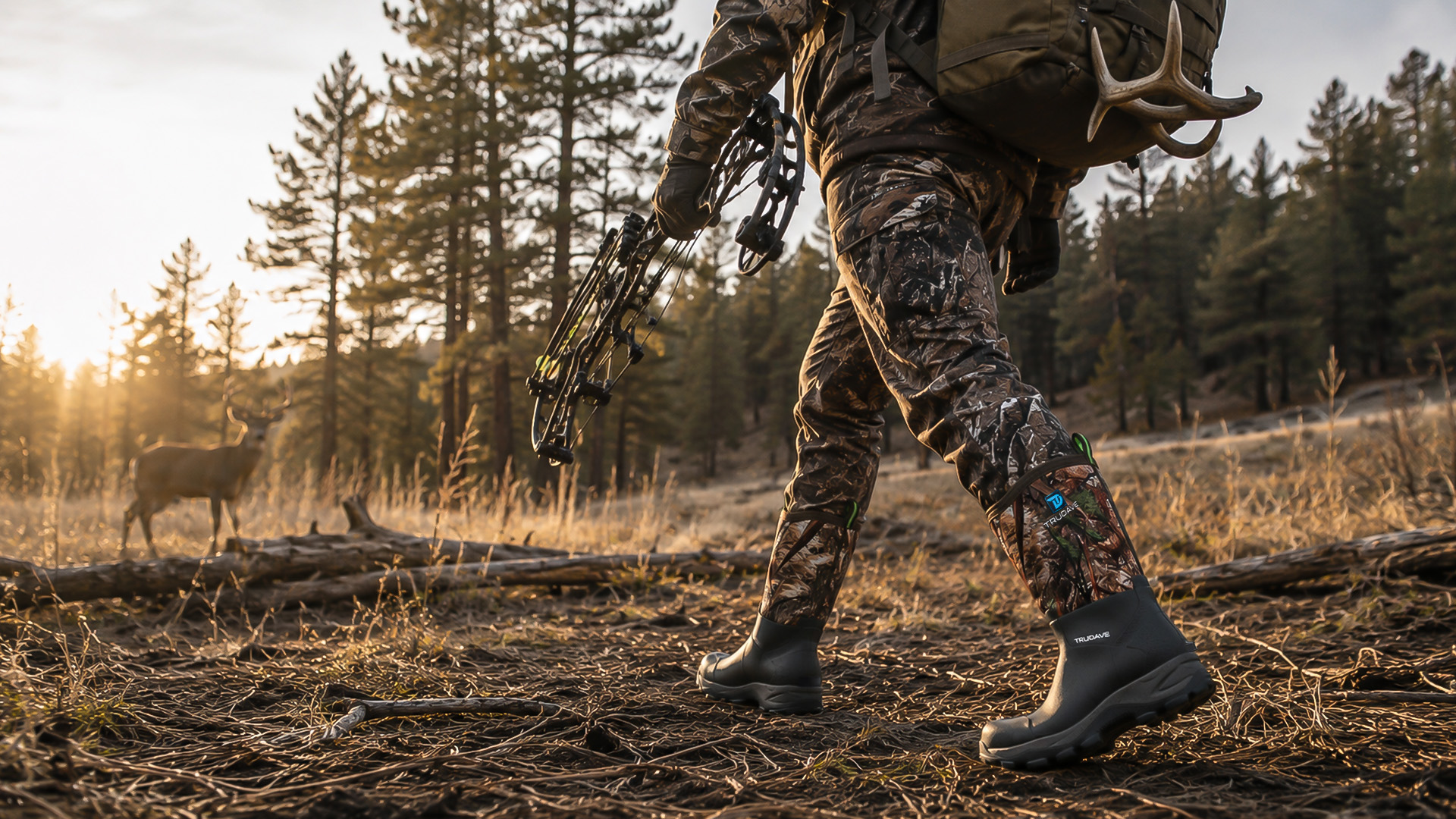
The WildGuard is Trudave‘s camouflage hunting boot for marshes, flooded timber, and wet woods — environments where water is the primary obstacle and cold is a close second. The camo finish “keeps you hidden in timber, reeds, or brush” while the “deep-lug outsole grips confidently on wet logs, rocky trails, and uneven ground”.
The 5mm neoprene upper provides insulation with a breathable liner that traps warmth without overheating during active approaches — critical for the hunter who walks a mile through wet grass at dawn and then sits for hours. The tall neoprene upper also “provides flexibility and protection through brush and wetlands,” reducing the scratches and abrasion that come with pushing through thick cover.
For the duck hunter working flooded timber in Arkansas, the whitetail hunter navigating November marshland in Michigan, or anyone whose hunt involves more water than solid ground, the WildGuard’s balance of waterproofing, warmth, and concealment makes it the right tool for the job.
DryFlow Series: The Mobile Hunter’s Lightweight Solution
The DryFlow takes a fundamentally different approach: no insulation at all. Built from “industrial-grade waterproof rubber with sealed seams”, the DryFlow is designed for the active hunter who generates body heat through continuous movement — spot-and-stalk bowhunters, spring turkey hunters covering ridges, and anyone who logs serious miles in mild-to-cool conditions where insulation would cause overheating and sweat buildup.
The DryFlow features “non-slip, oil-resistant rubber outsoles” and a “cleated outsole that pushes mud out with every step for constant ground contact”. A structured heel cup locks the foot in place, preventing heel slip that causes blisters and forces toes to grip the bottom of the boot for stability.
This boot is the right choice for early-season archery, spring turkey, and any hunt where movement generates more heat than insulation needs to retain. For the hunter who covers ground rather than sitting still, the DryFlow’s zero-insulation design is a feature, not a cost-saving measure.
Part 4: The Scent and Silence Advantage — Why Material Choice Matters
Two characteristics of vulcanized rubber-and-neoprene boots don’t appear on most spec sheets but matter enormously in the field: scent control and acoustic stealth.
Scent Control at Ground Level
A deer‘s olfactory system is estimated to be 500 to 1,000 times more sensitive than a human’s. Deer can distinguish between scents deposited minutes ago and those deposited hours ago, and they can separate human scent molecules from the complex background of forest smells. This is why bowhunters often switch specifically to rubber boots for scent control reasons: the idea is that scents do not stick to the rubber outer boot like they would to a leather or fabric hunting boot, and any human foot odor is kept inside the boot.
Rubber is non-porous. It doesn‘t absorb moisture from your feet, and it doesn’t absorb the volatile organic compounds dissolved in that moisture. When you walk in a rubber-and-neoprene boot, your foot scent stays inside the boot. The exterior of the boot contacts the ground without transferring scent-loaded moisture.
This isn‘t a chemical treatment that wears off. It’s a physical property of the material. For the stand hunter who walks the same entry path day after day, the scent-reduction advantage of vulcanized rubber boots means deer that cross that path are less likely to detect human presence and alter their behavior.
The Silence of Neoprene
Leather creaks. It‘s the nature of the material — when leather flexes, millions of microscopic fibers slide past each other, producing the characteristic sound that anyone who has worn leather boots knows. In a quiet November woods at dawn, that creak carries.
Neoprene doesn’t creak. Unlike traditional hunting boots which can produce loud crunching or creaking noises when moving over branches, rocks, or dry leaves, neoprene boots provide silent steps. The non-fibrous structure of neoprene and rubber means there are no internal components to rub together and generate noise. The boot flexes quietly because there‘s nothing inside it that can produce sound.
This is not a marketing claim — it’s a straightforward consequence of material physics. Fibrous materials produce friction noise when they flex. Homogeneous materials don‘t. The same property that makes neoprene a good insulator (its closed-cell foam structure) also makes it a quiet material (no fibers to rub). For the hunter who values silence as much as warmth, this is a meaningful advantage.
Part 5: The Direct-to-Consumer Model — Why These Boots Cost What They Do
The global hunting boots market reached US8.1billionin2026[reference:29].Thatgrowthhasbeenaccompaniedbypremiumpricingfromlegacybrandsthatpassretailmarkupsandmarketingcostsontoconsumers.Premiumbootsin2026regularlysellfor200 to $455.
Trudave operates differently. By selling directly to the consumer — bypassing the wholesale distributor, the retail shelf-space fees, and the massive marketing campaigns — they can invest in vulcanized natural rubber, 5mm neoprene, and EVA midsole architecture at price points that reflect the materials rather than the brand name.
This is the business model that L.L. Bean pioneered in 1911 — selling directly to hunters through mail-order flyers — applied to the modern era of e-commerce. Bean understood that a better boot at a fair price, backed by a guarantee, would sell itself. Trudave‘s approach is built on the same insight: “We didn’t start with profit margins, fancy features, or marketing gimmicks. We started with a simple question: What do we actually need out there?”
Part 6: The Decision Framework — Matching the Boot to the Body of Work
| Your Hunt | Primary Challenge | Trudave Match | Key Feature |
|---|---|---|---|
| Late-season whitetail stand hunting (-10°F to 25°F) | Extreme cold during stationary sits | TrailGuard | 5mm neoprene + fleece liner |
| Duck hunting, flooded timber, wet marsh | Water and moderate cold | WildGuard | Camo + 5mm neoprene + deep-lug outsole |
| Early-season bowhunting, spring turkey | Overheating during active movement | DryFlow | Zero insulation + oil-resistant outsole |
| Mixed terrain, long approaches, varied temps | Versatility across conditions | WildGuard + TrailGuard (two-boot solution) | Full temperature-spectrum coverage |
The hunters who benefit most from owning multiple pairs aren‘t gear-obsessed. They’re hunters whose season spans enough temperature and terrain variation that one boot cannot serve all conditions. An early-season DryFlow for September bowhunting, a WildGuard for November marsh hunts, and a TrailGuard for late-December stand sits cover the full calendar without compromise. And at Trudave‘s direct-to-consumer pricing, all three can be purchased for less than the cost of a single pair of top-tier premium boots.
**Conclusion: The Hunter’s Problem, Solved Across a Century
L.L. Bean couldn‘t solve the cold-feet problem in 1911 because the materials didn’t exist yet. LaCrosse came closer in 1957 with vulcanized rubber that kept water out but couldn‘t keep heat in. It took neoprene — a DuPont invention from the 1930s — to solve the insulation problem, and it took EVA midsole technology from the running-shoe industry to solve the weight problem. The materials were invented decades ago. The challenge was putting them together in a boot that was affordable enough for working hunters to actually buy.
Trudave Gear’s 2026 hunting boot lineup — TrailGuard for the frozen stand, WildGuard for the wet marsh, DryFlow for the mobile stalk — represents the current endpoint of a 114-year evolution that began with a frustrated Mainer and a pair of wet socks. The materials are modern. The construction is vulcanized. The business model is direct. But the problem is the same one L.L. Bean was trying to solve: cold, wet feet end hunts. The boots that keep you out there longer are the boots that earn their place in your gear room.
To explore the complete Trudave Gear hunting boot lineup and find the right pair for your next hunt, visit trudavegear.com.
