
Ask any seasoned whitetail hunter about the moments that stick with them, and you’ll hear about the ones that got away. Not the missed shots — those are easy to explain. The truly haunting ones are the deer that never showed up. The buck that should have walked past the stand at first light but didn’t. The crunch of a dry leaf underfoot that carried 200 yards through still morning air. The squeak of a leather tongue against an eyelet. The dull thud of a heel strike on frozen ground that sounded, to deer ears, exactly like what it was: a human, walking.
These are not dramatic failures. No seam split. No sole peeled off. The boots performed exactly as designed. They were just designed to be durable, not silent. And in the whitetail woods, where a deer’s hearing is acute enough to detect the snap of a twig at a quarter mile, “durable” without “quiet” is a liability wearing your shoe size.
Sound is the most under-discussed performance metric in hunting footwear. Hunters obsess over camouflage patterns, wind direction, and scent control sprays while lacing up boots that announce their presence with every step. The industry has trained us to evaluate boots by their insulation grams, their waterproof membranes, and their outsole lug depth — all of which matter — but has largely ignored the acoustic signature of the boot itself. What does it sound like when it flexes? When the upper rubs against brush? When the heel strikes frozen ground?
Trudave Gear has built its hunting boot lineup — the WildGuard, TrailGuard, and DryFlow series — around a materials-first philosophy that addresses noise at the source. Not by adding silent features on top of a noisy boot. But by choosing materials that are inherently quieter than the leather-and-fabric construction that dominates the market. This article is about why that matters, how it works, and why the quietest boot in the catalog might be the one that puts a buck in front of your stand this fall.
Part 1: The Acoustics of Failure — How Noisy Boots Ruin Hunts
Let’s start with what deer actually hear. A whitetail’s hearing range extends well into frequencies humans can’t detect, but their real advantage is not range — it’s sensitivity and localization. A deer can pinpoint the direction of a sound with precision that human ears can’t match, and they can distinguish between natural sounds (a squirrel rustling leaves, a branch falling) and unnatural ones (a human footfall, the squeak of man-made materials rubbing together) almost instantly. The deer doesn’t need to identify what made the sound. It only needs to know that the sound doesn’t belong.
The most common noise offenders in hunting boots fall into three categories:
The Flex Squeak: Leather boots, particularly when new or wet, produce a distinctive creaking sound as the upper flexes with each step. This is leather rubbing against leather — the tongue moving inside the upper, the ankle collar flexing around the leg. It’s quiet enough that you might not notice it while walking, but in still woods at dawn, it carries.
The Scrape: When a fabric or leather boot brushes against underbrush — briars, branches, tall grass — the textured surface creates audible friction. Smooth rubber slides past vegetation with far less noise. This is why many experienced still-hunters prefer rubber boots for the final approach through thick cover.
The Ground Strike: This is the hardest to eliminate because it involves the outsole hitting the ground. Hard rubber compounds produce a sharper impact sound. Softer compounds produce a duller thud. Deep, aggressive lugs can crackle on frozen leaves. Wide, flat soles can slap on hard ground. The ideal acoustic profile for a hunting boot outsole is a soft compound with enough lug depth for traction but enough surface area to distribute impact without a sharp report.
There’s a reason this matters more than most hunters realize: deer don’t just hear you when you’re close. They hear you when you’re still hundreds of yards away, walking in the dark, thinking you’re being quiet. By the time you reach your stand, the deer in the area have already registered your approach and adjusted their behavior. They may not spook — but they may alter their route, delay their movement, or simply avoid the area where they heard something that didn’t sound right. You never see them. You never know they were there. And you spend the morning wondering why the deer didn’t move.
This is the invisible cost of noisy boots. Not the deer that snorts and flags at 50 yards. The deer that quietly changes course at 300 yards, before you ever knew they existed.
Part 2: The Material Difference — Why Rubber and Neoprene Walk Quieter Than Leather
The choice of boot material isn’t just about waterproofing, durability, or warmth. It’s fundamentally about acoustics. And the acoustic properties of rubber, neoprene, and leather are radically different.
Leather is a natural material with a fibrous structure. When leather flexes, those fibers rub against each other, producing the characteristic creak that anyone who has worn leather boots knows well. This is especially pronounced in cold weather, when leather stiffens and the fibers become more resistant to bending. Leather also has a textured surface that creates friction noise when it contacts brush, briars, and branches. And leather absorbs water, which changes its weight, flexibility, and acoustic profile as the hunt progresses — boots that were quiet at dawn can become louder by mid-morning as the leather softens and the fit changes.
Rubber and neoprene are fundamentally different acoustically. Rubber is non-fibrous — it’s a continuous, homogeneous material that flexes without internal friction. No fibers rubbing together means no creak. Neoprene, as a closed-cell foam, is even quieter: the millions of air pockets in its structure absorb vibration rather than transmitting it, which is why neoprene wetsuits are used by divers who need to move silently underwater.
The scent-control advantage of non-porous materials is well documented: rubber is a non-porous material that does not absorb or retain human odor, effectively trapping scent inside the boot rather than releasing it into the environment. But the acoustic advantage is less discussed and arguably just as important. A boot that leaves no ground scent but announces your approach with every step is solving half the problem. A boot that leaves no ground scent and walks quietly is solving the whole thing.
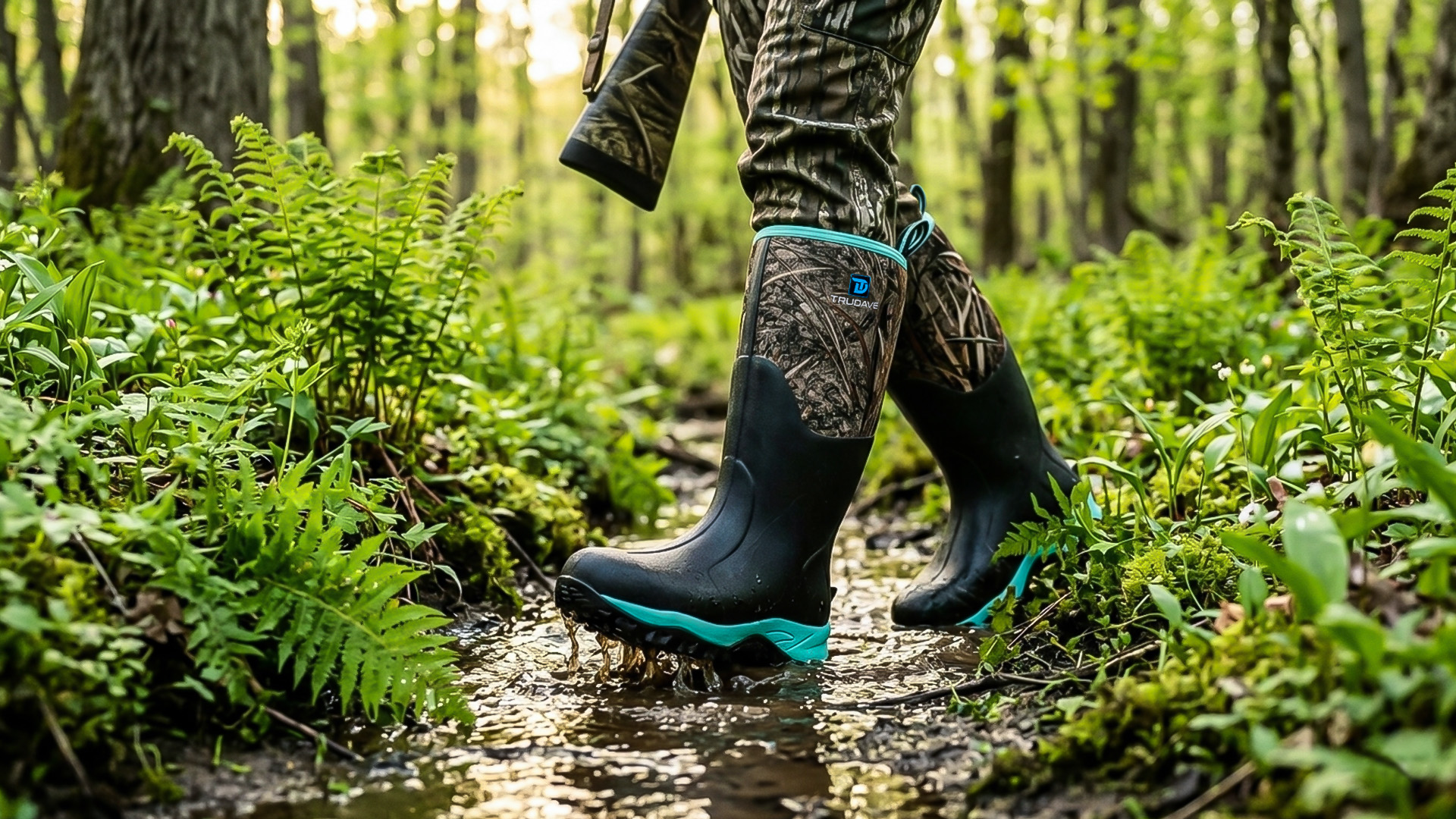
Trudave boots are crafted from natural rubber and neoprene — materials that are inherently non-porous, scent-proof, and acoustically dampened. The WildGuard and TrailGuard series use a 5mm neoprene upper bonded to a natural rubber lower shell. The neoprene shaft is silent when it flexes, conforming to the calf without the stiff, creaking motion of a pure rubber boot. The rubber lower shell provides waterproofing and durability. And because the entire upper is a single vulcanized unit with no separate tongue, no laces, and no stitching to rub together, there are simply fewer opportunities for noise generation.
The DryFlow series takes a different acoustic approach — a thinner, more flexible rubber construction that provides better ground feel and allows for more precise foot placement on dry leaves and twigs. For the still-hunter who needs to place every step deliberately, that ground feel translates directly into quieter movement.
Part 3: The Bonded Advantage — Why Vulcanized Construction Stays Quiet
Noise in a boot doesn’t just come from the materials. It comes from the construction — specifically, from the places where different materials meet. Every seam, every glued joint, every stitched panel is a potential noise source. When two pieces of material flex against each other at different rates (because they have different densities, different thicknesses, different stiffness), they can produce friction noise — the same principle that makes a squeaky hinge squeak.
Glued construction amplifies this problem over time. As the adhesive degrades — which it inevitably does when exposed to water, temperature swings, and thousands of flex cycles — the bond between the upper and the outsole can develop microscopic gaps. Those gaps allow movement between components that were never designed to move independently. And that movement produces sound.
Vulcanized construction solves this at the molecular level. Vulcanization is a chemical process that cross-links rubber polymers, creating a permanent bond that transforms multiple components into a single continuous unit. As Trudave’s product documentation describes, “Rubber is treated with a curative substance and formed into precise shapes and dimensions, bonding the rubber in such a way that it becomes one solid unit. This process is responsible for the waterproof and scent-free attributes of vulcanized rubber boots, as there are no pores for water or scents to become trapped in.” There are also no seams to separate, no glued joints to degrade, and no moving parts to generate noise.
This is why the 7-day continuous wear test Trudave conducted produced a finding that should matter to every whitetail hunter: after 168 hours of mud, timber, and concrete — conditions designed to destroy glued seams — the boots showed “no blown seams. No peeling soles. No cracked rubber at the toe flex point”. A boot that holds together silently after that kind of abuse is a boot that will stay quiet through a full hunting season and beyond.
Part 4: Terrain Acoustics — What Your Boots Sound Like Where You Actually Hunt
Noise isn’t just about the boot. It’s about the boot interacting with the ground. And different hunting terrains produce different acoustic challenges that demand different boot characteristics.
Dry Leaves and Hardwood Timber
This is the acoustically unforgiving terrain of early bow season in the East and Midwest. A layer of dry oak leaves on the forest floor amplifies every footstep into a crackle that carries hundreds of yards in still air. The challenge here is two-fold: the impact sound of the outsole hitting the ground, and the leaf-crushing sound of weight transfer as you roll through your step.
For this terrain, a softer rubber compound helps — it dampens the initial impact. But equally important is ground feel: the ability to sense what’s underfoot before you commit your full weight. The DryFlow series, with its thinner, more flexible rubber construction and zero insulation, provides this ground feel. A structured heel cup locks the foot in place, preventing the internal foot movement that can cause an unexpected, noisy slip.
Frozen Ground and Crusted Snow
Late-season hunting introduces a different acoustic problem. Frozen ground is hard and reflective — sound travels further. Crusted snow has a brittle surface that fractures underfoot with a distinctive crunch. Cold temperatures stiffen rubber compounds, making them louder on impact.
The TrailGuard series addresses this with its all-terrain outsole designed for snow, loose dirt, and frozen ground. The self-cleaning tread pattern sheds mud and debris that would otherwise freeze into noisy clumps. The 5mm neoprene upper with fleece lining provides insulation that keeps the foot warm during stationary sits, but the neoprene’s flexibility in cold weather — it doesn’t stiffen the way pure rubber does — also maintains a quieter flex profile when you do need to move.
Wet Grass and Swamp Edges
Wet terrain is quieter than dry terrain in general — water dampens sound. But it introduces its own acoustic challenge: the squelch of a boot pulling out of mud, the splash of a misjudged step into standing water. These sounds are less about the boot material and more about the outsole design. Deep, widely-spaced lugs release from mud cleanly rather than creating suction. The WildGuard series, designed specifically for marshes, flooded timber, and wet woods, features a deep-lug outsole that “grips confidently on wet logs, rocky trails, and uneven ground” while releasing from mud without the sucking sound that densely-spaced lugs produce.
Part 5: The Scent-Sound Connection — Why the Same Materials Solve Both Problems
One of the most elegant aspects of Trudave’s material strategy is that the same properties that make neoprene and rubber quiet also make them scent-free. This isn’t a coincidence — it’s a function of the materials’ physical structure.
Porous materials (leather, fabric) absorb moisture from your feet, and with that moisture, the volatile organic compounds that make up human scent. As the material flexes, those compounds are released into the air and onto the ground. This is the scent trail that deer detect hours after you’ve walked past.
Non-porous materials (rubber, neoprene) don’t absorb moisture, so they don’t absorb scent in the first place. “Rubber boots cut ground scent somewhat,” but the real advantage is at the point of ground contact — there’s no transfer of scent-loaded moisture from the boot to the ground. At the same time, the non-porous, non-fibrous structure of rubber and neoprene means there are no internal fibers rubbing together to produce the creaks and squeaks that porous materials generate.
A comprehensive guide to scent-control boots reinforces this connection: “Look for boots made with waterproof neoprene and tough rubber to block moisture and odors”. The same materials that block odors also dampen sound. It’s a rare case in gear design where two seemingly unrelated performance characteristics — scent control and acoustic quietness — are achieved through the same fundamental material choice.
Part 6: The Outsole Factor — Tread Pattern and the Sound of Traction
The outsole is where the boot meets the ground, and its acoustic signature varies dramatically depending on tread pattern, rubber compound hardness, and ground surface.
On dry leaves, wide, flat lugs produce more noise than narrow, widely-spaced lugs because they trap and crush leaves rather than parting them. On frozen ground, a softer rubber compound (lower durometer) produces a duller impact sound than a hard compound. On wet rock, siping — the thousands of tiny slits cut into the rubber — improves traction and reduces the high-frequency squeak of rubber sliding on smooth stone.
Trudave’s outsole designs vary by series to match the terrain each boot targets. The WildGuard features a camo-finished, deep-lug outsole for wet, uneven ground where the primary acoustic concern is mud release. The TrailGuard uses an aggressive all-terrain tread pattern with self-cleaning channels that prevent frozen mud buildup. The DryFlow features an oil-resistant, non-slip outsole with a cleated design that pushes mud out with every step for constant ground contact.
None of these outsoles were designed primarily for acoustic performance. But the same tread characteristics that improve traction — wide spacing, self-cleaning channels, softer compounds — also reduce noise. It’s an example of good functional design producing benefits beyond the original design brief.
Part 7: The Still-Hunter’s Toolkit — How to Move Quieter in Any Boot
Even the quietest boots won’t make you silent. Movement produces noise — that’s physics. But you can minimize the noise you produce by understanding how your boots interact with different surfaces and adjusting your movement accordingly.
The Heel-to-Toe Roll: The loudest part of any step is the heel strike — the initial impact of the boot hitting the ground. By rolling from the outside of the heel through to the toe in a smooth motion, you distribute the impact over a longer period, reducing the peak noise. This requires a boot flexible enough to allow a natural rolling stride — stiff boots force a flat-footed walk that’s inherently louder.
The Pause Step: On dry leaves or frozen crust, pause between steps. The noise of your previous step masks the sound of deer movement for a few seconds after you stop. By pausing, you give the woods time to settle back into its natural soundscape — and you might hear a deer that was frozen, waiting to identify you.
The Brush Avoidance Route: Rubber and neoprene uppers slide past brush more quietly than leather or fabric. But the quietest contact with brush is no contact. Pick your path to avoid brushing against branches and briars, even if it means taking a slightly longer route to your stand. The extra two minutes of walking are worth the dozens of deer that never hear you coming.
Boot Maintenance for Quiet: Dried mud on the outsole changes the tread pattern and can create unexpected noise — a chunk of dried mud cracking underfoot, a pebble grinding against rock. The Trudave care protocol — rinse with clean water after each use, air dry, avoid heat — keeps the outsole clean and the rubber supple, which maintains its acoustic properties over time.
Part 8: The Series-by-Series Acoustic Profile
Each Trudave hunting boot series has a distinct acoustic signature, shaped by its materials, construction, and intended use.
WildGuard Series: The 5mm neoprene upper bonded to a natural rubber lower shell creates a boot that’s quiet at the flex point — no creaking, no popping. The camo-finished deep-lug outsole releases cleanly from mud without suction noise. Best for marsh hunting, wet woods, and terrain where water noise masks footfalls. As Trudave’s product page states, the camo finish keeps you hidden in timber, reeds, or brush — visual concealment paired with acoustic dampening for complete stealth.
TrailGuard Series: The same 5mm neoprene upper with the addition of a fleece liner provides maximum insulation for late-season sits, but the neoprene’s flexibility prevents the stiff, noisy gait that heavily insulated leather boots produce. The aggressive all-terrain outsole with self-cleaning tread sheds frozen mud that would otherwise accumulate and crackle with each step. Built for late-season hunting in snow, frozen ground, and sub-freezing temperatures where staying warm enough to sit still matters more than moving silently.
DryFlow Series: The acoustically quietest of the three — thinner rubber construction, no insulation, maximum ground feel. The structured heel cup prevents internal foot slip. The flexible sole allows a natural, quiet rolling stride. The zero-insulation design means the boot can be worn with lighter socks for maximum sensory feedback through the sole. Best for early-season still-hunting, spot-and-stalk, and any hunt where covering ground quietly is the primary challenge.
Conclusion: The Sound of Success
The hunting industry has spent decades telling hunters to buy boots based on warmth, waterproofing, and durability. Those matter. But so does noise. A boot that keeps your feet warm and dry but announces your presence to every deer within 300 yards is a boot that’s costing you opportunities you never knew existed.
Trudave Gear’s approach — vulcanized natural rubber and neoprene construction, bonded seams that can’t separate or squeak, outsoles designed for terrain-specific traction that also happen to be quieter — addresses noise not as an afterthought but as an inherent property of the materials and construction. The WildGuard for wet-terrain silence. The TrailGuard for frozen-ground warmth with acoustic flexibility. The DryFlow for the still-hunter who needs to feel the ground and move without a sound.
The deer you never spook are the deer you never know were there. And those are the deer that walk out in front of your stand when the light is perfect and the wind is right, completely unaware that you arrived hours ago. That’s what quiet boots buy you. Not a guarantee. Just a cleaner slate. And in the whitetail woods, a clean slate is everything.
To explore the complete Trudave Gear hunting boot lineup and find the right pair for your next hunt, visit trudavegear.com.
