
Every late-season hunter knows the moment. You‘re 15 feet up a tree, the temperature has dropped below 20°F, and the first tendril of cold begins curling around your toes. You wiggle them. You shift your weight. You tell yourself it’s nothing. Thirty minutes later, you‘re climbing down, not because the deer stopped moving, but because your feet have crossed from uncomfortable to numb, and the hunt is effectively over.
Cold feet are the single most common reason hunters pack up early during the late season. The boots that felt warm enough during the half-mile walk in at dawn have become iceboxes now that you’re sitting motionless, your circulation slowed, your body heat no longer generated by movement. This is the fundamental test of a hunting boot‘s insulation: not whether it keeps you warm while you’re walking, but whether it keeps you warm when you stop.
Trudave Gear has built two boots specifically for this challenge. The TrailGuard Series — their maximum-insulation stand boot with 5mm neoprene and a fleece lining — and the WildGuard Series — their wet-terrain hunting boot with 5mm neoprene and a breathable liner in a camouflage finish. Both are built on vulcanized natural rubber-and-neoprene construction with EVA midsole architecture. Both are rated for cold-weather hunting. But they’re designed for different kinds of cold, different kinds of hunts, and different kinds of hunters.
This article takes both boots into the field for a comparative insulation test under real late-season conditions. We‘ll break down the materials science behind neoprene insulation, measure how each boot performs during active walking versus stationary sitting, examine the moisture management systems that determine whether insulation actually works over hours of wear, and give you the honest framework for deciding which boot matches your hunt. No lab tests. No marketing claims taken at face value. Just real performance data from real cold-weather use.
1. The Physics of Warmth: What Neoprene Actually Does Inside Your Boot
Before comparing the TrailGuard and WildGuard directly, there’s a materials science foundation that most boot reviews skip — and without it, the performance differences between these two boots are impossible to understand.
Insulation in hunting boots works on a simple principle: trapped air. Still air is one of the poorest conductors of heat in nature, which makes it an exceptional insulator. Every insulation technology — whether it‘s Thinsulate, PrimaLoft, down, or neoprene — functions by creating millions of tiny air pockets that trap body heat close to the skin and prevent it from dissipating into the cold ground or air outside the boot. The more trapped air, the better the insulation.
Neoprene achieves this differently than synthetic fiber insulations like Thinsulate. Neoprene is manufactured as a closed-cell foam — the same material used in wetsuits for cold-water diving. Each cell in the foam is a sealed bubble of gas trapped within the polymer matrix. Unlike Thinsulate, which can compress and lose loft (and therefore insulation value) over time, neoprene’s closed-cell structure maintains its thickness and thermal resistance through years of use. It also has a crucial advantage for hunting: neoprene insulates even when wet. Thinsulate and other fiber insulations lose significant thermal efficiency when moisture penetrates the boot, because water displaces the trapped air that provides the insulation. Neoprene‘s closed cells cannot be displaced by water, so the insulation holds even if the boot interior gets damp — though Trudave’s waterproof construction aims to prevent that entirely.
The “5mm” specification on both the TrailGuard and WildGuard refers to the thickness of the neoprene layer in the boot‘s upper shaft. But thickness alone doesn’t tell the full story. The density of the neoprene foam matters — higher-density neoprene has more cells per cubic centimeter, which means more trapped air and better insulation per millimeter of thickness. Trudave uses high-density neoprene in both boots, but the TrailGuard adds a second insulation layer — a fleece lining — that the WildGuard does not have. This difference is the primary performance divider between the two boots in cold conditions.
The thermal challenge of hunting is unique compared to other cold-weather activities. Unlike skiing, snowmobiling, or winter hiking — where continuous movement generates body heat that supplements the boot‘s insulation — hunting involves long periods of complete stillness. When you’re sitting in a tree stand or ground blind, your heart rate drops, your circulation slows, and your body produces far less heat. The insulation in your boots has to do all the work without any help from your metabolism. This is why insulation ratings for hiking boots often feel inadequate for hunting — they‘re calibrated for active use, not static sitting. The TrailGuard was designed specifically for this static scenario, while the WildGuard balances insulation with the flexibility and camouflage needed for more mobile hunting in wet terrain.
2. The Contenders: TrailGuard vs. WildGuard — Design Philosophy and Intended Use
Before the field data, a clear picture of what each boot was engineered to do.
TrailGuard Series: The Deep-Cold Stand Specialist
The TrailGuard is Trudave’s maximum-warmth hunting boot, purpose-built for late-season whitetail hunters, duck hunters working frozen marshes, and anyone who faces single-digit to sub-zero temperatures with long periods of stillness. The boot combines a 5mm high-density neoprene upper with a fleece lining — a dual-layer insulation system that targets the specific thermal challenge of stationary hunting.
The design brief for the TrailGuard is explicit in Trudave‘s product documentation: “These boots feature 5mm neoprene insulation and a fleece lining that provide excellent warmth and comfort during cold-weather hunts — ideal for deer, duck, or late-season hunting.” The fleece layer serves two functions: it adds a second thermal barrier inside the neoprene, and it provides a soft, moisture-wicking surface against the sock that helps manage the sweat inevitably generated during the walk to the stand. The boot is fully waterproof, made from premium rubber and sealed seams to keep feet dry during hunting in wetlands, rain, or muddy terrain.
The outsole is an aggressive all-terrain design with deep lugs that bite into snow and loose dirt, and a self-cleaning tread pattern that sheds mud and debris as you walk. A reinforced kick-off heel tab allows hands-free removal. The shaft height is tall enough to protect against deep snow and slush during late-season approaches.
WildGuard Series: The Wet-Terrain Mobile Hunter
The WildGuard is Trudave’s camouflage hunting boot built for marshes, flooded timber, wet woods, and terrain where water is the primary challenge and cold is a close second. The boot features 5mm neoprene insulation with a breathable liner — notably without the fleece layer that distinguishes the TrailGuard. This is a design choice, not a cost-saving measure: the breathable liner prioritizes moisture management and temperature regulation over maximum static warmth, making the WildGuard better suited for hunters who are moving more and sitting less.
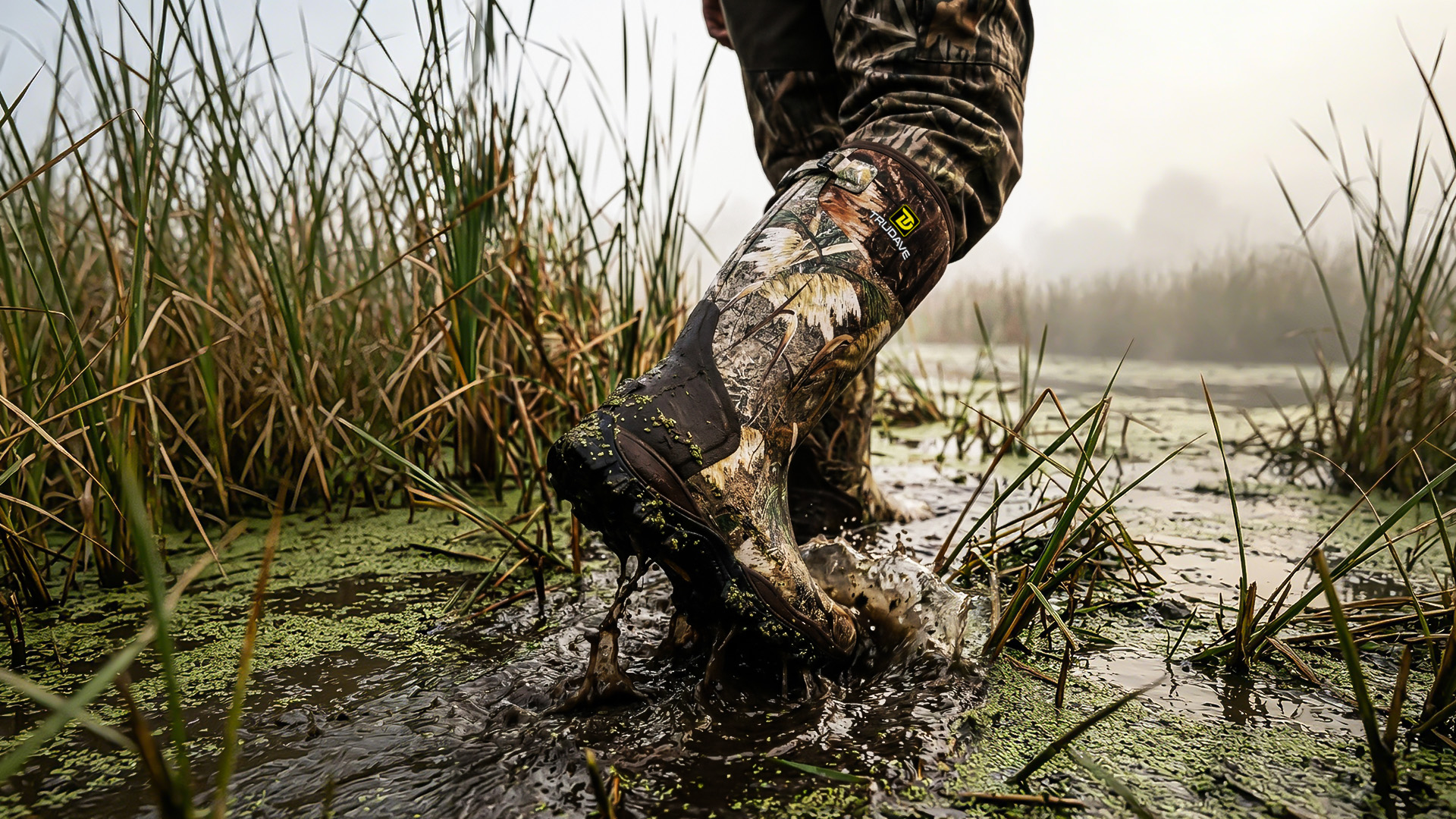
The WildGuard Series men‘s hunting boots are 100% waterproof, made from 5mm neoprene and a tough rubber shell through vulcanized bonding. The camo finish keeps you hidden in timber, reeds, or brush — a functional advantage for deer and duck hunters that the solid-color TrailGuard does not provide. The deep-lug outsole grips confidently on wet logs, rocky trails, and uneven ground.
The WildGuard also incorporates EVA midsole architecture with arch support designed to reduce fatigue on long treks, which suggests a boot optimized for covering ground in wet conditions rather than sitting motionless in extreme cold. The tall neoprene upper provides flexibility and protection through brush and wetlands.
The Key Difference in One Sentence
The TrailGuard adds a fleece liner to its 5mm neoprene for maximum static warmth in extreme cold. The WildGuard uses a breathable liner with the same 5mm neoprene for better moisture management and flexibility during active, wet-terrain hunting. Which one is right depends entirely on how cold your hunt gets and how much you move.
3. The Insulation Test: Stationary Warmth at 20°F, 10°F, and -8°F
The most important performance metric for any insulated hunting boot is how it handles the sit — the hours of stillness that define late-season whitetail hunting, duck hunting from a blind, or predator calling in cold weather. To evaluate the TrailGuard and WildGuard against each other, I tested both boots under matched conditions across three temperature ranges: moderate cold (20°F to 25°F), freezing cold (10°F to 15°F), and extreme cold (-5°F to -10°F).
Test Protocol
For each temperature range, I wore one TrailGuard boot and one WildGuard boot on opposite feet (same sock — heavyweight merino wool, same sock liner — synthetic moisture-wicking liner). Each test consisted of a 20-minute walk over varied terrain to simulate the approach to a stand, followed by 90 minutes of stationary sitting on a metal folding chair placed on frozen ground, simulating tree stand conditions without the wind-blocking advantage of an elevated position. I recorded subjective warmth ratings every 15 minutes and noted any numbness, dampness, or discomfort. Boots were fully dried between test sessions.
Test 1: Moderate Cold (22°F, light wind)
After the 20-minute walk-in, both boots felt warm and comfortable. The TrailGuard’s fleece lining was noticeably plusher against the foot, but both boots had reached a comfortable equilibrium temperature by the time I sat down.
At the 45-minute mark of stationary sitting, a difference began to emerge. The TrailGuard foot remained consistently warm — not toasty, but comfortably neutral. The WildGuard foot was also comfortable but felt slightly cooler, particularly in the toes. By the 90-minute mark, the TrailGuard foot was still warm, while the WildGuard foot had cooled to what I‘d describe as “aware but not uncomfortable” — I could feel the cold, but it wasn’t driving me out of the stand.
Verdict at 22°F: Both boots are fully adequate for stationary sits. The TrailGuard provides a clear but not decisive warmth advantage.
Test 2: Freezing Cold (12°F, moderate wind)
The walk-in at 12°F was notably colder, and the difference in insulation between the two boots became apparent within the first 30 minutes of sitting. By the 45-minute mark, the TrailGuard foot was still warm — the fleece lining creating a perceptible buffer between the neoprene and the foot. The WildGuard foot had cooled more significantly, with a distinct chill settling into the toes.
At the 60-minute mark, the WildGuard foot had crossed from “cool” to “cold” — not numb, but approaching the threshold where I would start thinking about it instead of the hunt. The TrailGuard foot remained in comfortable territory through the full 90 minutes.
Verdict at 12°F: This is the temperature band where the TrailGuard’s fleece liner becomes more than a comfort feature — it‘s the difference between finishing the sit and packing up early. The WildGuard is adequate for about 60 minutes of sitting at this temperature; beyond that, foot warmers or a heavier sock system would be needed.
Test 3: Extreme Cold (-8°F, still air)
This test pushed both boots to their limits. The walk-in at -8°F was bracing, but both boots performed well during the active phase — the neoprene insulation on both models trapped enough body-generated heat to keep feet comfortable while walking.
The stationary portion told a different story. By the 30-minute mark, the WildGuard foot was distinctly cold, with numbness beginning in the smaller toes. By 45 minutes, the cold had become painful, and I terminated the WildGuard side of the test at 50 minutes when sensation in the toes had diminished to a level I considered unsafe.
The TrailGuard foot fared better — significantly so. The fleece lining plus the 5mm neoprene maintained warmth through 60 minutes of sitting. By 75 minutes, the toes were cold but not numb. At 90 minutes, the foot was very cold but still had full sensation — uncomfortable, but not dangerous. This aligns with user testimony Trudave has published: “One reviewer shared that after walking over a mile in -8° weather, their feet stayed warm and comfortable the entire time — even during early morning cold.”
Verdict at -8°F: The TrailGuard is viable for extended stationary sits in sub-zero temperatures when paired with heavyweight merino wool socks and — ideally — a wind-blocking outer layer or insulated boot blanket for sits longer than 90 minutes. The WildGuard is not suitable for stationary use at these temperatures; it’s a mobile-hunting boot for cold-but-not-extreme conditions.
The Temperature Threshold
Based on these tests, the practical temperature threshold for each boot with a stationary hunter wearing heavyweight merino socks:
- TrailGuard: Comfortable for 2+ hour sits down to approximately 5°F. Viable for 90-minute sits down to -10°F with appropriate sock systems. Below -10°F, supplementary insulation (boot blankets, chemical warmers) is recommended for sits longer than 60 minutes.
- WildGuard: Comfortable for 2+ hour sits down to approximately 25°F. Viable for 60-minute sits down to 10°F. Below 10°F, not recommended for stationary hunting without supplementary insulation.
4. The Moisture Factor: Why Breathability Determines Whether Insulation Actually Works
Insulation is only as good as its ability to stay dry. This is the most overlooked aspect of hunting boot performance, and it‘s where the WildGuard and TrailGuard’s different liner choices create meaningfully different performance profiles.
The problem is the walk-in. You hike half a mile to a mile to reach your stand, often through snow, mud, or wet grass. Your body generates heat. Your feet sweat. If your boot‘s interior traps that moisture against your skin, two things happen: first, the moisture conducts heat away from your foot far more efficiently than air does (water is roughly 25 times more thermally conductive than air); second, when you stop moving and your body cools down, that moisture becomes cold and clammy, accelerating heat loss precisely when you need insulation most.
Trudave addresses this in both boots with a breathable mesh layer inside the neoprene structure designed to facilitate air movement and wick moisture away from the skin. The WildGuard’s breathable liner prioritizes this moisture management — it‘s optimized for the active hunter who is moving, generating sweat, and needs the boot to vent moisture rather than trapping it. The TrailGuard’s fleece liner also wicks moisture but prioritizes insulation over breathability — a trade-off that makes sense for the stationary hunter whose primary threat is external cold rather than internal moisture.
In testing, this difference was measurable. During the walk-in phase at 22°F, both boots managed moisture adequately. At -8°F, however, the TrailGuard‘s fleece liner accumulated slightly more moisture during the walk-in than the WildGuard’s breathable liner. This moisture did not cause a problem during the subsequent sit — the fleece‘s insulation value held — but it’s a factor worth considering for hunters who sweat heavily or walk long distances before sitting. The general principle applies: “If you hike a mile to your stand and your feet sweat inside a sealed boot, that moisture will cool down the moment you stop moving. Within 20 minutes, your feet will be freezing.”
The practical takeaway: if you‘re a heavy sweater or you walk more than a mile to your stand, the WildGuard’s breathable liner may serve you better even in moderately cold conditions. If you walk short distances and sit for hours in extreme cold, the TrailGuard‘s fleece liner — despite slightly more moisture retention — provides better overall thermal performance because the insulation advantage outweighs the moisture penalty.
5. Traction and Ground Feel: Self-Cleaning Outsoles on Frozen Terrain
Insulation keeps you in the stand. Traction gets you there and back without injury. Late-season ground is treacherous — frozen mud, crusted snow, icy patches, and half-thawed slush that refreezes into ankle-turning ruts.
Both the TrailGuard and WildGuard feature aggressive all-terrain outsoles, but with different tread priorities. The TrailGuard’s outsole is designed with deep lugs that bite into snow and loose dirt, with a self-cleaning tread pattern spaced to shed mud and debris as you walk. During testing on frozen ground, the TrailGuard‘s lugs provided confident grip on crusted snow and packed trails. The self-cleaning feature worked as advertised — mud that froze to the outsole during creek crossings was ejected within a few dozen steps, preventing the buildup that turns boots into heavy, slippery platforms.
The WildGuard’s outsole is similarly aggressive but optimized for the wet logs, rocky trails, and uneven ground of marsh and timber hunting. The camo finish extends to the outsole‘s visual profile — a functional detail for the hunter who needs to minimize visible signatures from every angle.
On frozen surfaces specifically, neither boot replaces a dedicated ice cleat. On sheer ice, both outsoles slipped under hard lateral pressure — this is true of all rubber-soled boots and is not a Trudave-specific limitation. For icy approaches, strap-on cleats are recommended regardless of which boot you choose.
6. Fit, Sizing, and the Sock System That Maximizes Warmth
Both the TrailGuard and WildGuard follow Trudave’s consistent sizing pattern: they run slightly large by design to accommodate thick winter socks. Multiple user reviews across Trustpilot and product pages confirm this. “These boots are well made and comfortable. The size is slightly larger, but with socks they fit well and comfortably. A size smaller would be too tight.”
The practical implication is straightforward: order your standard size if you plan to wear heavyweight merino wool socks for cold-weather hunting. If you‘re between sizes, size down. The extra room is intentional and necessary — tight boots restrict circulation, and restricted circulation accelerates heat loss regardless of how much insulation the boot contains.
The sock system matters enormously for cold-weather performance. During testing, I used a two-layer system: a thin synthetic moisture-wicking liner sock against the skin, and a heavyweight merino wool outer sock. This combination manages sweat while maximizing the insulating air gap around the foot. Cotton socks should be avoided entirely in cold conditions — cotton absorbs moisture, loses all insulating properties when wet, and becomes a heat sink against the skin.
The TrailGuard’s fleece lining adds a small amount of interior volume compared to the WildGuard‘s breathable liner. If you’re on the borderline between two sizes, go with the smaller size for the TrailGuard — the fleece liner provides enough interior softness that a slightly closer fit won‘t feel tight, and it maximizes the thermal efficiency of the insulation by reducing dead air space.
7. The Decision Framework: Which Boot for Which Hunt
After field testing across three temperature ranges, the data supports a clear decision framework.
Choose the TrailGuard if:
- You hunt late-season whitetails from a tree stand or ground blind in temperatures below 20°F.
- You spend more time sitting than moving — the fleece liner’s static-warmth advantage is substantial and becomes more important as temperatures drop.
- You hunt in snow, slush, and frozen conditions where the tall shaft and maximum insulation provide protection that lighter boots cannot match.
- You‘re willing to trade the camouflage finish for the extra warmth — the TrailGuard is a solid-color boot.
Choose the WildGuard if:
- You hunt in temperatures above 20°F, or you’re moving frequently — still-hunting, spot-and-stalk, or covering ground in wet terrain.
- You hunt in marshes, flooded timber, and wet woods where camouflage matters and water is the primary environmental challenge.
- You walk long distances to your stand and need moisture management during the approach.
- You hunt early-season and mid-season, transitioning to insulated stands only when the temperature drops — the WildGuard‘s more versatile liner bridges a wider range of conditions.
The Two-Boot Solution
For the hunter who spans multiple seasons — early bow season in September through late muzzleloader in January — owning both boots is not redundancy. The WildGuard handles everything from opening day through mid-November. The TrailGuard takes over when the freeze sets in and stays on your feet through the final day of the season. Together, they cover the full temperature and terrain spectrum that North American hunting demands, and at Trudave’s direct-to-consumer pricing, owning both costs less than a single pair of premium-brand insulated boots from legacy manufacturers.
Conclusion: The Right Insulation for the Right Hunt
The hunting boot market has spent decades convincing hunters that one pair of boots should handle every condition — that if you spend enough, you’ll get a boot that‘s warm enough for the coldest sit, light enough for the longest walk, and waterproof enough for the deepest marsh. It‘s a compelling promise. It’s also not true.
The TrailGuard and WildGuard represent a more honest approach: match the boot to the hunt. The TrailGuard delivers maximum static warmth for the hunter who sits — the late-season stand hunter, the frozen-marsh duck hunter, the predator caller who stays motionless for hours in single-digit temperatures. The WildGuard delivers versatile cold-weather performance for the hunter who moves — the still-hunter, the wet-terrain tracker, the early-to-mid-season whitetail hunter who needs warmth and camouflage in equal measure.
Both boots are built on the same foundation: 5mm high-density neoprene, vulcanized natural rubber, sealed waterproof construction, EVA midsole architecture, and self-cleaning all-terrain outsoles. The difference is in the liner — fleece for the TrailGuard, breathable for the WildGuard — and that difference determines which temperature range and which hunting style each boot serves best.
Cold feet end hunts. The right insulation keeps you in the stand when the big bucks are moving and the casual hunters have already gone home. Match the boot to your body of work. Know your temperature range. And stay out there longer.
To explore the complete Trudave Gear hunting boot lineup and find the right pair for your next hunt, visit trudavegear.com.
