
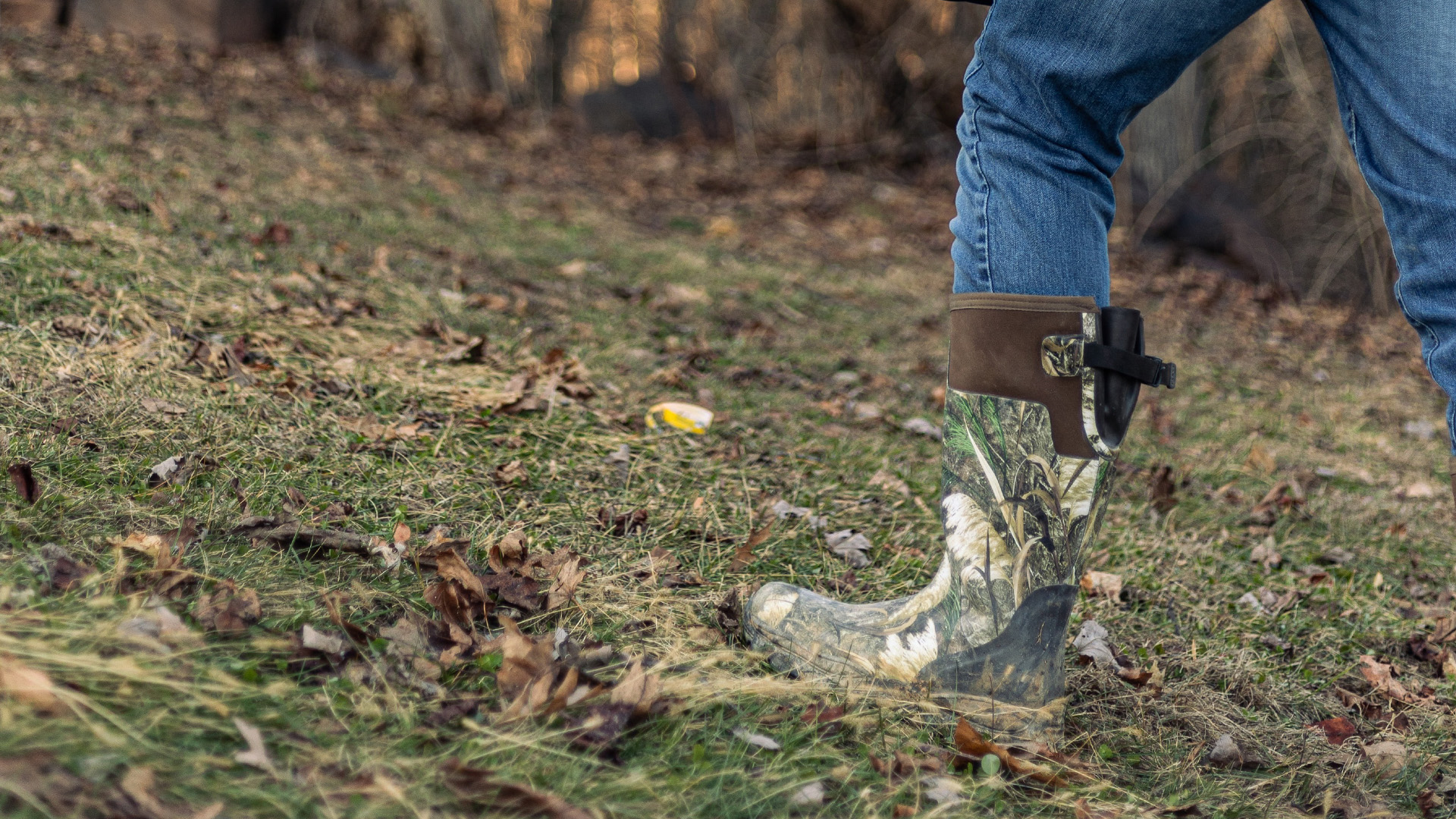
In 1857, a Frenchman named François-Louis Godillot filed a patent that would change the history of outdoor footwear. His innovation was simple but transformative: a boot made entirely of vulcanized rubber, designed specifically for soldiers marching through the muddy, waterlogged trenches of the Crimean War. For the first time, a soldier could stand in ankle-deep water and emerge with dry feet. The military-grade waterproof boot was born.
Fast-forward more than a century and a half to 1957, when LaCrosse Footwear introduced the Grange, a rubber hunting boot that would become iconic among American sportsmen. The Grange didn‘t just keep water out — it established a new category standard by proving that rubber was simultaneously the best scent-free and 100% waterproof material available to hunters. Generations of deer hunters in the Upper Midwest, duck hunters in the Arkansas timber, and upland bird hunters across the Great Plains grew up believing that “hunting boots” and “rubber boots” were essentially the same thing.
And for a long time, they were right. Rubber was the default. But it came with a cost: rubber boots were cold, stiff, and heavy. They conducted heat away from the foot with an efficiency that made extended sits in freezing temperatures a genuine test of endurance rather than patience. As one comprehensive buyer‘s guide notes, rubber boots have evolved from all-purpose “mucking-around” rain boots to highly engineered hunting boots, work boots, and even snake boots — and the most significant driver of that evolution has been the introduction of neoprene as a complementary material.
When the rubber-and-neoprene combination arrived for hunting boots and waders, hunters rejoiced. They were warmer, more comfortable, easier to put on and take off, and they’ve continued to improve as better materials, designs, and bonding methods have emerged. What started as a simple marriage of two materials has become, in the decades since, a sophisticated materials science problem: how do you build a boot that’s warm enough for a late-season sit but flexible enough for an all-day stalk? Waterproof enough for flooded timber but breathable enough to prevent sweat from becoming a mid-hunt disaster? Durable enough to survive sharp rocks and abrasive brush but light enough to wear for 10 miles without regret?
Trudave Gear has built its 2026 hunting boot lineup — the WildGuard, TrailGuard, and DryFlow series — on the premise that these questions don’t have a single answer. Different hunts demand different material profiles, and a one-material-fits-all approach inevitably compromises somewhere. This article traces the full arc of hunting boot waterproofing technology, from the vulcanization breakthroughs of the 19th century to the bonded neoprene-and-rubber construction that defines the current golden age. We‘ll examine the materials science behind each component, explain the specific problems each Trudave series was built to solve, and give you the framework for matching boot construction to your actual hunting conditions.
Part 1: Vulcanization — The 180-Year-Old Technology That Still Defines Waterproof Footwear
To understand why modern hunting boots work the way they do — and why some fail while others hold up season after season — you have to understand vulcanization. It’s a term that appears in almost every product description for premium rubber boots, but its actual meaning, and its relationship to boot quality, remains poorly understood even among experienced hunters.
Vulcanization is a chemical process discovered by Charles Goodyear in 1839, in which natural rubber is heated with sulfur to create cross-links between the rubber polymer chains. These cross-links transform raw rubber — which is sticky in heat, brittle in cold, and generally useless as a structural material — into a stable, elastic, durable substance that can flex repeatedly without losing its shape. Rubber is treated with a curative substance and formed into precise shapes and dimensions, bonding the rubber in such a way that it becomes one solid unit. This process is responsible for the waterproof and scent-free attributes of vulcanized rubber boots, as there are no pores for water or scents to become trapped in.
The vulcanization process also helps prevent fading, chipping, or peeling of the rubber surface over time. This is not a trivial benefit for hunting boots that are exposed to abrasive brush, sharp rocks, and repeated freeze-thaw cycles. A boot that chips or peels at the surface is a boot that has begun to compromise its waterproof integrity, even if the damage appears cosmetic at first.
The alternative to vulcanization is adhesive bonding — essentially gluing the boot components together with strong, waterproof adhesives rather than chemically fusing them. Adhesive-bonded boots are cheaper and faster to manufacture, which is why they dominate the budget end of the market. But they come with a structural vulnerability that vulcanized boots avoid: adhesives degrade over time when exposed to water, temperature swings, and the constant flexing that occurs with every step. The seam between the upper and the outsole — the most mechanically stressed junction in any boot — is where adhesive-bonded boots most commonly fail.
The 1957 Standard-Bearer
When LaCrosse introduced the Grange in 1957, it established rubber as the best scent-free, 100% waterproof hunting boot solution available to American hunters. The Grange became the reference point against which all subsequent rubber hunting boots would be measured for decades. But it was, at its core, a pure rubber boot — and that meant it inherited all of rubber’s inherent limitations. It was waterproof but not warm. Durable but stiff. Scent-free but heavy. The next major evolutionary step would address these limitations by introducing a material that rubber alone could not match: neoprene.
Part 2: Neoprene — The Material That Changed Everything
Neoprene, technically polychloroprene, was invented by DuPont scientists in 1930 as an oil-resistant synthetic rubber. Its original applications were industrial — gaskets, hoses, corrosion-resistant coatings. But its physical structure turned out to have properties that made it revolutionary for cold-weather outdoor gear: neoprene is manufactured as a foam, with millions of microscopic air bubbles trapped within its polymer matrix.
Those air bubbles are what give neoprene its defining characteristic as a boot material: insulation. Unlike solid rubber, which conducts heat away from the foot efficiently (bad for warmth), neoprene traps body heat in those air pockets, creating a thermal barrier between the wearer and the cold ground or water outside the boot. This is the same principle that makes neoprene the material of choice for wetsuits — it keeps divers warm in cold water by trapping a thin layer of body-warmed water against the skin.
For hunters, the implications were immediate. Neoprene hunting boots offer better warmth and flexibility when trekking through muddy terrain, while rubber boots score higher on raw durability and water resistance. Neoprene boots generally keep feet warmer than rubber boots because neoprene provides better insulation by trapping heat close to the skin. The material creates a warm pocket of air around the foot and lower leg while remaining flexible — meaning hunters no longer had to choose between staying warm and being able to move naturally.
But neoprene has its own trade-offs. It is less resistant to cuts, punctures, and abrasion than natural rubber. It can degrade more quickly with prolonged exposure to sunlight and sharp objects. And while neoprene provides warmth, it does not breathe in the way that fabric membranes like Gore-Tex do — sweat that builds up inside a neoprene boot stays trapped unless the boot includes a moisture-wicking liner to manage it.
These complementary strengths and weaknesses — rubber for durability and waterproofing, neoprene for insulation and flexibility — made the combination of the two materials an obvious design path. But combining them effectively required solving the same seam-integrity problem that had always plagued multi-material boots. The solution was the same technology that had started the waterproof boot revolution in the first place: vulcanization.
Part 3: The Bonded Boot — Why Trudave Uses Vulcanized Neoprene-and-Rubber Construction
The most important quality distinction in a neoprene-and-rubber hunting boot isn‘t visible on the surface. It’s the bond between the neoprene upper and the rubber lower — the junction where two different materials must form a single continuous waterproof barrier. If this junction is glued, it will eventually delaminate. If it is vulcanized, it becomes permanent.
Trudave builds their WildGuard and TrailGuard hunting boots on this principle. The WildGuard Series men‘s hunting boots are 100% waterproof, made from 5mm neoprene and a tough rubber shell bonded through vulcanization, keeping feet dry and steady in marshes, mud, and wet woods. The TrailGuard Series men’s boots are fully waterproof, made from premium rubber and sealed seams to keep feet dry during hunting in wetlands, rain, or muddy terrain. In both cases, the bond between the neoprene shaft and the rubber lower is a vulcanized chemical fusion, not an adhesive joint.
This construction approach directly addresses the most common failure mode in hunting boots: seam separation. When a boot is exposed to water, mud, temperature swings, and thousands of flex cycles, glued seams experience mechanical stress that gradually breaks the adhesive bond. A vulcanized bond, by contrast, is a single piece of material at the molecular level — there is no “seam” to separate in the traditional sense. The rubber and neoprene have become one continuous waterproof barrier.
Part 4: The Three-Series System — Matching Material Profiles to Hunting Styles
Trudave‘s 2026 hunting boot lineup is built on the recognition that different hunting styles make fundamentally different demands on boot materials. A stand hunter sitting motionless in freezing temperatures needs maximum insulation. A mobile hunter covering miles through varied terrain needs flexibility, breathability, and lightweight construction. A marsh hunter wading through standing water needs tall, 100% waterproof protection above all else. One boot cannot be optimal for all three profiles — but a system of three purpose-built boots can.
WildGuard Series: The Wet-Cold Specialist
The WildGuard was designed for the hunter who operates in marshes, flooded timber, and wet woods — environments where water is the primary challenge and cold is a close second. As Trudave’s official product description states, the “camo finish keeps you hidden in timber, reeds, or brush” while the “deep-lug outsole grips confidently on wet logs, rocky trails, and uneven ground”.
The material profile for the WildGuard is 5mm neoprene bonded to a tough rubber lower shell. The 5mm neoprene upper provides insulation with a breathable liner that traps warmth without overheating — essential for the hunter who walks a mile to the stand through wet grass at dawn and then sits motionless for hours while the temperature hovers near freezing. The rubber lower handles abrasion from submerged rocks, marsh mud, and the general punishment that wet-ground hunting inflicts on boots.
The WildGuard also incorporates EVA (ethylene-vinyl acetate) midsole architecture for comfort during long approaches. The cushioned EVA midsoles and arch support reduce fatigue on long treks, while the tall neoprene upper provides flexibility and protection through brush and wetlands. The terrain specificity is worth noting: Trudave explicitly positions the WildGuard for marshlands, fields, and forests — anywhere a hunter needs waterproof traction and insulation.
TrailGuard Series: The Deep-Cold Stand Hunter
If the WildGuard is a wet-cold specialist, the TrailGuard is a deep-cold specialist — built for the late-season hunter who faces frozen ground, single-digit temperatures, and long, still sits in tree stands or ground blinds. The TrailGuard was engineered specifically for thermal regulation in freezing conditions, using a hybrid construction strategy that layers neoprene insulation over the entire foot and lower leg.
The upper portion of the TrailGuard is constructed from premium, high-density neoprene — the same material used in deep-sea diving suits — that traps body heat and creates a warm pocket of air around the legs while remaining flexible enough to walk naturally. Crucially, the insulation is not confined to the footbed; it extends up the shaft, which matters because blood flow through the calves is a significant factor in overall foot warmth during stationary sits.
The TrailGuard‘s insulating system includes a fleece lining in addition to the 5mm neoprene layer, providing warmth and comfort during cold-weather hunts. Users have validated this in extreme conditions: one reviewer reported that after walking over a mile in -8°F weather, their feet stayed warm and comfortable the entire time — even during the early morning hours when temperatures bottomed out.
The boot also features an aggressive all-terrain outsole with deep lugs that bite into snow and loose dirt, plus a self-cleaning tread pattern that sheds mud and debris as you walk — preventing the boot from accumulating five pounds of frozen mud by the end of a hunt. A reinforced kick-off heel tab allows hands-free removal without damaging the heel structure, a small but significant detail for anyone who has wrestled frozen, mud-caked boots off at the end of a long day.
DryFlow Series: The Active-Weather Mobile Hunter
The DryFlow takes a fundamentally different approach to the insulation question: it provides none. Built as a rubber work boot rather than an insulated hunting boot, the DryFlow is designed for active hunters who generate their own body heat through continuous movement — spot-and-stalk hunters, early-season bowhunters, and those who cover significant mileage in mild-to-cool conditions where traditional insulation would cause overheating and sweat buildup.
The DryFlow features rugged soles that keep the wearer planted on the ground while reducing leg fatigue, along with an aggressive cleated outsole that pushes mud out with every step for constant ground contact. The boot‘s architecture includes a structured heel cup that locks the foot in place, preventing the heel slip that causes blisters and forces the toes to grip the bottom of the boot for stability. This level of foot security is particularly important for hunters navigating uneven terrain under load, where a shifting foot inside the boot can cause instability at exactly the wrong moment.
After a seven-day continuous wear test through mud, timber, and warehouse concrete, Trudave reported that the boot showed no blown seams, no peeling soles, and no cracked rubber at the toe flex point — structural integrity maintained through conditions that would have destroyed a cheaper boot. For the mobile hunter who covers ground rather than sitting still, the DryFlow’s lightweight, breathable, zero-insulation design solves a problem that heavily insulated boots create: sweat that turns cold the moment you stop moving.
Part 5: The Scent-Control Advantage — Why Material Choice Matters for Whitetail Hunters
One of the most underappreciated advantages of vulcanized neoprene-and-rubber boots is scent control — a factor that matters enormously for whitetail hunters but is rarely discussed in terms of materials science.
Rubber is a non-porous material. This means it does not absorb or retain human odor, effectively trapping scent inside the boot rather than releasing it into the environment. For whitetail hunting from a treestand or blind, rubber boots offer the best combination of scent control, waterproofing, and stationary warmth. Deer rely on an olfactory system estimated to be 500 to 1,000 times more sensitive than a human‘s, and they can distinguish between scents deposited minutes ago versus hours ago. A boot material that doesn’t absorb and re-emit foot odor provides a real, measurable advantage over leather or fabric boots in terms of reducing the ground-scent trail that deer cross on their way past a stand.
It‘s important to be clear about what rubber boots do and don’t accomplish in terms of scent. Rubber boots do not eliminate scent entirely — a deer can still smell where a hunter has walked, because scent comes from breath, sweat, clothing, and the disturbance of ground vegetation, not just from footwear. As one comprehensive analysis notes, rubber boots cut ground scent somewhat, but the biggest scent problem remains breath, sweat, and how a hunter walks in. What rubber boots provide is a scent-reduction advantage at the point of ground contact — and for stand hunters who walk the same entry path day after day, that reduction can mean the difference between deer that cross the path without alarm and deer that stop, smell, and reverse direction.
The scent-control properties of rubber are inherent to the material — they don‘t wash off, wear out, or require reapplication. This is distinct from scent-eliminating sprays, which must be reapplied and can be compromised by rain, mud, or simply the passage of time. For the hunter who wants to minimize their ground-scent footprint without adding steps to an already complicated pre-hunt routine, vulcanized rubber boots offer a permanent, passive advantage.
Part 6: Care, Maintenance, and the Economics of Longevity
A premium hunting boot is an investment, and like any investment, its return depends on how well it’s maintained. The care protocols for neoprene-and-rubber boots are straightforward, but they‘re often ignored — and the cost of ignoring them is a boot that fails in its third season rather than its eighth.
Trudave’s official care guidance is consistent across all three series: rinse off mud with water after each hunt, clean with mild soap if needed, and air dry in the shade. Avoid heat or direct sunlight, which can degrade neoprene flexibility and compromise the waterproof seal. This last point is critical and frequently violated: leaving boots to dry next to a heater, fireplace, or in direct summer sun is one of the fastest ways to ruin vulcanized rubber, as heat breaks down the polymer cross-links that give vulcanized rubber its strength and flexibility.
Professional boot care experts recommend a more thorough seasonal maintenance routine. After cleaning and drying, apply a rubber conditioner every few weeks during heavy-use periods to keep the material supple and prevent cracking. A conditioning spray developed specifically for natural rubber boots can restore shine, remove the white, chalky “bloom” that sometimes appears on high-quality natural rubber (bloom is a normal characteristic of natural rubber, not a defect), and provide a protective layer against UV radiation and grime.
Proper maintenance for quality hunting boots centers on a consistent routine of cleaning, conditioning, drying, and inspection. This proactive care preserves the complex materials — natural rubber, neoprene, waterproof membranes, EVA midsoles — ensuring the boots provide the support, protection, and waterproofing they were engineered to deliver across multiple seasons.
The economic case for maintenance is straightforward: a pair of properly cared-for vulcanized neoprene-and-rubber boots can deliver five to eight seasons of reliable service. The same boots, neglected — left muddy, dried by a heater, never conditioned — may fail in two to three seasons as the rubber dries out, cracks at the flex points, and begins to leak. The difference in cost per season is dramatic, and it‘s achieved through a routine that takes less than five minutes after each hunt.
Conclusion: The Boot That Matches Your Body of Work
The hunting boot market in 2026 offers more genuine performance options than at any previous point in the category’s 160-year history. The legacy of vulcanization — a technology that Charles Goodyear pioneered before the Civil War — remains the foundation of waterproof boot construction, but the materials and design philosophies built on that foundation have diversified dramatically.
Trudave Gear‘s three-series approach — WildGuard for wet-cold marsh and timber hunting, TrailGuard for deep-cold stationary sits, DryFlow for active, mild-weather mobile hunting — represents the logical endpoint of that diversification. Rather than asking one boot to be all things to all hunters, each series is built around a specific set of material properties matched to a specific set of hunting conditions. The 5mm neoprene provides insulation where it’s needed; the vulcanized rubber shell provides waterproofing and durability everywhere; the EVA midsole provides comfort on long approaches; and the bonded construction ensures the whole system stays intact season after season.
The right hunting boot isn‘t the one with the highest price tag or the longest heritage. It’s the one whose material profile matches the body of work you‘re asking it to do. For the hunter who understands their terrain, their climate, and their own movement patterns, that match is increasingly findable — and increasingly affordable — in a market that has finally moved beyond the assumption that one boot can serve every hunter equally well.
To explore the complete Trudave Gear hunting boot lineup and find the right pair for your next hunt, visit trudavegear.com.
