
Introduction: The Step Count That Separates Success from Failure
Most hunters don’t track their steps. They remember the shot, the recovery, the weight of the animal on their back. But the story of a successful hunt is often written in the miles that came before—the silent approach through a dark timber stand, the ridge climbed twice because the wind shifted, the extra loop through a bedding area that produced a flicker of brown at first light. Every one of those steps required energy, and every ounce on your feet either conserved that energy or stole it.
Research on hiking and load carriage consistently shows that weight on the feet is disproportionately fatiguing. A widely cited estimate suggests that one pound on the feet equals roughly five pounds on the back in terms of perceived exertion. Whether the ratio is precisely accurate or not, the principle holds up under any hunter’s experience: heavy boots make you tired faster. When you’re tired, you move slower, you make noise, you cut your loops short, and you head back to the truck before the best movement hours begin. In short, heavy boots shrink your hunting range.
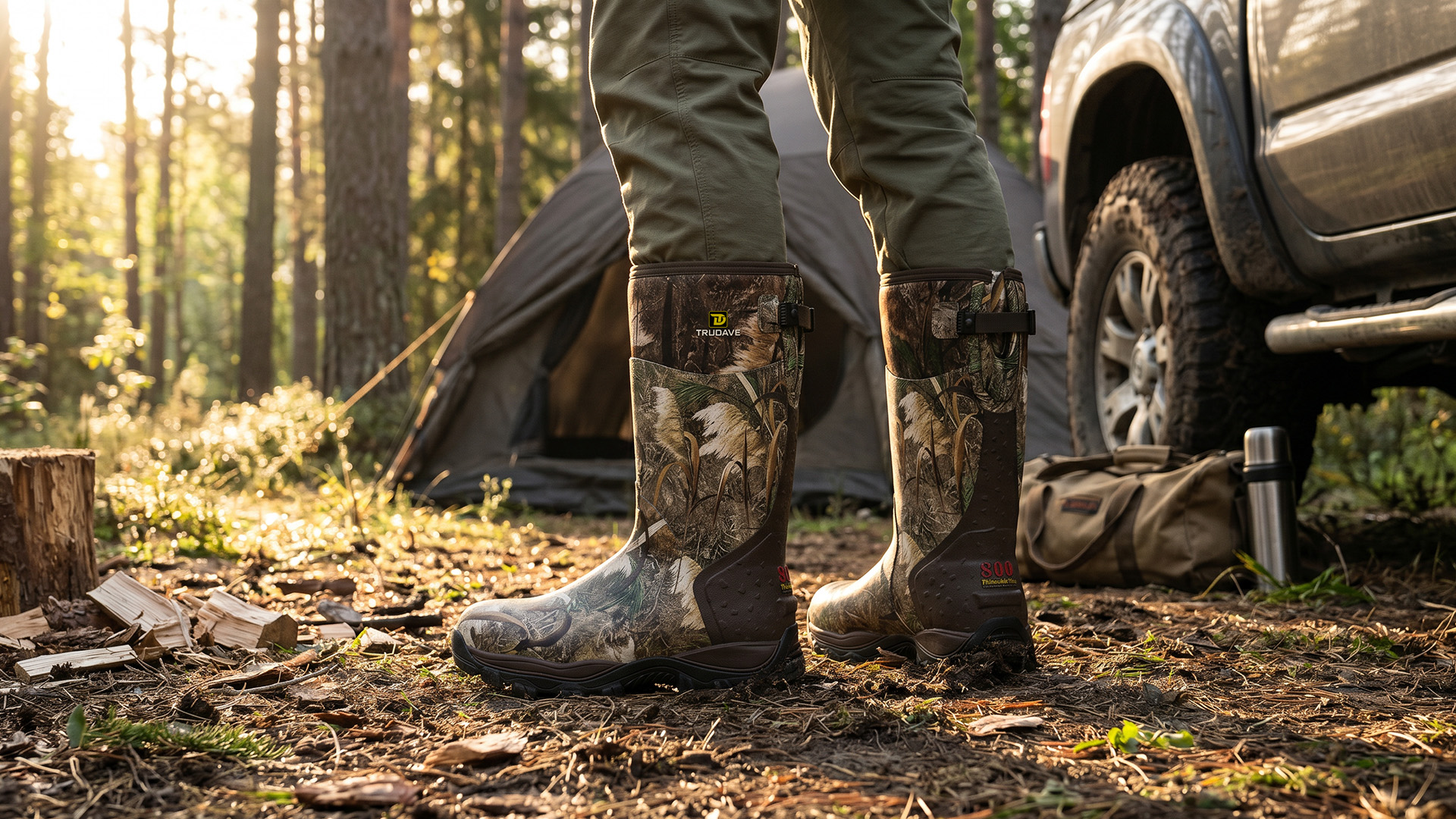
Trudave Gear built the DryFlow Series to solve exactly this problem. It’s a zero-insulation, industrial-grade waterproof hunting boot that strips away every unnecessary gram while maintaining absolute waterproof protection and the support your feet need for long days on uneven ground. This article explores the science of foot weight and fatigue, how the DryFlow’s material choices keep ounces off without sacrificing performance, and why a lighter boot can mean more ground covered, more game seen, and more tags filled.
Part 1: The Physics of Foot Weight and Fatigue
To understand why a lightweight boot matters, imagine walking a mile with a pair of five-pound dumbbells strapped to your ankles. Now imagine doing it over uneven terrain, with a loaded pack, for ten miles. Every time you lift your foot, you’re not just moving the boot—you’re lifting the weight of the boot against gravity, then decelerating it as it comes down. Over thousands of steps, the energy cost compounds.
Physiologists measure this cost in terms of oxygen consumption and heart rate. Studies have found that adding weight to the feet increases metabolic cost significantly more than adding the same weight to the torso. The reason is biomechanical: your legs act as pendulums during walking, and adding mass to the end of the pendulum requires more muscular effort to swing it forward and control it.
For hunters, this translates into real-world consequences. On a six-mile day with 10,000 steps, lifting a boot that’s just four ounces heavier means lifting an extra 2,500 pounds cumulatively. That’s energy that could have gone toward glassing longer, stalking deeper, or hauling out meat. Heavy boots also alter your gait, encouraging a shuffling, less stable stride that can increase the risk of trips and ankle rolls on rough terrain. Conversely, a lighter boot allows a more natural, energy-efficient stride and preserves the agility needed to navigate rocks, roots, and deadfall quietly.
The Trudave DryFlow is engineered with this physics in mind. By eliminating the 5mm neoprene and fleece insulation found in the TrailGuard and WildGuard, and by replacing the traditional steel shank with an EVA midsole, the DryFlow cuts significant weight—making it the lightest hunting boot in the Trudave lineup. The reduction in mass directly reduces the muscular effort required for every step, translating into less fatigue and more miles before exhaustion sets in.
Part 2: The DryFlow Design: How Trudave Shed Weight Without Sacrificing Performance
Reducing a boot’s weight is easy if you’re willing to compromise on durability, support, or waterproofing. The challenge is shedding ounces while maintaining the protection and structure a hunting boot requires. Trudave achieved this with three specific design choices.
First, the DryFlow is a zero-insulation boot. Unlike the 5mm neoprene-and-rubber WildGuard and TrailGuard, the DryFlow’s upper is built from a single, industrial-grade vulcanized natural rubber shell. There is no neoprene liner, no fleece, no insulating layer of any kind. This isn’t a cost-saving measure—it’s a deliberate performance decision. For early-season bowhunting, spring turkey, and any active hunt in mild temperatures, insulation is unnecessary dead weight. Your body generates ample heat through movement, and any insulation in the boot would trap that heat, cause sweating, and add ounces with no benefit. By stripping insulation away, Trudave created a boot that weighs approximately 25-30% less than its insulated counterparts.
Second, the DryFlow eliminates the steel shank found in traditional work boots and replaces it with an EVA (ethylene-vinyl acetate) midsole. Steel shanks add significant weight and conduct cold from the ground into the foot. EVA is a lightweight, closed-cell foam that provides shock absorption and arch support without the mass. The EVA midsole cushions each step, reducing impact on the knees and lower back, and its closed-cell structure acts as a thermal barrier—keeping the cold of the ground from seeping through the sole even without insulation. For the active hunter covering miles, the EVA midsole’s combination of lightness and support is a genuine performance advantage.
Third, the DryFlow uses a streamlined construction with a structured heel cup and a flexible rubber upper that conforms to the foot without the need for heavy reinforcing layers. The aggressive cleated outsole is designed for traction on mixed terrain—mud, rock, gravel, and hard dirt—without the deep, heavy lugs that add weight and trap debris. The result is a boot that’s light enough for long approaches yet tough enough for the abuse of backcountry hunting.
Importantly, the weight savings don’t come at the expense of waterproofing. The DryFlow is built from the same vulcanized natural rubber as every other Trudave boot. The seams are chemically fused at the molecular level, creating a single, continuous, permanently waterproof barrier. Creek crossings, wet grass, and sudden rainstorms are handled without a second thought. You get absolute waterproof protection without the weight penalty of traditional insulated rubber boots.
Part 3: How Less Weight Translates to More Game
The link between boot weight and hunting success isn’t theoretical. It plays out in the field every season. Consider a typical early-season bowhunt. You park the truck an hour before first light, hike two miles into a ridge system, and spend the morning glassing and still-hunting through oak groves. In heavy boots, you’re aware of your feet by mile three—a hot spot forming, a dull ache in your arches. By mid-morning, you’re moving slower, taking fewer side-loops, and thinking about the walk back.
In lightweight boots like the DryFlow, that fatigue is delayed or eliminated. You cover an extra mile without noticing. You take that side trail to check a bedding area you’d otherwise skip. You stay on your feet through the midday lull instead of sitting against a tree and waiting. Those extra miles are where the opportunities live—the buck bedded just over the next ridge, the gobbler that sounded off at 11 a.m., the fresh sign that tells you you’re close.
The same principle applies to spring turkey hunting, where mobile hunters may cover five to eight miles a day, and to spot-and-stalk western hunting, where ten-mile days with significant elevation gain are routine. In all these scenarios, a lighter boot directly increases your effective range—the distance you can cover comfortably before fatigue starts to compromise your alertness, stealth, and decision-making.
There’s also a safety dimension. Fatigue leads to sloppy foot placement, which leads to ankle rolls and falls. A lighter boot reduces the muscular exhaustion that contributes to those mistakes. And the DryFlow’s structured heel cup and flexible sole provide the stability and ground feel needed to navigate uneven terrain with confidence. You’re not just covering more miles—you’re covering them more safely.
Part 4: The DryFlow in Context: When Insulation Is the Enemy
The DryFlow’s zero-insulation design is not for every hunt. When temperatures drop below freezing and you’re sitting motionless in a stand, insulation becomes essential—and that’s where the TrailGuard and WildGuard excel. But for a significant portion of the hunting year—early archery season, spring turkey, scouting trips, and mild-weather western hunts—insulation is a liability, not an asset.
Insulation traps body heat. When you’re active, your body generates more heat than it needs to maintain a comfortable temperature. In an insulated boot, that excess heat builds up, causing your feet to sweat. The sweat saturates your socks, and the moment you stop moving—to glass, to call, to wait—that moisture cools rapidly, leaving your feet cold and clammy. This is the “sweat trap,” and it’s one of the most common causes of cold feet among active hunters. The insulation that was supposed to keep you warm ends up making you colder, while also adding weight and reducing breathability.
The DryFlow avoids this entirely. By providing no insulation, it allows your body’s natural thermoregulation to function. The boot keeps external water out while letting heat and moisture escape through the breathable liner and the sock system. In temperatures from 45°F up to 75°F and beyond, this is the optimal thermal profile for active hunting. When it’s cold, you pair the DryFlow with a midweight or heavyweight merino wool sock. When it’s warm, a lightweight sock keeps feet cool. The boot doesn’t lock you into a fixed insulation level; it adapts to conditions through your sock choice. This versatility, combined with the weight savings, makes the DryFlow the most agile and adaptable boot in the Trudave lineup.
Part 5: What DryFlow Users Are Saying
Real-world feedback from hunters who’ve put the DryFlow through its paces confirms the design. A Colorado elk hunter who covers 10 to 12 miles a day during early archery season reported: “I used to wear insulated boots for everything, and my feet would be swimming in sweat by 9 a.m. The DryFlows are so much lighter—I feel like I can walk all day without my legs getting heavy. And my feet stay dry, both from creek crossings and from sweat. I saw more elk this season than any year prior, and I attribute a lot of that to being able to cover more ground.”
A spring turkey hunter in the Ozarks wrote: “Turkey hunting is a run-and-gun game. I’m constantly moving, calling, and repositioning. The DryFlow boots are perfect for that. They’re light, they flex with my feet, and I don’t overheat. I can focus on the birds instead of my feet.”
A public-land whitetail bowhunter in Michigan noted: “I scout a lot in August and September, hanging stands and checking cameras. The DryFlows are my go-to for that work. They’re tough, waterproof, and I can put in a full day without my feet aching. When the season shifts to cold sits, I switch to my TrailGuards. But for early season, the DryFlow is the only boot I need.”
These accounts highlight a common theme: the DryFlow isn’t meant to replace an insulated boot for late-season stand hunting. It’s the specialist tool for the active, warm-weather months—and in that role, it delivers a level of comfort and range that heavier boots can’t match.
Part 6: Building a Seasonal System with the DryFlow as the Foundation
No single boot covers every hunting scenario, and the DryFlow doesn’t pretend to. It’s the early-season, high-mileage anchor of a larger system. A serious hunter might build a Trudave rotation like this:
- DryFlow (Zero Insulation): August through mid-October. Early bow season, scouting, spring turkey, and any hunt where heat buildup and weight are the primary concerns.
- WildGuard (5mm Neoprene + Breathable Liner): Mid-October through November. The rut and wet, variable conditions where moderate warmth and waterproofing are paramount.
- TrailGuard (5mm Neoprene + Fleece Liner): Late November through January. The deep freeze, when static warmth is everything.
At Trudave’s direct-to-consumer pricing, building a complete three-boot system costs less than a single pair of premium insulated boots from a legacy brand sold through retail. The DryFlow is the foundation of that system—the boot that carries you through the scouting, the early sits, the long stalks, and the warm-weather adventures that define the edges of the hunting calendar.
Part 7: Caring for Your DryFlow Boots
The DryFlow’s simple, uninsulated construction makes care straightforward. After each hunt, rinse off mud and debris with clean water. Use a soft brush and mild soap for stubborn grime. Remove the EVA insole and let it dry separately; the uninsulated interior dries quickly on its own. Never place the boots near a heater, radiator, or campfire—heat is the enemy of vulcanized rubber. Air dry at room temperature in a shaded, well-ventilated area.
Every few months during heavy use, apply a silicone-free rubber conditioner to the exterior. This keeps the rubber flexible and resistant to cracking. Inspect the cleated outsole for embedded debris and the toe crease for any signs of hairline cracks. A small crack caught early can be sealed with flexible waterproof adhesive; ignored, it becomes a leak.
With basic care, a pair of DryFlows will deliver season after season of high-mileage performance. The vulcanized rubber won’t delaminate. The EVA midsole won’t pack out prematurely. And the lightweight construction will continue to save you energy on every step, hunt after hunt.
Conclusion: The Boot That Extends Your Range
Hunting success often comes down to the extra mile you were willing to walk. The bedding area no one else reaches. The ridge you glassed one more time before dark. The gobbler you chased across two drainages when a heavier-booted hunter would have turned back. Your boots determine where you can go, how long you can stay, and how quietly you can move through the world. Choose boots that weigh you down, and you’ll be limited by them. Choose boots that free you up, and your only limit is your own ambition.
The Trudave DryFlow is built to be the lightest, most agile tool in a hunter’s arsenal. Its zero-insulation design, industrial-grade vulcanized rubber, EVA midsole, and streamlined construction strip away every unnecessary ounce without sacrificing waterproofing, traction, or support. For the early season, the active stalk, and the high-mileage scout, it’s the boot that extends your range—and with it, your opportunities. When the temperature drops and the snow flies, reach for the TrailGuard or the WildGuard. But when the woods are warm, the creeks are running, and the miles are long, the DryFlow is the boot you want on your feet.
To explore the complete Trudave Gear hunting boot lineup and find the right pair for every phase of your season, visit trudavegear.com.
