
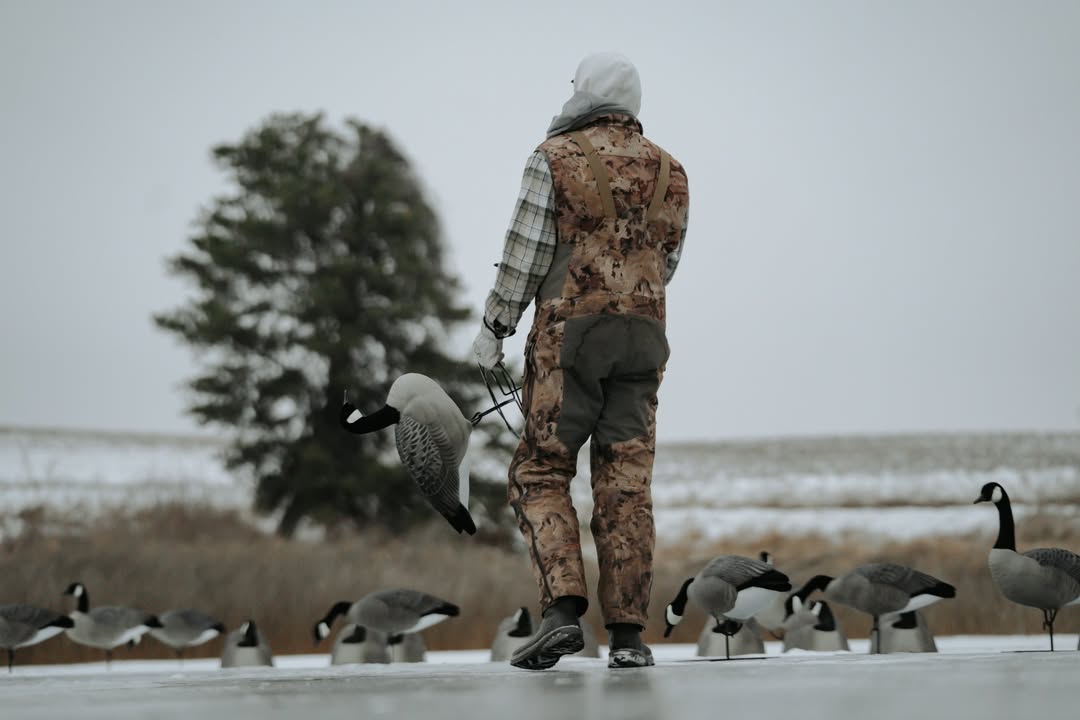
When winter tightens its grip and ice starts creeping across ponds, marshes, and backwater sloughs, waterfowl behavior changes fast. Ducks and geese aren’t just searching for food—they’re desperately seeking safe, open water where they can rest, feed, and escape predators. And that’s exactly why the ice line becomes the single most important feature in a frozen landscape.
Hunters who understand where to place decoys along this transition zone can turn tough, late-season days into some of the best shooting of the year. But getting it right means more than just tossing floaters in the nearest open pocket. Birds want a specific edge, at a specific depth, with a specific look.
Here’s how to identify the perfect ice line, set decoys with precision, and create a spread that birds can’t resist—even when conditions seem locked up.
1. Why Waterfowl Key In on Ice Lines in Winter
The ice line attracts birds for three primary reasons:
1. Safety
Predators struggle near thin or broken ice, and open water gives ducks room to escape. Birds naturally gravitate toward edges where they can jump, swim, and take flight instantly.
2. Comfort
The water at the ice line often:
- Stays slightly warmer
- Holds more oxygen
- Offers exposed vegetation and invertebrates
These micro-warm pockets make the edge more attractive than deep, fully open sections.
3. Social Magnetism
When one flock settles along an ice edge, others follow.
It’s visual proof that the location:
- Is safe
- Has food
- Can support multiple birds
That’s exactly what you must mimic with your decoy spread.
2. Finding the “Exact Edge” Birds Naturally Prefer
Not all edges are equal. Birds choose certain ones for very predictable reasons.
A. Wind-Blown Edges
Birds prefer the side of the pond where the wind pushes ice away, keeping water open. This creates:
- Softer edges
- Warm surface mixing
- Better visibility
If wind has been steady for 24–48 hours, the blown-off shoreline is almost always the top choice.
B. Sun-Facing Edges
South-facing banks thaw earlier and retain heat longer. Ducks consistently gather on edges that catch the morning or afternoon sun.
C. Depth-Based Edges
Look for edges where water is:
- 6–18 inches deep for mallards and wigeon
- 2–4 feet deep for divers
- Shallow shelves transitioning into deeper pockets
Birds avoid edges that drop too sharply.
D. “Soft Ice” vs. “Hard Ice”
A perfect ice line has soft, fractured, or slushy ice nearby—not thick, white, firmly set ice.
Soft ice signals:
- Recent activity
- Warm water movement
- Safe landing pockets
Hard ice signals: “nothing alive here.”
3. Building the Perfect Ice-Line Decoy Spread
A. Start With a Natural Opening
If there’s already an open pocket, use it.
If not, you may need to break a small shape—but the key is to make it look natural.
Avoid:
- Perfect circles
- Smooth, artificial edges
- Wide-open holes in otherwise frozen ponds
Opt for:
- Irregular shapes
- Jagged, wind-blown edges
- Narrow pockets that widen slightly at one end
Think “wind melt,” not “ax chop.”
B. Place Floaters Right at the Ice Break
This is the most important part.
Floaters should sit:
- Right at the ice edge, almost touching it
- Half in/half out when possible
- Tight enough to mimic real duck loafing
Late-season birds pack tighter than early-season ducks, so don’t be afraid to cluster decoys close.
C. Mix in Resters and Sleepers
In icy conditions, resting postures look more realistic than aggressive, feeding birds.
Use:
- 60–70% resters/sleepers
- 30–40% upright birds
- 1–2 sentry decoys on the downwind edge
This posture combination tells birds:
“This is a safe spot to conserve energy.”
D. Use a “Landing Slot” Along the Soft Edge
Leave a narrow, V-shaped opening along the open-water side.
Late-season ducks prefer:
- Narrow landing lanes
- Calm water
- Low-risk entry routes
A 15–20 foot gap leading into the pocket works best.
E. Add a Few Ice-Decoy Setups
You can place:
- 1–2 decoys directly on top of thin, broken ice
- 1–2 decoys belly-down in slush
These micro-details mimic real behavior:
- Birds slide up on the ice edge
- Loaf in half-frozen water
- Rest in “ice beds” just off the main open pocket
This small trick has an unusually high success rate with late-season mallards.
4. Motion Matters More in Ice Conditions
When the water is cold and still, motion is everything.
But choose carefully.
A. Use minimal but realistic motion
- Pulsator decoys
- Ice-eaters
- Light ripplers
Avoid violent or aggressive motion—birds are conserving energy, not splashing around.
B. Place motion devices at the downwind edge
Wind carries ripples across the pocket, helping your whole spread look alive.
C. Use wind to your advantage
If wind is strong, position decoys on the upwind ice line so they don’t drift into clumps.
5. Perfect Blind Placement for Ice-Line Hunts
You don’t need to be centered on the hole.
In fact, being too close will flare birds.
Ideal Position
- 20–40 yards downwind of the landing pocket
- Concealed in brush, cattails, or snow-covered ground
- Slightly offset from the opening—not directly in front
Birds want to:
- Circle into the wind
- Land into the hole
- Drift naturally toward the rest of the spread
Line yourself up with this natural path, not the ice edge itself.
6. Common Mistakes Hunters Make With Ice-Line Decoys
Avoid these winter killers:
❌ Making the opening too big
❌ Leaving floaters far off the ice edge
❌ Using too many high-head or feeder decoys
❌ Setting decoys in unnatural perfect clusters
❌ Standing to break ice minutes before shooting light
❌ Spooking birds off their natural roost
Icy-water ducks are sensitive. Realism matters.
7. Why Ice-Line Hunts Are Some of the Best of the Year
The beauty of ice-line hunting is simple:
- Birds are predictable
- Food is limited
- Competition is low
- Movement funnels to small, huntable areas
- Open water becomes a magnet
When you create the exact ice-edge look birds want, you transform a frozen, lifeless marsh into the most attractive spot in the region.
Final Thoughts
Ice-line hunting is all about precision.
Set your decoys exactly where birds naturally settle—tight to the edge, close together, low-energy, and realistic. Combine that with smart blind placement, subtle motion, and a natural-looking pocket, and you’ll experience some of the finest late-season duck hunts of your life.
