
I still remember the morning clearly. 18 degrees, a fresh dusting of snow on the ground, and the kind of silence that makes you feel like the only person left on earth. I was 22, hunting public land in northern Michigan, and I’d saved up for months to buy what a magazine had called “the only hunting boot you’ll ever need.” They were stiff, full-grain leather, heavily insulated, and cost more than my first truck payment.
By 8:30 AM, I couldn’t feel my toes. By 9:15, I was hobbling back to the truck, leaving fresh buck tracks in the snow that I never got to follow. The boots weren’t defective. They were just completely wrong for what I was asking them to do.
Here’s the thing most gear guides won’t tell you: the majority of ruined hunts don’t happen because you missed a shot. They happen because your feet failed you hours before you ever saw an animal. And the frustrating part? Most of those failures are preventable.
Over the years, I’ve identified five specific boot mistakes that hunters make over and over again — and here’s the interesting part: when you look at how Trudave Gear designs their hunting boots, it becomes obvious that someone on their product team has made every single one of these mistakes personally, and then built boots specifically to prevent them. Let’s walk through each one.
Mistake #1: The “One Boot to Rule Them All” Delusion
Every hunter has thought it at some point: “I’ll just buy one really good pair of boots and use them for everything.” It’s an appealing idea — spend more upfront, simplify your gear room, one less decision to make at 4 AM. It’s also, unfortunately, a fantasy.
Here’s the fundamental physics problem: a boot cannot be both heavily insulated for a freezing late-season sit AND breathable enough for a warm early-season stalk. It cannot be stiff enough for rocky mountain terrain AND flexible enough for silent stalking through flat timber. These are not minor trade-offs — they are direct contradictions in material science and boot construction.
The most common and costly mistakes hunters make are chasing the most expensive, heavily marketed boot and searching for a single pair that can do everything. A boot cannot be both exceptionally breathable for warm weather and heavily insulated for extreme cold. It cannot be both stiff enough for mountain support and flexible enough for silent stalking on flat ground. Attempting to find one boot for all conditions guarantees it will be compromised in most of them.
How Trudave solved this: Instead of trying to build one “perfect” boot, Trudave built a system. The WildGuard Series is optimized for wet, marshy terrain with 5mm neoprene insulation and a breathable liner that keeps your feet warm during long, still sits in the cold — perfect for the whitetail hunter who walks a mile to the stand and then stays put for hours. The TrailGuard Series takes the same waterproof construction but adds a fleece lining and an aggressive self-cleaning outsole designed for hunters who cover ground through varied terrain in colder weather. The DryFlow Series strips away the heavy insulation in favor of industrial-grade waterproof rubber, a steel shank for arch support, and an oil-resistant outsole — ideal for the active hunter who needs a boot that works as hard as they do without overheating. Different boots for different hunts. Not a marketing gimmick — just physics.
Mistake #2: Falling for the “Most Expensive = Best” Trap
Walk into any big-box outdoor retailer and you’ll see it: the flagship boot display. Full-grain leather, Vibram soles, Thinsulate ratings in bold print, and a price tag that makes you wince. The marketing tells you this is the boot the pros use. What it doesn’t tell you is that those “pro” features are designed for the most extreme 1% of hunting scenarios — high-altitude sheep hunts, multi-day backcountry expeditions — and they can actually work against you in the whitetail woods or the duck marsh.
A high price tag and aggressive marketing campaign do not automatically equate to a better boot for your specific needs. In many cases, the most expensive options are highly specialized tools that can become a liability outside of their intended environment. A stiff, heavy mountain boot designed for scaling rocky terrain is a significant disadvantage when trying to stalk quietly through a forest. Likewise, a heavily insulated boot will cause excessive sweating and blistering during an early-season hunt in warm weather.
Marketing sells a singular “pro” model — often designed for the most demanding 1% of scenarios — and creates an illusion that it’s the best for all situations. The core mistake is allowing marketing to define what is “best.” The right hunting boot is not the most expensive one — it is the one that functions as a seamless tool for your specific terrain, climate, and physical demands.
How Trudave flips this: Trudave operates on a direct-to-consumer model. They skip the retail markup entirely. The 5mm neoprene, the vulcanized rubber shells, the EVA midsoles, the sealed seams — these are the same materials you’ll find in boots costing 80–120 more. The difference is that Trudave doesn’t charge you for a brand name or a fancy retail display. They charge you for the materials and construction. A perfectly fitted, moderately-priced boot designed for your local terrain will always outperform an ill-fitting, top-of-the-line boot that is mismatched to the conditions.
Mistake #3: Assuming Leather Is Always Superior
Leather boots have a certain romance to them. They look serious. They feel substantial. Hunters have been wearing leather for generations, and there’s a persistent belief that rubber boots are the “budget” option — something you settle for when you can’t afford the real thing.
The truth is more nuanced. Leather boots offer excellent durability and ankle support for mountain terrain. But for the kind of hunting where water, mud, and scent control are the primary challenges — whitetail stands, duck blinds, spring turkey in wet conditions — rubber and neoprene boots offer distinct advantages that leather simply cannot match.
Rubber boots offer several advantages on the hunt. They are scent-free, so they’ll never give your location away. They are also waterproof, making them perfect for treks across streams, marshes and swampy areas. Rubber boots don’t absorb water the way leather does, which means they don’t get heavier as the day goes on. And because neoprene and rubber construction doesn’t involve stitched seams — the most common failure point for waterproof leather boots — the waterproof barrier tends to last longer in wet-ground applications.
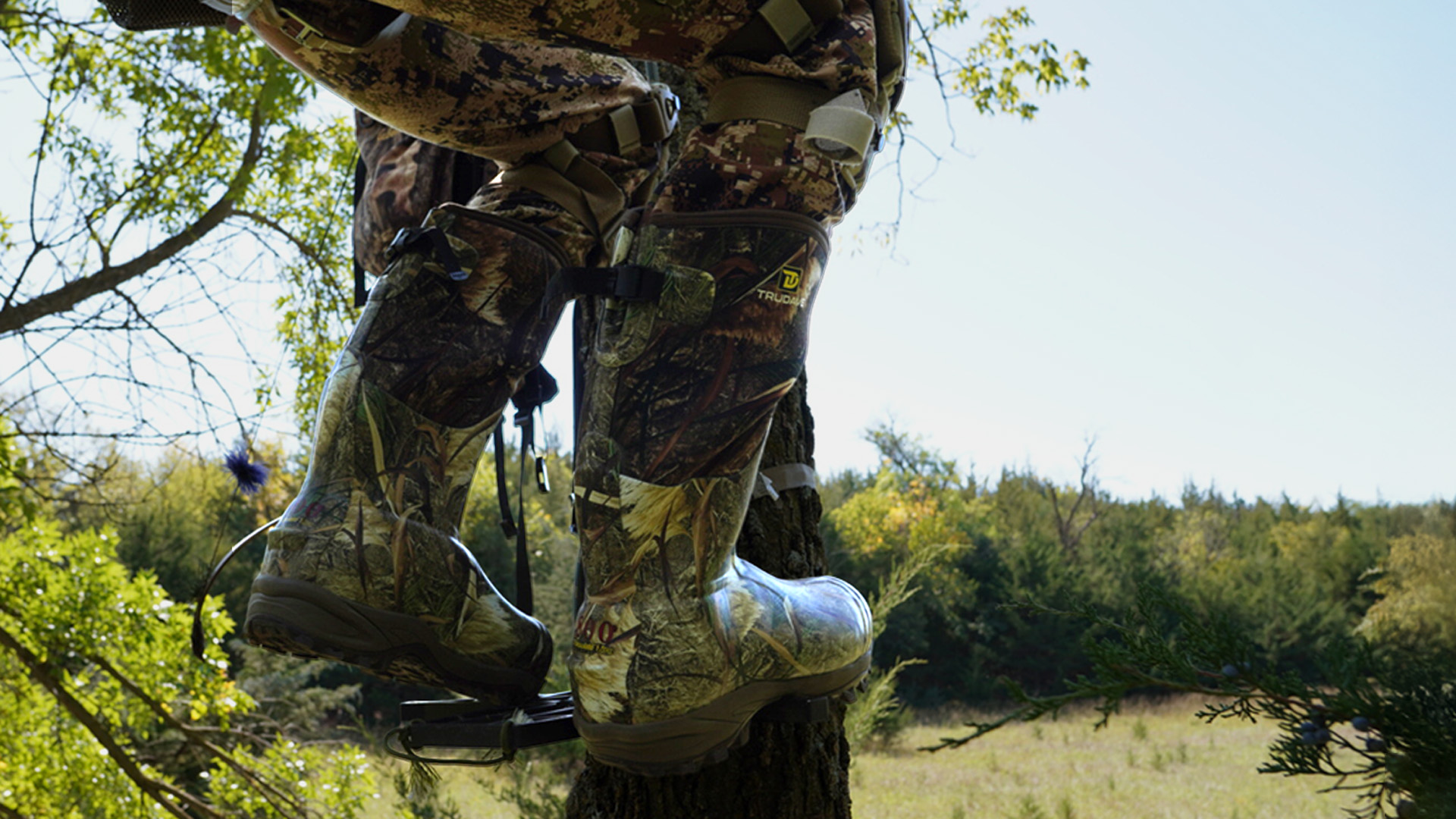
Critically, Trudave’s hunting boots are designed with rubber and neoprene construction that traps odor and doesn’t allow the scent of your feet to escape — a definite advantage over leather and synthetic boots when it comes to scent control. For whitetail hunters who spend hours in a stand with the wind swirling, this matters more than most people realize.
What Trudave gets right: Their boots don’t pretend to be leather boots. They lean into what rubber and neoprene do best: 100% waterproofing with zero break-in time, genuine insulation that stays effective when wet (unlike some synthetic insulations that collapse), and superior scent control — all without the weight penalty of waterlogged leather.
Mistake #4: Ignoring Scent Control at Ground Level
Talk to any seasoned whitetail hunter about scent control and they’ll tell you about their ozone generator, their carbon-filtered clothing, their scent-eliminating sprays. But ask them about their boots, and you’ll often get a blank stare. Here’s the reality: every step you take leaves a ground-level scent trail that a deer can detect hours after you’ve passed through.
The science is straightforward. Your feet have more sweat glands per square inch than almost any other part of your body. When you walk into your hunting area in breathable boots — especially leather or fabric boots — you’re essentially pumping a cloud of human scent into the ground with every step. Deer don’t just smell where you are; they smell everywhere you’ve been.
Scent-wise, both leather and rubber have advantages. More important, both have weaknesses. Rubber boots don’t leave human scent behind, but because of their loose design, there’s a forceful puff of air that takes place with every step. This is why boot fit and shaft design matter for scent control — a boot that’s too loose will actively pump scent-laden air out with each stride.
Trudave’s neoprene-and-rubber hunting boots address this through material choice and fit. The neoprene shaft conforms to your calf, reducing that “bellows effect” of air exchange. And the rubber lower shell is non-porous — it doesn’t absorb or transmit scent the way leather does. For the whitetail hunter, this isn’t a minor detail. It’s the difference between a deer crossing your entry path and stopping dead, or walking right past without alarm.
Mistake #5: Buying the Wrong Size Because You Didn’t Account for Swelling and Sock Thickness
This is the most mundane mistake on the list, and also the most common. Hunters buy boots that fit perfectly in the store — wearing thin cotton socks, at 2 PM on a Tuesday — and then discover on opening morning, with thick wool socks on feet that have swollen slightly from the hike in, that their toes are jammed against the front of the boot.
Your feet swell during the day and especially during strenuous hikes. Always try on boots in the afternoon or after being on your feet for a while. Crucially, wear the exact high-quality socks you plan to hunt with. The thickness of your sock dramatically impacts the boot’s fit.
Multiple user reviews across Trustpilot and Amazon consistently note that Trudave boots run slightly large by design. This is intentional: the extra room accommodates thick merino wool socks (essential for cold-weather hunts) and allows for natural foot swelling during a long day in the field. The general guidance is simple: if you’re between sizes, size down. If you plan to wear heavy wool socks exclusively, order your standard size. The neoprene upper on Trudave’s tall boots also offers some natural stretch, conforming to your calf without the stiff, unyielding fit of pure rubber boots.
The Bottom Line: Learn From Other People’s Mistakes
Every one of these five mistakes is something I’ve either done myself or watched a hunting partner do. The common thread? They’re all avoidable. The right boot for the right hunt — matched to your terrain, your hunting style, and the actual conditions you’ll face, not the fantasy conditions in a catalog photo — will keep you in the field longer, more comfortably, and more effectively than any amount of expensive gear stacked on top of bad footwear decisions.
Trudave Gear didn’t reinvent the hunting boot. What they did was pay attention to exactly where other boots fail, and then build products that address those failures directly — without adding unnecessary features that drive up cost without driving up performance. For hunters who want gear built tough enough to keep up with the wild — rather than gear designed to look good on a retail shelf — that approach makes a real difference where it matters: on your feet, in the field, when the buck finally steps out.
