
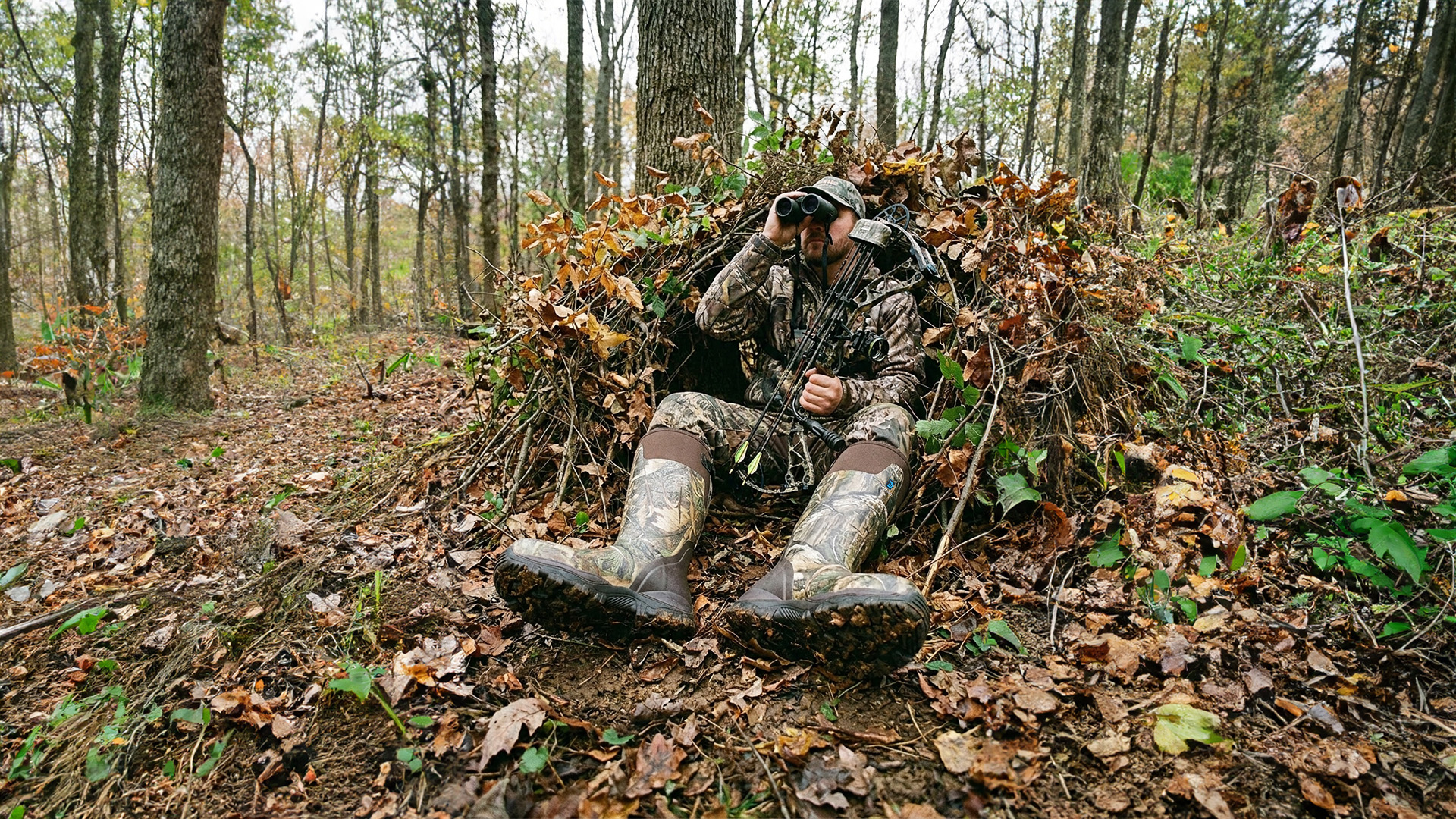
Ankle hunting boots get dismissed. The Trudave HuntGuard changes that conversation — steel shank, deep-lug traction, camo neoprene, and the mobility advantage that calf-high boots can’t deliver. Full honest review.
Here’s a bias that runs deep in hunting culture: taller boots are always better boots.
The reasoning sounds logical on the surface — more coverage means more protection means better performance. And for certain hunting scenarios, it’s correct. Flooded timber duck hunting, spring turkey in knee-deep marsh, late-season whitetail through saturated creek bottoms — these are the situations where a calf-high boot earns every inch of its height.
But here’s what that logic misses: a meaningful portion of hunting happens in conditions where calf-high boots are actively working against you.
The archery hunter covering six miles of open country in September doesn’t need the weight and ankle restriction of a tall rubber boot. The upland hunter behind pointing dogs on dry ridges is carrying unnecessary thermal mass when the temperature is 62°F. The scout who runs trail cameras through mixed terrain in August is fatiguing his legs with every step because the boot he chose was built for standing still in a blind, not covering ground.
The Trudave HuntGuard was designed for these hunters and these scenarios — the ones that reward ankle mobility, weight savings, and active-movement performance over the maximum coverage that tall boots provide.
This review covers everything you need to know: the real specs, the real performance, the specific scenarios where the HuntGuard wins, and the scenarios where you should reach for something taller instead.
What the HuntGuard Is — In Its Own Words
The Trudave HuntGuard pairs a camo neoprene bootie with a one-piece rubber shell to create a continuous, waterproof wrap that’s warm and flexible at the ankle. A lightweight EVA midsole cushions long hikes, while a rear kick plate and pull loop make glove-friendly on/off effortless. A field-tuned deep-lug rubber outsole bites into mud, grass, and rock, and a steel shank underfoot adds torsional stability and arch protection. Reinforced rubber toe and heel boost abrasion and impact resistance. With natural camo that blends in and protective sidewalls, it looks as capable as it performs — from camp to treeline. websta
That description covers the what. The review covers the why — why each of these specifications matters specifically for hunting use, and why the ankle-height configuration makes the HuntGuard the right tool for more hunting scenarios than most hunters assume.
The Specs: Breaking Down What Actually Matters for Hunters
Camo Neoprene Bootie + One-Piece Rubber Shell
The Trudave HuntGuard Series men’s waterproof rain boots pair a camo neoprene bootie with a durable, one-piece rubber shell, forming a seamless waterproof barrier that keeps your feet dry from garden mud to rainy worksites. Flylords Mag
The construction architecture here is worth understanding because it’s the right approach for hunting footwear, not just adequate construction.
The neoprene bootie is the inner waterproofing and insulation layer — flexible, warm, and conforming to the ankle’s natural movement. The one-piece rubber shell is the outer protection layer — impervious to moisture, abrasion-resistant, and easy to rinse clean after a muddy hunt.
Rubber rain boots are ideal for various conditions like floods, snow, and mud — they have a definite advantage over leather and synthetic boots when it comes to scent control because they trap odor and don’t allow the scent of your feet to escape. nationalfisherman
This scent management property is particularly relevant for whitetail hunters. The rubber shell doesn’t absorb and hold human scent the way leather or synthetic fabrics do — a genuine advantage on pressured hunting ground where the trail you leave to your setup can alert deer for hours after you’ve passed through.
The camo pattern is functional, not decorative. Four colorways across multiple camos and earth-tone options provide terrain-matched concealment. Ground-level hunting scenarios — turkey hunting from a ground blind, still-hunting for deer, quail hunting over dogs in open terrain — all involve the possibility that a game animal’s eye will reach boot level. Camo construction at ankle height reduces this visual variable in situations where it matters. websta
Steel Shank: The Feature Ankle Boots Usually Skip
A steel shank underfoot adds torsional stability and arch protection. websta
Most ankle rubber boots skip the steel shank as a cost-cutting measure. The HuntGuard’s inclusion of it is the specification that separates a serious hunting ankle boot from a casual outdoor slip-on.
Here’s why it matters for hunters specifically: torsional stability — the resistance to the boot twisting laterally under load — directly affects footing on uneven terrain. When you’re navigating a rocky creek bank, climbing a steep side hill, or stepping across exposed roots on a woodland floor, the steel shank keeps the sole from flexing unpredictably under lateral force. Without it, the boot twists with the terrain, requiring constant micro-corrections from your ankle muscles that add up to genuine fatigue over the course of a long hunting day.
The arch protection component is equally relevant for hunters covering serious mileage. Active-movement hunting — pheasant hunting behind dogs, turkey scouting, pre-season trail camera runs — loads the arch repeatedly across miles of walking. The steel shank distributes this load more evenly than a flexible sole, which reduces the concentrated pressure on the arch that causes cumulative fatigue on long hunting days.
The Field-Tuned Deep-Lug Outsole
A field-tuned deep-lug rubber outsole bites into mud, grass, and rock, and broad biting lugs with drainage channels grip wet grass, mud, and rock. websta
“Field-tuned” is doing real work in this description. The lug pattern on the HuntGuard is calibrated for hunting terrain variety — the mixed surfaces that a hunting day typically involves — rather than optimized for a single surface type.
The drainage channels between the lugs are the functional detail that most hunters overlook when evaluating outsole traction. Lug patterns without drainage channels pack with mud during wet terrain walking, progressively filling the space between lugs until the boot is effectively flat-soled. The HuntGuard’s drainage channels evacuate mud between steps, maintaining functional lug-to-ground contact even as conditions get progressively murkier.
This drainage function matters most in the shoulder-season hunting conditions where the HuntGuard is most appropriate — September turkey hunting in morning-dew-soaked fields, October pheasant hunting in prairie grass wet from overnight rain, early deer season scouting through muddy forest floors.
Warm, Breathable Multi-Layer Interior
A warm, breathable lining: multi-layer interior manages heat and moisture during active use. Flylords Mag
This is the specification that makes the HuntGuard work for active movement hunting rather than stationary stand hunting. The multi-layer interior’s moisture management function is what prevents the swamp-foot condition that heavy, unvented rubber boots produce during active movement.
Active hunting generates perspiration. Perspiration in a sealed rubber boot with no moisture management creates wet feet from the inside — which then become cold feet when you stop moving, eliminating any thermal advantage the boot’s insulation provides. The HuntGuard’s breathable lining moves perspiration away from the foot during active hunting without venting the boot’s waterproofing integrity.
This moisture management function is why the HuntGuard works for warm-season and active-movement hunting scenarios where heavily insulated boots with minimal breathability fail in the opposite direction — overheating active hunters who generate more body heat than the boot can manage.
Rear Kick Plate and Pull Loop
A rear kick plate and pull loop make glove-friendly on/off effortless. websta
The on/off system on hunting boots is undervalued until you’re trying to change footwear in the dark at 5 a.m. with cold hands, or removing muddy boots before entering a vehicle, or making a quick boot swap during a hunting day when conditions change.
The HuntGuard’s rear kick plate — a raised rubber ridge at the heel — allows boot-to-boot removal without bending down or using your hands. The pull loop provides a secure grab point for entry. Both features work with gloved hands in the cold, which is when you need them to work and when lesser boot entry systems fail.
Reinforced Rubber Toe and Heel
Reinforced rubber toe and heel boost abrasion and impact resistance. websta
An ankle boot that encounters hunting terrain accumulates abrasion at the toe and heel faster than the shaft experiences it — you’re kicking through brush, stepping over roots, and making foot-first contact with the environmental obstacles of hunting terrain constantly. The reinforced rubber at these wear points extends the boot’s usable life significantly compared to uniform-thickness construction that wears through fastest at exactly these high-contact locations.
Field Performance: Where the HuntGuard Actually Excels
Active Upland Hunting (Pheasant, Quail, and Prairie Birds)
This is the HuntGuard’s primary hunting use case and where the ankle-height advantage is most decisive. Pheasant hunting in the Midwest involves five to eight miles of daily movement through mixed terrain — CRP grass, creek drainages, cattail edges, gravel farm roads, and the occasional muddy field margin.
A calf-high hunting boot covers this terrain adequately but penalizes the angler with weight — both the literal boot weight and the thermal mass of more neoprene than the conditions require in October when temperatures run 50°F to 65°F.
The HuntGuard’s ankle cut eliminates the calf restriction that slows stride and builds fatigue during the high-mileage days that pheasant hunting demands. The steel shank’s arch support specifically addresses the cumulative load of these mileage totals. The multi-layer breathable lining prevents the overheating that kills upland hunters’ energy by noon on a warm October day.
What slows a hunt isn’t just the miles — it’s cold, wet, and slick footing plus the constant on/off. Dew-soaked grass, creek edges, mixed mud and rock — knee boots feel heavy; regular shoes get soaked and slip. HuntGuard was built to be a nimble ankle-height boot that’s fully waterproof, sure-footed in mud and rock, and fast to pull on/off — so every move from hike-in to hide-out feels locked in. websta
This is exactly the upland hunting performance description — hiking in, setting up, moving through varied terrain between flushes — that pheasant and quail hunters recognize immediately.
Spring Turkey Hunting (Warm-Weather Active Pursuit)
Spring turkey hunting in April and May involves the temperature and mobility profile where the HuntGuard’s specifications are directly matched to hunting demands. Air temperatures 45°F to 70°F. Active movement between setups covering two to four miles. Ground conditions wet from spring rain and morning dew. Terrain transitions between wet timber, field edges, and dry ridge tops.
The HuntGuard’s waterproof construction handles the wet spring conditions. The multi-layer breathable interior handles the body heat generated during active morning movement. The ankle cut allows the full stride length that covering miles of spring turkey habitat demands. The camo construction matters at ground level during the close-range setup approach that archery and shotgun turkey hunting both require.
For spring turkey hunting specifically, the HuntGuard outperforms calf-high boots in active performance while providing every waterproof and concealment feature that turkey hunting demands.
Pre-Season Scouting and Trail Camera Work
This is a hunting application that boot guides rarely address specifically and that represents a significant portion of serious hunters’ annual boot use. Scouting and trail camera management runs from August through September in most of the country — warm to hot temperatures, varied terrain, high mileage, and repeated wet-grass morning exposure.
A calf-high muck boot for August scouting is thermal overkill. The HuntGuard’s ankle cut and breathable lining make scouting in warm conditions comfortable rather than sweaty, while the waterproof rubber shell handles the morning dew exposure that soaks lightweight trail shoes by the first field crossing.
The on/off convenience matters specifically for trail camera work — camera placement, SD card swaps, and camera repositioning involve frequent terrain transitions where being able to remove and replace boots quickly is a genuine time-saver across a full camera-running circuit.
Waterfowl Hunting: Specific Conditions Where Ankle Boots Work
The HuntGuard is not a dedicated waterfowl boot — that’s the TrailMist and WildGuard’s territory. But for early teal season hunting in shallow marsh conditions where water depth stays reliably below ankle height, the HuntGuard’s lighter weight and better mobility make it a legitimate alternative to heavier options during the warm-weather teal hunting window.
For layout blind goose hunting in dry or lightly wet fields — where the challenge is access trail mud rather than sustained water immersion — the HuntGuard’s mud traction and waterproofing handle the conditions without the bulk that a taller muck boot adds to ground-level layout work.
Sizing: Getting the Ankle Boot Fit Right
The HuntGuard features cushioned insoles, breathable lining, and ergonomic arch support for long-day comfort — sized to US sizing standards with a camo neoprene construction that accommodates standard sock weights at true-to-size ordering. Flylords Mag
For hunting use, the sock weight consideration is important but differently configured than with tall boots. An ankle boot at true-to-size accommodates a midweight merino wool sock — appropriate for the fall hunting conditions where the HuntGuard is most used — without toe compression. The ankle cut doesn’t have the calf-height fitting complexity of tall boots, making the sizing more straightforward.
The honest fit note: The HuntGuard is an ankle boot, which means it provides less ankle wrap than a calf-high construction. Hunters with a history of ankle instability or who regularly navigate very uneven terrain should evaluate whether the ankle support of the HuntGuard’s construction is adequate for their specific terrain requirements. The steel shank provides torsional stability throughout the sole, but the ankle wrap of a calf-high boot provides additional lateral support that an ankle boot, by definition, doesn’t replicate.
When to Choose the HuntGuard Over a Taller Trudave Boot
The HuntGuard is the right choice when the hunting scenario prioritizes mobility over maximum coverage:
- Active upland hunting where mileage, temperature, and mobility matter more than coverage
- Spring turkey hunting in warm conditions with mixed wet and dry terrain
- Pre-season scouting in warm weather where thermal mass is a liability
- Quail hunting behind dogs where ankle flexibility improves walking pace and stride
- Early teal season in shallow marsh conditions where water depth stays reliably below ankle height
- Layout blind and dry-field waterfowl hunting where the challenge is mud access rather than water depth
Reach for the StreamTrek, WildGuard, or TrailGuard instead when:
- Water depth at the hunting location regularly exceeds ankle boot collar height
- Sustained cold below 20°F makes 6mm neoprene or heavier insulation necessary
- Technical terrain with significant elevation change requires more ankle wrap support
- Flooded timber or marsh hunting puts you in unpredictable water depths
The HuntGuard vs. Other Trudave Ankle-Height Options
The HuntGuard’s closest comparison within Trudave’s lineup is the WaveLock deck boot — also an ankle-height rubber-and-neoprene construction. The functional differences matter for understanding each boot’s appropriate use:
| Feature | HuntGuard | WaveLock |
|---|---|---|
| Outsole | Deep-lug hunting terrain | Fine-siped deck traction |
| Camo | Yes — 4 patterns | No |
| Primary surface | Mud, grass, rock | Wet fiberglass, dock wood |
| Steel shank | Yes | No |
| Non-marking | Not specified | Yes — deck required |
| Primary use | Active hunting, upland, scouting | Boat deck, marina, dock |
The HuntGuard’s deep-lug outsole grips soft natural terrain that the WaveLock’s siped deck outsole doesn’t address. The WaveLock’s non-marking compound protects boat surfaces that the HuntGuard’s hunting-focused construction doesn’t require. These are purpose-built different tools, not interchangeable sizes.
Pros and Cons
Pros
- Ankle height delivers real weight and mobility advantages that matter across miles of active hunting movement
- Steel shank provides torsional stability and arch support uncommon in ankle rubber boots at this price point
- Camo neoprene construction with natural patterns that function at ground level, not just in marketing photos
- Breathable multi-layer interior manages active-movement moisture in ways that sealed rubber interiors don’t
- Field-tuned deep-lug outsole with drainage channels maintains grip through muddy hunting terrain
- Rear kick plate and pull loop that function with cold, gloved hands in actual hunting conditions
- Reinforced toe and heel that extend boot life through the abrasive contact of hunting terrain
- Scent-resistant rubber exterior that doesn’t absorb ambient odors between hunts
Cons
- Not a stand boot — the ankle height and moderate insulation aren’t appropriate for extended stationary cold exposure; reach for TrailGuard in that scenario
- Not a deep-water boot — ankle collar height is the waterproof limit; water above ankle height requires a taller boot or waders
- Less ankle wrap than calf-high boots — hunters with significant ankle instability on rough terrain should evaluate whether additional support is needed
FAQ
What is the Trudave HuntGuard best used for? The HuntGuard is built for hunting in woods and marsh edges, bank fishing, ranch chores, and wet-season work — a nimble ankle-height boot that’s fully waterproof, sure-footed in mud and rock, and fast to pull on/off. For hunters specifically, active upland hunting, spring turkey, pre-season scouting, and any mobile hunting scenario prioritizing weight and mobility over maximum coverage. websta
Is the HuntGuard warm enough for fall hunting? The warm, breathable multi-layer interior manages heat and moisture during active use. For active fall hunting in the 35°F to 60°F range, paired with a midweight wool sock, the HuntGuard’s neoprene construction provides adequate thermal protection. For stationary hunting or temperatures consistently below 25°F, the TrailGuard’s heavier insulation system is more appropriate. Flylords Mag
Does the HuntGuard provide scent control for deer hunting? Rubber boots have a definite advantage over leather and synthetic boots when it comes to scent control because they trap odor and don’t allow the scent of your feet to escape. The HuntGuard’s rubber exterior doesn’t absorb ambient odors the way leather boots do. Store sealed between hunts, spray with scent eliminator before each outing for best results. nationalfisherman
How does the HuntGuard’s steel shank help during hunting? The steel shank underfoot adds torsional stability and arch protection — resistance to lateral boot twist on uneven terrain, and arch support that reduces fatigue during the active-movement hunting scenarios where the HuntGuard is most appropriate. It’s a genuine performance feature, not a marketing specification. websta
Are Trudave HuntGuard boots true to size? True to US sizing. For standard sock weights appropriate to active fall hunting, order your normal size. The ankle construction eliminates the calf-height fit complexity of tall hunting boots.
Where can I buy the Trudave HuntGuard? Available at trudavegear.com/products/huntguard with free shipping to the continental US and through Amazon.
Final Verdict
The HuntGuard earns its place in a serious hunter’s boot rotation by delivering exactly what active hunting scenarios demand: ankle mobility, steel shank stability, genuine waterproofing, and camo concealment in a construction light enough to carry through miles of upland and turkey hunting without the weight penalty that taller hunting boots impose.
It’s not the right boot for every hunt. For stand hunting in deep cold, for flooded timber duck hunting, for the heaviest mud terrain — taller Trudave boots serve those scenarios better. But for the half of a serious hunter’s season that involves active movement, warm conditions, and the kind of ground coverage where boot weight accumulates into real fatigue, the HuntGuard is the tool that doesn’t get talked about enough.
Rating: 4.5 / 5
Shop the Trudave HuntGuard → trudavegear.com/products/huntguard
