
Introduction: The Hunter’s Responsibility
Ethical hunting isn’t just about taking clean shots and following game laws. It’s about the entire footprint you leave on the landscape—the scent trail on the forest floor, the noise that disturbs wildlife long after you’ve passed, and the gear that eventually ends up in a landfill. Every hunter who has packed out another person’s empty shell casings or abandoned blaze orange knows the frustration: some people talk about stewardship, but their choices don’t back it up.
Your boots are the foundation of your ethical practice in the field. They’re the primary point of contact between you and the ground. The materials they’re made from, how long they last, and how you maintain them all ripple outward into the ecosystems you hunt. A cheap PVC boot that cracks after a single season becomes landfill waste. A heavily scented leather boot leaves a chemical trail that educates deer and alters their movement patterns. A noisy, stiff boot disturbs the peace of the woods for every creature in earshot.
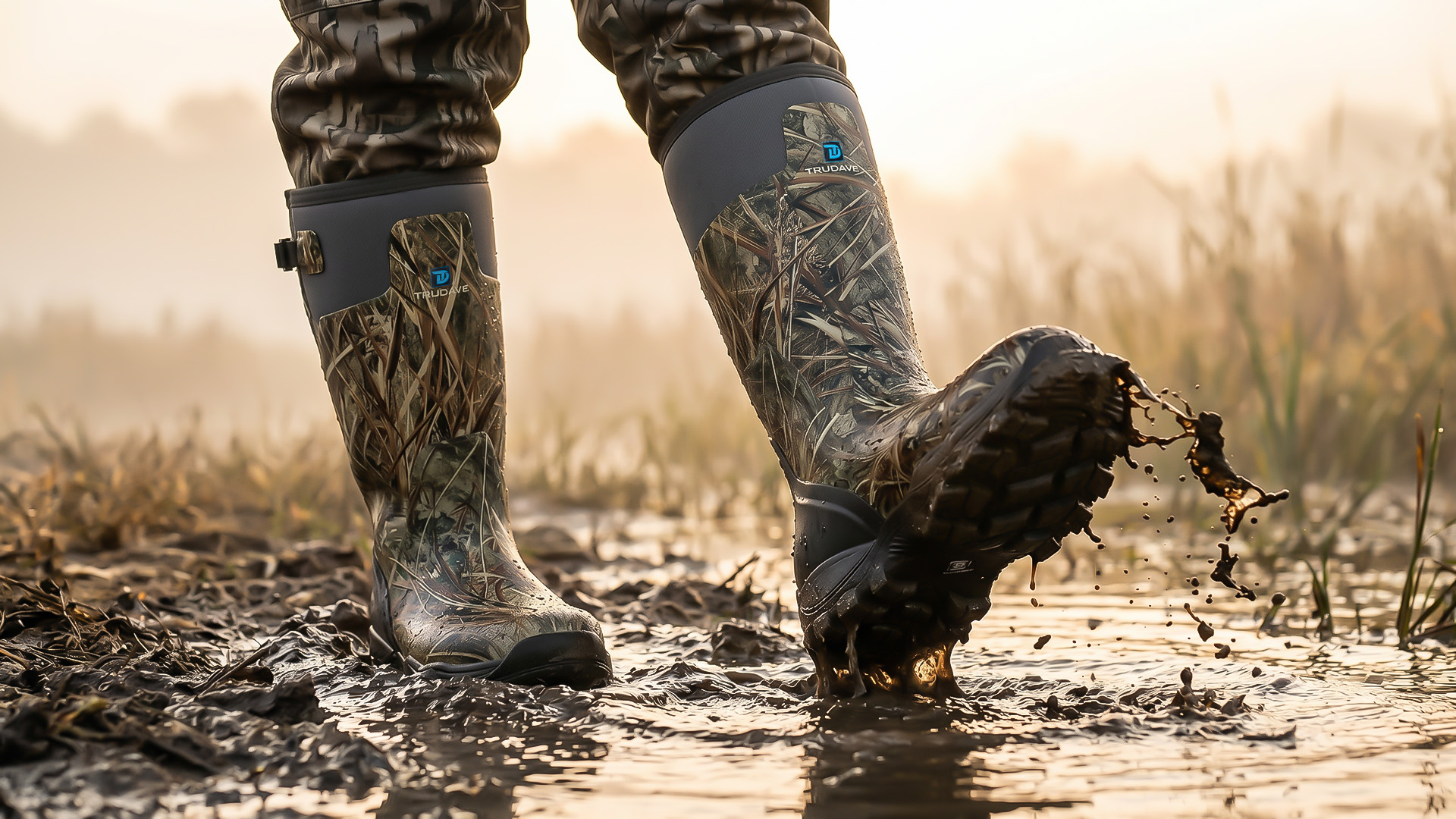
Trudave Gear’s hunting boots—the WildGuard, TrailGuard, and DryFlow—are built on a set of material choices that align with the principles of ethical, conservation-minded hunting. Vulcanized natural rubber, a renewable resource, instead of petroleum-based PVC. Non-porous, scent-free materials that minimize your olfactory impact on game and non-game species alike. A modular, repairable design that keeps boots out of the landfill for years longer than disposable alternatives. And a direct-to-consumer model that reduces the carbon footprint of getting those boots to your door.
This guide explores how Trudave’s design philosophy supports the broader goals of ethical hunting: minimizing environmental impact, practicing genuine scent control without relying on chemical sprays, and choosing gear that’s built to last rather than built to be replaced.
1. The Material Choice: Natural Rubber vs. PVC
The most significant environmental decision in a hunting boot is the material it’s made from. The vast majority of budget rain and hunting boots on the market are manufactured from PVC (polyvinyl chloride), a petroleum-based plastic. PVC production releases dioxins—some of the most potent carcinogens known—into the environment. The material itself is notoriously difficult to recycle. When a PVC boot cracks at the toe crease after a season or two of hard hunting, it’s destined for a landfill, where it will persist for centuries, slowly breaking down into microplastics that contaminate soil and waterways.
Trudave builds every hunting boot in its lineup from vulcanized natural rubber, derived from the latex of the Hevea brasiliensis tree. Natural rubber is a renewable resource. The trees can be tapped for latex for 25 years or more without being cut down. Responsibly managed rubber plantations can function as carbon sinks, absorbing CO2 from the atmosphere. The vulcanization process itself—discovered by Charles Goodyear in 1839—uses heat and sulfur to cross-link the rubber molecules into a stable, elastic, waterproof material. It doesn’t require the toxic additives that PVC does.
This choice has practical hunting benefits as well. Natural rubber stays flexible in freezing temperatures, unlike PVC, which stiffens and cracks. It bonds well with repair adhesives, meaning a punctured Trudave boot can be patched and returned to service rather than thrown away. And at the end of its life—which, with proper care, is many seasons down the road—natural rubber is theoretically biodegradable over long timescales, unlike PVC, which persists essentially forever.
For the hunter who thinks about the long-term health of the ecosystems they hunt, the choice between natural rubber and PVC is straightforward. One is a renewable material that can be repaired and eventually returned to the earth. The other is a plastic that will outlive the hunter, their children, and their grandchildren.
2. Scent Control Without the Spray Bottle
Walk into any hunting retailer in October, and you’ll find an entire aisle dedicated to scent elimination: sprays, detergents, carbon-lined clothing bags, ozone generators. The industry has built a multi-million-dollar category around the idea that hunters need to chemically mask their human odor. But the most effective scent-control strategy doesn’t come in a bottle. It comes from the materials your boots are made of.
Rubber is non-porous. It does not absorb moisture, and it does not absorb the volatile organic compounds that make up human scent. When you walk into your hunting area in a pair of Trudave boots, your foot odor stays inside the boot. The exterior of the boot contacts the ground without transferring a scent-loaded moisture layer. This is a permanent, passive property of the material—it doesn’t wash off, wear out, or require reapplication.
The neoprene uppers on the WildGuard and TrailGuard add another dimension to this scent containment. Neoprene is a closed-cell foam—the same material used in wetsuits. It’s also non-porous. And because the neoprene shaft conforms to your calf, it reduces what some hunters call the “bellows effect”: the pumping of scent-laden air out of the top of the boot with every step. A loose-fitting rubber boot acts like a bellows, pushing foot odor into the environment with each stride. The snug, conforming fit of a Trudave neoprene upper minimizes that exchange.
This passive scent control has ethical implications beyond just increasing your odds of seeing deer. It reduces the overall human scent load in the environment. It means you’re not leaving a chemical trail of synthetic sprays on the forest floor. And it means the deer you don’t shoot—the ones that cross your entry path hours after you’ve passed—are less likely to be disturbed by your presence, less likely to alter their movement patterns, and less likely to be pushed onto neighboring properties or into dangerous crossings. Ethical hunting is about minimizing your impact on all wildlife, not just the animal you’re pursuing. Scent-free boots are a quiet but meaningful part of that practice.
3. Silence as a Form of Respect
Noise in the woods isn’t just a tactical disadvantage. It’s a form of disturbance that affects every living thing within earshot. The crack of a stiff boot sole on a frozen branch, the creak of leather as you shift your weight in the stand, the rustle of fabric against brush—these sounds travel far in the still air of a November morning, and they don’t just alert deer. They stress songbirds, flush grouse, and put the entire forest on edge.
Trudave’s vulcanized rubber and neoprene are inherently quieter than leather or fabric. Rubber is non-fibrous—it flexes as a single, homogeneous material without the internal friction that makes leather creak. Neoprene absorbs vibration rather than transmitting it, dampening the sound of footfalls and the rustle of the boot shaft against underbrush. The vulcanized construction means there are no separate soles to flap, no glued seams to squeak as they degrade. The boot is a single, silent unit.
For the ethical hunter, this silence is a form of respect for the woods and its inhabitants. Moving quietly means you’re not broadcasting your presence to every animal within a quarter-mile. It means the doe and her fawns can continue browsing undisturbed as you slip past on your way to a stand. It means the grouse won’t explode from cover, burning precious calories in a panicked flush. It means the woods remain as close to their natural state as possible, even with you in them. Ethical hunting is about leaving no trace, and that includes acoustic trace.
4. Built to Last: The Anti-Disposable Boot
Perhaps the most significant ethical choice a hunter can make with their gear is to buy products that last. The outdoor industry has normalized disposability. Budget boots are designed to fail within a season or two, ensuring the consumer returns to buy another pair. The cycle feeds landfills, consumes resources, and treats gear as a consumable rather than an investment.
Trudave’s vulcanized construction is the antithesis of planned obsolescence. A vulcanized boot is, at the molecular level, a single continuous unit. There are no glued seams to separate after a season of flexing. There are no stitches to rot. The EVA midsole doesn’t pack out like cheap foam footbeds. The removable insole can be replaced when it eventually compresses, extending the boot’s life without requiring a whole new pair. Small cracks and punctures can be repaired with a flexible waterproof adhesive, a $7 fix that prevents a $100 boot from becoming trash.
This modular, repairable design has a real environmental impact. A pair of TrailGuards that lasts five seasons replaces multiple pairs of disposable PVC boots that would have been manufactured, shipped, and landfilled in that same time period. Fewer boots manufactured means less raw material extracted, less energy consumed in production, less fuel burned in transportation, and less waste sent to the landfill. It’s a small choice in the grand scheme, but it’s one that reflects the hunter’s commitment to stewardship: taking care of what you own, fixing it when it breaks, and making it last.
5. The Direct-to-Consumer Model: Cutting Carbon, Not Corners
Trudave sells its boots directly to hunters through its website, bypassing the traditional retail supply chain. This model has an environmental dimension that’s easy to overlook. Traditional retail involves a long, energy-intensive journey: factory to central warehouse, warehouse to regional distribution center, distribution center to retail store, and finally to the consumer’s vehicle and home. Each leg of that journey burns fuel. Retail stores themselves consume electricity for lighting, heating, and cooling. And the retail model generates enormous waste in the form of unsold inventory—products that are manufactured, shipped, and never sold, eventually ending up in clearance bins or landfills.
The direct-to-consumer model shortens that chain. Products move from factory to fulfillment center to the consumer’s doorstep, reducing overall transportation emissions. And because DTC brands produce based on demand rather than speculative retail orders, they generate far less unsold inventory waste. For the hunter who factors their carbon footprint into their ethical practice, choosing a DTC brand is a small but meaningful way to reduce the environmental cost of their gear.
6. Caring for Your Boots as an Act of Stewardship
The most sustainable boot is the one you already own, properly maintained. Trudave’s care protocol is simple, but it’s also an expression of the hunter’s responsibility to their gear and their environment.
Rinse your boots after every hunt. Mud, blood, and organic debris left on the rubber will degrade it over time, shortening the boot’s life. Use mild soap and a soft brush—no harsh chemicals that will wash into the soil. Remove the insoles and let them dry separately. Stuff the boots with newspaper to wick moisture from the interior, and let them air-dry at room temperature, away from heat sources. Heat accelerates the degradation of rubber and consumes energy.
Every few months, condition the rubber exterior with a silicone-free rubber conditioner. Choose a product with biodegradable ingredients when possible. This keeps the rubber supple and prevents the micro-cracks that can eventually become leaks. When a crack does appear, repair it immediately with a flexible waterproof adhesive rather than discarding the boot. A repaired boot is a badge of honor, not a compromise.
At the end of the boot’s life—after many seasons of service—dispose of it responsibly. Natural rubber is not accepted by most municipal recycling programs, but it can sometimes be ground up and used as filler material for playgrounds, running tracks, and other industrial applications. Organizations like TerraCycle offer mail-in recycling programs for rubber footwear. The extra effort is small, but it keeps one more pair of boots out of the landfill.
Conclusion: The Bootprint You Leave Behind
Ethical hunting is a practice, not a label. It’s the sum of a thousand small choices—the shot you don’t take, the trail you don’t cut, the wrapper you pack out, the gear you choose to buy and maintain. Your boots are part of that equation. Every step you take in the woods leaves a bootprint: the scent you deposit, the sound you make, the materials that will eventually return to the earth or persist in a landfill.
Trudave Gear’s WildGuard, TrailGuard, and DryFlow boots are built for the hunter who thinks about that bootprint. Renewable natural rubber instead of petroleum-based PVC. Passive, chemical-free scent control that minimizes your impact on wildlife. A quiet, flexible step that respects the acoustic peace of the woods. And a durable, repairable design that keeps boots in service for years, not months.
Choose boots that match your ethics. Take care of them. Repair them when they break. And leave the woods a little better than you found them.
To explore the complete Trudave Gear hunting boot lineup, visit trudavegear.com.
