
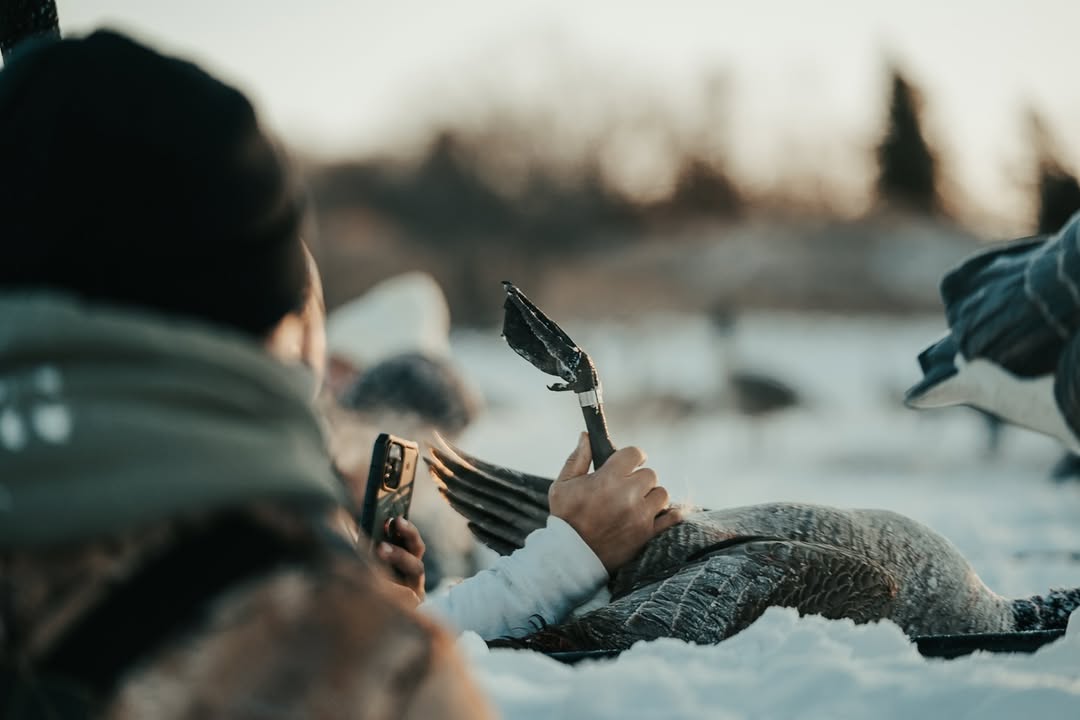
By the time January sets in, the late-season goose migration has settled into a rhythm that seasoned hunters can read like a map—if they know what to look for. Bitter temperatures, locked-up roosts, limited food, and high hunting pressure all push geese into more predictable travel and landing patterns. One of the most reliable behaviors you can bank on in midwinter is the “J-hook” landing pattern, a consistent approach geese use when they commit to a feed field.
Understanding how and why geese use this maneuver can turn an average hunt into a limit-fast morning. Below is a comprehensive breakdown of January J-hooks, how they form, and how hunters can take advantage of the pattern when temperatures—and hunting pressure—are at their peak.
What Exactly Is a J-Hook?
A J-hook is a landing pattern where a flock approaches a field from downwind or crosswind, then swings into a long curved arc—shaped like the letter J—before straightening out and locking their wings for the final descent.
Think of it as a setup move:
A flock doesn’t just drop straight in. They circle, evaluate, commit, and only then slide into the pocket.
This behavior is nearly universal among Canada geese and snows once winter fully settles in.
Why Geese Rely on J-Hooks More in January
A combination of environmental pressures and survival instincts make J-hooks more pronounced during midwinter:
1. Frozen Fields and Limited Food Narrow Their Choices
By January, most agricultural fields have:
- left-over grain buried beneath snow
- frozen soil
- limited open feed pockets
When geese find a spot where food is exposed—wind-swept edges, plowed strips, cattle feeding areas—they approach more cautiously and methodically. They rely on the predictable J-hook because it gives them the best visual angle to assess the risk before committing.
2. High Hunting Pressure Makes Geese More Methodical
After weeks of gunfire and decoy spreads, geese become “educated.” They won’t simply divebomb the first field with a few silhouettes sticking out.
The J-hook gives them:
- A wide vantage point to scan for hunters
- Time to look for movement
- A safe approach that keeps them in control
This is why late-season geese often swing way out before turning—sometimes several hundred yards.
3. Wind Dictates Their Approach
Wind is the primary factor in goose landings. In January, stronger north winds and colder storms force geese into consistent flight lanes.
They’ll:
- Start downwind
- Gain altitude
- Swing wide
- Then hook into the wind for a textbook landing
Predictable wind patterns = predictable landing patterns.
How to Use the J-Hook to Your Advantage
Midwinter goose hunting isn’t just about calling or having more decoys—it’s about positioning yourself exactly where geese want to finish.
Here’s how to use the J-hook to stack the odds in your favor.
1. Set Up on the Downwind Side—Not the Middle of the Field
This is the biggest mistake hunters make:
They place blinds dead center in a feed field, expecting geese to come straight in.
But geese don’t land that way in January.
They start downwind, swing wide, then finish into the wind.
Correct approach:
Place your hide on the downwind third of the field, where the hook begins to tighten and the flock levels out.
This is where the flock commits—where the killing happens.
2. Build a Decoy Spread That Guides the Hook
Your decoy spread should create the J-hook, not just react to it.
The goal is to:
- Give the flock a lane
- Lead them into a pocket
- Make it feel natural
The most effective January pattern is:
A long tail of decoys extending downwind, curving into a pocket near your hide.
This creates:
- A visual runway
- A natural landing pocket
- A believable feeding line
Think of your spread like a neon arrow pointing toward where you want them.
3. Hide Where the Hook Straightens Out
Geese will expose themselves the most during the final straight line of the hook. That’s where you need to be.
Position your layout or A-frame:
- In a shadow line
- Beside a terrace ridge
- Next to a round bale
- In snow-covered grass
- Inside a brushed-up fencerow
The key is to be invisible.
Midwinter geese pick up even the smallest shine or movement.
4. Call Less—Let the Flight Path Do the Work
January geese rely more on sight than sound when landing. By the time they’re making the long hook, they’ve already scanned the field.
Use calling to:
- Catch their attention at a distance
- Keep them on line
- Confirm the landing pocket is active
Don’t over-call.
Let the wide, natural J-hook lane you created visually guide them.
5. Watch the Lead Birds Carefully
The entire flock follows the leaders during the hook. If the lead three or four birds:
- Slow down
- Tilt into the wind
- Lower altitude
…the flock is committed.
If they:
- Climb
- Straighten prematurely
- Slide wide
…they don’t like what they’re seeing.
Adjust your flagging, your calling, or your concealment if birds repeatedly flare during the straightening phase of the hook.
6. Snow Conditions Reveal Tomorrow’s Hook
Geese tend to repeat successful patterns. After a morning hunt, study:
- Wing marks
- Belly drag streaks
- Landing strip burnouts
- Tracks from the previous descent
You can tell exactly where geese feel safest.
Set up there the next morning—and you’ll be waiting in the landing zone.
Why January J-Hooks Are So Predictable
By midwinter, geese:
- Fly the same routes
- Hit the same feed spots
- Approach from the same angles
- Land with the same wind strategy
It’s not guesswork.
It’s behavior rooted in safety, energy conservation, and habit.
When the environment locks into a winter pattern, geese follow suit.
Final Thoughts: Master the Hook, Master the Hunt
January is one of the toughest times to chase geese—but also one of the most rewarding. When you understand the J-hook and set your spread to complement it, the late-season birds that used to frustrate you suddenly start finishing at 20 yards, feet down, wings locked.
Geese may get smarter in midwinter, but their landing pattern becomes more predictable.
If you hunt where the hook tightens, you won’t just see geese—you’ll finish them.
