
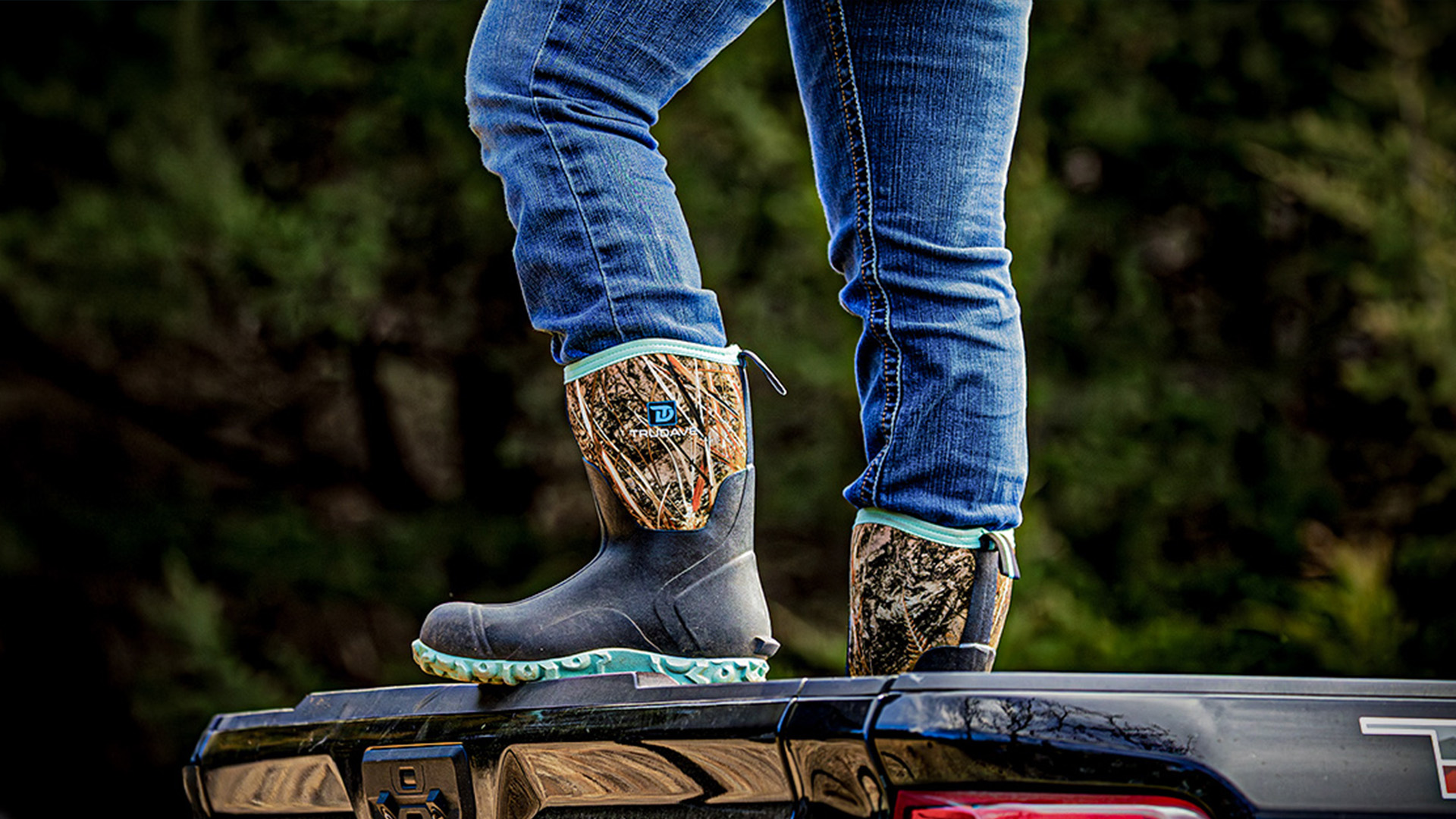
Deep South hunting doesn’t play by the same rules as northern deer season. Swamps, cottonmouths, wild hogs, and year-round warmth demand a completely different boot strategy. Here’s the complete Trudave guide for Southern hunters in 2025.
If you’ve ever read a hunting boot guide written by someone in Minnesota or Ohio in October, you know the feeling: the entire article is built around one cold morning in a deer stand. Heavy insulation, late-season freeze protection, sub-zero traction — all of it. Genuinely useful for the hunter it’s written for. Genuinely irrelevant for the hunter standing in knee-deep Louisiana marsh water in November wearing a light jacket.
Deep South hunting doesn’t share many conditions with the hunting that dominates outdoor media. The whitetail seasons run later and often warmer. The terrain includes cypress swamps, flooded bottomland hardwoods, palmetto brakes, and blackwater creeks that no Midwest stand hunter will ever set foot in. The wildlife hazards include cottonmouths and copperheads that are actively relevant to boot selection in ways that have zero Northern equivalent. And the year-round presence of wild hogs creates a hunting opportunity — and a specific set of physical demands — that doesn’t exist at scale anywhere else in the country.
This guide is written for the hunter in the Deep South: Alabama, Georgia, Louisiana, Mississippi, South Carolina, and the Florida panhandle. The conditions are different here. The boot selection logic is different here. And the content that serves you is different from the content written for where the hunting boot industry grew up.
What Makes Deep South Hunting Different — And Why It Matters for Boots
Temperature Profiles That Invert Northern Logic
Northern hunting boot guides build their thermal recommendations around the assumption that hunting season equals cold weather. In the Deep South, this logic inverts.
Alabama’s early archery opener runs from mid-October when daytime temperatures routinely hit 80°F. Georgia’s firearms season opens in late October with temperatures often in the 60s and 70s during the day. Louisiana’s split deer season means hunting in December, January, and February — but even the coldest mornings rarely drop below 25°F, and most hunting happens in 35°F to 55°F conditions.
This changes the thermal calculus for boot selection completely. The boot that serves a Minnesota deer hunter perfectly — maximum insulation, designed for sustained cold — creates overheating problems for a Georgia swamp hunter who’s covering ground in 65°F weather. The Deep South hunter needs boots that provide adequate cold protection for cool mornings without the thermal overload that ruins a warm-weather hunting day.
The Swamp and Wetland Terrain Reality
Southern bottomland hunting terrain has no direct equivalent in the Midwest or Northeast. Cypress swamps with standing water. Flooded bottomland hardwood flats where water depth is variable and the footing is root-tangled and unstable. Blackwater creek bottoms with soft, silt-heavy mud that works differently from the clay soils of agricultural Midwest terrain. Palmetto scrub with the particular abrasion challenge of palmetto fronds on boot materials.
A WildGuard buyer’s review captured the Southern swamp hunting scenario directly: “I bought these boots for my son, who hunts in swampy and rugged areas, and they have exceeded our expectations. The fully waterproof design keeps his feet dry no matter how wet the swamp gets. The rubber outsole handles mud, snow, and uneven terrain with ease.” Trudavegear
“No matter how wet the swamp gets” is the Southern hunting terrain condition. Not “during occasional creek crossings” or “when it rains before the hunt” — actual swamp hunting where water contact is constant and the depth is unpredictable.
Venomous Snake Exposure: The Boot Factor Northern Guides Skip
This is where Deep South boot selection diverges most dramatically from Northern boot guides, which mention snakes as an afterthought if at all.
In the Deep South, cottonmouths (water moccasins), copperheads, and eastern diamondback rattlesnakes share the same habitats that Southern hunters work in. Swamp edges, flooded timber, palmetto scrub, and blackwater creek bottoms are all primary snake country — and primary hunting country in Alabama, Georgia, and Louisiana.
The WildGuard’s reinforced rubber construction addresses this directly: a verified buyer specifically cited “the reinforced toe cap for snake protection, essential in his hunting area” as a key purchasing factor for hunting in swampy and rugged Southern terrain. Trudavegear
The relevant boot specification for snake-country hunting is thick rubber construction that provides resistance to snake bite penetration at the foot and lower leg level. Trudave’s warranty notes explicitly that certain products “may have passed tests for resistance to standard reasonably expected snake bites” — the DeltaTrek Series’ integrated boots specifically feature deep-tread, snake-resistant rubber soles. Flylords Mag
For Southern hunters working in known snake country, the rubber construction standard of Trudave’s hunting boot lineup provides meaningful resistance compared to fabric-faced membrane boots. The thicker the rubber, the more resistance it provides — a functional consideration for boots worn in cottonmouth habitat.
Year-Round Feral Hog Hunting: A Different Activity Profile
Feral hog hunting in the South is not a seasonal pursuit — it’s a year-round activity driven by wildlife management necessity and recreational opportunity. Texas, Alabama, Florida, Georgia, and Louisiana host the largest feral hog populations in the country, and landowners and hunters pursue them across 12 months in conditions that range from July heat to January cool snaps.
Hog hunting creates specific boot demands that deer hunting doesn’t. The active pursuit pace — running between positions, navigating thick cover quickly, responding to dog strikes or electronic call locations — requires lighter, more mobile boots than stand hunting. The year-round calendar means thermal requirements shift dramatically across the hunting months. And the thick briar and brush cover where hogs hold during the day creates abrasion demands on boot materials.
The Heat Management Challenge Northern Guides Don’t Solve
The thermal problem for Deep South hunters is the opposite of what Northern boot guides address: heat management rather than cold protection.
A rubber boot in 75°F weather generates genuine thermal load from the rubber’s insulating properties. An unventilated rubber boot with heavy neoprene lining in Alabama in October is genuinely uncomfortable — the heat trap it creates during active movement will limit a hunting day before any other factor does.
Southern hunters need boots with enough thermal protection for pre-dawn cool mornings and enough breathability to handle afternoon warmth and active movement. The 5mm or 6mm neoprene construction of Trudave’s heavier models is appropriate for November through February Deep South hunting. The lighter thermal constructions are more appropriate for early season and warm-condition hunting.
Scenario 1: Swamp Edge and Bottomland Whitetail — The Core Southern Hunt
What This Looks Like
You’re hunting whitetail in Alabama or Mississippi river bottom country. The access to your stand involves wading a blackwater drainage that runs somewhere between 6 inches and 18 inches depending on recent rainfall. Your stand is positioned on a dry hummock in flooded timber where the deer move through water to access the food source you’ve located. Water depth at the stand site is variable — occasionally your boot tops are the waterline.
Morning temperatures in November and December run 30°F to 45°F. Afternoon temperatures sometimes reach 60°F. You need waterproof construction that handles the morning wade, thermal protection for the cold sit, and a boot that manages the afternoon warmth when you’re active.
The boot demands:
- Full waterproof construction that handles calf-deep variable water crossings reliably
- Moderate cold protection for Southern winter mornings — adequate for 30°F, not overkill for 60°F afternoons
- Snake-resistant rubber construction for the swamp and creek bottom terrain
- Terrain traction on root-tangled, soft, silt-heavy bottomland mud
The right Trudave boot: WildGuard Series
The WildGuard’s one-piece rubber shell wraps the foot and shaft for full waterproof protection and abrasion resistance. Inside, a ~6mm thermal lining with breathable mesh locks in warmth without trapping moisture — keeping feet dry and comfortable during long hunts. The rubber outsole handles mud, snow, and uneven terrain with ease, making these boots extremely versatile for all types of outdoor adventures. The fully waterproof design keeps feet dry no matter how wet the swamp gets. Trudavegear
The WildGuard’s 6mm thermal lining is the right thermal specification for Deep South winter hunting — warm enough for the 30°F to 35°F cold fronts that Southern deer hunters call “good hunting weather” without the extreme insulation that creates overheating when afternoon temperatures climb into the 50s and 60s.
The rubber construction’s natural abrasion resistance handles the palmetto scrub, cypress knees, and woody debris of Southern bottomland terrain in ways that fabric-faced boots don’t survive season after season. And the reinforced rubber construction provides the snake-resistance layer that every Southern hunter working in cottonmouth country should have as baseline protection.
Scenario 2: Warm-Season and Early Archery Hunting — The 75°F Opening Day
What This Looks Like
It’s the third week of October. The high temperature today will be 78°F. You’re bowhunting from a ladder stand on a food plot edge in central Georgia. Morning temperature at your 5:30 a.m. launch is 62°F. By the time deer activity picks up at 7 a.m., it’s 68°F. You’ll be in the stand until noon. The access walk to the stand crosses a dew-soaked pasture.
This is the scenario where Northern boot content is actively dangerous for Southern hunters. The heavy insulated boot a Northern whitetail guide would recommend creates sweat-soaked feet before you reach the stand in these conditions.
The boot demands:
- Waterproof for heavy morning dew and the occasional drainage crossing in the access trail
- Minimal thermal mass — enough warmth for a 62°F morning without overheating at 78°F
- Quiet construction for the archery hunting approach and stand setup
- Scent management from rubber construction that doesn’t absorb ambient odors
The right Trudave boot: StreamTrek Series
The StreamTrek is built with 5mm neoprene and a breathable airmesh lining — fully waterproof, ideal for deer, duck, and upland hunting. The moisture-wicking airmesh lining helps legs stay dry and comfortable during long days outdoors. Trudave Gear
The breathable airmesh lining is the specific feature that makes the StreamTrek the right call for warm-season Deep South hunting. It moves perspiration away from the foot during the warm-morning access walk, prevents the swamp-foot condition that kills all-day hunting comfort, and maintains thermal effectiveness once you’re stationary in the stand when temperatures are actually manageable.
The StreamTrek’s 5mm neoprene provides enough thermal protection for the cooler end of Southern hunting conditions — the December and January mornings that genuinely require some insulation — without the overkill that 800-gram systems create in typical Southern winter temperatures.
Scenario 3: Wild Hog Hunting — Active Pursuit in Variable Conditions
What This Looks Like
You’re running dogs on wild hogs in the palmetto scrub and pine flatwoods of South Alabama or the Gulf Coast swamp country. The dogs strike and you’re moving — fast, through thick cover, across varied terrain that includes dry sandy soil, wet creek bottoms, thick palmetto fronds, and the occasional standing water flat. You might cover two miles in a 20-minute stand sequence.
Hog hunting creates a specific boot challenge: the pace is too active for a heavy insulated boot designed for stationary stand work, but the terrain is too aggressive for a lightweight boot that prioritizes mobility over protection. The snake risk is real at all times in this country. And the year-round calendar means you’re doing this in July heat and January cool fronts with the same boot.
The boot demands:
- Lightweight enough for active pursuit pace — covering ground quickly through thick cover
- Snake-resistant rubber construction — mandatory in palmetto and swamp hog country
- Abrasion resistance for palmetto and briar contact — these materials destroy fabric-faced boots
- All-season versatility for year-round hog hunting across wide temperature ranges
- Ankle stability for uneven terrain traversed at speed in pursuit situations
The right Trudave boot: TrailMist Series or WildGuard Series
For hog hunting, the TrailMist Series’ 6mm neoprene combined with thickened rubber shell addresses the snake resistance requirement while providing enough thermal mass for cool-season hog hunting without extreme insulation. The trail-style outsole’s aggressive self-cleaning lugs handle the diverse terrain of active hog pursuit — dry sandy flatwoods, wet creek crossings, and thick palmetto country — without packing the channels solid in adhesive wet soil.
For warmer-season hog hunting in the summer and early fall months, the WildGuard’s slightly lighter thermal profile with camo concealment covers the active pursuit scenario. The camo construction matters when you’re at ground level approaching a bayed hog or moving through open palmetto with dogs working ahead — ground-level visual exposure is real in hog hunting in ways that elevated stand hunting doesn’t create.
One verified hog country user specifically noted the WildGuard’s reinforced toe cap for snake protection as “essential in his hunting area” — exactly the concern that Deep South hog hunters share across palmetto scrub and swamp edge environments. Trudavegear
Scenario 4: Gulf Coast and Louisiana Duck Hunting — Warm-Weather Waterfowl
What This Looks Like
You’re hunting mallards, teal, and gadwall in the coastal marshes of Louisiana or the flooded rice fields of the Texas Gulf Coast. Water temperatures are in the 55°F to 65°F range in November and December — cold enough to require waterproof protection, not cold enough to require the extreme insulation of Minnesota or Dakota duck hunting. Air temperatures run 40°F to 65°F across the core of the season.
Southern duck hunting is physically different from northern duck hunting in ways that change boot requirements. The marsh wading is often through softer, siltier bottom that creates different traction challenges than the harder-packed flooded agricultural soils of the Mississippi Flyway’s northern reach. The warmer air temperatures create a thermal balance where moderate insulation is exactly right and heavy insulation is genuinely too much.
The boot demands:
- Full waterproof construction for sustained marsh wading
- Moderate thermal protection — appropriate for Southern winter duck hunting conditions without northern-level overkill
- Camo construction for marsh and coastal concealment in open water environments
- Mud performance on the softer, siltier bottom of Gulf Coast marshes
The right Trudave boot: Real Reed Series (camo pattern) or WildGuard Series
The Real Reed Series features waterproof rubber and 5mm neoprene material, with an anti-slip outsole with extra regular tooth depth, abrasion-resistant and self-cleaning for grip while hunting. The boots are designed for duck and hunting use, with a patented Real Reed and Reed Grass camo pattern designed for wetland, marsh, and coastal environments. Trudavegear
The Real Reed’s wetland-specific camo is directly matched to Gulf Coast and Louisiana marsh duck hunting environments — it blends into the grass and reed vegetation of coastal marshes in ways that woodland camo doesn’t. The 5mm neoprene provides the moderate cold protection appropriate for Southern duck hunting temperatures without the extreme insulation that creates overheating during active decoy placement in 55°F water.
Scenario 5: Deer Camp in the Deep South — Managing Multiple Hunt Types in One Trip
What This Looks Like
You’re spending a week at a Mississippi deer camp. The week’s hunting includes stand hunting for whitetail in flooded bottom hardwoods, opportunistic hog hunting when deer activity is slow, evening deer hunts from ground setups, and the various camp activities that involve constant boot use across varied terrain for 12+ hours per day.
This is the Deep South hunting reality that most Southern hunters recognize: multiple species, multiple terrain types, multiple activity levels, all in the same week from the same camp. A boot strategy that optimizes for one of these hunts at the expense of the others creates daily compromises.
The solution: Two-boot camp strategy
Active boots (in camp during the day, hog hunting, stand access): StreamTrek or WildGuard — lighter thermal mass for the active daytime hours, full waterproofing for terrain access, adequate thermal protection for the Southern winter temperature range.
Stand boots (dedicated to the cold morning sit): WildGuard or TrailMist — the slightly heavier thermal spec covers the pre-dawn and early morning hours when temperature is at its lowest and the hunter is stationary.
The temperature differential between a 35°F pre-dawn swamp walk and a 65°F midday camp activity is large enough that optimizing one boot for the cold sit and another for active camp use is the practical Deep South camp strategy.
The Deep South Snake Country Protocol: What Every Southern Hunter Needs to Know
Snake exposure is a year-round reality in the Deep South, and boot selection is the most practical footwear management strategy available. Here’s what matters:
Rubber thickness as protection: Thicker rubber construction provides more resistance to snake bite penetration than thinner rubber. The TrailMist’s thickened rubber shell and WildGuard’s reinforced rubber construction represent the best snake-resistance specifications in Trudave’s hunting boot lineup. Fabric-faced membrane boots provide essentially no snake bite resistance.
Height matters: Mid-calf boots provide coverage for the primary strike zone of cottonmouths and copperheads — which typically strike at ankle to mid-calf height when encountered during ground-level walking in swamp and brush terrain. Ankle-height boots expose the lower calf area that taller boots protect.
The honest limitation: Trudave’s warranty acknowledges the relevant limitation directly: “Trudave does not warrant any of its products provides protection from snake bites or bites from other wildlife and is not liable for personal injury resulting from such bites; however, certain products, if so referenced, may have passed tests for resistance to standard reasonably expected snake bites.” No rubber boot provides guaranteed snake bite prevention. Thick rubber construction provides meaningful resistance to typical strike force; dedicated snake-proof boot systems with specific anti-penetration materials provide higher protection levels for hunters working in extremely high-density snake environments. Flylords Mag
Situational awareness: The most effective snake management tool in Deep South hunting is visual awareness of where you’re stepping and what you’re reaching into — especially when stepping over logs, reaching into palmetto scrub, and moving through dense ground cover where snakes rest unseen.
Deep South Boot Care: The Heat, Humidity, and Biological Contamination Challenge
Southern hunting environments are harder on boot materials than Northern environments in a specific way: the combination of heat, humidity, and biological contamination from swamp water, mud, and organic debris creates faster material degradation than the clean, cold-dry environments of Northern hunting.
After every Southern hunt: Rinse thoroughly with clean water, focusing specifically on the outsole channels and the boot interior if any moisture entry occurred. Southern swamp water carries organic material that, left on rubber and neoprene surfaces, accelerates degradation faster than clean mud or rain water.
Dry between uses: High humidity in Southern environments means boots that seem dry may retain moisture in the neoprene shaft. Standing upright in a ventilated location — not a sealed storage bag — between hunts allows adequate drying.
Mildew prevention: The combination of Southern heat and residual moisture creates mildew conditions inside rubber boots faster than Northern hunters typically encounter. A diluted white vinegar spray into the interior after any session where moisture entered the boot prevents the mildew development that degrades neoprene and creates persistent odor.
UV and heat storage: Rinse boots with water after each hunt, wipe off dirt with mild soap, and let them air dry naturally. In the South, the additional step of storing away from direct sun and vehicle heat is more urgent than in Northern climates — UV and heat intensity at Southern latitudes accelerates rubber degradation faster than the cooler storage conditions Northern hunters typically maintain. Trudave Gear
Deep South Boot Selection Quick Reference
| Hunt Type | Season | Primary Challenge | Recommended Boot |
|---|---|---|---|
| Bottomland whitetail | Nov–Jan | Swamp water + moderate cold | WildGuard |
| Early archery (warm weather) | Sept–Oct | Heat management + dew | StreamTrek |
| Wild hog (active pursuit) | Year-round | Mobility + snake country | TrailMist or WildGuard |
| Gulf Coast/Louisiana duck | Nov–Jan | Marsh wading + moderate cold | Real Reed or WildGuard |
| Deer camp (mixed use) | Nov–Jan | Versatility across activities | Two-boot: StreamTrek + WildGuard |
| Late season (cold fronts) | Dec–Feb | Cold front 25°F conditions | WildGuard + heavyweight wool socks |
FAQ
What hunting boots work best for Southern swamp hunting? The WildGuard Series delivers waterproof performance in swampy and rugged areas with the fully waterproof design keeping feet dry no matter how wet the swamp gets, the rubber outsole handling mud and uneven terrain with ease, and the reinforced toe cap providing snake protection essential in Southern hunting areas. For whitetail hunting in flooded bottomland and swamp-edge terrain, the WildGuard’s combination of rubber construction, 6mm thermal lining, and reinforced protection covers the primary demands of Deep South hunting. Trudavegear
Do I need snake-resistant boots for hunting in Alabama, Georgia, and Louisiana? Rubber-and-neoprene hunting boot construction provides meaningful resistance to typical snake strike force compared to fabric-faced alternatives. The WildGuard and TrailMist’s thick rubber construction specifically addresses the snake-country boot protection concern that Southern hunters face. Certain Trudave products have passed tests for resistance to standard reasonably expected snake bites, though no boot is warranted to prevent all snake bites. Flylords Mag
What insulation do I need for Deep South deer hunting? Deep South deer hunting in November through February typically requires 5mm to 6mm neoprene thermal protection for the moderate cold of Southern winter — adequate for 25°F to 40°F mornings without the overheating that 800-gram insulation systems create during active movement in 50°F to 65°F afternoon conditions.
Can I use Northern-spec cold weather boots for hunting in the South? Heavily insulated boots designed for Midwest or Northern late-season hunting are generally over-insulated for Deep South hunting conditions. The 800-gram insulation system appropriate for Minnesota stand hunting in January creates significant overheating during Georgia or Alabama hunting in similar calendar months where temperatures are 20 to 30 degrees warmer.
Where can I buy Trudave hunting boots for Deep South hunting? Available at trudavegear.com/collections/hunting-boots with free shipping to the continental US and through Amazon.
Final Thoughts
Deep South hunting is its own discipline with its own terrain, its own hazards, and its own conditions. The content written for Minnesota or Ohio hunters serves those hunters well — and underserves the Alabama swamp hunter, the Georgia bottomland deer hunter, and the Louisiana marsh duck hunter who face genuinely different conditions.
Trudave’s hunting boot lineup covers the Deep South’s real requirements: WildGuard for bottomland whitetail and swamp-edge hunting, StreamTrek for warm early-season archery hunting, TrailMist for active hog pursuit in snake country, Real Reed for Gulf Coast duck hunting.
Get the boot that matches your terrain, your temperature range, and the specific hazards of where you actually hunt. The Deep South deserves content written for its conditions.
Shop Trudave Hunting Boots → trudavegear.com/collections/hunting-boots
