
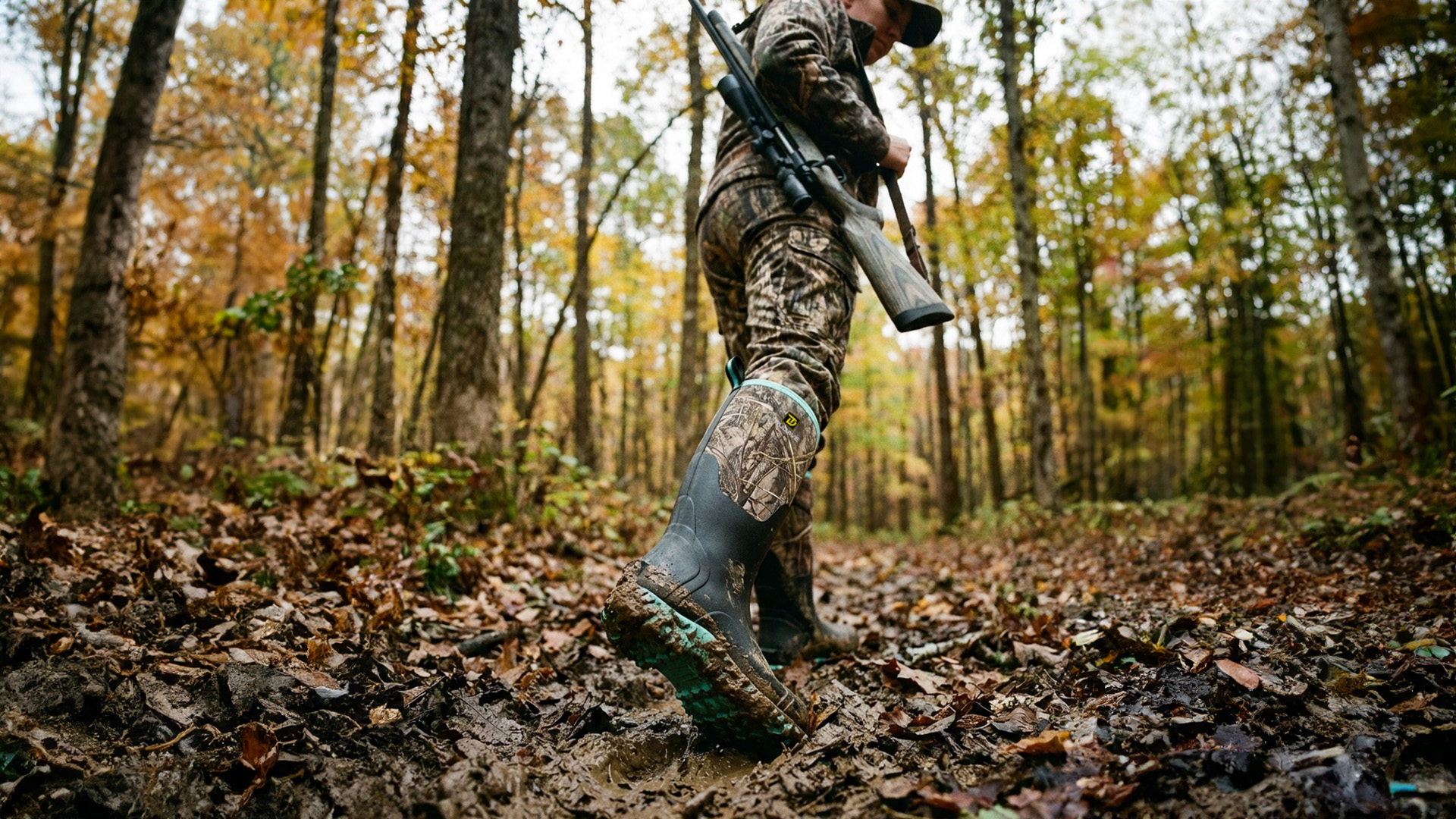
Bowhunting puts demands on hunting boots that rifle hunting never creates — scent control, silence, cold-stand thermal management, and draw-cycle stability. Here’s the complete Trudave boot guide for serious bowhunters in 2025.
Bowhunting is not a subset of deer hunting. It’s a completely different discipline.
The rifle hunter who harvests a deer at 120 yards from an elevated stand won’t understand why a bowhunter cares deeply about whether his boots creak on the ladder stand rungs at 5 a.m. — because the rifle hunter’s shots are taken from a distance that makes those micro-details irrelevant to success. The bowhunter who needs a mature buck within 25 yards, standing broadside, head-down on a scrape, on a calm morning with his scent profile under control — that hunter understands that every detail in the setup matters and that boots are not exempt from that scrutiny.
This guide is written for the bowhunter who takes the discipline seriously. We’ll break down the specific demands that archery hunting places on footwear — demands that are meaningfully different from rifle hunting and that most generic hunting boot content ignores — and map Trudave’s hunting boot lineup to each bowhunting scenario with the specificity that archery hunting deserves.
Five Ways Bowhunting Creates Boot Demands That Rifle Hunting Doesn’t
1. Scent Control Is an Operational Requirement, Not a Preference
A rifle hunter who harvests deer at 100 yards can succeed with adequate scent control — wind discipline and a basic spray routine get the job done for most shots at that distance because the animal’s primary assessment at 100 yards is visual, not olfactory.
A bowhunter needs an animal within 25 to 40 yards, often motionless, presenting a clean angle, for an extended period. At that distance, scent is the dominant threat detection mechanism for whitetail deer — and deer that scent-check a stand location from 40 yards and detect human odor will not step into shooting range.
Whitetail deer can detect human scent from up to half a mile away, making scent control one of the most important factors for hunters who rely on stealth to get close to their prey. Rubber boots provide an added advantage because they are naturally more scent-proof than leather or fabric boots — they prevent human odor from seeping through. Trudavegear
This scent management property of rubber construction is genuinely more important for bowhunters than for rifle hunters. The same physical property that makes rubber easy to rinse clean — its non-porous surface that doesn’t absorb compounds — means it doesn’t absorb and hold the environmental odors (fuel, food, household chemicals, pets) that leather boots accumulate between hunts and carry into the field.
For bowhunters specifically: rubber boots stored sealed and sprayed before each hunt carry dramatically less ambient odor to the field than leather boots that have been absorbing garage and vehicle odors for weeks between hunts. The ground scent trail a bowhunter leaves walking to a stand persists for hours and can alert deer approaching a setup from the entry trail direction. Reducing that trail’s scent intensity is part of the bowhunter’s standard operating procedure — and rubber boot construction is the starting point, not the endpoint, of foot-level scent management.
2. Stand Noise Is a Stand-Ending Issue, Not a Minor Inconvenience
A rifle hunter who bumps his boot on a ladder rung or shifts his weight on a metal platform with a boot squeak is mildly embarrassed. A bowhunter who does the same thing when a mature buck is at 45 yards and closing may end his hunt for that morning — or educate that buck to avoid the stand location for the remainder of the season.
Bowhunting stand work involves sounds at a proximity where deer can both hear and locate noise with precision. Boot-generated sounds on ladder stand rungs, tree step platforms, and wooden stand floors are the most common sources of stand noise that bowhunters report as hunt-ending in otherwise perfect situations.
The TrailGuard’s lightweight construction keeps every step silent and fluid. Designed for long sits and stealthy approaches, these waterproof insulated hunting boots let you move quietly and stay warm through hours in the wild. Kalkal
The boot properties that contribute to stand silence: neoprene upper flexibility (doesn’t make crackling sounds when bent on ladder rungs), rubber outsole grip on metal surfaces (prevents the slip-and-catch that creates sudden noise), and EVA midsole cushioning (dampens heel contact on wooden stand platforms).
3. Draw Cycle Stability — The Bowhunting-Specific Demand
Here’s a boot requirement that no deer hunting content ever addresses and that matters exclusively for bowhunters: the stability of your footing during the draw cycle.
Drawing a bow from a tree stand or a ground blind requires a specific body rotation — hips angling toward the target, upper body rotating to draw, weight shifting slightly through the draw. On an elevated platform, this weight shift means the foot inside the boot is creating lateral pressure against the boot’s torsional structure.
A boot that flexes excessively during this lateral load — a soft, flexible boot without torsional support — creates micro-instability during the draw that manifests as form inconsistency and can affect arrow placement even at ethical distances. The steel shank’s torsional rigidity prevents this lateral flex, keeping the foot platform stable during the draw cycle in ways that change the consistency of a bowhunter’s execution under pressure.
This sounds like a minor detail. Ask any bowhunter who has drawn on a shooter buck from a stand in heavy clothing and a cold morning how stable their footing felt during the draw — and the answer is often that footing stability was the last thing they were thinking about, which is exactly the point. Good boot construction handles this so the hunter’s attention stays on the shot.
4. Cold Stand Thermal Demands Are Extended, Not Abbreviated
The bowhunter’s cold tolerance requirement exceeds the rifle hunter’s by a meaningful margin in a specific way: the season.
Most rifle deer seasons run for 1 to 3 weeks in November or December. Archery deer seasons run for 2 to 5 months — September or October through January in most states — meaning bowhunters are in the field across the full cold arc of the hunting year. The September bowhunter needs a breathable, lightweight boot for warm early-season sits. The January bowhunter needs maximum insulation for the coldest mornings of the year.
This seasonal arc creates a boot selection challenge that rifle hunters almost never face: no single boot optimally covers September through January for an active bowhunter. Understanding this leads directly to the two-boot strategy that serious bowhunters should consider.
5. Ground Hunting and Stalking Create Different Demands Than Stand Hunting
More bowhunters are hunting from the ground — ground blinds, saddles, improvised setups — than ever before. Ground hunting creates boot requirements that elevated stand hunting doesn’t: the need for pattern-level concealment at ground contact (a deer’s eyes are at a level where boot pattern is visible), the absence of a fixed platform (you may be moving slightly to achieve the right shot angle), and the terrain-level contact with wet leaves, soft mud, and ground debris that a stand-elevated hunter doesn’t experience.
The Bowhunter’s Boot by Season
Early Season Bowhunting (September–October): The Warm-Weather Challenge
What it looks like: September opener. Air temperature at 5 a.m. is 62°F. You’re on stand by 6 a.m. Deer activity runs through the first two hours of light and picks up again before dark. You’ll be in the stand for a potential 10-hour sit if the action is right. Temperature climbs to 78°F by noon.
The boot demands for early season:
- Breathability above all — the most common early season bowhunting mistake is wearing late-season insulated boots that produce sweaty, swamp-foot conditions by 8 a.m.
- Waterproof for morning dew on the access walk — early season grass holds heavy dew that soaks non-waterproof footwear before the stand is reached
- Lightweight for the longer access walks that many September setups require — early season deer haven’t been pressured yet and are often deeper in than late-season stands
- Quiet construction for the stand approach and setup
The right Trudave boot: StreamTrek Series
Built with 5mm neoprene and a breathable airmesh lining, the StreamTrek is fully waterproof and ideal for deer, duck, and upland hunting across varied terrain. The moisture-wicking airmesh lining helps legs stay dry and comfortable during long days outdoors. nationalfisherman
The StreamTrek’s breathable airmesh lining is the key early season feature for bowhunters. September bowhunting generates body heat during the access walk that needs to escape during the stand sit — an unventilated boot traps this heat and creates the swamp-foot condition that makes a 10-hour early season sit genuinely miserable by mid-morning. The airmesh allows enough moisture escape to prevent heat accumulation while maintaining full waterproof protection.
Early season scent protocol with the StreamTrek: The rubber exterior doesn’t absorb environmental odors between hunts. Store in a sealed scent-control bag. Spray with quality scent eliminator before each hunt — the rubber surface responds well to scent elimination products, allowing a more complete odor reset between outings than leather alternatives.
Pre-Rut and Rut Bowhunting (October–November): The Prime Time Setup
What it looks like: October 28th. The scrapes are lit up. You’ve got a shooter buck on camera at 4 a.m. You’re in your stand before first light at 6:15 a.m., and you’re staying until dark at 6:45 p.m. Temperatures range from 28°F at dawn to 52°F by 2 p.m. You’ll make two stand transitions during the day — dropping to the ground at noon to move to an afternoon setup 400 yards away.
The boot demands for rut hunting:
- Thermal versatility across a 24°F temperature swing — adequate warmth at 28°F without overheating at 52°F during the midday move
- Scent management at maximum priority — the rut brings deer through unpredictably, and every hunt has potential for a mature buck to appear from any direction
- Transition capability — you’re climbing, sitting stationary, descending, walking 400 yards, and climbing again; the boot needs to handle all of these
- Steel shank stability for the tree stand draw cycle moments when a shooter buck appears
The right Trudave boot: WildGuard Series
The WildGuard’s 5mm neoprene insulation with breathable liner traps warmth without overheating, perfect for early morning or winter hunts in cold, wet conditions. The camo pattern helps you blend into natural surroundings. The cushioned EVA midsoles and arch support reduce fatigue on long treks. The tall neoprene upper provides flexibility and protection through brush and wetlands. Amazon
The WildGuard’s 5mm neoprene hits the thermal sweet spot for rut hunting — warm enough for the 28°F pre-dawn sit, not so heavily insulated that the midday transition at 52°F creates overheating. The camo construction matters during the midday move when you’re at ground level in daylight, and for any ground hunting scenarios that rut mobility requires.
The scent protocol for rut bowhunting: Rubber boots are naturally more scent-proof than leather or fabric boots — they prevent human odor from seeping through. Some rubber boots are treated with scent control technology to help minimize human odor and prevent detection by game. Trudavegear
Store WildGuard boots sealed in a dedicated scent-control bag between every hunt. Keep them outside the vehicle cab during transport — the cab accumulates fuel, food, and household odors that penetrate leather boot materials easily. Rubber construction resists this absorption significantly.
Late Season Bowhunting (December–January): The Cold Sit Challenge
What it looks like: January 8th. The late season lull has broken — deer are back on pattern to food sources. The thermometer at the barn read -6°F this morning. You’re sitting a ladder stand over a picked bean field that’s been drawing deer every evening. You’ve been on stand since 3 p.m. It’s 4:45 p.m., last light is at 5:15 p.m. You haven’t moved meaningfully in 90 minutes. Your feet need to be functional for the shot when it comes.
The boot demands for late season:
- Maximum thermal protection — -6°F stationary for 90 minutes is the most demanding boot thermal scenario in all of hunting
- Scent management maintained — pressured late-season deer are the most scent-alert of the year; a mature buck that has survived to January has specifically learned to connect human scent with danger
- Draw cycle stability at maximum insulation — heavily insulated boots can compromise ankle stability during the draw; the steel shank prevents this
- Full waterproofing for the snow and slush that accompany January late-season hunting
The right Trudave boot: TrailGuard Series
The TrailGuard uses a hybrid construction strategy designed for thermal regulation: the neoprene upper is constructed from premium, high-density neoprene — the same material used in deep-sea diving suits. It traps your body heat, creating a warm pocket of air around your legs while remaining flexible. Total waterproof sealing ensures cold often coming from wetness is blocked completely. Trudave Gear
Inside, a 6mm neoprene liner and breathable airmesh work with 800-gram insulation to retain warmth while wicking away moisture. A shock-absorbing EVA midsole and steel shank stabilize each step. Kalkal
The TrailGuard’s 800-gram insulation system combined with 6mm neoprene is the maximum thermal solution for late-season bowhunting. The steel shank’s stability specifically addresses the draw cycle concern — an 800-gram insulated boot without structural support can feel spongy during the lateral loading of a draw from an elevated stand.
Late season bowhunting thermal protocol:
- Heavyweight merino wool sock as the primary thermal layer inside the TrailGuard
- Chemical toe warmers for sits expected to exceed 90 minutes at temperatures below 10°F
- Insulated boot covers as an additional optional layer for the most extreme conditions
- The TrailGuard’s adjustable calf gusset accommodates the heavyweight base layer pants that late-season bowhunting demands
Ground Blind Bowhunting: The Concealment-Priority Scenario
What it looks like: You’ve set up a pop-up blind in a food plot edge to intercept a pressured mature buck that won’t approach a ladder stand. You’re hunting at ground level, in the blind, 18 yards from a primary scrape. Any light leak from the blind that illuminates boot detail could alert an approaching deer to your position. You need to be able to shift your feet silently in the blind floor to achieve the right shot angle.
The boot demands for ground blind hunting:
- Camo or dark construction — foot movement in a blind that admits light to boot level requires boot color/pattern that doesn’t create visual contrast
- Quiet movement on the blind floor — blind floors are typically soft but every noise from clothing and boot movement risks alarming a close deer
- Full scent management — ground level deer approach more common from nose-range distance in blind hunting than elevated stand hunting
The right Trudave boot: WildGuard Series (camo) or StreamTrek Series
Both the WildGuard’s woodland camo and the StreamTrek’s construction minimize the visual contrast of boot movement inside a ground blind. The WildGuard’s camo pattern specifically eliminates the bright color contrast that solid-color boots create against blind floor material when light enters the blind from a bottom gap.
Ground blind boot sound management: Wear rubber-soled boots on soft blind flooring rather than carpet-soled options — rubber’s natural slight tack on soft surfaces provides better positional stability during the quiet foot repositioning that shot setup in a blind requires.
The Bowhunter’s Two-Boot Strategy
Given the 4-month seasonal arc of archery deer hunting and the genuinely different demands of September versus January bowhunting, most serious bowhunters benefit from a two-boot rotation rather than a single all-season compromise:
Early and mid season (September–November, active temperatures): StreamTrek — 5mm neoprene, breathable airmesh, lightweight construction handles the warm-to-moderate temperature range and the active access mileage of early season bowhunting.
Late season (December–January, cold stationary sits): TrailGuard — 800-gram insulation, 6mm neoprene, maximum thermal for the cold stands that late season bowhunting demands.
The total cost of this two-boot rotation is typically less than a single premium leather bowhunting boot and provides meaningfully better seasonal performance than any single boot can deliver across the full archery calendar.
Scent Management Boot Protocol for Bowhunters: The Complete System
Boot scent management for bowhunters goes beyond simply owning rubber boots. Here is the complete protocol that serious bowhunters use:
Between hunts — storage: Store boots in a dedicated scent-control bag with carbon or activated charcoal panels. Keep the bag in a location away from fuel, food preparation, household cleaning products, and pets — the garage, vehicle cab, and mudroom are the worst storage locations because of their ambient chemical environment.
Pre-hunt — spray protocol: Spray the boot exterior and outsole with quality scent-elimination product 15 to 20 minutes before entering the field — not in the vehicle cab where spray compounds can linger and re-contaminate. Let the spray dry naturally on the boot surface before walking the access trail.
During access — ground scent minimization: Walk through vegetation rather than open bare ground when possible. Each vegetation contact with the boot surface removes accumulated surface compounds. Change access routes periodically to prevent building a consistent human scent corridor that deer learn to avoid.
Post-hunt — reset: Rinse boots with clean water, allow to fully dry, return to sealed storage. The rubber surface resets more completely than leather between hunts — each properly executed reset cycle reduces ambient scent accumulation across the season.
The rubber advantage quantified: Rubber is naturally better at containing human scent compared to fabric or leather boots, making it a great choice for hunters who need to avoid detection by game like deer. Trudavegear
FAQ
What’s the best Trudave hunting boot for early season bowhunting? The StreamTrek Series is the primary recommendation for September through October bowhunting. The breathable airmesh lining helps legs stay dry and comfortable during long days outdoors — the specific feature that prevents the early-season thermal overload that heavy insulated boots produce during warm-weather archery sits. nationalfisherman
Why do rubber boots matter more for bowhunting than for rifle hunting? Bowhunting’s 25-yard shooting distance requires that animals are fully unaware of the hunter’s presence — scent, sound, and visual — at close range. Rubber boots have a definite advantage for scent control because they prevent human odor from seeping through, which can help you avoid detection by deer. At bowhunting distances, the margin for scent detection is zero — a deer that scents a hunter at 35 yards will not provide a shot opportunity. Trudavegear
How does the steel shank help during archery hunting? The steel shank’s torsional stability maintains foot platform integrity during the draw cycle — the weight shift and body rotation required to draw a bow from an elevated or ground position. The steel shank stabilizes each step and provides underfoot support that prevents the boot from flexing unpredictably under the lateral loading of the draw. Kalkal
Is the TrailGuard warm enough for January bowhunting in the Midwest? The TrailGuard’s 6mm neoprene liner and 800-gram insulation package keeps feet warm in sub-freezing mornings without bulk. For January bowhunting in the Midwest in temperatures from -10°F to 20°F, the TrailGuard combined with heavyweight wool socks handles the stationary stand sits that late-season bowhunting demands. Kalkal
Should bowhunters choose camo or solid-color hunting boots? For elevated stand hunting where boots are above the deer’s primary visual field, the color difference matters less. For ground hunting — ground blinds, saddle hunting, spot-and-stalk — camo construction at boot level reduces one more visual cue. The WildGuard’s camo patterns are designed for the terrain types where ground-level concealment matters most.
Where can I buy Trudave hunting boots for bowhunting? Available at trudavegear.com/collections/hunting-boots with free shipping to the continental US and through Amazon.
Final Thoughts
Bowhunting rewards preparation more completely than any other hunting discipline. The margin for error at 25 yards is narrow — narrow enough that boot-generated scent, boot-generated noise, and boot-generated instability during the draw cycle are all variables worth addressing specifically, not as afterthoughts to a deer hunting boot recommendation written without archery in mind.
Trudave’s hunting boot lineup — StreamTrek for the early and mid-season archery hunter, WildGuard for the rut and ground hunting scenarios, TrailGuard for the late-season cold sit — covers the archery season’s full thermal and terrain arc with purpose-built construction rather than generic hunting boot recommendations.
The best shot you’ll ever take starts with the best setup you’ll ever make. Your boots are part of that setup.
Shop Trudave Hunting Boots → trudavegear.com/collections/hunting-boots
