
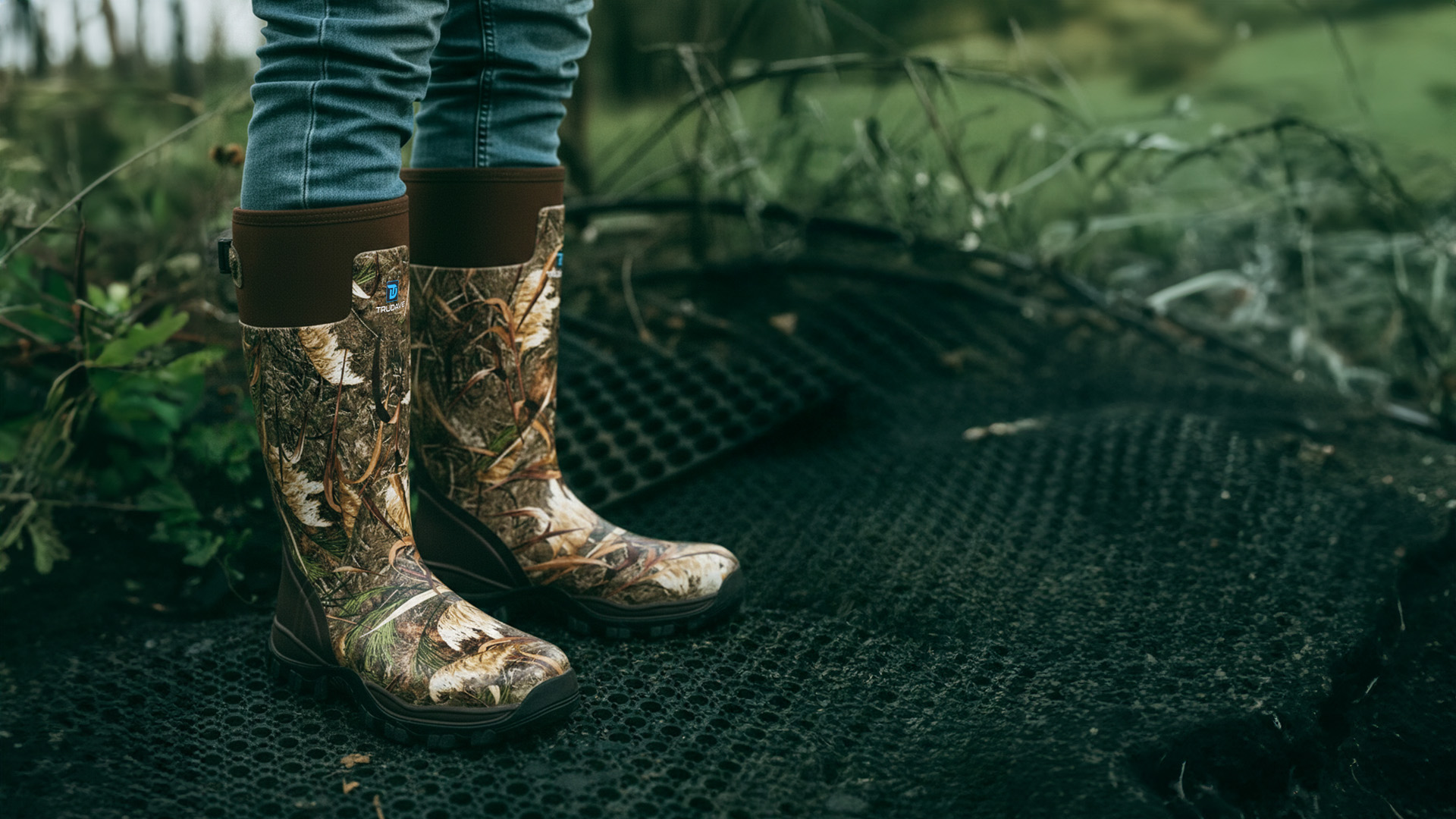
Western hunting — elk, mule deer, antelope, sage grouse — demands completely different boots than eastern whitetail. Here’s the complete Trudave guide for high-country and western terrain hunters in 2025.
Everything you know about hunting boots from whitetail season in the Midwest needs to be reconsidered for western hunting.
The terrain is different. The distances are different. The elevation is different. The physical demands on your footwear — and on you — are in a different category entirely from posting up in a stand over a food plot in Iowa or working a river bottom in Ohio.
Western hunting is a physical endeavor that separates hunters who prepared from hunters who didn’t. The guy who drove 1,200 miles to hunt Colorado elk only to discover that his Midwestern rubber hunting boots are completely inadequate for the talus slopes and steep timber country of Unit 54 has learned an expensive lesson. The guy who understood the terrain before he drove is the guy who fills his tag.
This guide is written for hunters planning western big game or upland hunts — elk, mule deer, pronghorn antelope, bighorn sheep, mountain goat, or the western upland birds like sage grouse and chukar — who need to understand what western terrain demands from hunting footwear and how Trudave’s lineup addresses those demands.
Why Western Hunting Is Different — And Why It Changes Boot Requirements Fundamentally
The Terrain Reality
Eastern and Midwestern whitetail hunting takes place on relatively flat to rolling terrain with elevation changes rarely exceeding a few hundred feet. The footing is typically predictable: forest floor, field edges, muddy creek banks. The challenges are moisture and cold, not unstable terrain and elevation.
Western hunting terrain is a different world:
Elevation gain. An elk hunt in Colorado’s Unit 54 or 61 may involve hiking from a trailhead at 9,000 feet to a hunting area at 11,500 feet — 2,500 feet of elevation gain over several miles. A mule deer hunt in the breaks of Montana involves repeated descents into and climbs out of steep coulees. Every thousand feet of elevation gain and loss multiplies the physical demand on your footwear, particularly ankle support and outsole stability.
Talus and scree. Rocky slopes with loose rock — talus and scree — are common in the high country that holds big elk and mountain mule deer. Walking on talus requires an outsole that grips irregularly shaped, sometimes unstable rock. The flexibility of pure rubber boot construction works against you on talus; you need enough outsole rigidity to allow confident footing on sharp, uneven rock.
Steep slopes. Sidehilling — traversing steep slopes rather than ascending or descending them directly — is a basic movement pattern for western hunters that most eastern hunters never encounter. It requires lateral ankle stability that ankle-height or soft-construction boots provide inadequately. The boot wants to collapse downhill; the hunter’s ankle fights it with every step.
High-altitude cold and unpredictable weather. High country weather in September through November is famously unpredictable. A warm morning can become a blizzard by afternoon at elevation. Boots that handle Midwestern September whitetail weather in the low 60s are inadequate for a 35°F afternoon on a windswept ridge at 10,500 feet after unexpected weather rolls in.
Distance. Pack-in elk hunts in wilderness areas commonly involve hiking 8 to 15 miles over multiple days to reach hunting areas. Even non-wilderness elk hunting in Colorado or Wyoming often involves 4 to 8-mile daily mileage across demanding terrain. The boot weight and fit quality that’s adequate for a quarter-mile whitetail stand walk becomes critically important at these distances.
What This Means for Boot Selection
These terrain and distance factors drive a set of boot requirements that differ fundamentally from whitetail boot requirements:
Ankle support. True lateral ankle support — the kind that prevents ankle rolls on talus, sidehills, and steep descents — requires a stiff-enough boot structure to resist ankle collapse. Fully flexible rubber hunting boots that are excellent for flat terrain are inadequate for technical western terrain.
Outsole rigidity and edge grip. An outsole that flexes easily with the foot is ideal for flat terrain. On steep slopes and rock, some outsole rigidity allows the sole to edge into the slope rather than folding with the foot. Vibram-style aggressive rubber with directional lug patterns was invented for exactly this terrain.
Weight matters more than anywhere else. The weight penalty of a heavy boot multiplies dramatically over 8-mile hunting days with elevation gain. A boot that’s half a pound heavier than necessary per foot — one pound per pair — translates into lifting an additional 2,000 pounds over the course of a day’s hunting. Boot weight is the variable that most whitetail hunters underestimate when planning their first western hunt.
Waterproofing for different conditions. Western high country precipitation comes in forms that Midwestern hunters rarely deal with: afternoon thunderstorms that soak you in minutes, early-season wet snow that’s gone by noon, stream crossings in alpine basins where the water is cold year-round, and morning hoarfrost on grass that soaks boots before the dew burns off.
Scenario 1: The Archery Elk Hunter (September, Active High-Country Pursuit)
What This Hunting Looks Like
September archery elk season in Colorado, Wyoming, New Mexico, or Montana is physically demanding hunting. You’re covering 5 to 10 miles daily at elevation, calling bulls, chasing bugles, and making precise, quiet movements through timber and open parks. Temperatures swing from 65°F midday to 28°F overnight. You’ll encounter wet grass from morning dew, occasional afternoon thunderstorms, creek crossings in alpine basins, and both timber and open terrain.
You’re moving too much and too far for a heavy, stiff mountain boot designed primarily for load carrying. But you need more support and outsole capability than a standard rubber hunting boot provides on the terrain you’ll encounter.
What This Demands
- Lightweight construction — 8-mile days at elevation reward every ounce of boot weight reduction
- Adequate ankle support for moderate western terrain — not as aggressive as a technical mountaineering boot, but substantially more than a rubber hunting boot
- Waterproof construction for morning dew, afternoon weather events, and creek crossings
- Outsole grip on varied terrain — packed trail, wet meadow, timber floor, loose rock
- Quiet movement — archery elk hunting requires silent footwork through dry timber
The Trudave Solution: StreamTrek Series With Considerations
For western archery elk hunting, the StreamTrek’s 5mm neoprene and rubber construction covers the waterproofing demands — morning dew, creek crossings, afternoon showers — without the thermal overload of heavily insulated boots during active September movement.
The multi-directional lug outsole handles the varied terrain of September elk country: packed trail, wet meadow, timber floor. The calf-height construction provides more support than ankle boots on moderate uneven terrain.
The honest western caveat: The StreamTrek is built primarily for flat to rolling hunting terrain. For the most technical high-country elk hunting — significant talus, steep sidehilling on loose rock, aggressive elevation change — a dedicated mountain hunting boot with a stiffer outsole construction is the appropriate tool. The StreamTrek covers the significant portion of elk hunting that takes place on moderate terrain, but hunters pursuing elk in the most technical alpine terrain should evaluate whether the StreamTrek’s flexible construction provides adequate support.
Where the StreamTrek shines for western hunting: Areas where elk are hunted in mixed timber and moderate terrain — the foothills of the Rockies, the ponderosa pine country of New Mexico and Arizona, the oak brush and sage country of western Colorado — are fully within the StreamTrek’s performance envelope. Not all western elk hunting is technical alpine; much of it is moderate terrain hunting where the StreamTrek’s combination of waterproofing, cold-weather capability, and light weight is exactly right.
Scenario 2: The Rifle Elk Hunter (October–November, Variable Conditions)
What This Hunting Looks Like
Rifle elk season in the Rockies runs October through November — conditions that range from warm, dry early October in the foothills to genuine early-winter snowfall and sub-freezing temperatures at elevation by November. You may be hunting from a truck-accessible area or packing into a wilderness unit on horseback or by foot. Terrain varies from moderate to challenging.
The October rifle hunter typically covers less daily distance than an archery hunter but hunts in colder conditions with more probability of snow and ice at elevation.
What This Demands
- Thermal protection for cold-condition October and November hunting — temperatures routinely below 30°F at elevation
- Waterproofing for snow — wet early-season snow and slush are the primary moisture challenges for late-season western hunting
- Stability on frozen ground and light snow — cold-hardened soil and snow-covered terrain require reliable outsole grip
- Adequate coverage for the elevation-driven cold that’s colder than what the air temperature alone suggests at any given time
The Trudave Solution: TrailGuard Series for Cold Rifle Elk Season
The TrailGuard’s 800g insulation system addresses the specific thermal challenge of rifle elk hunting in late October and November at elevation. At 10,000 feet in late October, air temperatures that read 32°F on the forecast feel significantly colder due to wind and elevation factors. Stationary glass-and-stalk elk hunting — the glassing hours that precede movement — subjects hunters to the same sustained-cold challenge as whitetail stand hunting.
The fully sealed waterproof construction handles wet snow and light slush from morning travel across snow-covered terrain. The multi-directional outsole maintains grip on the frozen-ground-to-mud-to-gravel terrain transitions common in mountain elk hunting areas.
TrailGuard for western hunting consideration: Like the StreamTrek, the TrailGuard’s rubber-and-neoprene construction is optimized for flat to moderate terrain. For technical rocky descents and steep sidehilling, the TrailGuard’s flexible rubber sole provides less edge grip than a stiff-soled mountain hunting boot. For the moderate-terrain majority of Rocky Mountain rifle elk hunting — road-accessible hunting, moderate pack-in hunts, glassing ridge hunts — the TrailGuard’s thermal protection and waterproofing are the right specification.
Scenario 3: The Mule Deer Hunter (October–December, Canyon and Break Country)
What This Hunting Looks Like
Mule deer hunting in the breaks of eastern Montana, the canyon country of Colorado and Utah, the sagebrush hills of Wyoming, or the rimrock terrain of the Pacific Northwest involves a specific set of terrain challenges: steep descents into drainages, loose shale and rimrock, wind-exposed ridge terrain, and the repeated climb-and-descend cycle of coulee and canyon country.
Mule deer are not hunted like whitetail. They’re spotted at distance, then you move to intercept. That movement frequently involves steep terrain, loose footing, and the kind of aggressive downhill travel that destroys boot soles and tests ankle stability. November mule deer hunting in Wyoming can involve true cold — sub-zero mornings, all-day wind, and the kind of exposure that makes thermal protection a survival consideration, not just a comfort one.
What This Demands
- Ankle stability on steep and loose terrain — mule deer hunting involves more aggressive terrain than any whitetail scenario
- Cold protection for November and December in exposed plains and canyon country
- Durability on rock and shale — rimrock mule deer hunting tears outsoles faster than any other hunting terrain
- Adequate coverage height for crossing the irrigation ditches and seasonal creek crossings of western ranch country
The Trudave Solution: WildGuard for Moderate Terrain / TrailGuard for Cold Country
For the mule deer hunter in moderate terrain — sagebrush hills, mixed grass and timber, moderate canyon edges — the WildGuard’s combination of camo concealment (mule deer country is open, and ground-level visibility matters), steel shank stability, and all-season waterproof construction covers the primary demands.
The TrailGuard’s heavier insulation is the choice for late-season November and December mule deer hunting in the northern Rockies and plains where cold is the dominant challenge. Wyoming December mule deer hunting involves wind and cold that punishes under-insulated footwear in ways that make the TrailGuard’s 800g system genuinely necessary rather than excessive.
Scenario 4: The Pronghorn Antelope Hunter (August–September, Open Country)
What This Hunting Looks Like
Pronghorn antelope season opens in August and September in most western states — the hottest, driest hunting conditions of the year. Open grassland, sagebrush flats, and the occasional creek drainage are the terrain. You’re spot-and-stalk hunting in 85°F to 95°F temperatures, covering miles of flat to rolling terrain in full sun, with minimal precipitation concerns but maximum heat management demands.
Pronghorn hunting is the western hunting scenario most similar to upland hunting in thermal demands — active movement in warm conditions where heat management is the dominant comfort challenge.
What This Demands
- Lightweight and breathable — August heat and miles of active movement penalize heavy, insulated boots severely
- Adequate waterproofing for the occasional creek crossing and morning dew exposure
- Flat terrain outsole — antelope country is not technical terrain; grip requirements are minimal compared to high-country hunting
The Trudave Solution: StreamTrek in Warm Configuration
The StreamTrek’s 5mm neoprene with breathable airmesh lining is the lightest and most breathable option in Trudave’s hunting boot lineup — appropriate for the warm, active conditions of August and September antelope hunting. Paired with a lightweight merino wool sock that manages moisture without adding thermal mass, the StreamTrek handles the thermal demands of hot-weather western hunting without the insulation that becomes oppressive in August temperatures.
Scenario 5: The Western Upland Hunter — Chukar, Sage Grouse, and Hungarian Partridge
What This Hunting Looks Like
Chukar hunting in the rimrock canyons of Idaho, Oregon, and Washington is legendary for its physical demands — and legendary for destroying unprepared hunters and their gear. Chukars live on the steepest, most exposed, rockiest terrain accessible by a bird hunter. A serious chukar day involves 2,000 to 3,000 feet of elevation change, loose shale and basalt rock faces, October cold in the canyon bottoms, and the terrain of a technical scramble done at hunting pace.
Sage grouse hunting in Wyoming and Montana is the opposite end of the western upland spectrum — flat to rolling sagebrush terrain at high elevation, cold September mornings, and walking miles between flushes. Hungarian partridge in the wheat stubble of eastern Montana and the Dakotas involves long mileage on flat terrain in variable conditions.
What This Demands (by species)
Chukar: The most demanding western upland situation — ankle stability on steep rocky terrain, outsole grip on loose shale, waterproofing for cold canyon morning conditions, durability against rock abrasion. The StreamTrek covers the waterproofing; the terrain demands are at the aggressive edge of what flexible rubber construction handles adequately.
Sage grouse: Cold-morning thermal protection for high-altitude September hunting, waterproofing for wet morning sagebrush, adequate walking comfort for long-mileage open-country hunting. StreamTrek or WildGuard.
Hungarian partridge: Similar to pheasant hunting terrain demands — cold shoulder-season conditions, long mileage on flat agricultural terrain. StreamTrek or TrailGuard depending on temperature conditions.
Western Boot Care: Conditions That Are Harder on Gear
Western hunting terrain imposes specific maintenance demands:
Rock abrasion on outsoles. Rocky western terrain wears outsole lugs faster than soft terrain. Check outsole depth at mid-season — hunters who cover 50+ miles of rocky terrain in a single elk season will see more outsole wear than a full whitetail season of flat-terrain hunting.
Altitude and UV. Higher elevation UV intensity is meaningfully greater than sea level — the same sun exposure at 10,000 feet degrades rubber faster than at 1,000 feet. Store boots away from direct sunlight during western hunting trips, including during midday breaks.
Dust and dry-dirt cleaning. Western hunting terrain produces dry dust and clay that packs into outsole channels differently from eastern mud. Dry debris requires a boot brush rather than a rinse to clear — establish a brush-out routine after each dry-terrain hunt day.
Temperature swing cycling. Western high-country temperatures swing dramatically between day and night — 30°F overnight to 70°F midday in September is common. This thermal cycling accelerates rubber material stress more than sustained cold or sustained heat. Full drying and room-temperature storage between hunting days extends boot life in western conditions.
The Western Hunter’s Boot Selection Summary
| Western Hunt | Season | Primary Challenge | Recommended Boot |
|---|---|---|---|
| Archery elk (moderate terrain) | September | Active movement + wet | StreamTrek |
| Archery elk (technical alpine) | September | Terrain + distance | Consider dedicated mountain boot |
| Rifle elk (moderate) | October | Wet snow + cold | TrailGuard |
| Rifle elk (cold late season) | November | Deep cold + snow | TrailGuard |
| Mule deer (moderate) | October | Varied terrain + cold | WildGuard |
| Mule deer (cold north) | November–December | Extreme cold | TrailGuard |
| Pronghorn antelope | August–September | Heat + active mileage | StreamTrek (light socks) |
| Chukar (technical) | October–November | Rocky terrain + cold | StreamTrek + consider ankle support |
| Sage grouse | September–October | Cold mornings + mileage | StreamTrek or WildGuard |
| Hungarian partridge | October–November | Cold shoulder season | StreamTrek or TrailGuard |
FAQ
Can I use Trudave hunting boots for elk hunting? Yes — the StreamTrek and WildGuard cover the majority of elk hunting terrain in the Rockies, particularly for moderate terrain hunting in the foothills and mixed timber country where most elk hunting takes place. For technical alpine terrain with significant talus and steep sidehilling, evaluate whether a stiffer-soled mountain hunting boot provides better edge grip on loose rock.
What’s the best Trudave boot for mule deer hunting in Wyoming? The WildGuard for October mule deer in moderate terrain, and the TrailGuard for late-season November and December hunting when Wyoming cold becomes the dominant boot challenge. Both provide the waterproof construction that snow, frost, and creek crossings in western mule deer country require.
Are rubber hunting boots adequate for western hunting? For the majority of western hunting that takes place on moderate terrain — the foothills, mixed timber, and sagebrush country where most elk, mule deer, and upland birds are actually hunted — rubber-and-neoprene hunting boot construction is fully adequate. For the most technical alpine terrain — sustained talus scrambles, very steep sidehilling on loose rock — a stiff-soled mountain boot provides better edge grip. Know your specific terrain before deciding.
What boot should I bring for an archery elk hunt in New Mexico? New Mexico archery elk hunting in September involves warm temperatures, mixed timber and open terrain, and the active pursuit that archery hunting demands. The StreamTrek’s 5mm neoprene and breathable airmesh lining handles the waterproofing requirements without overheating during active movement — the right specification for New Mexico September conditions.
How do Trudave hunting boots handle high-altitude cold? High altitude cold is more intense than sea-level cold at the same air temperature due to wind exposure and the body heat demands of uphill hiking. The TrailGuard’s 800g insulation system is the most capable Trudave boot for cold high-altitude conditions — appropriate for late-season rifle elk and mule deer hunting at elevation where temperatures drop significantly.
Where can I buy Trudave hunting boots for western hunting? Available at trudavegear.com/collections/hunting-boots with free shipping to the continental US and through Amazon.
Final Thoughts
Western hunting is a different world from the whitetail stands and river bottoms that define hunting for most of the country. The terrain is bigger, the distances are longer, the elevation is real, and the consequences of under-prepared gear show up faster and more severely than they do in the predictable, flat country of the Midwest and South.
Trudave’s hunting boot lineup — StreamTrek for active moderate-terrain western hunting, WildGuard for all-season versatility, TrailGuard for cold late-season western conditions — covers the realistic range of what most western hunters face on the ground. Know your specific terrain, know your temperature range, and match your boot to both.
The western mountain doesn’t care what gear you brought. Go prepared.
Shop Trudave Gear Hunting Boots → trudavegear.com/collections/hunting-boots
