
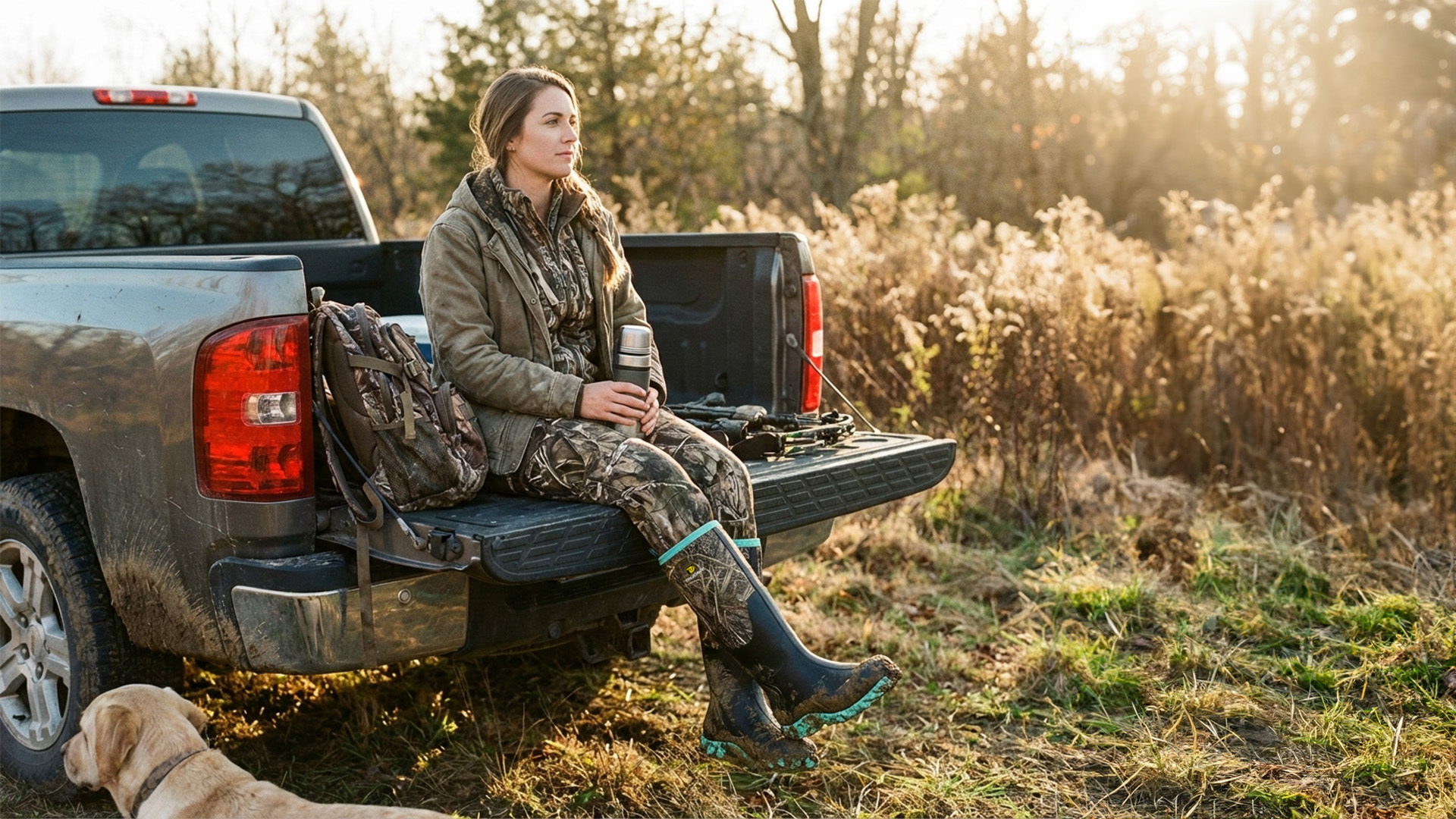
Public land hunters and private land hunters face completely different boot demands. Here’s the definitive Trudave boot guide organized around where you hunt — not what you hunt or what season it is.
Most hunting boot content is organized around what you’re hunting or when you’re hunting. Deer boots. Duck boots. Late-season boots. Early season boots.
That framework is useful — but it misses one of the most important variables in hunting boot selection: where you hunt.
Public land hunting and private land hunting place genuinely different demands on your footwear. The distance from truck to stand, the terrain pressure and hunting intensity, the importance of scent management, the durability requirements of high-frequency use — all of these variables change significantly depending on whether you’re hunting ground you own or lease versus competing for space on a national forest, state wildlife management area, or walk-in access program land.
Understanding this distinction changes boot recommendations in real ways. The boot that perfectly serves a private land hunter with a 200-yard walk to a maintained stand is not the best boot for a public land hunter covering three miles of mixed terrain to find an unpressured drainage on opening weekend.
This guide organizes hunting boot selection around hunting access type rather than species or season — a framework that fills a gap in the conversation and gives you better guidance on which Trudave boot fits your actual hunting reality.
The Public Land Hunter’s Boot Demands
What Public Land Hunting Actually Involves
Public land hunting in America has a character that private land hunting rarely matches: pressure, distance, and variety.
Distance. The hunters who find unpressured public land deer, consistent turkey populations, and productive pheasant are almost always the hunters willing to walk farther than most. The accessible areas — the first quarter mile from parking areas, the easy-access fields, the popular food plot areas in managed WMAs — are the most heavily hunted. The productive ground is typically a mile, two miles, or more from the trailhead.
A recent survey of successful public land whitetail hunters found that the average distance from vehicle to stand location on public ground was 1.8 miles — more than three times the average private land equivalent. That distance difference changes every boot specification that matters.
Terrain variety. Public land doesn’t come with maintained access paths. You’re navigating whatever the terrain offers: creek crossings, blowdowns, steep ridges, marshy bottoms, agricultural edges, and dense timber. The terrain shifts constantly in ways that private land with established access routes doesn’t.
Pressure management. On pressured public land, every boot-related decision has a scent management component. The trail you leave to your stand persists for hours. Other hunters moving through the same areas push deer into sensitized patterns. The difference between rubber construction and leather construction in terms of scent absorption is a real, measurable factor on high-pressure public ground.
Use intensity. Serious public land hunters often hunt 40 to 60+ days per season across multiple species and seasons. The durability demands on a boot used at this frequency are meaningfully higher than those on a boot used 15 to 20 days per season.
What Public Land Hunting Needs From a Boot
1. Durability for high-frequency use. A boot used 60 days per year needs to hold up to three to four times the stress that a 15-day-per-year boot faces in the same calendar span. Construction quality, outsole compound durability, and material resilience all matter more for the public land hunter than the occasional private land hunter.
2. Long-walk comfort. A boot that feels fine at 200 yards becomes a problem at two miles. Cushioning, arch support, ankle stability, and overall weight all affect how your feet feel after an hour and a half of walking to a stand location — and how effectively you can hunt when you arrive.
3. Scent management construction. Rubber and neoprene construction doesn’t absorb and hold human scent the way leather does. For high-pressure public land where every scent cue matters, rubber hunting boots provide a natural advantage over leather or fabric-faced alternatives.
4. Terrain-versatile outsole. Public land terrain requires an outsole that works on soft mud, wet leaves, creek rock, frozen ground, and hardwood forest floor without being optimized too heavily for any single surface. Multi-directional lug patterns with appropriate lug depth handle this variety better than specialized single-surface outsoles.
5. Weather resilience. Public land hunters don’t have the option of waiting for perfect conditions — the season is finite, the pressure requires early and consistent presence, and the hunting day happens regardless of what the weather does.
The Trudave Boot for Public Land Hunting
Primary recommendation: StreamTrek Series
The StreamTrek’s combination of specifications makes it the strongest public land hunting boot in Trudave’s lineup:
The 5mm neoprene shaft with breathable airmesh lining handles the moisture management challenge of long access walks — keeping feet dry from the inside during the perspiration-generating walk-in, then transitioning to the thermal protection needed once you’re stationary at your stand location. The adjustable calf buckle with gusset accommodates the full range of cold-weather layering without requiring a boot change between early October and late December. The multi-directional lug outsole handles the terrain variety of public land without optimizing for a single surface.
Critically for scent management, the rubber-and-neoprene exterior doesn’t accumulate and hold human scent through the off-season storage that leather boots do. A rubber boot stored sealed and sprayed before each use carries meaningfully less ground-level scent than leather alternatives — a real advantage on pressured public land where deer have learned to associate human scent with danger at trace concentrations.
For durability at public land use intensity — 40 to 60 days per season — the rubber-and-neoprene construction holds up through this frequency without the seam failures and outsole delamination that cheaper boots show under sustained use.
Cold public land hunting: TrailGuard Series
For public land hunting in November and December when temperatures consistently drop below 20°F, the TrailGuard’s 800g insulation system provides the thermal protection needed for stationary stand sits on cold ground after a long, heat-generating access walk. The transition from active-movement-warm to stationary-cold is most severe for public land hunters who have been moving fast to cover distance and then stop completely in the stand — the TrailGuard handles both ends of this thermal swing better than lighter insulation options.
Wet terrain public land: TrailMist Series
For public land hunting that requires sustained wet terrain access — the creek bottom properties, flooded WMA timber, swamp-edge whitetail ground — the TrailMist’s 6mm neoprene and one-piece rubber lower provide the durability and waterproof reliability that public land’s lack of access path maintenance demands. Perfect for farm chores, muddy trails, or early season bow hunting. Easy to kick off with the heel ledge and completely bombproof against briars. Trudavegear
The Private Land Hunter’s Boot Demands
What Private Land Hunting Actually Involves
Private land hunting — owned property, long-term leases, or established access agreements — has a different character from public land in almost every relevant dimension.
Distance. Private land stands are typically closer to vehicle access than public land locations. Established food plots, stands in regular use, and maintained access paths reduce the walk-in distance substantially. The average private land stand access is under half a mile in most operations.
Known terrain. You’ve walked your private property hundreds of times. You know where the creek crossings are, where the mud gets deep in wet weather, where the frost stays longest on the north-facing slopes. This knowledge changes boot selection because you’re not navigating unknown terrain — you’re equipping for the specific challenges your property presents.
Comfort over distance. With shorter access distances, the long-walk comfort factors that dominate public land boot selection matter less. The boot that’s great for 200 yards to a ladder stand doesn’t need to perform at mile two the way a public land boot does.
Lower pressure, higher pattern predictability. Private land deer patterns are more predictable because hunting pressure is controlled. The scent management urgency of public land is still real — whitetail noses don’t care whose name is on the deed — but the differential between rubber and leather construction matters less when hunting pressure isn’t activating maximum deer alertness consistently.
Stand types matter more. Private land hunters often have specific stand infrastructure — ladder stands, box blinds, elevated platforms — that create specific boot requirements around climbing safety, comfort during extended sits, and the transition from vehicle to blind in controlled conditions.
What Private Land Hunting Needs From a Boot
1. Comfort for the sit, not just the walk. The private land hunter’s boot challenge is comfort during a three to five hour stationary wait, not comfort during a two-mile access hike. Cushioning, insulation quality, and thermal management during stationary periods matter more than trail performance.
2. Terrain-specific performance. You know your property. If it’s predominantly dry hardwood ridge, you need a different boot than if it’s creek bottom swamp. Private land knowledge allows more specialized boot selection than public land’s terrain variety demands.
3. Stand safety features. Ladder stand climbing and tree step use require specific outsole qualities — grip on metal rungs, torsional support through the sole, and ankle stability on narrow footholds. The steel shank in some Trudave models is specifically relevant here.
4. Property-matched insulation. Private land hunters who know their terrain know their weather exposure. A box blind hunter who’s enclosed during the sit needs different insulation than an open platform hunter exposed to wind from the same temperature.
Trudave Boot Recommendations by Private Land Scenario
The classic whitetail private land stand hunter: WildGuard Series
The WildGuard Series men’s tall waterproof camo hunting boots feature a rugged, one-piece rubber shell that wraps the foot and shaft for full waterproof protection and abrasion resistance. Inside, a ~6mm thermal lining with breathable mesh locks in warmth without trapping moisture. An adjustable calf strap fine-tunes the fit and seals out water. Underfoot, a ~10mm multi-directional lug outsole grips wet mud, slick rock, and light snow. Tactical Gear
For private land stand hunters with moderate access distances and typical whitetail terrain, the WildGuard provides the all-season versatility, camo concealment for ground-level hunting situations, and waterproof reliability that covers the full season arc from September to January. The steel shank provides the stand step and ladder rung stability that matters for hunters regularly using elevated fixed infrastructure on known property.
The private land cold-weather stand specialist: TrailGuard Series
For private land hunters whose primary setup is an elevated stand in late season conditions — the December 9°F morning when the cold front pushed in overnight — the TrailGuard’s 800g insulation system is the specific tool for extended stationary thermal protection. Private land hunters can optimize for this scenario because they know their stand locations and can plan boot selection around specific setups rather than the terrain variety that public land demands.
The private land swamp and creek bottom hunter: TrailMist Series
Private land hunters whose property centers on creek bottoms, flooded timber, or wetland-adjacent ground deal with a defined mud and water challenge — and the TrailMist’s 6mm neoprene and trail-style mud-shedding outsole is the most capable tool in Trudave’s lineup for sustained wet terrain hunting on ground you know and return to consistently.
The private land turkey and upland hunter: StreamTrek or HuntGuard
Spring turkey on private land involves a defined set of terrain — you know your timber stands, your field edges, your gobbler roosting areas. For active spring turkey work on private land, the StreamTrek’s balance of waterproofing and mobility covers typical private land turkey terrain well. The HuntGuard’s ankle-height construction is the alternative for private land hunters who run-and-gun actively and prioritize ankle mobility over calf-height coverage.
The Decision Matrix: Public vs. Private Land Boot Selection
| Factor | Public Land Priority | Private Land Priority |
|---|---|---|
| Walk distance | High — boots must perform at 2+ miles | Low — short access typically |
| Terrain variety | High — unknown, changing terrain | Low — known, consistent terrain |
| Scent management | Critical — rubber construction strongly preferred | Important — still matters |
| Durability | High — 40–60+ days/season | Moderate — 15–30 days/season |
| Thermal priority | Active warmth + transition management | Stationary warmth for sit |
| Primary recommendation | StreamTrek (most conditions) | WildGuard (general) |
| Cold conditions | TrailGuard | TrailGuard |
| Wet terrain | TrailMist | TrailMist |
| Active/upland | StreamTrek, HuntGuard | StreamTrek, HuntGuard |
Special Case: The Hunter Who Does Both
Many serious hunters split their season between public and private land — private land in the early season when access is easier to manage, public land during the peak rut when pressure on private land becomes a factor, private land again for late season in cold weather.
For this hunter, a two-boot rotation makes more sense than trying to find one boot that optimally covers both:
Private land early season (September–October): WildGuard — camo concealment, all-season thermal versatility, private land terrain coverage.
Public land rut (November): StreamTrek — long-walk comfort, rubber scent management, terrain versatility for public land navigation.
Late season (December–January, private land cold sits): TrailGuard — maximum insulation for the stationary late-season sits on private property where access distance is manageable.
This three-boot strategy costs less than two premium-brand boots and provides genuinely optimized footwear for each phase of the season. The total investment in a StreamTrek, WildGuard, and TrailGuard covers every hunting scenario across both land types throughout the full season arc.
Scent Management by Boot Type: The Public Land Edge
For public land hunters specifically, the scent management advantage of rubber-and-neoprene construction deserves explicit attention:
Rubber doesn’t store scent the way leather does. Human scent compounds — the volatile organic compounds that deer detect — absorb into porous materials and off-gas over time. Leather hunting boots that have been stored in a garage absorb ambient odors (fuel, dog, food, synthetic chemicals) and carry them into the field for hours after you’ve sprayed the exterior. Rubber boots, properly stored and sprayed, provide a much cleaner scent profile.
The ground scent trail matters on pressured ground. On high-pressure public land, mature deer have learned to associate human foot scent trails with danger — not just the hunter’s presence at a stand, but the trail leading to the stand. Rubber construction reduces the scent loading of each boot contact with the ground. Combined with spray-down before each hunt and sealed storage between outings, rubber hunting boots provide the most effective foot-level scent management available without resorting to chemical foot powder systems.
Practical scent protocol for public land hunters: Store boots sealed in a scent-control bag between every outing. Keep them out of the garage, away from fuel, away from food prep areas. Spray thoroughly with quality scent eliminator before entering the field — the rubber exterior responds to scent elimination products more effectively than leather because the compounds don’t penetrate the surface. Walk through tall grass during the last portion of the approach when possible, allowing vegetation contact to remove residual scent from the outsole.
FAQ
What’s the best Trudave boot for public land deer hunting? The StreamTrek Series is the primary public land hunting boot recommendation — 5mm neoprene provides cold protection without overheating during long walks, the breathable airmesh manages perspiration during the access hike, the multi-directional outsole handles varied terrain, and rubber construction provides the scent management advantage that pressured public land demands.
Do I need different boots for public and private land hunting? Not necessarily — the StreamTrek covers both reasonably well. But if you hunt extensively on both, a two-boot approach (StreamTrek for public land, WildGuard or TrailGuard for private land depending on conditions) provides meaningfully better seasonal performance for each situation.
How does rubber boot construction help with scent control on public land? Rubber doesn’t absorb and hold human scent compounds the way leather and fabric materials do. Properly stored and sprayed rubber hunting boots carry less ambient odor into the field and deposit less scent on the ground trail to your stand — a genuine advantage on pressured public land where deer have learned to associate human foot scent with danger.
What’s the best Trudave boot for long-distance public land stand access? The StreamTrek, with its breathable airmesh lining, flexible neoprene construction, and multi-directional outsole for terrain variety, provides the best balance of long-walk comfort and field performance in Trudave’s hunting lineup. The cushioned footbed reduces fatigue over the 1.5 to 3-mile walk-ins that productive public land hunting often requires.
Should private land hunters prioritize the same features as public land hunters? No. Private land hunters can optimize more specifically — prioritizing stationary comfort and insulation for stand hunting rather than long-walk performance, selecting terrain-specific boots based on known property characteristics, and choosing insulation levels matched to their specific stand setup (open platform vs. enclosed box blind) rather than the full terrain variety of public land.
Where can I buy Trudave hunting boots? Available at trudavegear.com/collections/hunting-boots with free shipping to the continental US and through Amazon.
Final Thoughts
Where you hunt matters as much as what you hunt or when you hunt when it comes to boot selection — and it’s the variable that gets addressed least often in hunting boot content.
Public land hunters need boots built for long distances, terrain variety, high-frequency use, and the scent management pressures of hunting heavily competed ground. Private land hunters can optimize more specifically for the known terrain, predictable access distances, and stand-specific comfort requirements of hunting ground they know intimately.
Trudave Gear’s hunting boot lineup — StreamTrek for public land versatility, WildGuard for private land all-season use, TrailGuard for extreme cold, TrailMist for wet and muddy terrain — covers both sides of this equation.
Know where you hunt. Choose the boot that fits that ground. Then hunt it harder than anyone else is willing to.
Shop Trudave Gear Hunting Boots → trudavegear.com/collections/hunting-boots
