
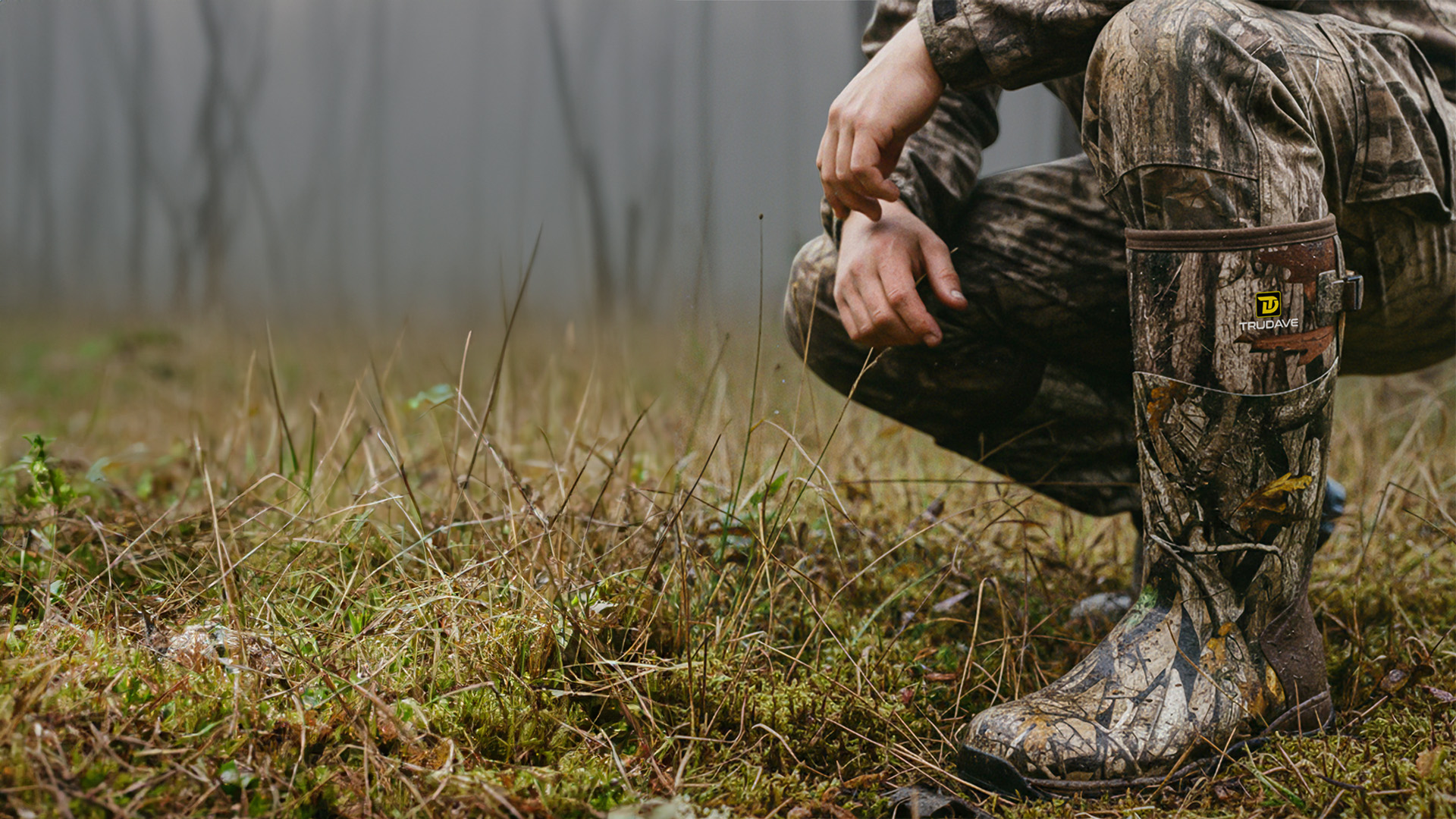
Meta Description: Wrong boots have ended more good hunts than bad weather ever will. Here’s a hunter-by-hunter breakdown of the most common footwear mistakes — and exactly which Trudave boot solves each one.
Every experienced hunter has a boot story that ends badly.
The guy who wore his deer boots on a long walk-in and had soaked, blistered feet before he ever climbed his stand. The guy who wore last year’s boots into a swamp and found out mid-creek that the waterproofing had failed. The guy who wore uninsulated boots on a cold November sit because “it won’t be that bad” and cut his best hunt of the season short after ninety minutes because he couldn’t feel his toes anymore.
These aren’t bad luck stories. They’re wrong-boot stories. And wrong-boot problems are preventable.
This guide is organized around the specific hunting styles and mistakes that cost hunters the most — not generic advice about waterproofing and traction, but the real decisions that go wrong in the field. For each scenario, we’ll identify the problem, explain what it actually costs you, and show you exactly which Trudave Gear boot addresses it.
Mistake #1: Using the Same Boot for Every Hunt All Season
The Hunt It Ruins
Early September, 58 degrees, you’re bowhunting a food source edge from a ground blind. You pull on your late-season deer boots — 800g insulation, rubber construction — because they’re what you wore all last season. You’re sweating through your baselayer before you’re out of the parking area. Your feet are soaked in sweat by the time you reach the blind. The thermoregulation you lost before the hunt even started has your body temperature fluctuating all evening, you’re fidgeting, and the doe you were hoping to arrow smells you at 40 yards.
Why It Happens
Hunters treat hunting boots like they treat hunting licenses: one per season, covers everything. The reality is that early season hunting in 55–65°F temperatures and late season hunting at 15°F are as different as running shoes and ski boots in the demands they place on footwear.
What It Actually Costs You
Sweat-soaked feet in warm conditions create two problems simultaneously: they cool you down when you stop moving (evaporative cooling makes you colder than ambient temperature), and they create enough discomfort and fidgeting that your movement discipline breaks down in the stand or blind. Deer detect movement. Sweat-driven discomfort causes movement. The math is direct.
The Trudave Fix
StreamTrek Series for early and shoulder season (September–October). The StreamTrek’s breathable waterproof membrane construction and 6mm neoprene shaft with airmesh lining handles the temperature range and activity level of early season hunting — light insulation, genuine waterproofing for morning dew and rain, and enough breathability to survive the walk-in without turning your feet into a swamp before you’re settled.
TrailGuard Series for late season (November–January). When temperatures drop into the teens and twenties and you’re sitting stationary for three to four hours in a stand, the TrailGuard’s 800g insulation system takes over. This isn’t the same boot — and it shouldn’t be.
The two-boot strategy pays for itself in one recovered hunt. A missed early season buck because your boots were too hot, or a cut-short late season sit because your feet were too cold, costs you more than the price difference between owning one boot and owning two.
Mistake #2: Ignoring Scent Control from the Ground Up
The Hunt It Ruins
You do everything right above the waist: Scent-Lok jacket, sprayed-down face mask, wind-checked your entry three times. You walk into your stand with leather lace-up boots that have been sitting in your garage since last season, absorbing every ambient odor in a twelve-month span — gasoline, dog, lawn fertilizer, whatever the garage floor has accumulated. You’re 80 yards from your stand when a mature doe throws her head up, stares hard at your track, and ghosts into the timber. She didn’t see you. She smelled where you’d been.
Why It Happens
Hunters spend disproportionate attention on upper-body scent control and underinvest in footwear scent management. Leather and fabric boots are scent sponges — they absorb ambient odors and hold them through repeated use. The trail you leave walking to your stand is as important as the scent you’re emitting from your position.
What It Actually Costs You
Mature deer in pressured areas have learned to associate human foot scent with danger. In high-pressure public land environments or areas that receive heavy hunting pressure early in the season, even a minimally contaminated boot trail can push deer out of an area entirely — not just for the day, but for days afterward as the ground scent persists.
The Trudave Fix
WildGuard Series (rubber construction, naturally scent-resistant). Rubber boots are the single most effective footwear solution for scent management in deer hunting. Rubber doesn’t absorb and hold odors the way leather or synthetic fabric does — a rubber boot surface can be sprayed clean with a quality scent eliminator and genuinely cleared of ambient odors between hunts. The WildGuard’s one-piece rubber shell construction means there’s no leather or fabric component in the lower boot to absorb and hold ground-level odors.
TrailGuard Series (same rubber exterior). The TrailGuard’s sealed rubber shell provides the same scent-management advantage as the WildGuard for stand hunters who prioritize thermal protection.
Practical scent protocol for Trudave rubber hunting boots: Store boots in a sealed bag or container between hunts — out of the garage, away from fuel odors, away from food and pet odors. Spray with a quality scent eliminator before each hunt, focusing on the boot exterior and outsole. The rubber surface responds to scent elimination sprays in ways that leather and fabric don’t, allowing a more complete scent reset between outings.
Mistake #3: Buying “Waterproof” Boots That Aren’t Actually Waterproof
The Hunt It Ruins
Opening day of rifle season. You cross a small creek on the way to your stand — ankle-deep, five steps, nothing you haven’t done a hundred times. Except this year, somewhere between last season and this one, the waterproof membrane in your three-year-old hunting boots decided it was done. Cold water seeps through a seam you can’t see, and by the time you’re in your stand, your right foot is wet and getting colder. The hunt lasts two hours instead of six.
Why It Happens
Waterproof membranes — Gore-Tex and its equivalents — are excellent technology that degrades over time under specific stresses. Cold cycling (freezing and thawing repeatedly) compromises the bond between membrane and fabric facing. Repeated flexion at seam points creates micro-tears that aren’t visible but allow water intrusion. Many hunters don’t realize their “waterproof” boots have failed until they’re standing in a creek.
The other common version of this problem is boots that are water-resistant rather than waterproof — a marketing distinction that matters enormously in the field. Water-resistant construction repels light rain and surface moisture. It doesn’t keep your feet dry when you’re ankle-deep in a creek for ten seconds.
What It Actually Costs You
Wet feet in cold hunting conditions don’t just cause discomfort. They trigger a physiological response — your body redirects warmth from extremities to core temperature maintenance, which means wet, cold feet become significantly colder than dry cold feet would be at the same ambient temperature. Hunters with genuinely wet feet in cold conditions rarely last more than two hours in a stationary position before the cold becomes genuinely distracting or dangerous.
The Trudave Fix
StreamTrek, WildGuard, and TrailGuard — all use rubber-and-neoprene construction, not membrane construction. This is not a minor distinction. Rubber construction doesn’t fail at seams through cold cycling. It doesn’t delaminate between the waterproof layer and the boot material after three seasons of use. The waterproofing in a rubber boot is the rubber itself — not a separate layer that can fail independently.
The TrailGuard’s fully sealed seams with heat-bonded construction address even the collar transition — the area where rubber meets neoprene at the top of the boot, which on lesser boots can be a cold-water entry point. The WildGuard’s one-piece rubber shell wrap eliminates lower-boot seams entirely.
For hunters who have been burned by membrane boots: The rubber construction difference isn’t marketing — it’s a fundamentally different failure mode. Rubber wears out (outsole degradation, rubber cracking from UV exposure) on a timeline of years. Membranes can fail in the second or third season from stresses you can’t see. For hunting boots that live in your truck bed and get used in real conditions, rubber construction is the more reliable long-term choice.
Mistake #4: Buying Boots That Fit in the Store but Fail in the Field
The Hunt It Ruins
You tried them on in October wearing athletic socks, they felt great, you bought them. November comes, you put on the heavyweight wool hunting socks you actually wear in the field, and suddenly the boot is too tight across the toe box. Compressed toes mean cold toes mean a miserable four-hour sit that ends two hours early.
Why It Happens
Boot fitting for hunting is genuinely different from boot fitting for anything else. The sock weight you wear in a hunting boot — especially a cold-weather hunting boot — is significantly heavier than the socks you wear testing boots in a store. And toe box compression in a cold-weather insulated boot is a serious thermal problem, not just a comfort one: compressed toes have reduced blood circulation, which means reduced warmth at the exact extremity where cold strikes first.
The Trudave Fix
Both the TrailGuard and WildGuard are built with intentional extra room in the toe box specifically to accommodate thick hunting sock layers. The sizing philosophy acknowledges the real use case — not athletic socks in a showroom, but heavyweight wool in a deer stand at 18°F.
Sizing guidance for Trudave hunting boots: Order true to your US shoe size and wear the actual socks you’ll hunt in when you first try them on. Your toes should be able to flex fully without pressing against the toe cap. There should be a small amount of dead air space between your toes and the boot tip — that air space is part of the thermal system, not wasted space. If you feel toe contact while wearing your hunting socks, size up half a size.
The adjustable calf gusset (TrailGuard) and calf strap (WildGuard) address the other common fit failure point — the calf fit changing dramatically between a thin baselayer and a heavyweight wool underlayer. Both systems provide genuine adjustment range rather than token lacing that doesn’t actually change the fit.
Mistake #5: Using Deer-Season Boots for Elk or Big Woods Hunting
The Hunt It Ruins
Your buddy tags out on elk in Colorado and invites you along next year. You’re planning to use the same rubber deer boots you’ve worn for three Midwestern whitetail seasons. The boots that served you perfectly in Iowa are going to face eight miles of elevation gain over four days at 9,000 feet on terrain that destroys footwear the way flat corn-country hunting never approaches.
Why It Happens
Hunting is not one sport. The terrain, distance, load, and elevation demands of an elk hunt in the Rockies or a public-land mule deer hunt in the West are completely different from the demands of a whitetail hunt in the Midwest or South. Rubber boots optimized for waterproof flat-country hunting are not mountain hunting boots.
The Trudave Fix
For flat-country hunting — the whitetail, duck, and turkey hunting that defines most North American hunting — StreamTrek, WildGuard, and TrailGuard are purpose-built solutions. They cover the terrain they’re designed for with excellent performance.
For western mountain hunting — elk, mule deer, sheep, high-country pronghorn — the right tool is a stiff-soled leather or synthetic mountain boot with proper ankle support for lateral stability on steep terrain. Trudave’s current lineup is built for the conditions North American deer, duck, and upland hunters actually face. Use the right boot for the right terrain.
The important implication: Trudave hunting boots are the right answer for the vast majority of American hunters — those hunting whitetail, turkey, waterfowl, and upland birds across the East, Midwest, and South. For the minority of hunters pursuing western big game in mountain terrain, that’s a different boot category entirely, and Trudave’s waterproof lineup remains relevant for base camp and travel boots even on those hunts.
Mistake #6: Neglecting Boot Care Between Seasons
The Hunt It Ruins
You pull your hunting boots out of the garage in September, looking forward to opening day. The rubber has developed a network of fine surface cracks from twelve months of exposure to UV light and temperature cycling in an uncontrolled storage environment. The outsole is slightly delaminating at one heel edge. The neoprene collar is stiff and showing early cracking. You either hunt in compromised boots all season or scramble for a replacement with two weeks to opening.
Why It Happens
Rubber and neoprene degrade faster from improper storage than from field use. UV exposure, temperature extremes, and stored-wet conditions break down materials that proper field use barely touches. Most hunters treat their hunting boots as indestructible until they fail — they’re not.
The Trudave Fix
A 15-minute seasonal maintenance routine extends hunting boot life dramatically:
End of season: Clean thoroughly — remove all mud, organic debris, and biological matter from boot exterior and outsole channels. Rinse with clean water. Allow to dry completely, unstuffed, in a climate-controlled location.
Off-season storage: Store in a cool, dark, temperature-stable location. A closet is better than a garage. A sealed bag protects against ambient humidity and odor absorption. Stuff loosely with newspaper to maintain shape if the boots will be stored for more than three months.
Pre-season inspection (August): Check the neoprene collar for cracking or stiffness. Check the outsole bond at the heel and toe edges. Check pull tabs for any fraying or attachment point loosening. Address small issues with waterproof adhesive and leather/rubber conditioner before they develop into mid-season failures.
During season: Rinse after every hunt. Dry before storage. Keep out of direct sun between uses.
Trudave’s rubber and neoprene construction is durable — but it’s not indestructible. Treat it like the gear investment it is, and it will last multiple seasons of serious hunting use.
The Right Trudave Boot for Every Hunting Style
| Hunter Type | Primary Season | Primary Challenge | Recommended Boot |
|---|---|---|---|
| Stand hunter, northern states | Late season (Nov–Jan) | Cold, stationary sits | TrailGuard |
| All-season whitetail hunter | Sep–Jan | Versatility, camo, movement | WildGuard |
| Still-hunter / ground hunter | Oct–Nov | Movement, mixed terrain | WildGuard or StreamTrek |
| Public land pressure hunter | All season | Scent control, durability | WildGuard (rubber construction) |
| Early season bowhunter | Sep–Oct | Breathability, light warmth | StreamTrek |
| Creek bottom / wetland hunter | Oct–Dec | Waterproofing, mud traction | TrailGuard or WildGuard |
FAQ
What’s the best Trudave hunting boot for cold-weather stand hunting? The TrailGuard Series, built specifically for stationary cold-weather hunting with its 800g insulation, 6mm neoprene liner, breathable airmesh, steel shank, and fully sealed waterproofing. For northern hunters who sit stands from late October through January, the TrailGuard is the most purpose-built option in Trudave’s lineup.
Are rubber hunting boots better than leather for deer hunting? For most whitetail hunting terrain — flat to rolling, mixed wet and dry conditions — rubber boots offer several real advantages: superior waterproofing reliability (no membrane to fail), better scent resistance (rubber doesn’t absorb and hold odors the way leather does), and easier maintenance. Leather boots have advantages in breathability and mountain terrain; for typical deer hunting, rubber wins more often than not.
How do I keep my Trudave hunting boots scent-free? Store in a sealed bag between hunts, away from fuel, food, and pet odors. Spray with a quality scent eliminator before each hunt. The rubber exterior responds to scent elimination sprays more effectively than leather or fabric because it doesn’t absorb odors as deeply.
Can I hunt turkeys in the same boots I use for deer? Yes. The WildGuard and StreamTrek both work well for turkey hunting — adequate waterproofing for spring turkey season’s wet morning conditions, and light enough construction to handle the active movement of call-and-run turkey tactics. The TrailGuard’s heavy insulation is overkill for spring turkey season.
What insulation rating do I need for late season hunting in Minnesota or Wisconsin? For stand hunting in December through January in Minnesota and Wisconsin, where temperatures regularly hit single digits and below zero, 800g insulation (TrailGuard) combined with heavyweight wool socks represents the practical ceiling for boot insulation in hunting footwear. Below -10°F, adding chemical heat packs inside the boot is a useful supplement regardless of insulation rating.
Where can I buy Trudave hunting boots? Available at trudavegear.com/collections/hunting-boots with free shipping to the continental US, and through Amazon.
Final Thoughts
Your hunting boots are the first decision you make every morning you head to the field, and the consequences of the wrong choice accumulate over the course of a season in ways that are easy to underestimate until you do the math on how many hunts ended early, how many big deer blew out of range, and how many miserable three-hour sits could have been six-hour sits with the right footwear.
Trudave Gear’s hunting boot lineup — TrailGuard for the cold-stand hunter, WildGuard for the all-season versatile hunter, StreamTrek for the early season active hunter — covers the real range of what North American deer hunters face on the ground.
Stop making the mistakes. Get the right boots for your hunting style. The season’s too short to spend it explaining what went wrong.
Shop Trudave Gear Hunting Boots → trudavegear.com/collections/hunting-boots
