
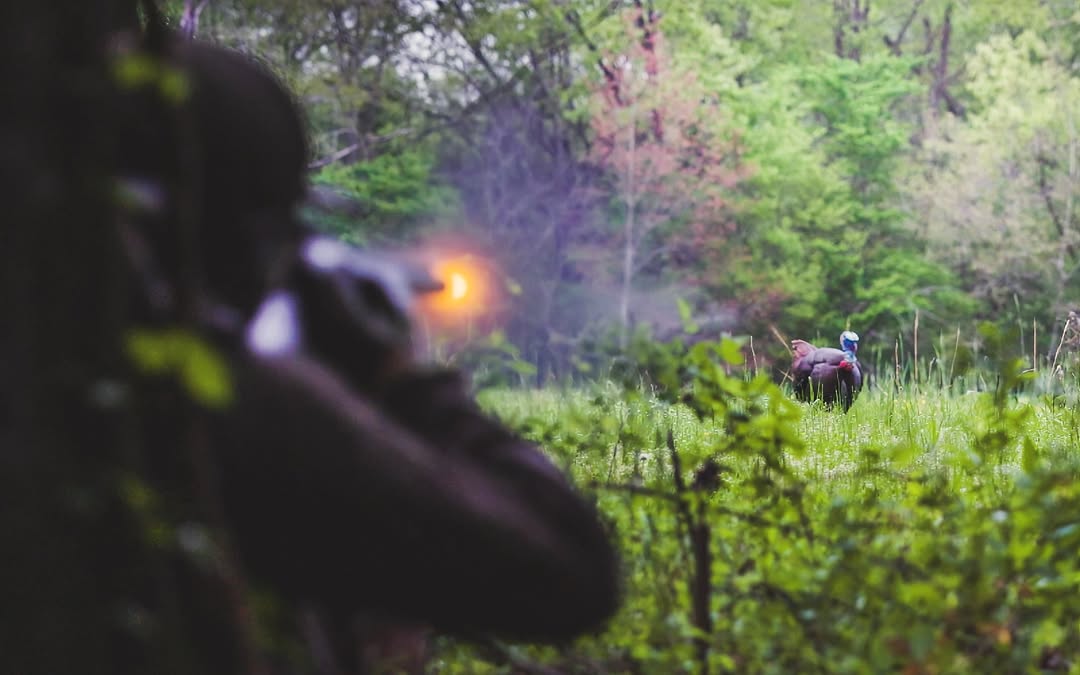
Early spring turkey season creates a short but powerful scouting advantage: sparse canopy conditions. Before hardwoods leaf out and underbrush thickens, the woods are open, sightlines are longer, and turkey movement is easier to interpret. For hunters targeting mature gobblers, this period offers a rare opportunity to pattern spring toms with precision—often weeks before hunting pressure intensifies.
If you understand how reduced foliage affects turkey behavior, travel routes, and strutting zones, you can build a reliable game plan that holds up once the season opens.
Why Sparse Canopy Changes the Game
Before green-up, deciduous trees are bare, sunlight penetrates deeper into the forest floor, and understory vegetation remains minimal. These conditions influence turkey movement in several key ways:
- Increased visibility for both hunter and bird
- Longer visual communication distances between gobblers and hens
- More defined travel routes along terrain features
- Greater use of open hardwood ridges and field edges
Spring toms rely heavily on sight during the breeding season. When foliage is thin, they prefer areas where they can see approaching hens—and potential threats—from a distance.
That preference creates predictable patterns.
How Sparse Woods Reveal Travel Corridors
Without dense brush to mask movement, turkeys tend to favor:
- Logging roads
- Ridge tops
- Open hardwood benches
- Field transitions
- South-facing slopes
These areas allow gobblers to strut, display, and move with confidence. In thick cover, turkeys often slow down or avoid tight spaces. But in open timber, they move deliberately and consistently.
By scouting during sparse canopy conditions, you can:
- Identify daily travel loops
- Locate strut zones
- Track entry and exit routes from roost sites
- Observe flock hierarchy behavior
Once vegetation fills in, these routes become harder to interpret.
Identifying Early Spring Roost-to-Feed Patterns
Sparse canopy makes it easier to pinpoint:
- Roost trees along creek bottoms or ridge points
- Fly-down zones with scratch marks
- Morning travel direction
- Midday loafing areas
During early spring, gobblers typically:
- Fly down to open terrain.
- Gather hens in visible strut zones.
- Transition toward feeding areas by mid-morning.
- Loaf in open timber during midday.
- Begin working back toward roost areas in late afternoon.
Open woods let you glass these transitions from a distance without pushing birds.
Spotting Strut Zones Before They’re Hidden
Strut zones are often located in:
- Slightly elevated hardwood flats
- Field corners
- Open ridge spines
- Logging clearings
In sparse canopy conditions, you can spot:
- Drag marks from wing tips
- Concentrated scratching
- Dropping clusters
- Feather scatter
These signs are much easier to find before leaves and undergrowth conceal them.
Mapping these strut areas now gives you prime setup locations for opening week.
How Light Penetration Affects Tom Behavior
With more sunlight reaching the forest floor, early spring turkeys often gravitate toward:
- Warm south-facing slopes
- Sunlit hardwood benches
- Open clearings that heat quickly
Sunlight not only warms insects and forage—it also enhances visibility for displaying gobblers. Mature toms prefer open ground where hens can see their full strut.
As canopy thickens, gobblers adjust and may shift to more open agricultural fields. But early on, open timber is prime real estate.
Scouting Strategies During Sparse Canopy
To maximize this window:
1. Glass From a Distance
Use ridgelines and elevated terrain to observe movement without intrusion.
2. Avoid Roost Intrusion
Never walk directly into suspected roost zones. Early-season pressure can shift birds permanently.
3. Scout Midday
Midday scouting minimizes disruption and allows you to locate loafing zones and scratching patterns.
4. Mark Terrain Funnels
Saddles, ridge ends, and narrow timber fingers often serve as daily travel corridors.
5. Limit Trail Camera Pressure
If using cameras, place them along travel routes—not directly in strut zones.
Common Mistakes Hunters Make
- Over-calling during scouting
- Walking under active roost trees
- Assuming birds will use the same zones once green-up occurs
- Ignoring midday movement patterns
- Waiting until season opens to begin scouting
Sparse canopy conditions offer clarity. Waiting too long means losing valuable information.
Transitioning Into Green-Up
As foliage thickens:
- Gobblers may reduce movement inside dense timber
- Strut zones shift closer to field edges
- Visibility decreases, requiring tighter setups
- Sound carries differently through leaf cover
The intel you gather during sparse canopy conditions helps you anticipate these adjustments instead of reacting to them.
Final Thoughts
Understanding how sparse canopy conditions help you pattern spring toms gives you a strategic edge before hunting pressure escalates. Open woods reveal movement corridors, strut zones, and travel habits that become nearly invisible once vegetation explodes.
The key is disciplined observation. Scout smart. Keep pressure low. Gather information without altering natural behavior.
When opening morning arrives, you won’t be guessing where the gobbler will be—you’ll already know.
